
Natural wonder Africa
Senegal River
The Senegal River flows across West Africa to the Atlantic Ocean. Near the sea, its wetlands are a stopping place for more than a million birds.
The Senegal River begins where two rivers, the Bafing and the Bakoye, meet in Mali; the Bafing rises in the Fouta Djallon highlands of Guinea. The river crosses dry Sahel country to the Atlantic, and in its delta the Djoudj National Bird Sanctuary shelters more than 1.5 million birds.
An FAO survey (1975) traces the Senegal River from the Bafing's source in Guinea's Fouta Djallon, through the Bafing-Bakoye confluence at Bafoulabé, across Guinea, Mali, Mauritania and Senegal to the Atlantic, with a flood season from August to November. Its delta holds Djoudj, a UNESCO site with more than 1.5 million birds of 365 species.
Photo: Gregor Rom, CC BY-SA 4.0, via Wikimedia Commons
Discover the Senegal River
The Senegal River is a long river in West Africa. It flows west and ends in the Atlantic Ocean.
In this photo, the river is wide and calm, with soft clouds in the sky.
The Food and Agriculture Organization (FAO) of the United Nations describes the Senegal River beginning where the Bafing and Bakoye rivers join at Bafoulabé. Its main branch, the Bafing, rises in the Fouta Djallon highlands of Guinea. The river runs through Guinea, Mali, Mauritania and Senegal and reaches the Atlantic Ocean south of Saint-Louis.
This photo by Gregor Rom, taken on 11 November 2017 near Saint-Louis, shows the river wide and calm, with buildings along the right bank.
A 1975 FAO report on the inland waters of the Sahel gives the Senegal River's origin at the Bafing-Bakoye confluence at Bafoulabé, its major tributary, the Bafing, rising in Guinea's Fouta Djallon, a total length of 1,641 km including the Bafing, a drainage area of 338,000 km², and the countries traversed as Guinea, Mali, Mauritania and Senegal. Other tributaries it lists include the Falémé, Baoulé, Kolombiné, Karakoro and Gorgol.
The hero photo, by Gregor Rom (11 November 2017), is captioned 'Fluss Senegal bei Saint Louis' (the Senegal River near Saint-Louis): a broad, calm channel, low banks and a line of buildings on the right bank.
- Begins at
- the meeting of the Bafing and Bakoye rivers, at Bafoulabé
- Countries crossed
- Guinea, Mali, Mauritania, Senegal (FAO, 1975)
- Mouth
- the Atlantic Ocean, south of Saint-Louis
- Birds in the Djoudj sanctuary
- more than 1.5 million, of 365 species
From highlands to the sea
The river starts in highlands far inland.
Two rivers join together. Then the river flows west, all the way to the ocean.
The Bafing begins in the Fouta Djallon, highlands in Guinea, where FAO gives the source's height as about 1,200 meters. At Bafoulabé in Mali it meets the Bakoye, and from there the joined river is called the Senegal. Other rivers, such as the Falémé and the Gorgol, add more water on the way.
When the rains come, the river rises and spreads over its floodplain. In 1975, FAO described a flood season from August to November, highest in September.
FAO's 1975 data sheet places the source (the Bafing, in the Fouta Djallon) at about 1,200 m and records a flood regime of August to November with a September maximum: in the rains the river overflowed downstream of Bakel across about 1,300,000 ha, of which about 1,200,000 ha were dry at low water. Its listed discharge at the mouth was 5,000 m³/s for a 100-year flood.
All of these FAO figures date from its 1975 report.
A sanctuary for birds
Near the sea, the river spreads into lakes, streams and ponds.
Pelicans, herons and spoonbills come there in huge numbers.
In the Senegal River delta, the Djoudj National Bird Sanctuary protects about 16,000 hectares of wetland: a large lake surrounded by streams, ponds and backwaters. UNESCO says it shelters more than 1.5 million birds.
For many migrating birds, Djoudj is their first stop after crossing the Sahara. White pelicans, purple herons, African spoonbills and great egrets nest there, and crocodiles and manatees live in its waters.
UNESCO's World Heritage listing (1981) describes Djoudj as a wetland of about 16,000 ha with more than 1.5 million birds of 365 species, including over 120 species of Palaearctic migrants, and calls it 'an oasis in the desert': a chain of lakes, backwaters, fords and sandbanks that is the first migration stopover after the Sahara for Palaearctic and Afrotropical birds.
Nesting species include the white pelican (Pelecanus onocrotalus), purple heron, African spoonbill, great egret, night heron and cormorant, and the property holds large populations of crocodiles and manatees.
Fish and fishing
Many kinds of fish swim in the river and its branches.
In 1975, people along the river caught many fish.
FAO's 1975 survey counted 54 kinds of fish in just two of the river's branches, the Baoulé and the Bakoye. Fishing was important along the river then: Mauritania and Senegal together caught 28,000 to 40,000 tonnes of fish a year.
In northern Senegal lies Lake Guiers, which FAO described as filled and emptied through a channel joined to the Senegal River.
FAO's 1975 data sheet cites 54 fish species in the Baoulé and Bakoye rivers (Daget, 1961) and a total annual catch of 28,000-40,000 t (Mauritania 13,000-15,000 t; Senegal 15,000-25,000 t).
It describes Lake Guiers in northern Senegal (170 km², about 70 km long, 3.5 m deep at most) as having no inflowing river: it fills and empties through the Tawey channel, which connects it to the Senegal River.
Visiting safely
The river looks calm, but rivers can be deep and strong.
Wear a life jacket on a boat, and stay close to your grown-up.
The US Centers for Disease Control and Prevention (CDC) says life jackets lower the risk of drowning while boating, for people of all ages and swimming abilities, and that children should wear them for all activities in and around natural water.
Grown-ups should watch children closely near water, even when lifeguards are there.
The CDC advises that life jackets reduce the risk of drowning while boating for people of all ages and swimming abilities, that children should use them for all activities in and around natural water, and that air-filled or foam toys are not safety devices. Adults should supervise children closely, even when lifeguards are present.
In Djoudj, UNESCO notes, no exploitation is permitted except for scientific purposes, and the park works with an inter-village committee and community eco-guards.
Amazing facts
-
For many birds, the river's wetlands are the first stop after flying over the Sahara.
UNESCO says Djoudj is the first stopover for many migrating birds after they cross the Sahara.
UNESCO describes Djoudj as the first migration stopover after the Sahara for Palaearctic and Afrotropical species, with over 120 Palaearctic migrant species.
-
Manatees and crocodiles live in the river's wetlands.
The Djoudj wetlands hold large populations of crocodiles and manatees.
Besides its birds, Djoudj holds large populations of crocodiles and manatees, according to UNESCO.
-
The Senegal River is made when two rivers meet.
The Senegal River starts where the Bafing and the Bakoye meet, at Bafoulabé.
FAO places the river's origin at the Bafing-Bakoye confluence at Bafoulabé; the Bafing, its major tributary, rises in the Fouta Djallon.
Words to know
- confluence
- the place where two rivers meet and join
- tributary
- a river or stream that flows into a bigger river
- delta
- low, often swampy land where a river spreads out as it reaches the sea
- migration
- a journey that animals make from one place to another, often at the same time each year
- Sahel
- the dry belt of land along the southern edge of the Sahara Desert
Discovery challenge
-
Which ocean does the Senegal River flow into?
Which ocean does the Senegal River reach?
Into which ocean does FAO say the Senegal River discharges?
- The Atlantic Ocean
- The Indian Ocean
- The Arctic Ocean
Show the answer
The Atlantic Ocean
The Atlantic Ocean.
The Atlantic Ocean, south of Saint-Louis.
The Atlantic, south of Saint-Louis.
-
Which two rivers join to make the Senegal River?
At Bafoulabé, which two rivers meet to form the Senegal River?
Which confluence does FAO give as the origin of the Senegal River?
- The Bafing and the Bakoye
- The Nile and the Congo
- The Amazon and the Orinoco
Show the answer
The Bafing and the Bakoye
The Bafing and the Bakoye.
The Bafing and the Bakoye, at Bafoulabé.
The Bafing-Bakoye confluence at Bafoulabé.
-
About how many birds use the Djoudj wetlands?
About how many birds does UNESCO say the Djoudj sanctuary shelters?
How many birds does UNESCO's listing give for Djoudj?
- More than 1.5 million
- About 150
- About 15
Show the answer
More than 1.5 million
More than one and a half million!
More than 1.5 million birds.
More than 1.5 million birds of 365 species.
-
When is the river highest?
In which month did FAO record the river's flood at its highest?
Which month was the maximum of the August-November flood in FAO's 1975 data?
- September
- January
- April
Show the answer
September
September, after the rains.
September, during the August-to-November flood season.
September (FAO, 1975).
-
What should children wear on a boat?
What does the CDC say children should wear for all activities in and around natural water?
According to the CDC, what reduces the risk of drowning while boating for people of all ages?
- A life jacket
- A foam toy
- A sun hat
Show the answer
A life jacket
A life jacket.
A life jacket. Foam toys are not safety devices.
A life jacket; air-filled or foam toys are not safety devices.
Nearby places
-
 Watch
City
Bamako
Bamako is the capital and by far the biggest city of Mali, on both banks of the Niger River. It began as a market village, grew quickly after the railway from Dakar was built in 1904, and now stretches about 22 kilometers from east to west. About 4.17 million people lived there in 2023.
-
 Watch
City
Conakry
Conakry is the capital of Guinea, on the Atlantic coast of West Africa. It began on Tombo island and spread along the Kaloum peninsula. Guinea's 2025 census counted 3,407,327 people in Conakry in its preliminary results, more than eight times Kankan, the next city.
-
 Watch
City
Freetown
Freetown is the capital of Sierra Leone, on the Atlantic coast of West Africa. It stretches from east to west between a jagged shore and hills 350 to 400 meters high. First founded in 1787 and founded again in 1792, it had 609,174 people at the 2021 mid-term census.
-
 Watch
Landmark
Great Mosque of Djenné
The Great Mosque of Djenné is a huge earthen building in the old town of Djenné in Mali. It was rebuilt in 1906–1907, and its walls of earth are kept in shape by plastering campaigns every year. It is part of the Old Towns of Djenné World Heritage Site.
-
 Watch
City
Dakar
Dakar is the capital of Senegal, on the Cap-Vert peninsula facing the Atlantic Ocean. Universalis calls it the westernmost city in Africa. Founded in 1857 on the site of a fishing village, it grew into a big port. Senegal's 2023 census counted 1,278,469 people in the Dakar department and 3,186,088 in the wider city.
-
 Watch
City
Nouakchott
Nouakchott is the capital of Mauritania, on the Atlantic coast of West Africa. In 1950 it was a small camp of about 500 people. It became the capital in 1957 and has grown very fast since then: the census of 2023 counted 1,446,761 people.
-
 Watch
City
Monrovia
Monrovia is the capital of Liberia and its only large city: 1,761,032 people lived there at the 2022 census. It was founded in 1822 by settlers from the United States and stretches along a narrow sandy strip of coast around Cape Mesurado. It is one of the rainiest capitals in Africa.
-
 Watch
City
Yamoussoukro
Yamoussoukro has officially been the capital of Côte d'Ivoire since 21 March 1983. It lies in the center of the country, on the main road from south to north. The city is spread out, with wide avenues, major colleges and a basilica. At the 2014 census the city had 212,670 people.
Explore next
-
 Watch
Natural wonder
Sahara
The Sahara fills almost all of northern Africa. Britannica calls it the largest hot desert in the world: about 4,800 kilometers from east to west and about 8.6 million square kilometers in all. Only about a quarter of it is sand dunes; the rest is gravel plains, rocky plateaus and mountains.
-
Watch
 Country
Senegal
Senegal is a country at the far western tip of Africa, on the Atlantic Ocean. Its capital, Dakar, sits on the westernmost point of the continent. About 19 million people live there, and the Senegal River, wetlands full of birds and quiet mangrove deltas make it a place of water as well as dry grassland.
-
 Watch
 Country
Mauritania
Mauritania is a large country in northwest Africa where the Sahara meets the Atlantic Ocean. Dunes cover about half the land, ancient trading towns stand by desert oases, and many kinds of migrating birds spend the winter on its coast. About 5.3 million people live there.
-
Watch
 Country
Mali
Mali is one of the largest countries in Africa. Its north is part of the Sahara, its middle is the dry Sahel, and its south has savanna. The Niger River flows through it, and long ago great empires grew rich here from trade in gold. About 25.2 million people lived there in 2025.
- Watch Geography Rivers from source to mouth A river is fresh water that flows downhill, pulled by gravity. It begins at a source, such as a spring, melting snow or a lake. Smaller streams called tributaries join it along the way, so it grows bigger, until it empties into a lake, a larger river or the ocean at its mouth.
- Watch Geography River deltas A delta is land a river builds where it slows down and empties into a sea, a lake or another river. The slowing water drops its sand and mud, which pile up into low, flat, watery land. Many deltas are fan-shaped, like the Greek letter delta (Δ), but some look like a bird's foot.
-
 Watch
Natural wonder
Victoria Falls
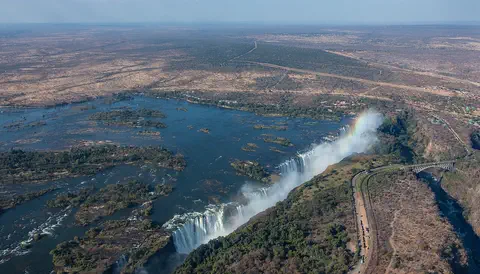
Victoria Falls, on the Zambezi River between Zambia and Zimbabwe, is about 1,708 meters wide and up to 108 meters deep. UNESCO calls it the largest curtain of falling water in the world, and its spray can be seen from tens of kilometers away.
-
 Watch
Natural wonder
Mount Kilimanjaro
Mount Kilimanjaro, in northeastern Tanzania, is what UNESCO calls the highest mountain in Africa: its top is 5,895 meters high. It is a huge volcanic mountain standing alone above the plains, and as you climb it you pass through farms, forest, moorland and high alpine desert to its icy top.
For parents & teachers
What children will learn
- Trace the Senegal River from Guinea's highlands to the Atlantic Ocean.
- Explain what a confluence and a tributary are.
- Describe why the Djoudj wetlands matter to migrating birds.
- Know how to stay safe near rivers and on boats.
Recommended ages: 3 to 17 · About 15 minutes
Talk about it
- Why might a wetland near a desert be so important to birds?
- Why might a river rise and fall at different times of the year?
- How could a river get a new name where two rivers meet?
Try at home or in class
- Draw two streams on paper that join into one river, and label the confluence, the tributaries and the mouth.
- Look at a map of Africa and trace a bird's flight from Europe across the Sahara to the Senegal River delta.
Key vocabulary: confluence, tributary, delta, migration, Sahel
Where these facts come from
- Wikidata , Wikimedia Foundation (CC0 1.0)
- Data on the major inland waters of the Sahelian zone: Senegal system (Report of the Consultation on Fisheries Problems in the Sahelian Zone, CIFA/OP 4) , Food and Agriculture Organization of the United Nations
- Djoudj National Bird Sanctuary , UNESCO World Heritage Centre
- Preventing Drowning , US Centers for Disease Control and Prevention
- File:Fluss Senegal.jpg , Wikimedia Commons
- Natural Earth vector data , Natural Earth (NACIS) (Public domain)
- Wikimedia Commons , Wikimedia Foundation (Per file (public domain, CC0, CC BY or CC BY-SA); see each media record)
Checked, not yet human-reviewed. Last updated November 1, 2026. Spotted a mistake? Tell us.