Natural wonders
Mountains, deserts, waterfalls, reefs, rivers, caves and volcanoes, and how nature made them.
84 to explore · page 1 of 2
-
 Watch
Natural wonder
Aconcagua
Aconcagua, in the Andes of Argentina near the border with Chile, is the highest mountain in the Western Hemisphere. Its height has been measured several ways: a 2012 expedition backed by Argentina's National Geographic Institute found 6,960.8 meters. Aconcagua formed from an old volcano, but it is not an active volcano today, and climbers first reached its top in 1897.
-
 Watch
Natural wonder
Ajanta Caves
The Ajanta Caves are about 30 halls and rooms carved by hand into a curving cliff above the Waghora River in western India. Buddhist communities made them in two big phases, starting more than 2,000 years ago. Their wall paintings and stone carvings are some of the most famous ancient art in India, and they have been a UNESCO World Heritage Site since 1983.
-
 Watch
Natural wonder
Alps
The Alps are Europe's great mountain range, an arc about 1,200 kilometers long that runs from the Mediterranean coast near Nice, in France, to Vienna, in Austria. Their highest peak is Mont Blanc, which Britannica gives as 4,807 meters. The Alps rose when the plate carrying Africa pushed north into Europe, and Ice Age glaciers carved their sharp peaks and deep valleys.
-
 Watch
Natural wonder
Amazon rainforest
The Amazon rainforest covers about 6 million square kilometers around the Amazon River and its branches in northern South America, and about 60 percent of it is in Brazil. Britannica calls it the world's richest and most varied home for living things, with millions of kinds of insects, plants and animals.
-
 Watch
Natural wonder
Amazon River
The Amazon River flows from tiny streams in the Andes Mountains of Peru across Colombia and Brazil to the Atlantic Ocean. NASA calls it the largest river in the world: about 219,000 cubic meters of water pour into the ocean every second, nearly a fifth of all the water that rivers carry to the oceans.
-
Watch
Natural wonder
Andes
The Andes run down the whole western side of South America, from the Caribbean coast to the continent's southern tip, through seven countries. Britannica measures them at about 8,900 kilometers, and their highest peak, Aconcagua, rises to 6,959 meters. They are still growing as one plate of Earth's crust slides under another, which is why the Andes have so many volcanoes and earthquakes.
-
 Watch
Natural wonder
Angel Falls
Angel Falls is a waterfall in Canaima National Park in Venezuela. It pours off the cliff of Auyán-tepui, a giant table-shaped mountain, and falls about 979 meters. UNESCO calls it the world's highest waterfall.
-
 Watch
Natural wonder
Aoraki / Mount Cook
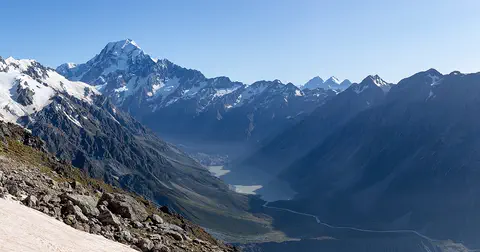
Aoraki / Mount Cook is New Zealand's highest mountain, in the Southern Alps of the South Island. Its name joins its Māori name, Aoraki, with its English name, Mount Cook. The mountain is being pushed up where two of Earth's plates meet, and glaciers carve the valleys around it. In 2013 surveyors measured it at 3,724 meters.
-
 Watch
Natural wonder
Atacama Desert
The Atacama is a cool desert in northern Chile, squeezed between the Pacific coast and the Andes mountains, about 1,000 to 1,100 kilometers long. It is one of the driest places on Earth: the city of Arica, on its coast, averages less than 1 millimeter of rain a year. Its dry, clear air makes it a top place for giant telescopes.
-
 Watch
Natural wonder
Banff National Park
Banff National Park lies in the Rocky Mountains of Alberta, in western Canada. It began in 1885 around a group of hot springs, which makes it Canada's first national park. Today it covers 6,641 square kilometers of jagged peaks, glaciers, forests and turquoise lakes such as Lake Louise and Moraine Lake, and it is home to grizzly bears, wolves, elk and many more animals.
-
 Watch
Natural wonder
Bryce Canyon National Park
Bryce Canyon National Park, in southern Utah, is not really a canyon. It is a row of giant bowls, called amphitheaters, carved into the edge of a high plateau and filled with colorful rock spires called hoodoos. The park says it has the largest collection of hoodoos in the world. Ice and rain shaped them from rocks first laid down in an ancient lake.
- Watch Natural wonder Cave of Altamira The Cave of Altamira, in northern Spain, holds some of the most famous prehistoric paintings in the world. People who hunted and gathered their food used the cave between about 36,000 and 13,000 years ago, and painted and engraved bison, horses, deer, hands and signs on its walls and ceiling. It was the first cave where prehistoric cave art was ever recognized.
-
 Watch
Natural wonder
Chitwan National Park
Chitwan National Park, in the lowlands of southern Nepal, was Nepal's first national park. Its sal forests, tall grasslands and rivers are home to the second-largest population of greater one-horned rhinoceroses in the world, 694 in 2021, and to Bengal tigers, 145 counted in and around the park in 2026.
-
 Watch
Natural wonder
Danube
The Danube is Europe's second-longest river, after the Volga. It begins as two small streams in Germany's Black Forest and flows about 2,850 kilometers east to the Black Sea, passing through 10 countries and four capital cities. For more than 2,000 years it has been a border, a highway for boats and a home for wildlife, and it ends in a giant delta of reeds, lakes and birds.
-
 Watch
Natural wonder
Dead Sea
The Dead Sea is a salt lake in the Middle East, with Jordan on its eastern shore and the Palestinian West Bank along part of its western shore. Its surface lies far below sea level, about 435 meters down in 2019, and its water is nearly ten times saltier than the ocean, so swimmers bob on top without trying.
-
 Watch
Natural wonder
Denali
Denali is North America's highest mountain, 6,190 meters (20,310 feet) tall, in the Alaska Range. It rises about 5.6 kilometers from its base, more than Mount Everest does from its own high base. Huge glaciers spread from it in every direction, and the national park around it is home to grizzly bears, moose, caribou, Dall sheep and wolves.
-
 Watch
Natural wonder
Easter Island
Easter Island, called Rapa Nui by its first people, is a small volcanic island in the Pacific Ocean, about 3,540 kilometers west of Chile. Polynesian settlers who arrived long ago carved more than 600 giant stone statues, called moai, from the rock of a volcano and set many of them on stone platforms. Today the island's national park is a World Heritage Site cared for by the Rapa Nui people.
-
 Watch
Natural wonder
Everglades National Park
Everglades National Park covers 1.5 million acres at the southern tip of Florida. It protects marshes of sawgrass, forests of mangroves and pines, and shallow bays, all fed by fresh water flowing slowly south. It is home to alligators and crocodiles, the rare Florida panther and hundreds of kinds of birds, but invasive Burmese pythons have caused serious harm to its wildlife.
-
 Watch
Natural wonder
Eyjafjallajökull
Eyjafjallajökull is an ice cap in southern Iceland that covers a volcano. In 2010 the volcano erupted for the first time since 1821. Melting ice and hot lava made very fine ash, and winds carried it over Europe. To keep passengers safe, more than 100,000 flights were canceled in one week of April.
-
 Watch
Natural wonder
Galápagos Islands
The Galápagos Islands are a group of volcanic islands in the Pacific Ocean, about 1,000 kilometers off the coast of Ecuador. Many of their animals live nowhere else on Earth, and they helped inspire Charles Darwin's theory of evolution by natural selection.
-
 Watch
Natural wonder
Ganges
The Ganges, called the Ganga in India, flows about 2,510 kilometers from a glacier in the Himalayas across the plains of northern India to the Bay of Bengal, through India and Bangladesh. Its basin is home to hundreds of millions of people who farm, fish and travel on it. For many Hindus it is the holiest of rivers. Near the sea it builds a giant delta with the Brahmaputra.
-
 Watch
Natural wonder
Giant's Causeway
The Giant's Causeway, on the north coast of Northern Ireland, is made of some 40,000 columns of dark basalt rock, many of them six-sided, packed together like a honeycomb. They formed about 60 million years ago, when a deep pool of lava cooled slowly, shrank and cracked into columns.
-
 Watch
Natural wonder
Gobi Desert
The Gobi is a giant desert stretching across Mongolia and China. Britannica says its name comes from a Mongolian word meaning waterless place. Much of it is bare rock and gravel rather than sand, winters are bitterly cold and summers hot, and its rocks hold remarkable dinosaur fossils, including the first dinosaur eggs known to science.
-
 Watch
Natural wonder
Grand Canyon
The Grand Canyon is a huge, steep-sided canyon in Arizona carved by the Colorado River. It is about 447 kilometers long and, on average, 1.6 kilometers deep, and its walls show layers of rock almost two billion years old.
-
 Watch
Natural wonder
Great Barrier Reef
The Great Barrier Reef stretches about 2,300 kilometers along the coast of Queensland, Australia. It is made of about 2,500 separate reefs and more than 900 islands, built by tiny coral animals, and it is home to more than 1,500 kinds of fish.
-
 Watch
Natural wonder
Great Rift Valley
The Great Rift Valley is a huge valley that runs through East Africa, where the continent is slowly being stretched and pulled apart. Long, steep cliffs line its sides, its floor holds lakes full of flamingos, and giant volcanoes such as Kilimanjaro and Mount Kenya rose beside it. Scientists think a new ocean may one day open here.
-
 Watch
Natural wonder
Ha Long Bay
Ha Long Bay is a bay in northeast Vietnam where more than a thousand limestone islands rise straight out of the sea. Over millions of years, water dissolved the limestone into towers and caves, and then the sea flooded in around them. Together with the nearby Cat Ba Archipelago it is a World Heritage site.
-
 Watch
Natural wonder
Himalayas
The Himalayas are a giant wall of mountains in Asia, between the high Plateau of Tibet and the plains of India. They hold the highest mountains in the world, including Mount Everest. They rose when the land carrying India crashed into Asia, and their snow and ice feed great rivers such as the Ganges and the Indus.
-
 Watch
Natural wonder
Iguaçu Falls
Iguaçu Falls, on the Iguaçu River where Brazil and Argentina meet, is a system of many waterfalls and rapids almost three kilometers wide, with drops of up to about 80 meters. Clouds of spray keep the rainforest around it green and wet.
-
 Watch
Natural wonder
K'gari
K'gari, off the coast of Queensland in Australia, is the largest sand island in the world. Sand dunes rise up to about 250 meters, rainforest grows right on the sand, and about half of the world's perched dune lakes sparkle among the dunes. Once called Fraser Island, it was officially renamed K'gari, the Butchulla people's name for it, in 2023.
-
 Watch
Natural wonder
K2
K2 is the world's second highest mountain, 8,611 meters tall, in the Karakoram Range of Asia. It got its short name in 1856, when a surveyor marked it as the second peak he measured in the Karakoram. It is one of the hardest mountains to climb, and its summit was first reached in 1954.
-
 Watch
Natural wonder
Kakadu National Park
Kakadu, in Australia's Northern Territory, is the country's largest national park. It stretches from a high sandstone cliff called the escarpment down to floodplains, mangroves and the sea. Aboriginal people have lived here for tens of thousands of years, and their rock paintings, some up to 20,000 years old, record their way of life.
-
 Watch
Natural wonder
Kalahari Desert
The Kalahari is a giant sandy plain in southern Africa, covering almost all of Botswana and parts of Namibia and South Africa. It stretches about 1,600 kilometers from north to south. Its southwest is a true desert, with long red dunes, while its north is green with woodlands and even has a huge swamp, the Okavango Delta.
-
 Watch
Natural wonder
Kaziranga National Park
Kaziranga National Park lies beside the great Brahmaputra River in Assam, in northeastern India. Every year the river floods parts of the park, keeping its tall grasslands, marshes and pools alive. It is home to the world's largest population of greater one-horned rhinoceroses, more than 2,600 in 2024, which grew from only a handful about a hundred years earlier.
-
 Watch
Natural wonder
Komodo National Park
Komodo National Park, in Indonesia, is a group of rugged, dry islands between Sumbawa and Flores. Its three main islands, Komodo, Rinca and Padar, were made by volcanoes. The park contains most of the places where wild Komodo dragons, the largest living lizards, still live, along with rich coral reefs visited by turtles, dolphins and whales.
-
 Watch
Natural wonder
Lake Baikal
Lake Baikal, in southern Siberia, Russia, fills a deep crack in the Earth's crust where the land is pulling apart. UNESCO calls it the oldest and deepest lake in the world, about 25 million years old, and it holds about a fifth of the world's unfrozen fresh water. Many of its animals, like the Baikal seal, live nowhere else.
-
 Watch
Natural wonder
Lake Superior
Lake Superior is the largest of North America's five Great Lakes, shared by the United States and Canada. It covers about 82,100 square kilometers, reaches 406 meters deep, and holds more water than the other four Great Lakes put together. It sits in an ancient crack in the continent that glaciers scooped out.
-
 Watch
Natural wonder
Lake Tanganyika
Lake Tanganyika lies in a deep crack in Africa called a rift valley. Britannica calls it the longest freshwater lake in the world, and only Lake Baikal, in Russia, is deeper. Four countries share it: Tanzania, the Democratic Republic of the Congo, Burundi and Zambia. Its water is home to about 250 kinds of cichlid fish found nowhere else.
-
 Watch
Natural wonder
Lake Titicaca
Lake Titicaca lies 3,810 meters above sea level in the Andes of South America, on the border between Peru and Bolivia. Britannica calls it the world's highest lake that large ships can sail on. Some people still live on floating islands made of totora reeds, and a big, wrinkly frog lives in its water and nowhere else.
-
 Watch
Natural wonder
Lake Victoria
Lake Victoria is the largest lake in Africa, and Britannica says only Lake Superior, in North America, is a bigger freshwater lake. It is shared by Kenya, Tanzania and Uganda. The lake is wide but shallow, its only outlet is the Nile, and it is home to hundreds of kinds of colorful fish called cichlids.
- Watch Natural wonder Mariana Trench The Mariana Trench is a long, curving valley in the floor of the western Pacific Ocean, near the island of Guam. Its deepest spot, the Challenger Deep, is the deepest place known in the whole ocean, close to 11,000 meters down. If Mount Everest stood on the bottom, its peak would still be about 2 kilometers under water.
-
 Watch
Natural wonder
Matterhorn
The Matterhorn is a 4,478-meter mountain in the Alps, on the border between Switzerland and Italy. Its rock was pushed up when Africa moved toward Europe, and glaciers later carved its steep sides into a pyramid shape. Climbers first reached its top on 14 July 1865.
-
 Watch
Natural wonder
Mississippi River
The Mississippi River flows about 3,770 kilometers from Lake Itasca in Minnesota to the Gulf of Mexico, through the middle of the United States. Its basin drains about 40 percent of the continental United States. Long ago Native Americans paddled canoes on it; later came steamboats, and today huge barges carry grain and fuel. Millions of birds follow it when they migrate.
-
 Watch
Natural wonder
Mont Blanc
Mont Blanc is the highest peak in the Alps, on the border of France and Italy. Its snowy top changes height a little from year to year: in September 2026, French surveyors measured it at 4,807.47 meters. People first climbed it in 1786, and today a long tunnel runs right underneath it.
-
 Watch
Natural wonder
Mount Agung
Mount Agung is a cone-shaped volcano on the eastern end of Bali, in Indonesia, and the island's highest point at about 3,000 meters. It erupted strongly in 1963 and 1964, and again with explosions, ash clouds and lava in its crater from 2017 to 2019. Scientists watch it all the time and set safety zones around it when it is restless.
-
 Watch
Natural wonder
Mount Ararat
Mount Ararat is a huge volcanic mountain in the far east of Türkiye, close to where Türkiye, Iran and Armenia meet. It has two peaks: Great Ararat, about 5,165 meters high and the tallest mountain in Türkiye, and the smaller, cone-shaped Little Ararat. Snow covers the top all year, and a glacier clings to its north side.
-
 Watch
Natural wonder
Mount Elbrus
Mount Elbrus is the highest peak of the Caucasus Mountains, in southwestern Russia. It is an old volcano with two snow-covered tops, the higher one 5,642 meters tall. Twenty-two glaciers cover its slopes and feed rivers below. Whether it counts as Europe's highest mountain depends on where you draw the line between Europe and Asia.
-
 Watch
Natural wonder
Mount Etna
Mount Etna is a huge, active volcano on the east coast of Sicily, in Italy. UNESCO calls it the most active stratovolcano in the world, and people have written about its eruptions for at least 2,700 years. Its height changes as eruptions build it up and crater rims collapse. Vineyards and orchards grow on its rich lower slopes, and scientists watch it every day.