How do bridges hold so much weight?
Compare beam, arch and suspension bridges, and see how squeezes and stretches hold up the traffic.
The big idea: Every bridge carries its own weight plus the traffic. Some parts get squeezed (compression) and some get stretched (tension). Beams, arches and cables each handle these forces in their own way.
It's like
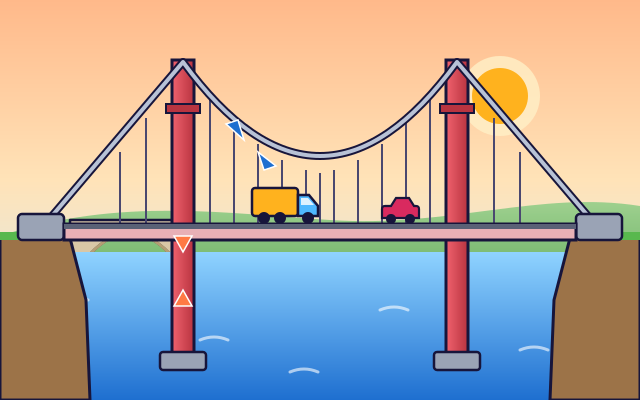
The interactive parts didn't load. The explanations below still work; try reloading the page.
How bridges stay up
- To cross a river, you could lay a log across. That's a beam bridge! But step on the middle, and it bends.
- When a beam bends, its top is squeezed together. That's compression. Its bottom is stretched apart. That's tension.
- Beam bridges stand on piers, strong pillars in the water, which make each span shorter. Shorter spans bend much less.
- An arch carries the load around its curve to the ground. The whole arch is squeezed, and the ground at each end pushes back.
- A suspension bridge hangs the road from giant cables. The cables are stretched, the tall towers are squeezed, and the cable ends are anchored in the ground.
- Engineers design bridges to carry much more than the heaviest traffic, with strength to spare. They also inspect them often to keep them safe.
Parts of a bridge
Here are three kinds of bridges. Tap each part to see whether it is squeezed or stretched.
- Deck. The deck is the road surface. It carries the cars and trucks and passes their weight to the rest of the bridge.
- Beam (girder). The beam bends a little under the load. Its top is squeezed (compression), and its bottom is stretched (tension).
- Pier. Piers are pillars that hold up the beam in the middle of the river. They are squeezed by the weight above.
- Arch. The arch is squeezed all along its curve. That's why arches can be made of stone, which is very strong when squeezed.
- Abutment. Abutments are the strong supports at each end. They push back against the arch so it can't spread apart.
- Columns. Short posts carry the weight of the road down onto the arch. They are squeezed.
- Tower. The towers hold the main cables up high. The cables press down on them, so the towers are squeezed.
- Main cable. Each main cable is made of thousands of steel wires. It is stretched (tension) as it holds up the deck.
- Hangers. Hangers are thin vertical cables that connect the deck to the main cables. They are stretched.
- Anchorage. Huge concrete blocks at each end hold the ends of the main cables tight.
Beam, arch or suspension?
Add cars and trucks, then switch between bridge types. Watch the sag and the squeeze and stretch arrows. Which bridge bends the most over the same gap?
Experiment: Over the same gap with the same traffic, which bridge sags the most?
- Add a car and a truck to the beam bridge.
- Watch how much it sags.
- Switch to the arch and the suspension bridge.
What we found: The long beam sagged the most, because it has to bend to carry the load. The arch turns the weight into a squeeze along its curve, and the suspension bridge hangs from stretched cables, so both barely sag.
Turn on JavaScript to try it yourself.
Strengthen the bridge
Add piers, or buy a stronger deck, so the trucks can cross safely. Stay within 14 coins.
Squeezes and stretches
Every part of a bridge is being squeezed or stretched. Squeezing is called compression, and stretching is called tension. Engineers choose shapes and materials that handle these forces well: stone and concrete are great when squeezed, while steel cables are great when stretched.
A beam bridge is the simplest kind. When weight presses on a beam, it bends: the top gets squeezed and the bottom gets stretched. Long beams bend a lot, so beam bridges use piers to break a long crossing into shorter spans.
An arch bridge carries weight around its curve. The arch is squeezed, and it pushes down and outward at its ends, so it needs strong ground or abutments to push back. Some stone arch bridges are about 2,000 years old.
A suspension bridge hangs its road from huge cables. The cables are stretched, the towers are squeezed, and the cable ends are anchored into the ground. This design can cross the widest gaps, more than a kilometer between towers.
Key words
- Compression
- A squeezing force that pushes material together.
- Tension
- A stretching force that pulls material apart.
- Span
- The distance between two supports of a bridge.
- Pier
- A pillar that holds up a bridge between its ends.
- Abutment
- The strong support at each end of a bridge that holds it up and pushes back.
- Load path
- The route a force takes through a structure down into the ground.
Check your thinking
-
What happens to the top of a beam when it bends under a load?
Show the answer
It gets squeezed (compression). The top of a bending beam is pushed together, and the bottom is pulled apart.
-
Why do beam bridges have piers?
Show the answer
To make each span shorter, so it bends less. A shorter span bends much less under the same weight.
-
Which force does an arch mostly carry?
Show the answer
Compression (squeezing). The weight squeezes the arch all along its curve down to the ground.
-
In a suspension bridge, what is happening to the towers?
Show the answer
They are squeezed by the cables pressing down. The cables press down on the tower tops, so the towers carry compression.
-
Which shape is an arch?
Show the answer
A curve like a rainbow. An arch is a curve, like a rainbow upside down on its ends.
You're a Buildings & city systems expert!
You watched, looked inside, tried it, solved the challenge and went deeper. Pick another question below, or switch the age at the top to see this topic another way.
More about buildings & city systems
 #63
Buildings & city systems
How do skyscrapers stay standing?
Explore foundations, columns, bracing, and structural cores. Build a model tower and compare how different designs respond to weight and wind.
#63
Buildings & city systems
How do skyscrapers stay standing?
Explore foundations, columns, bracing, and structural cores. Build a model tower and compare how different designs respond to weight and wind.
 #64
Buildings & city systems
How do traffic lights manage busy roads?
Program signals at an intersection and include pedestrian crossings. Compare how different timings affect queues and help everyone move through safely.
#64
Buildings & city systems
How do traffic lights manage busy roads?
Program signals at an intersection and include pedestrian crossings. Compare how different timings affect queues and help everyone move through safely.
 #65
Buildings & city systems
How does a recycling center sort materials?
Send materials along a conveyor and explore magnets, screens, and sorting equipment. Follow selected paper, metal, and plastic items into processing.
#65
Buildings & city systems
How does a recycling center sort materials?
Send materials along a conveyor and explore magnets, screens, and sorting equipment. Follow selected paper, metal, and plastic items into processing.
 #66
Buildings & city systems
How do construction cranes lift heavy things?
Explore the boom, cables, pulleys, and counterweights. Move virtual loads while investigating how their position affects the crane's balance.
#66
Buildings & city systems
How do construction cranes lift heavy things?
Explore the boom, cables, pulleys, and counterweights. Move virtual loads while investigating how their position affects the crane's balance.
Keep exploring
Games to play next
- Bridge LabBuild a bridge from beams, brace it with triangles, and stay on budget.
- Plane Flight SimulatorTake off from the runway and thread numbered sky hoops in order. Every clean flight is a new personal best.
- Area ArchitectDesign rooms that hit the area and perimeter on the blueprint.
Draw it or make it
- Folded-Beam Paper BridgePaper craft
Guide for grown-ups
- How to start homeschooling: a step-by-step guide for familiesA guide for parents · 7 min read
Science games by grade
Science worksheets by grade
- Preschool Science Worksheets
- Pre-K Science Worksheets
- Kindergarten Science Worksheets
- 1st Grade Science Worksheets
- 2nd Grade Science Worksheets
- 3rd Grade Science Worksheets
- 4th Grade Science Worksheets
- 5th Grade Science Worksheets
- 6th Grade Science Worksheets
- 7th Grade Science Worksheets
- 8th Grade Science Worksheets