How do cats extend and retract their claws?
A stretchy band keeps each claw tucked away. A muscle pulls a cord to swing it out for climbing and gripping.
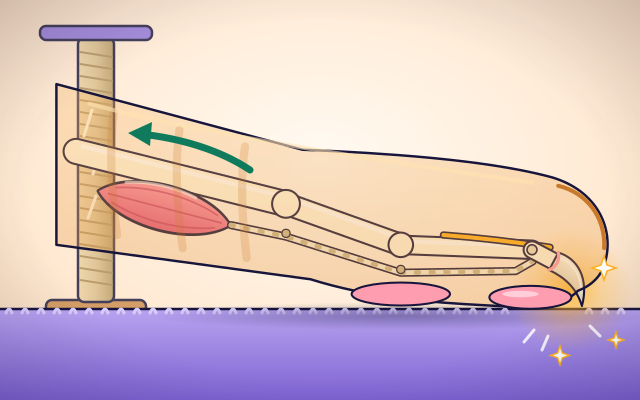
The big idea: Each claw is fixed to the last little bone of a toe. A stretchy band keeps that bone tipped back, so the claw stays hidden with no effort. When a muscle in the leg pulls a cord, the bone swings forward and the claw pops out.
It's like a click pen: push and the tip comes out, let go of the catch and a spring pulls it back inside where it is safe.
The interactive parts didn't load. The explanations below still work; try reloading the page.
The hidden claws
- A cat walks across the floor without a sound. Look at its paws: soft pads and fur, but no claws to be seen. A dog's claws would go click, click, click. Where are the cat's?
- But watch when the cat climbs its scratching post. In a blink, sharp curved claws are out, hooking into the rope. So the claws can come out and go back in.
- Let's look inside one toe. It has three small bones in a row. The claw is fixed to the very last bone, and right now that bone is tipped up and back.
- What holds it there? A stretchy band, a bit like a rubber band, joins the last bone to the middle one. It keeps the claw pulled in, and the cat does not have to try at all.
- To bring the claw out, a muscle up in the leg tightens and pulls a strong cord called a tendon. The cord runs under the toe to the last bone and swings it forward. The band is stretched tight.
- When the muscle relaxes, the stretched band springs back and pulls the claw in again. Hidden claws do not scrape on the ground, so they stay sharp for the next climb.
Look inside a see-through paw
This paw is see-through so you can find every part of the claw machine. Tap each one and watch it work.
- Claw. The claw is a sharp, curved hook made of keratin, the same material as your fingernails. It grows in layers, and the old outer layer peels away when a cat scratches.
- Last toe bone. The claw is fixed to the last bone of the toe. The bone can swing like a tiny seesaw on its joint: up and back to hide the claw, down and forward to show it.
- Middle toe bone. The middle bone has a slanted side. When the claw is pulled in, the last bone tucks neatly beside it instead of sitting on top, so the toe stays slim.
- Stretchy band. This stretchy band, called an elastic ligament, pulls the last bone back and keeps the claw hidden. It works like a rubber band, with no muscle needed.
- Pulling cord. The tendon is a strong cord that joins the muscle to the bone. It runs along the underside of the toe, and when it is pulled it swings the last bone forward.
- Leg muscle. The muscle that works the claws is not in the paw at all. It sits up in the lower leg. When it tightens, it gets shorter and pulls the cords to all the toes at once.
- Toe pad. Each toe has a soft pad underneath. The pads cushion every step, which is why a cat with its claws in walks so quietly.
- Skin pocket. When the claw is pulled in, it rests in a fold of skin and fur at the top of the toe. That pocket covers the sharp tip and keeps it clean.
Work the claw yourself
Drag the handle on the cord, or use the slider, to make the muscle pull. Watch the last bone, the claw and the stretchy band. Then let go.
Experiment: What happens to the claw when the muscle stops pulling?
- Pull the muscle all the way. Look at the claw and the band.
- Now slide the muscle back to resting, or just let go of the handle.
- Watch what the band does to the claw.
What we found: The claw springs back in by itself. Pulling it out stretched the band, and a stretched band always tries to get shorter again. So hiding the claws takes no effort, and only showing them needs a muscle.
Turn on JavaScript to try it yourself.
Sneak, then climb
Get the cat to its bed at the top. Walk with claws in so it stays quiet. Climb with claws out so it does not slip.
How the claw machine works
A cat's claw is not loose in the paw. It is fixed to the last bone of the toe, so wherever that bone goes, the claw goes too. The bone sits on a joint and can swing a long way: up and back to hide the claw, or down and forward to bring it out.
Two things move the bone. On top is a stretchy band, called an elastic ligament, that pulls it back. Underneath is a strong cord, called a tendon, that comes from a muscle in the leg. When the muscle tightens, the cord pulls and the claw swings out. When the muscle rests, the band wins and the claw goes back in.
This is a clever design, because the claws are hidden whenever the cat is relaxed. Hidden claws do not scrape on the ground, so they stay as sharp as needles. They also let the cat creep along on its soft pads without a sound.
Claws keep growing, like your nails. Cats scratch to pull off the old outer layer, to stretch, and to leave their scent. That is natural and important, so a cat needs a scratching post. If a cat scratches the sofa, it should never be punished. Give it something better to scratch instead.
Key words
- Retractable claw
- A claw that can be pulled back inside the paw and brought out again.
- Ligament
- A strong band that joins one bone to another. The ones in a cat's toes are stretchy.
- Tendon
- A strong cord that joins a muscle to a bone, so the muscle can pull on it.
- Keratin
- The tough material that claws, nails, hair and whiskers are made of.
- Elastic energy
- Energy stored in something stretched or squashed, ready to spring back.
Check your thinking
-
What keeps a resting cat's claws hidden?
Show the answer
A stretchy band that pulls the last bone back. The band does it without any effort, so the claws are in whenever the cat relaxes.
-
Why do a cat's claws stay sharper than a dog's?
Show the answer
They are tucked away and do not scrape on the ground. A dog's claws touch the ground with every step and wear blunt. A cat's stay hidden until they are needed.
-
A muscle in the leg tightens. What happens in the toe?
Show the answer
The cord pulls the last bone forward and the claw comes out. The cord runs under the toe to the last bone, so a pull swings that bone forward.
-
A cat's elastic ligaments are replaced, in a model, by ones twice as stiff. What changes?
Show the answer
About twice the muscle force is needed to extend the claws fully. A stiffer band pulls back harder for the same stretch, so the muscle must pull harder to reach the same angle.
-
Why do cats scratch things?
Show the answer
To peel off old claw layers, stretch and leave their scent. Scratching is natural claw care and a way of leaving messages for other cats.
You're a Animals expert!
You watched, looked inside, tried it, solved the challenge and went deeper. Pick another question below, or switch the age at the top to see this topic another way.
More about animals
 #205
Animals
How does an aquarium stay clean and healthy?
Balance feeding, filtration, oxygen, and helpful bacteria in a virtual aquarium.
#205
Animals
How does an aquarium stay clean and healthy?
Balance feeding, filtration, oxygen, and helpful bacteria in a virtual aquarium.
 #206
Animals
How do dogs communicate without words?
Compare posture, expressions, sounds, and context to explore different signals.
#206
Animals
How do dogs communicate without words?
Compare posture, expressions, sounds, and context to explore different signals.
 #207
Animals
How do mosquitoes develop and find food?
Follow their life cycle and compare how adult females and males obtain food.
#207
Animals
How do mosquitoes develop and find food?
Follow their life cycle and compare how adult females and males obtain food.
 #208
Animals
How can flies transfer germs between surfaces?
Track harmless markers on virtual fly feet as they contact different surfaces.
#208
Animals
How can flies transfer germs between surfaces?
Track harmless markers on virtual fly feet as they contact different surfaces.
Keep exploring
Games to play next
- Habitat Builder 3DFind the right home for frogs, camels, polar bears and more.
- Classification ExplorerSort living things by what you can see, then follow and build yes-or-no keys.
- Forest Trails PhotosCreep up on the animals of a big forest valley and take the closest, best wildlife photos you can, without startling them.
Draw it or make it
- How to draw a sitting catDrawing lesson
- Cat FaceOrigami
Guide for grown-ups
- How to start homeschooling: a step-by-step guide for familiesA guide for parents · 7 min read
Science games by grade
Science worksheets by grade
- Preschool Science Worksheets
- Pre-K Science Worksheets
- Kindergarten Science Worksheets
- 1st Grade Science Worksheets
- 2nd Grade Science Worksheets
- 3rd Grade Science Worksheets
- 4th Grade Science Worksheets
- 5th Grade Science Worksheets
- 6th Grade Science Worksheets
- 7th Grade Science Worksheets
- 8th Grade Science Worksheets