How do desalination plants remove salt from seawater?
A desalination plant squeezes seawater against a membrane. Water slips through, salt cannot, and a thirsty town gets fresh water.
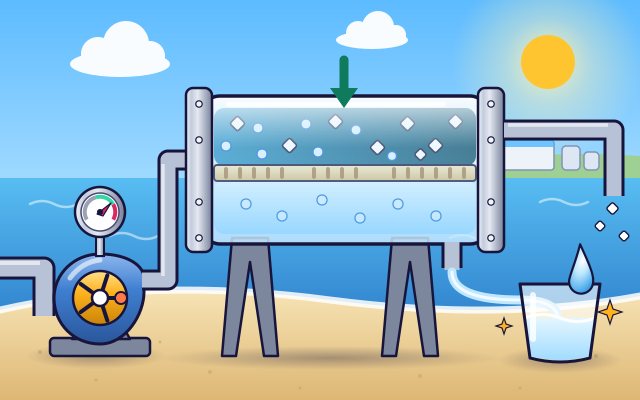
The big idea: A membrane has gaps so small that water can squeeze through but salt cannot. A strong pump pushes seawater against it, so fresh water comes out one side and extra-salty water is left on the other.
It's like a kitchen strainer with holes far too small to see. Water gets through, salt stays behind, and you need a very hard push.
The interactive parts didn't load. The explanations below still work; try reloading the page.
How a plant takes the salt out
- The sea holds most of the water on Earth, but it is too salty to drink. Salt water makes you thirstier, because your body uses up water to wash the salt out.
- A pipe pulls seawater into the plant. Filters catch sand, seaweed and tiny bits, so the water is clear. It is still just as salty, because salt is dissolved and slips through an ordinary filter.
- A powerful pump squeezes the seawater into a long tube. A gentle push does nothing. Only when the push is very strong do drops of fresh water begin to come through.
- Zoom in on the membrane, a thin plastic skin. Its gaps are so small that single water bits squeeze through. Each salt bit wears a coat of water, so it is too big and bounces back.
- Two streams leave the tube. One is fresh water. The other is the leftover seawater, called brine. It holds all the salt in less water, so it is about twice as salty as the sea.
- A few healthy minerals are added to the fresh water, and pipes carry it to homes and schools. Now even a dry town beside the sea has plenty to drink.
Look inside a desalination line
Tap each part. Follow the seawater from the pipe on the left to the two tanks on the right.
- Intake pipe. The intake pipe brings seawater into the plant. Its mouth sits out in the sea, with a screen so fish and seaweed stay outside.
- Pre-filter. The pre-filter traps sand and tiny floating bits. The water comes out clear, but it is exactly as salty as before.
- High-pressure pump. The high-pressure pump gives the big push. Without a push stronger than the pull of the salt, no fresh water comes through at all.
- Membrane tube. Inside the tube is the membrane, a thin plastic skin. Salty water runs along the top. Water squeezes down through the skin and the salt stays behind.
- Fresh-water tank. The water that got through the membrane collects here. It is fresh, with almost no salt left in it.
- Brine outlet. The leftover water is called brine. It holds all the salt in less water, so it is saltier than the sea. It is mixed back into the sea with care.
- Energy recovery turbine. The brine is still under a huge push. It spins this turbine on its way out, and the turbine helps the pump. That saves a lot of electricity.
Model plant: how hard must you push?
Turn the pump wheel or move the slider. Watch the tube and the two tanks. When does fresh water start to come out?
Experiment: What comes out if the pump only pushes gently on the seawater?
- Start with a gentle push and look at the fresh-water tank.
- Turn the push up a little at a time.
- Find the push where the first drops come through. Then push harder.
What we found: A gentle push makes no fresh water at all. The salt pulls on the water and holds it back. Only when the pump pushes harder than that pull does water squeeze through the membrane, and the harder you push, the faster it comes. The leftover water gets saltier and saltier.
Turn on JavaScript to try it yourself.
Water for the town
Fill the fresh-water tank to the line before time runs out. Do not let the leftover water get too salty.
How a membrane sorts water from salt
When salt dissolves in water it does not vanish. It breaks into bits far too small to see, and they spread out among the bits of water. That is why a paper filter cannot catch salt: the holes in paper are thousands of times too big.
A desalination membrane is a thin plastic skin with gaps so tiny that only water can work its way through. Each bit of salt holds a little coat of water around itself, and that makes it too big to fit.
But there is a catch. Salt pulls on water. If you just leave fresh water and salt water on two sides of a membrane, water moves toward the salty side. To make water go the other way, a pump has to push harder than the salt pulls. For seawater that takes a very strong push, as strong as the sea presses 600 meters down. So a desalination plant needs a lot of electricity.
About half of the seawater comes out as fresh water. The other half, called brine, holds all the salt, so it is about twice as salty as the sea. Plants mix it back into the sea carefully. Here the strainer idea stops working: a strainer needs no push at all, and its holes are easy to see.
Key words
- Desalination
- Taking the salt out of seawater to make fresh water.
- Membrane
- A thin skin that lets water through but holds salt back.
- Brine
- The extra-salty water left over after fresh water is taken out.
- Osmotic pressure
- How hard salt pulls on water. The pump must push harder than this.
- Reverse osmosis
- Pushing water through a membrane from the salty side to the fresh side.
- Permeate
- The fresh water that has passed through the membrane.
Check your thinking
-
Why can water get through the membrane when salt cannot?
Show the answer
Salt bits wear a coat of water, so they are too big for the tiny gaps. The gaps are just big enough for water. A salt bit with its coat of water does not fit.
-
The pump is running, but gently. How much fresh water comes out?
Show the answer
None, until the push is stronger than the pull of the salt. Salt pulls on water. Until the pump beats that pull, no water crosses the membrane.
-
A plant runs its pump at 20 bar on seawater. What happens?
Show the answer
No fresh water: 20 bar is below the osmotic pressure of about 27 bar. Only pressure above the osmotic pressure drives water through. Below it, nothing is produced.
-
A plant takes in 2 buckets of seawater and makes 1 bucket of fresh water. What is in the other bucket?
Show the answer
Water with all the salt in it, about twice as salty as the sea. All the salt from two buckets is now in one bucket of water, so it is twice as salty.
-
Why does a desalination plant use so much electricity?
Show the answer
The pump must push extremely hard. Beating the pull of the salt takes a huge push, and making that push takes electricity.
-
What does the energy recovery turbine do?
Show the answer
It uses the push left in the brine to help the pump. The brine comes out still squeezed hard. Its push spins the turbine, and that helps the pump.
You're a Buildings & city systems expert!
You watched, looked inside, tried it, solved the challenge and went deeper. Pick another question below, or switch the age at the top to see this topic another way.
More about buildings & city systems
 #362
Buildings & city systems
How can one heating plant warm a neighborhood?
Follow heat through insulated district pipes and building heat exchangers.
#362
Buildings & city systems
How can one heating plant warm a neighborhood?
Follow heat through insulated district pipes and building heat exchangers.
 #363
Buildings & city systems
How do prefabricated buildings fit together?
Assemble factory-made sections and match their structural, plumbing, and electrical connections.
#363
Buildings & city systems
How do prefabricated buildings fit together?
Assemble factory-made sections and match their structural, plumbing, and electrical connections.
 #364
Buildings & city systems
How do retaining walls hold back soil?
Compare wall shape, drainage, and reinforcement under different simulated loads.
#364
Buildings & city systems
How do retaining walls hold back soil?
Compare wall shape, drainage, and reinforcement under different simulated loads.
 #365
Buildings & city systems
How do parking garages identify empty spaces?
Move cars between bays and watch sensors update guidance signs.
#365
Buildings & city systems
How do parking garages identify empty spaces?
Move cars between bays and watch sensors update guidance signs.
Keep exploring
Games to play next
- River MysterySomething changed the river. Sample sites with a limited budget, follow the evidence and find where the change begins.
- Bridge LabBuild a bridge from beams, brace it with triangles, and stay on budget.
- Area ArchitectDesign rooms that hit the area and perimeter on the blueprint.
Guide for grown-ups
- How to start homeschooling: a step-by-step guide for familiesA guide for parents · 7 min read
Science games by grade
Science worksheets by grade
- Preschool Science Worksheets
- Pre-K Science Worksheets
- Kindergarten Science Worksheets
- 1st Grade Science Worksheets
- 2nd Grade Science Worksheets
- 3rd Grade Science Worksheets
- 4th Grade Science Worksheets
- 5th Grade Science Worksheets
- 6th Grade Science Worksheets
- 7th Grade Science Worksheets
- 8th Grade Science Worksheets