How do retaining walls hold back soil?
Soil pushes sideways on a wall, and wet soil pushes much harder. A wide base, drains and hidden steel keep a retaining wall standing.
The big idea: Piled-up soil always tries to spread out, so it pushes sideways on a wall, hardest at the bottom. The wall holds with its weight and a wide base, with drains that let water escape, and with steel bars inside.
It's like leaning on a door while a friend pushes from the other side. You spread your feet wide and lean in, so you do not tip or slide.
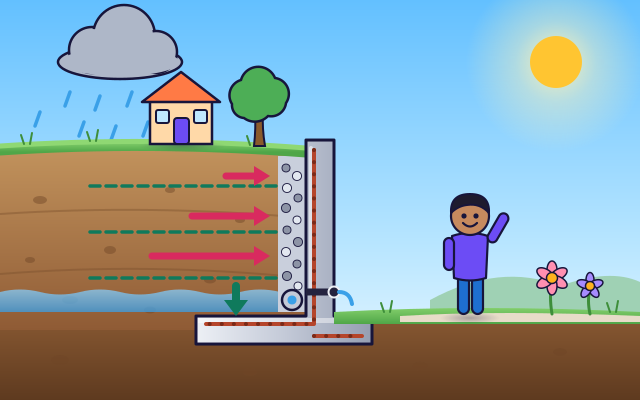
The interactive parts didn't load. The explanations below still work; try reloading the page.
Holding back a hillside
- A flat path has been cut into a hill. But soil cannot stand in a steep bank for long. Bit by bit it crumbles and slides, until it rests in a gentle slope across the path.
- A retaining wall holds the soil back. The soil pushes sideways against it. Deep down, the soil is squeezed by everything above, so the push is strongest at the bottom of the wall.
- A thin wall tips over. A thick, heavy wall with a wide base stays put. An L-shaped wall is cleverer: its long foot sits under the soil, so the soil's own weight holds the wall down.
- Now it rains. Water soaks into the soil and collects behind the wall. The trapped water pushes as well, and the push on the wall can more than double. The wall begins to lean.
- The fix is drainage. A layer of gravel behind the wall lets water sink down easily. A pipe at the bottom carries it away, and small weep holes let it drip out the front.
- Steel bars inside the concrete stop the wall from cracking where it bends. Layers of strong mesh can tie the soil itself together. The hillside is safe, with a garden on top.
Look inside a retaining wall
Tap each part of the wall and the ground behind it.
- Stem. The stem is the upright part you can see. The soil leans on it, pushing hardest near the bottom.
- Footing. The footing is the wall's foot, hidden underground. Most of it sits under the soil, so the soil's weight presses it down and stops the wall from tipping.
- Steel bars. Concrete is strong when squeezed but cracks when it is stretched. Steel bars inside take the stretch, so the wall can bend a tiny bit without breaking.
- Gravel layer. Behind the wall is a layer of gravel. Water runs down through the gaps between the stones instead of collecting in the soil.
- Drain pipe. A pipe with small holes lies at the bottom of the gravel. Water seeps in and flows away along the wall.
- Weep hole. Weep holes are small openings through the wall. After rain you can see water dripping out of them. That means the drain is working.
- Soil mesh. Sheets of strong plastic mesh are laid in the soil as it is filled in, layer by layer. They tie the soil together, so less of it pushes on the wall.
Test wall shapes, rain and drains
Choose a wall shape and a height. Make it rain, add drains and steel bars, and park a truck on top. Watch the push arrows and the safety meter.
Experiment: It rains hard and the wall has no drain. What happens to the push on the wall?
- Choose the thick wall and look at the push arrows.
- Make it rain with the drains switched off. Watch the arrows and the wall.
- Switch the drains on and watch again.
What we found: With no drain, rainwater collects behind the wall and pushes as well as the soil, so the total push more than doubles and the wall slides or tips. With gravel, a pipe and weep holes the water runs out, and the wall only has to hold the soil.
Turn on JavaScript to try it yourself.
Storm and truck test
Design a wall for a bank 3 meters high. It must survive the soil, a storm and a truck parked on top. Spend as few coins as you can.
Why soil pushes, and how walls push back
Tip out a bucket of dry sand and it never makes a tower. It spreads into a cone with gently sloping sides. Soil is the same. A steep bank of soil wants to slump into a gentle slope, so anything that holds it up gets pushed sideways.
The push is not the same all the way down. Soil near the bottom of the wall carries all the soil above it, so it is squeezed harder and pushes harder. Make a wall twice as high and the push becomes about four times as big.
Water makes it far worse. When rain soaks in and cannot get out, it fills the gaps in the soil and pushes on the wall like water behind a dam. That is why good walls have gravel behind them, a drain pipe at the bottom and weep holes through the front.
A wall can fail in three ways: it can tip over, slide forward or crack. A wide base stops tipping, weight and friction stop sliding, and steel bars stop cracking. The door comparison stops working in one way: a person gets tired of pushing, but soil never does, so a wall must hold for a hundred years.
Key words
- Retaining wall
- A wall built to hold back soil, so that the ground can be at two different levels.
- Earth pressure
- The sideways push of soil on a wall. It is strongest at the bottom.
- Footing
- The wide base of a wall, usually buried, that spreads its load and resists tipping.
- Weep hole
- A small opening through a wall that lets trapped water drain out.
- Safety factor
- How many times stronger a wall is than it needs to be.
- Geogrid
- A strong plastic mesh laid in layers of soil to tie it together.
Check your thinking
-
Where does the soil push hardest on a retaining wall?
Show the answer
Near the bottom. Soil deep down is squeezed by everything above it, so it pushes harder.
-
Why do retaining walls have weep holes and gravel behind them?
Show the answer
So water can escape instead of building up and pushing on the wall. Trapped water can more than double the push. Drains let it out.
-
A retaining wall 2 meters high is rebuilt 4 meters high in the same soil. About how much bigger is the soil's push?
Show the answer
Four times as big. The push depends on the height squared: 2 times the height gives 2 times 2, which is 4 times the push.
-
Why does an L-shaped wall need less concrete than a thick, heavy wall?
Show the answer
The soil standing on its foot helps to hold it down. The foot sits under the soil, so the soil's own weight presses the wall down.
-
Why are steel bars put inside a concrete wall?
Show the answer
Concrete cracks when it is stretched, and steel takes the stretch. The soil's push bends the wall. Steel bars hold the stretched side together.
-
A wall is leaning forward after weeks of rain. What is the most likely cause?
Show the answer
Its drains are blocked, so water is trapped behind it. Trapped water adds a big extra push. Blocked weep holes are a warning sign.
You're a Buildings & city systems expert!
You watched, looked inside, tried it, solved the challenge and went deeper. Pick another question below, or switch the age at the top to see this topic another way.
More about buildings & city systems
 #365
Buildings & city systems
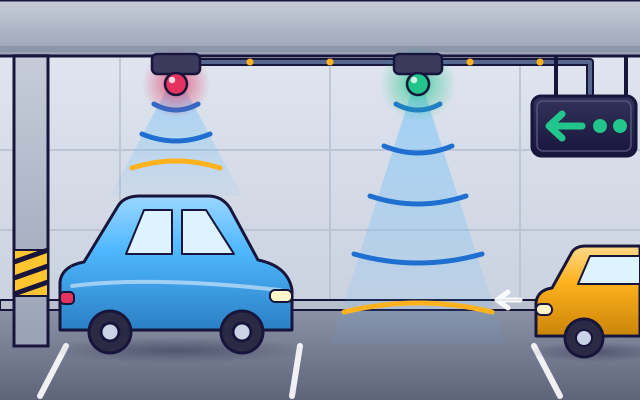
How do parking garages identify empty spaces?
Move cars between bays and watch sensors update guidance signs.
#365
Buildings & city systems
How do parking garages identify empty spaces?
Move cars between bays and watch sensors update guidance signs.
 #366
Buildings & city systems
How do railway signals keep trains separated?
Divide track into sections and operate signals as trains enter and leave.
#366
Buildings & city systems
How do railway signals keep trains separated?
Divide track into sections and operate signals as trains enter and leave.
 #367
Buildings & city systems
How does air traffic control organize flights?
Guide aircraft along assigned routes and coordinate spacing and runway approaches.
#367
Buildings & city systems
How does air traffic control organize flights?
Guide aircraft along assigned routes and coordinate spacing and runway approaches.
 #368
Buildings & city systems
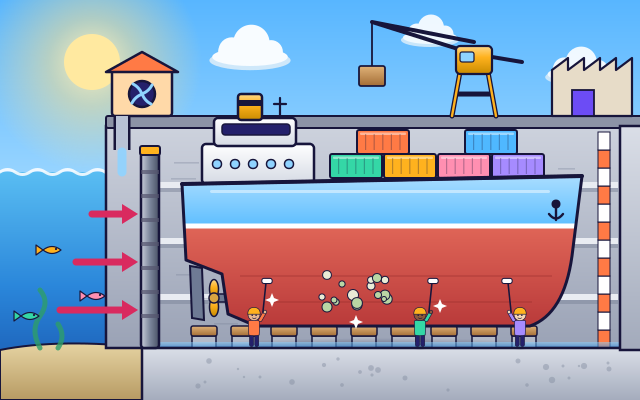
How do dry docks make ship repairs possible?
Float in a vessel, close the gate, and lower water around its hull.
#368
Buildings & city systems
How do dry docks make ship repairs possible?
Float in a vessel, close the gate, and lower water around its hull.
Keep exploring
Games to play next
- Bridge LabBuild a bridge from beams, brace it with triangles, and stay on budget.
- Area ArchitectDesign rooms that hit the area and perimeter on the blueprint.
- Route PlannerFind the shortest way around town, dodge closed roads, and measure trips with a scale bar.
Guide for grown-ups
- How to start homeschooling: a step-by-step guide for familiesA guide for parents · 7 min read
Science games by grade
Science worksheets by grade
- Preschool Science Worksheets
- Pre-K Science Worksheets
- Kindergarten Science Worksheets
- 1st Grade Science Worksheets
- 2nd Grade Science Worksheets
- 3rd Grade Science Worksheets
- 4th Grade Science Worksheets
- 5th Grade Science Worksheets
- 6th Grade Science Worksheets
- 7th Grade Science Worksheets
- 8th Grade Science Worksheets