How does a humidifier add moisture?
Compare two ways to put water into dry air: a fan and a wet wick, or a tiny disc that shakes water into mist.
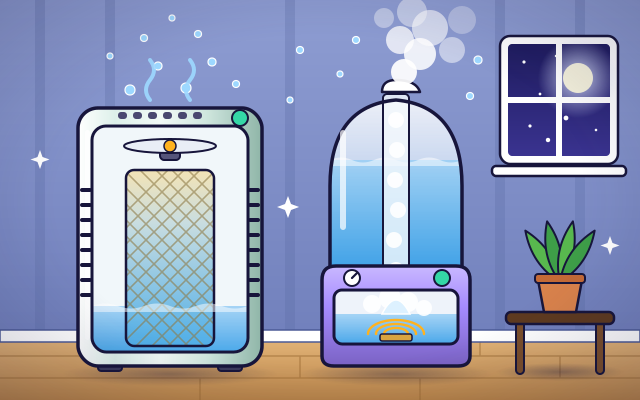
The big idea: A humidifier adds water to dry air. An evaporative one blows air through a wet wick, so water evaporates into it. An ultrasonic one shakes water into a fine mist that then evaporates in the room.
It's like a wet towel in front of a fan, or a plant sprayer. One lets water dry off into the air; the other breaks water into a fine mist.
The interactive parts didn't load. The explanations below still work; try reloading the page.
Two ways to dampen dry air
- In winter, heaters warm the air but add no water to it. The air gets very dry: lips feel chapped, plants droop and you get little static shocks.
- Hang up a wet towel and it dries. The water has not gone away. It has turned into water vapor, an invisible gas, and mixed into the air. That is evaporation.
- An evaporative humidifier is a towel and a fan in a box. A wick soaks up water from a tank, a fan pulls dry air through it, and the air leaves carrying water vapor you cannot see.
- An ultrasonic humidifier works differently. A small disc under the water vibrates far too fast to see. It shakes the surface so hard that tiny droplets fly off and make a cool mist.
- The mist floats up and fades away. Each tiny droplet evaporates in a second or two. So both machines end the same way: more water vapor in the air.
- A comfortable room has some water in its air, but not too much. Too damp, and windows fog and things feel clammy. So a humidifier is turned down or off when the air is right.
Look inside two humidifiers
Tap each part. The machine on the left uses a wick and a fan. The one on the right uses a vibrating disc.
- Water tray. The evaporative humidifier keeps its water in a tray at the bottom, where the wick stands in it.
- Wick. The wick is like thick paper folded into a honeycomb. Water creeps up through it, just as it climbs a paper towel dipped in a spill.
- Fan. The fan pulls dry room air through the wet wick and pushes the dampened air out of the top.
- Water tank. The ultrasonic humidifier has a tank on top. It lets water down into a shallow pool in the base, a little at a time.
- Vibrating disc. This small metal disc sits under the pool. Electricity makes it vibrate so fast that droplets jump off the water as mist.
- Mist tube and nozzle. A gentle puff of air carries the mist up this tube and out through the nozzle, which you can point where you like.
- Humidity dial. The dial sets how much mist is made. Some machines also sense how damp the air is and switch themselves off.
Wick against mist
Two rooms, the same size and just as dry. Tap each machine's green button and watch the dials. Which room stops by itself, and which keeps getting damper?
Experiment: Both machines run at full power for a long time. What happens in each room?
- Tap the green button on both machines.
- Watch the two dials for a while. Which needle slows down?
- Look at the floor and the plant in the mist room.
What we found: The wick machine slowed down as its room got damper, because damp air cannot dry a wet wick very fast. It settled in a comfy range. The mist machine kept pumping out droplets until the air could take no more and things got wet.
Turn on JavaScript to try it yourself.
Just right
Bring the room into the green zone on the dial and keep it there for 5 seconds. Do not let it get so damp that the floor gets wet!
Putting water into the air
Air always has some water in it, as an invisible gas called water vapor. In winter the air indoors is often very dry, because cold outdoor air holds little water and heating it does not add any. Dry air makes skin and lips feel tight, and it lets static electricity build up.
A humidifier adds water to the air. The evaporative kind copies a wet towel. A wick soaks up water, and a fan blows dry air through it. Water evaporates from the wick into the passing air. The damper the room gets, the slower the wick dries, so this machine cannot easily make a room too damp.
The ultrasonic kind makes mist instead. A small disc under the water vibrates more than a million times a second and throws tiny droplets into the air. They look like a white cloud, and then they evaporate too. This machine is quiet and quick, but it does not slow down by itself, so it has to be turned down when the air is right.
The towel and sprayer comparison is not exact: a plant sprayer makes big drops that fall and wet things, while the mist from the disc is fine enough to dry in the air. Humidifiers need care. A grown-up should empty and clean them often, and too much dampness is as unwelcome as too little.
Key words
- Humidity
- How much water vapor is in the air.
- Evaporation
- Liquid water turning into invisible water vapor.
- Wick
- A porous pad that soaks water upward, giving it a large surface to evaporate from.
- Ultrasonic
- Vibrating too fast for people to hear.
- Mist
- A cloud of tiny droplets of liquid water. It is not the same as vapor, which is a gas.
- Humidistat
- A switch that turns a humidifier off when the air is damp enough.
Check your thinking
-
Where does the water in a humidifier end up?
Show the answer
In the air, as invisible water vapor. Both machines end with water vapor mixed into the air.
-
How does an evaporative humidifier add water to the air?
Show the answer
A fan blows air through a wet wick. Water evaporates from the wet wick into the air that the fan pulls through it.
-
What makes the mist in an ultrasonic humidifier?
Show the answer
A tiny disc vibrating very fast under the water. The disc shakes the water so hard that tiny droplets fly off as a cool mist.
-
Which machine slows down by itself when the room gets damp?
Show the answer
The one with the wet wick. Damp air cannot dry a wet wick quickly, so less water goes into it.
-
An ultrasonic humidifier filled with hard tap water leaves white dust on the furniture. Why?
Show the answer
Each droplet evaporates and leaves its dissolved minerals floating in the air. The mist is liquid water, minerals and all. When the water evaporates the minerals remain as fine particles. Distilled water avoids this.
-
A room loses water vapor to ventilation as fast as the humidifier adds it. What happens to the humidity?
Show the answer
It stays steady. When the water added equals the water carried away, the amount in the air stops changing.
You're a Home systems expert!
You watched, looked inside, tried it, solved the challenge and went deeper. Pick another question below, or switch the age at the top to see this topic another way.
More about home systems
 #191
Home systems
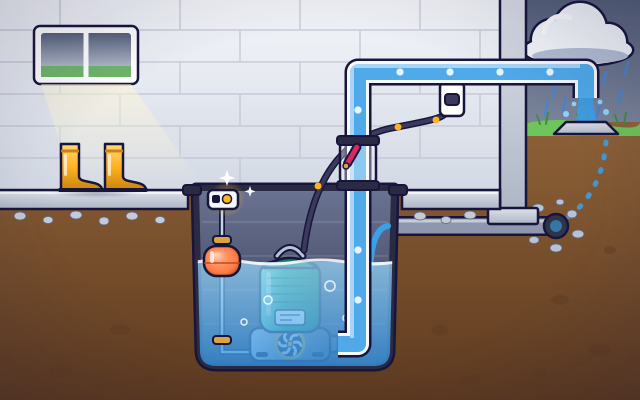
How does a sump pump keep a basement dry?
Raise water in a model sump and watch a float activate the pump.
#191
Home systems
How does a sump pump keep a basement dry?
Raise water in a model sump and watch a float activate the pump.
 #192
Home systems
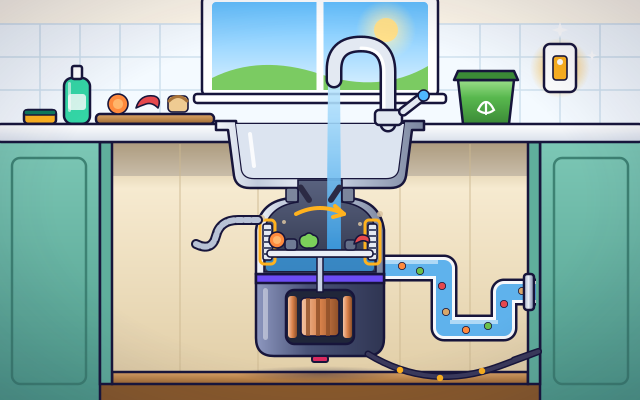
How does a kitchen garbage disposal work?
Observe impellers pushing suitable food scraps against a grinding ring beneath a sink.
#192
Home systems
How does a kitchen garbage disposal work?
Observe impellers pushing suitable food scraps against a grinding ring beneath a sink.
 #193
Home systems
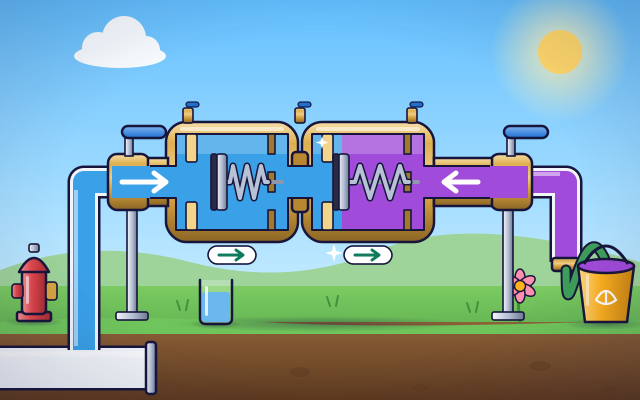
How do backflow preventers protect water supplies?
Change pipe pressures and watch valves prevent unwanted reverse flow.
#193
Home systems
How do backflow preventers protect water supplies?
Change pipe pressures and watch valves prevent unwanted reverse flow.
 #194
Home systems
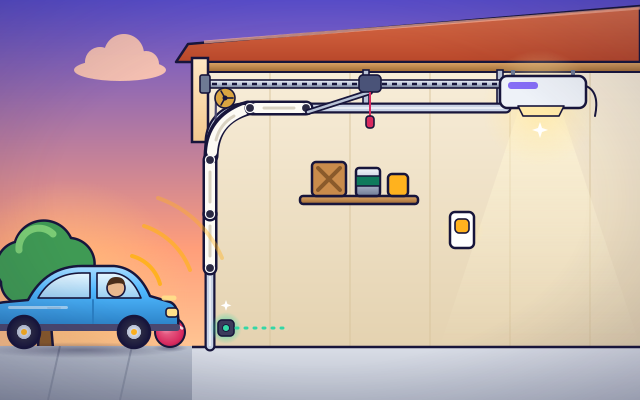
How does an automatic garage door open?
Explore the door's tracks, springs, cables, motor, and obstruction sensors.
#194
Home systems
How does an automatic garage door open?
Explore the door's tracks, springs, cables, motor, and obstruction sensors.
Keep exploring
Games to play next
- Weather LabPredict the weather in a box, then run a fair test to find out why.
- Machine RepairFix levers, pulleys, gears and ramps so every contraption works.
- Circuit Workshop 3DWire up batteries, bulbs and switches on a 3D workbench.
Guide for grown-ups
- How to start homeschooling: a step-by-step guide for familiesA guide for parents · 7 min read
Science games by grade
Science worksheets by grade
- Preschool Science Worksheets
- Pre-K Science Worksheets
- Kindergarten Science Worksheets
- 1st Grade Science Worksheets
- 2nd Grade Science Worksheets
- 3rd Grade Science Worksheets
- 4th Grade Science Worksheets
- 5th Grade Science Worksheets
- 6th Grade Science Worksheets
- 7th Grade Science Worksheets
- 8th Grade Science Worksheets