How do airport passenger bridges connect to airplanes?
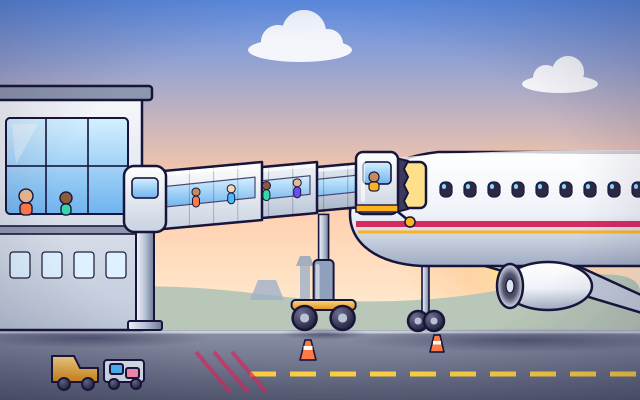
A jet bridge is a tunnel on wheels. It swings, stretches and rises to meet the door of each plane that parks at the gate.
The big idea: Planes come in many sizes, with doors in different places. The bridge turns at one end, slides longer or shorter, and lifts its far end until it lines up with the door.
It's like a desk lamp with a folding arm. It turns at the base, reaches out and tilts up or down, so the light ends up just where you want it.
The interactive parts didn't load. The explanations below still work; try reloading the page.
Docking a jet bridge
- A plane follows the yellow line to its gate and stops at a mark on the ground. The door is higher than a room is tall. The bridge is waiting, tucked out of the way.
- The bridge is fixed to the building by a round joint called the rotunda. It works like a hinge. Wheels at the far end drive sideways, and the whole tunnel swings toward the plane's door.
- The tunnel is made of two or three tubes, one inside the other, like a telescope. The wheels drive forward and the tubes slide out, so the bridge grows longer until it nearly touches the plane.
- Two strong lift columns stand on the wheels. They push the end of the bridge up or pull it down, until its floor is exactly level with the plane's doorstep.
- The little room at the end, the cab, turns to face the plane. A soft folding hood stretches out and presses gently around the door. A small wheel rests on the plane to feel if it moves up or down.
- The doors open and the passengers walk straight from the building onto the plane, warm and dry. When a bigger or smaller plane comes next, the bridge simply swings, stretches and lifts to a new spot.
Look inside a jet bridge
Tap each part. You see the bridge from above in the top picture, and from the side in the bottom one.
- Rotunda. The rotunda is the round room where the bridge joins the building. It stands on a strong pillar and works as a hinge, so the tunnel can swing left and right.
- Telescoping tunnels. The walkway is made of two or three tunnels that fit inside each other. They roll in and out like the tubes of a telescope, so the bridge can be short or long.
- Lift columns. The lift columns are two strong legs near the far end. They push up or pull down to set the floor at the height of the plane's door.
- Drive wheels. Under the lift columns is a pair of big wheels with electric motors. They can roll forward, backward and sideways, and that is what swings and stretches the bridge.
- Cab. The cab is the room at the end that meets the plane. The operator stands here and steers the bridge with a joystick, watching the door through a window.
- Canopy. The canopy is a soft hood that folds like an accordion. It reaches out and presses gently around the plane's door to close the gap.
- Auto-leveler. As people and bags go on, the plane sinks a little on its wheels. A small wheel resting on the plane feels this and tells the bridge to move down with it.
Dock the bridge
Drag the cab to the plane's door in the top picture, then set the height in the side picture. Then press Next plane and dock again.
Experiment: A small jet parks at the gate after a big one. What must the bridge do to meet its door?
- Dock the bridge with the plane at the gate. Notice the swing, the reach and the height.
- Press Next plane. A plane of a different size rolls in.
- Dock again. Which of the three settings had to change?
What we found: Each kind of plane has its door at a different height and a different distance from the building. So the bridge has to change all three things: where it points, how far it reaches and how high its end is. That is why it is built to turn, stretch and lift.
Turn on JavaScript to try it yourself.
Three planes in a row
Three planes are coming, one after another: small, medium and big. Dock the bridge with each one, without bumping any of them.
How a jet bridge reaches the door
Before jet bridges, passengers walked across the open ground and climbed a staircase to the plane, whatever the weather. A jet bridge is a covered walkway from the airport building straight to the plane's door. It keeps people warm, dry and safely away from the trucks and engines below.
The tricky part is that planes are not all alike. A small jet has its door near the ground, and a jumbo's door is as high as the roof of a house. The doors are at different distances from the building too. So the bridge has to be able to move in three ways.
It swings around a round joint called the rotunda, where it joins the building. It stretches, because its tunnels slide inside each other like a telescope. And it lifts, because strong columns raise or lower its far end. Big motor-driven wheels do the swinging and stretching by rolling across the ground.
At the end is the cab, where the operator steers with a joystick. A soft folding canopy closes the last gap, and a little sensing wheel keeps the floor level with the plane as it sinks under the weight of people and bags. A desk lamp's arm moves in similar ways, with one difference: a lamp bends at an elbow, while a jet bridge slides straight in and out.
Key words
- Jet bridge
- A covered, movable walkway that connects an airport building to an aircraft door.
- Rotunda
- The round joint at the building end, around which the bridge swings.
- Telescoping
- Getting longer or shorter by sliding tubes inside one another.
- Cab
- The room at the far end of the bridge that meets the aircraft.
- Door sill
- The doorstep of the plane's door.
- Slope
- How steep a floor is.
Check your thinking
-
How does a jet bridge change its length?
Show the answer
Its tunnels slide inside each other, like a telescope. The tunnel sections are nested, and the wheels drive them in or out.
-
Why must a jet bridge be able to move up and down?
Show the answer
Different planes have doors at different heights. A small jet's door is low and a jumbo's is high. The lift columns set the floor to match.
-
What is the rotunda for?
Show the answer
It is the hinge that lets the bridge swing left and right. The rotunda is the turning joint where the bridge is fixed to the building.
-
Why is the canopy at the end soft and folding?
Show the answer
So it can press gently around the plane's curved side without hurting it. A plane's skin is thin. A soft hood closes the gap and keeps the weather out without pushing hard.
-
The terminal floor is 4 meters high and a plane's door sill is 2 meters high. What is the shortest bridge that keeps the slope to 1 in 12?
Show the answer
24 meters. The height difference is 2 meters, and 2 times 12 is 24 meters of length.
-
A plane sinks a little as people get on. How does the bridge know?
Show the answer
A small wheel resting on the plane feels it move. That wheel is the auto-leveler. When the plane moves, it tells the lift columns to follow.
You're a Buildings & city systems expert!
You watched, looked inside, tried it, solved the challenge and went deeper. Pick another question below, or switch the age at the top to see this topic another way.
More about buildings & city systems
 #59
Buildings & city systems
How does clean water reach our taps?
Follow water through treatment, storage, and underground pipes. Explore the removal of visible and microscopic contaminants, then connect a neighborhood's water supply.
#59
Buildings & city systems
How does clean water reach our taps?
Follow water through treatment, storage, and underground pipes. Explore the removal of visible and microscopic contaminants, then connect a neighborhood's water supply.
 #60
Buildings & city systems
How do elevators work?
Add passengers and watch the motor, cables, elevator car, and counterweight move together. Deliver people to different floors in a transparent building.
#60
Buildings & city systems
How do elevators work?
Add passengers and watch the motor, cables, elevator car, and counterweight move together. Deliver people to different floors in a transparent building.
 #61
Buildings & city systems
What happens to water after it goes down the drain?
Follow wastewater through sewers, screens, settling tanks, and biological treatment. Operate a model treatment plant and investigate each stage's purpose.
#61
Buildings & city systems
What happens to water after it goes down the drain?
Follow wastewater through sewers, screens, settling tanks, and biological treatment. Operate a model treatment plant and investigate each stage's purpose.
 #62
Buildings & city systems
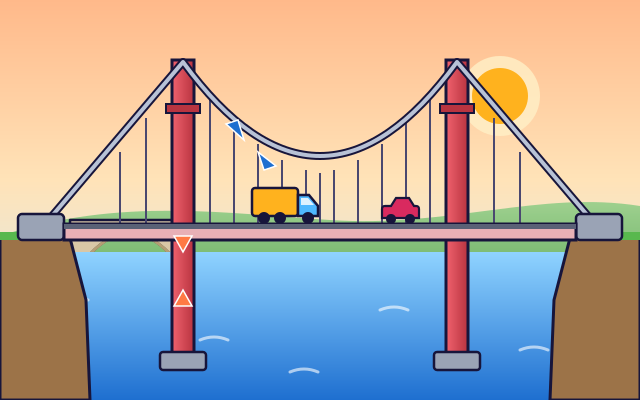
How do bridges hold so much weight?
Compare beam, arch, and suspension bridges. Add virtual traffic, watch simplified force arrows, and strengthen a bridge by changing its supports.
#62
Buildings & city systems
How do bridges hold so much weight?
Compare beam, arch, and suspension bridges. Add virtual traffic, watch simplified force arrows, and strengthen a bridge by changing its supports.
Keep exploring
Games to play next
- Plane Flight SimulatorTake off from the runway and thread numbered sky hoops in order. Every clean flight is a new personal best.
- Bridge LabBuild a bridge from beams, brace it with triangles, and stay on budget.
- Area ArchitectDesign rooms that hit the area and perimeter on the blueprint.
Guide for grown-ups
- How to start homeschooling: a step-by-step guide for familiesA guide for parents · 7 min read
Science games by grade
Science worksheets by grade
- Preschool Science Worksheets
- Pre-K Science Worksheets
- Kindergarten Science Worksheets
- 1st Grade Science Worksheets
- 2nd Grade Science Worksheets
- 3rd Grade Science Worksheets
- 4th Grade Science Worksheets
- 5th Grade Science Worksheets
- 6th Grade Science Worksheets
- 7th Grade Science Worksheets
- 8th Grade Science Worksheets