How do utilities find hidden water leaks?
A buried pipe is leaking and nobody can see it. Meters and careful listening lead the crew to the exact spot.
The big idea: First count the water: if more goes into a street than the houses use, some is escaping. Then listen: a leak hisses, and the hiss is loudest right above it.
It's like finding a hole in a bicycle tire. You cannot see it, so you listen for the hiss and move along until it is loudest.
The interactive parts didn't load. The explanations below still work; try reloading the page.
Finding a leak nobody can see
- Pipes under the streets carry clean water from the water tower to every house. Somewhere, one pipe has cracked. Water is escaping into the soil, and from the street you cannot see a thing.
- Meters count the water flowing into each street. Each house has a meter too. If more water goes into a street than its houses use, the rest must be escaping.
- In the middle of the night almost nobody uses water, so the meters should nearly stop. In two streets they do. In one street the meter keeps turning. Water is flowing with nowhere to go.
- Now follow the spinning meters, like clues. The big meter spins, the meter for the middle street spins, and so does the one halfway along. The leak must be in the far half of that street.
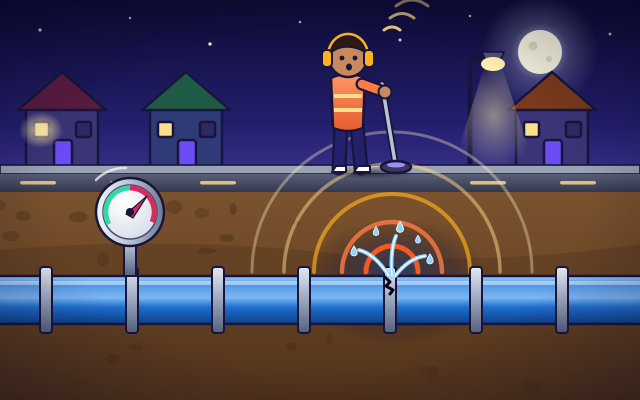
- Water squirting out of a pipe makes a hissing sound. A worker walks along the street with a ground microphone. The hiss gets louder and louder, then quieter again. The loudest spot is right above the leak.
- Now the crew digs one small hole in exactly the right place. There is the crack! They bolt a metal clamp around the pipe. The night meter slows right down, and the water is saved.
Tools for finding a leak
Tap each tool on the map to see what it tells the crew.
- Main meter. The main meter counts all the water going into this part of town. Add up what every house uses, and the two numbers should nearly match.
- Street meter. A meter at the start of each street, and another halfway along, count the water flowing past. If a meter spins when all the taps are off, the leak is somewhere beyond it.
- House meter. Every home has its own water meter. It counts the water for baths, cooking and washing. That is how the water company knows how much each street really uses.
- The leak. Here it is, shown as if the ground were glass. Water squirts through the crack and soaks away into the soil. The rushing water shakes the pipe and makes a steady hiss.
- Ground microphone. A worker presses a very sensitive microphone on the ground and listens with headphones. Step by step along the street, the hiss grows louder near the leak.
- Correlator. Two sensors are clipped to the pipe, one at each end of the stretch. The hiss reaches the nearer one first. A computer measures that tiny gap and works out where the leak is.
- Repair clamp. A repair clamp is a steel collar lined with rubber. Bolted tight around the pipe, it squeezes the rubber over the crack and seals it.
Track down the leak
Switch to night and see which meters still turn. Then tap the dots along that street to listen for the hiss. The loudest dot is right above the leak.
Experiment: It is the middle of the night and everyone is asleep. One street's meter is still turning. What does that tell you?
- Look at the meters by day. Can you tell which street has the leak?
- Switch to night and look again. Which meters are still turning?
- Tap the dots along that part of the street and find the loudest hiss.
What we found: By day, every street uses lots of water, so the leak is hidden among the showers and washing machines. At night the houses use almost nothing, and the only water still flowing is the water that is escaping. Then the hiss leads you to the exact spot.
Turn on JavaScript to try it yourself.
One hole only
There is a new leak. Find it, then press Dig here. Every hole in the wrong place costs a star, so be sure before you dig.
How crews find hidden leaks
The water that comes out of your tap has been cleaned, tested and pumped a long way. So it is a real waste when it escapes through a cracked pipe before it reaches anyone. The trouble is that most leaks are underground, and the water just soaks away. Nobody sees a puddle.
So water companies begin by counting. A big meter counts the water flowing into a neighborhood, and every house has a meter of its own. If much more water goes in than the houses use, there is a leak somewhere. The best time to check is the middle of the night, when nearly every tap is off. Any water still flowing then is probably escaping.
Smaller meters on each street show which way the missing water went. That narrows the search to one stretch of pipe. Then comes the listening. Water squirting from a crack makes the pipe hiss, and a worker with a ground microphone can hear it from the street. The hiss is loudest right above the leak, just like the hiss from a hole in a bicycle tire.
Then the crew digs one small hole and bolts a clamp around the pipe. Finding a tire's hole is easier in one way: you can dip the tire in water and watch for bubbles. Under a street you cannot see anything, so counting and listening have to do the job.
Key words
- Water main
- A large underground pipe that carries clean water along a street.
- Flow meter
- A device that measures how much water passes through a pipe.
- Water balance
- Comparing the water that goes in with the water that is used, to see how much is missing.
- Night flow
- The water still flowing in the middle of the night, when almost nobody is using any.
- Ground microphone
- A sensitive microphone that hears the hiss of a leak through the ground.
- Correlator
- A tool with two sensors that works out where a leak is from which sensor hears it first.
Check your thinking
-
How can a worker hear a leak that is under the street?
Show the answer
Escaping water makes the pipe hiss, and a ground microphone picks it up. The squirting water shakes the pipe. A sensitive microphone hears that through the ground.
-
Where along the street is the hiss loudest?
Show the answer
Right above the leak. Sound fades as it travels, so the loudest place is the closest one.
-
Why is the middle of the night the best time to look for a leak with meters?
Show the answer
Almost nobody is using water, so any flow is probably a leak. By day the leak is hidden among everybody's showers and washing. At night it is the only water moving.
-
The meter at the start of a street turns at night, but the meter halfway along is still. Where is the leak?
Show the answer
In the first half of the street. The water passed the first meter but never reached the second, so it got out in between.
-
Two sensors are 120 meters apart. Leak noise travels at 1,200 meters a second and reaches the first sensor 50 milliseconds before the second. How far is the leak from the first sensor?
Show the answer
30 meters. In 50 milliseconds sound travels 60 meters, so the leak is 60 meters nearer the first sensor: (120 minus 60) divided by 2 is 30 meters.
-
Why do crews work so hard to find the exact spot before digging?
Show the answer
So they dig one small hole instead of tearing up the whole street. Digging is slow and costly and blocks the road. Good detective work means one small hole.
You're a Buildings & city systems expert!
You watched, looked inside, tried it, solved the challenge and went deeper. Pick another question below, or switch the age at the top to see this topic another way.
More about buildings & city systems
 #375
Buildings & city systems
How do airport passenger bridges connect to airplanes?
Adjust height, direction, and extension to meet different aircraft doors.
#375
Buildings & city systems
How do airport passenger bridges connect to airplanes?
Adjust height, direction, and extension to meet different aircraft doors.
 #59
Buildings & city systems
How does clean water reach our taps?
Follow water through treatment, storage, and underground pipes. Explore the removal of visible and microscopic contaminants, then connect a neighborhood's water supply.
#59
Buildings & city systems
How does clean water reach our taps?
Follow water through treatment, storage, and underground pipes. Explore the removal of visible and microscopic contaminants, then connect a neighborhood's water supply.
 #60
Buildings & city systems
How do elevators work?
Add passengers and watch the motor, cables, elevator car, and counterweight move together. Deliver people to different floors in a transparent building.
#60
Buildings & city systems
How do elevators work?
Add passengers and watch the motor, cables, elevator car, and counterweight move together. Deliver people to different floors in a transparent building.
 #61
Buildings & city systems
What happens to water after it goes down the drain?
Follow wastewater through sewers, screens, settling tanks, and biological treatment. Operate a model treatment plant and investigate each stage's purpose.
#61
Buildings & city systems
What happens to water after it goes down the drain?
Follow wastewater through sewers, screens, settling tanks, and biological treatment. Operate a model treatment plant and investigate each stage's purpose.
Keep exploring
Games to play next
- River MysterySomething changed the river. Sample sites with a limited budget, follow the evidence and find where the change begins.
- Bridge LabBuild a bridge from beams, brace it with triangles, and stay on budget.
- Area ArchitectDesign rooms that hit the area and perimeter on the blueprint.
Guide for grown-ups
- How to start homeschooling: a step-by-step guide for familiesA guide for parents · 7 min read
Science games by grade
Science worksheets by grade
- Preschool Science Worksheets
- Pre-K Science Worksheets
- Kindergarten Science Worksheets
- 1st Grade Science Worksheets
- 2nd Grade Science Worksheets
- 3rd Grade Science Worksheets
- 4th Grade Science Worksheets
- 5th Grade Science Worksheets
- 6th Grade Science Worksheets
- 7th Grade Science Worksheets
- 8th Grade Science Worksheets