How do railway signals keep trains separated?
The track is cut into sections called blocks, and signals let only one train into each block at a time.
The big idea: A railway line is divided into blocks. A signal at the start of each block shows red while a train is inside, so the next train has to wait.
It's like a playground slide with a rule: nobody starts down until the child in front has left the slide, so nobody can bump into anyone.
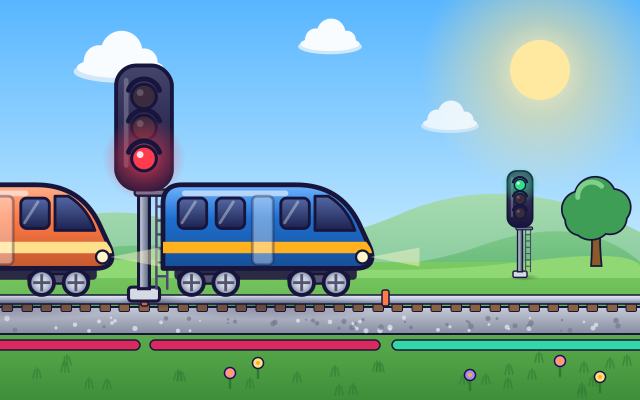
The interactive parts didn't load. The explanations below still work; try reloading the page.
One block, one train
- A train waits at a red signal. Trains are very heavy and cannot swerve, and they need a long way to stop. So how do they stay safely apart?
- The line is divided into sections called blocks. The rule is simple: only one train may be in a block at a time. A signal stands at the start of every block.
- A small electric current runs along one rail, through a switch called a relay, and back along the other rail. A train's metal wheels and axle join the two rails, so the current takes that shortcut and the relay lets go.
- As soon as the train's first wheels enter a block, the signal at the start of that block turns red. No other train may follow it in.
- When the train leaves a block, the signal behind changes to yellow. Yellow means the block is empty but the next signal is red, so get ready to stop. One block later it turns green.
- Now a second train follows. The signals pass the message back along the line, so it always stays at least one empty block behind the train in front.
Look inside one block
You are looking down on one block of track. Tap each part to see what it does.
- Signal. The signal stands at the start of the block. Red means stop, yellow means be ready to stop at the next signal, and green means the way ahead is clear.
- Insulated joint. At each end of the block the rails have a joint packed with a material that electricity cannot pass through. It keeps each block's current separate from its neighbors.
- Power feed. A small, safe electric supply is connected to the two rails at one end of the block. It sends a gentle current along the rails all day and all night.
- Wheels and axle. A train's two wheels are fixed to a solid steel axle. Steel carries electricity, so the wheels and axle make a bridge between the rails and the current takes that shortcut.
- Track relay. The relay is an electric switch at the far end of the block. While current reaches it, its arm stays up and the signal can show green. If the current stops for any reason, the arm falls and the signal turns red.
- Train stop. This device between the rails backs up the driver. If a train passes a red signal by mistake, it tells the train to put its brakes on automatically.
Drive through the blocks
Drag the blue train through the blocks and watch every signal behind it. Then send a second train after it. The dark panel is the signaller's map of the line.
Experiment: A train drives through three blocks. What does the first signal it passed show along the way?
- Drag the blue train past the first signal and look at that signal.
- Keep going into the next block, and the one after it.
- Send a second train and see where it has to wait.
What we found: The signal turns red as the train enters its block. When the train moves into the next block it turns yellow, and one block later it turns green. A following train is always held at least one block back.
Turn on JavaScript to try it yourself.
Be the signaller
Every signal starts at red. Tap a signal to clear it, but only when its block is empty. Get all three trains along the line.
How signals keep trains apart
A car can stop quickly and steer around things. A train cannot. Steel wheels on steel rails roll very easily, which saves energy, but it also means they do not grip much. A fast train can need more than a kilometer to stop. By the time a driver could see another train ahead, it would be too late to brake.
So railways use a simple rule. The line is cut into sections called blocks, and only one train may be in a block at a time. A signal stands at the start of each block. If a train is inside, the signal shows red and the next train must wait outside.
How does the signal know? A small electric current runs through the rails of each block. A train's metal wheels and axle join the two rails together, and the current takes that shortcut. A switch called a relay notices the current has gone and turns the signal red.
The signals also warn drivers early. When a block is empty but the next one is busy, the signal shows yellow, which means be ready to stop. Only when two blocks are empty does it show green. If anything breaks, the signal turns red, because red is the safe choice. The playground slide comparison stops working here: on a slide you can see the child in front, but a train driver often cannot see the next train at all.
Key words
- Block
- A section of track that only one train may be in at a time.
- Signal aspect
- What a signal is showing: red for stop, yellow for caution, green for clear.
- Track circuit
- A small electric current in the rails that shows whether a train is in the block.
- Relay
- A switch worked by electricity. A track relay drops when its current stops.
- Fail-safe
- Built so that if something breaks, it ends up in the safe position.
- Braking distance
- How far a train travels from the moment the brakes go on until it stops.
Check your thinking
-
What does a red signal at the start of a block mean?
Show the answer
Stop: there may be a train in the block. Red means the block is not clear, so the train must stop and wait.
-
Why is the line cut into blocks?
Show the answer
So only one train is in each section, with space between trains. One train per block means there is always a gap that is long enough for a train to stop in.
-
How does the track know that a train is in a block?
Show the answer
The metal wheels and axle join the two rails, so the current takes a shortcut. Steel wheels on a steel axle carry electricity from one rail to the other, so the current no longer reaches the relay.
-
A wire in the track circuit breaks. What does the signal do?
Show the answer
It turns red, just in case. No current reaches the relay, so it lets go and the signal shows red. Trains wait, but nobody is in danger.
-
A line's trains double their speed. About how much longer is the braking distance?
Show the answer
Four times as long. Braking distance depends on speed squared, so twice the speed needs about four times the distance.
-
A driver passes a yellow signal. What should the driver expect?
Show the answer
The next signal may be red, so slow down now. Yellow is an early warning that the next signal is red, so the driver starts braking in good time.
You're a Buildings & city systems expert!
You watched, looked inside, tried it, solved the challenge and went deeper. Pick another question below, or switch the age at the top to see this topic another way.
More about buildings & city systems
 #367
Buildings & city systems
How does air traffic control organize flights?
Guide aircraft along assigned routes and coordinate spacing and runway approaches.
#367
Buildings & city systems
How does air traffic control organize flights?
Guide aircraft along assigned routes and coordinate spacing and runway approaches.
 #368
Buildings & city systems
How do dry docks make ship repairs possible?
Float in a vessel, close the gate, and lower water around its hull.
#368
Buildings & city systems
How do dry docks make ship repairs possible?
Float in a vessel, close the gate, and lower water around its hull.
 #369
Buildings & city systems
How do utility maps show what is underground?
Switch between pipe and cable layers before planning a simulated excavation.
#369
Buildings & city systems
How do utility maps show what is underground?
Switch between pipe and cable layers before planning a simulated excavation.
 #370
Buildings & city systems
How does a stadium open and close its roof?
Coordinate movable roof sections as they travel along their tracks.
#370
Buildings & city systems
How does a stadium open and close its roof?
Coordinate movable roof sections as they travel along their tracks.
Keep exploring
Games to play next
- Timetable TerminalRead the departure board, count the minutes and catch your connection on time.
- Bridge LabBuild a bridge from beams, brace it with triangles, and stay on budget.
- Area ArchitectDesign rooms that hit the area and perimeter on the blueprint.
Guide for grown-ups
- How to start homeschooling: a step-by-step guide for familiesA guide for parents · 7 min read
Science games by grade
Science worksheets by grade
- Preschool Science Worksheets
- Pre-K Science Worksheets
- Kindergarten Science Worksheets
- 1st Grade Science Worksheets
- 2nd Grade Science Worksheets
- 3rd Grade Science Worksheets
- 4th Grade Science Worksheets
- 5th Grade Science Worksheets
- 6th Grade Science Worksheets
- 7th Grade Science Worksheets
- 8th Grade Science Worksheets