How do roofs keep rain out?
A roof is a slope of overlapping pieces. Every raindrop is guided down, around the joints and away.
The big idea: Water always runs downhill. A roof is built so that each piece hands the water on to the piece below, and never lets it reach a gap.
It's like a duck's feathers. Each feather lies over the next one, so water rolls from feather to feather and off, and the duck stays dry.
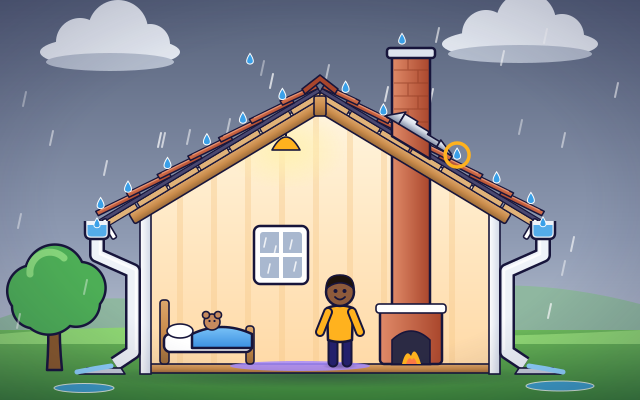
The interactive parts didn't load. The explanations below still work; try reloading the page.
Where does the rain go?
- A roof is like a hat for a house. Today the sun is out, but dark clouds are on the way. What will keep the rain off the bed inside?
- Here comes the rain. The roof slopes, and water always runs downhill. So every drop that lands slides straight down toward the edge.
- Look closely. The roof is covered in rows of shingles, and each row overlaps the row below it. A drop runs off one shingle and lands on top of the next. It never meets a gap.
- Peel the shingles back and there is more. A waterproof sheet called underlayment catches any drops that sneak past. It lies on wooden boards, the deck, and strong beams called rafters carry everything.
- Where a chimney pokes through, there is a joint, and joints are where leaks start. So roofers tuck strips of metal called flashing around it. The water is steered past the gap.
- At the bottom edge, a gutter catches the water and a downspout carries it to the ground, away from the walls. Slope, overlap, flashing and gutters: together they keep the house dry.
Look inside a roof
Tap each part. The magnifying glass shows the layers of the roof, from the outside in.
- Shingles. Shingles are the roof's raincoat. They are nailed on in rows, and every row overlaps the row below, so water runs from one to the next all the way down.
- Underlayment. Under the shingles is a thin waterproof sheet. If wind blows rain up under a shingle, the underlayment catches it and sends it on down the roof.
- Roof deck. The deck is a skin of wooden boards or big plywood sheets. It gives the roofers something solid to nail the other layers onto.
- Rafters. Rafters are sloping beams that run from the top of the roof to the walls. They give the roof its shape and carry its weight down to the walls.
- Ridge cap. The two slopes meet at the ridge, the highest line of the roof. A row of bent shingles sits over that joint like a tiny roof of its own.
- Flashing. Flashing is thin metal bent to fit around the chimney. It tucks under the shingles above and lies over the shingles below, so water slides past the joint.
- Gutter. The gutter is a trough along the bottom edge of the roof. It catches the water running off and slopes very gently toward the downspout.
- Downspout. The downspout carries the gutter's water down the wall. At the bottom, it tips the water out away from the house, so the ground by the walls stays dry.
Layer by layer
Build the roof layer by layer. Add flashing at the chimney and gutters at the edges. Follow the drops: where does the water get in?
Experiment: Each row of shingles overlaps the row below. What if the rows overlapped the wrong way round?
- Put on all three layers, with the shingles overlapping the right way. Watch the drops and the bed.
- Now switch the overlap to the wrong way. Look at the close-up circle.
- Count the drips inside each time.
What we found: Laid the right way, each shingle hands the water on to the top of the next one. Laid the wrong way, every joint is an open mouth facing the water, so it runs underneath and drips inside. The pieces are the same. Only the overlap is different.
Turn on JavaScript to try it yourself.
Roof inspector
This roof has four hidden faults. Make it rain, follow the drops, and tap each fault to fix it. Then test again until the house is dry.
How roofs shed water
A roof has one big job: keep the weather out. You might think the best way is to seal the top of a house like a lid on a jar. But most roofs do not work that way. They are covered in many separate pieces, with thousands of joints between them. The trick is not to block the water. It is to keep the water moving.
Water always runs downhill. So roofs slope, and every piece on a roof is laid so that it overlaps the piece below it. A raindrop that lands near the top runs off one shingle and onto the top of the next, again and again, like a ball bouncing down steps. Because it only ever flows over the overlaps, it never reaches the gaps underneath.
The hard places are the joints: around a chimney, around a pipe, or where the roof meets a wall. There, roofers fit bent strips of metal called flashing. The metal is tucked under the shingles above and lies over the shingles below, so it follows the same rule. Under everything is a waterproof sheet, the underlayment, to catch any drops the wind blows the wrong way.
At the bottom edge, gutters catch the water and downspouts carry it away from the walls. A duck's feathers work in the same way as shingles, with one difference: a duck also spreads oil on its feathers, while most shingles rely on overlap and slope alone.
Key words
- Pitch
- How steeply a roof slopes.
- Shingle
- A small flat piece of roofing laid in overlapping rows.
- Lap
- The part of one piece that lies on top of the next piece.
- Flashing
- Thin metal fitted around joints in a roof to carry water past them.
- Underlayment
- A waterproof sheet between the shingles and the wooden deck.
- Eaves
- The bottom edge of a roof, where it overhangs the walls.
Check your thinking
-
Why are most roofs sloped?
Show the answer
So water runs downhill and off the edge. Water always flows downhill. A slope keeps it moving until it leaves the roof.
-
A roofer lays the top row first, then tucks each lower row over it. What happens when it rains?
Show the answer
Water runs into the joints and leaks inside. The overlap must face downhill. If it faces uphill, every joint catches water like an open pocket.
-
What is flashing for?
Show the answer
To carry water past joints, such as around a chimney. A chimney makes a gap in the shingles. Bent metal covers the gap so water slides past.
-
A house has no gutters. Where does the roof's water go?
Show the answer
It pours off the edge and soaks the ground beside the walls. Without gutters the water lands next to the house, where it can splash and soak the walls.
-
With correct laps and no underlayment, a roof stays dry in calm rain but drips in a windy storm. Why?
Show the answer
Wind drives rain uphill under the shingle edges, and nothing is underneath to catch it. Laps only stop water that flows downhill. Wind can push it the other way, which is what the underlayment is for.
-
Which layer catches drops that the wind blows under the shingles?
Show the answer
The underlayment. The underlayment is a waterproof sheet under the shingles. It is the roof's second layer of defense.
You're a Buildings & city systems expert!
You watched, looked inside, tried it, solved the challenge and went deeper. Pick another question below, or switch the age at the top to see this topic another way.
More about buildings & city systems
 #373
Buildings & city systems
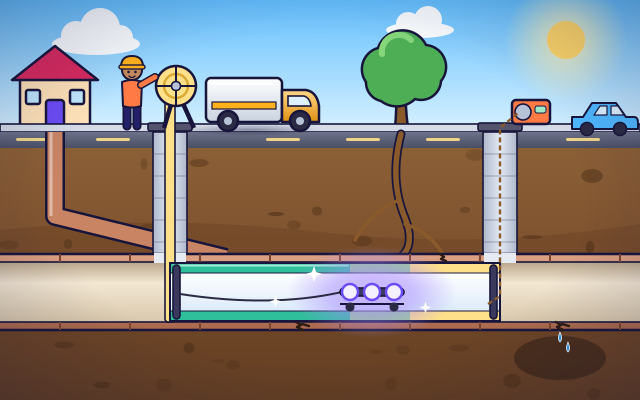
How can underground pipes be repaired without digging up a street?
Insert a virtual lining and watch a repaired passage form inside a damaged pipe.
#373
Buildings & city systems
How can underground pipes be repaired without digging up a street?
Insert a virtual lining and watch a repaired passage form inside a damaged pipe.
 #374
Buildings & city systems
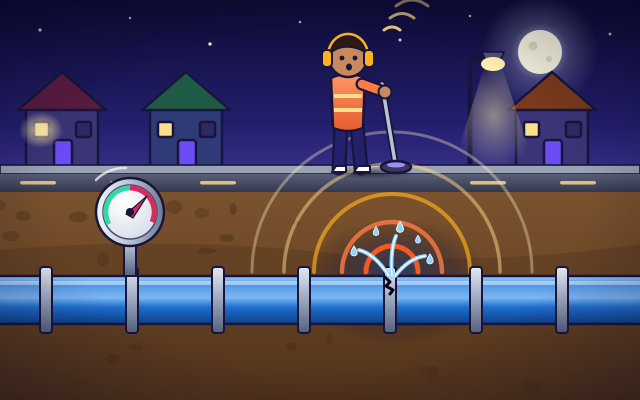
How do utilities find hidden water leaks?
Compare flow readings across a network and narrow down where water escapes.
#374
Buildings & city systems
How do utilities find hidden water leaks?
Compare flow readings across a network and narrow down where water escapes.
 #375
Buildings & city systems
How do airport passenger bridges connect to airplanes?
Adjust height, direction, and extension to meet different aircraft doors.
#375
Buildings & city systems
How do airport passenger bridges connect to airplanes?
Adjust height, direction, and extension to meet different aircraft doors.
 #59
Buildings & city systems
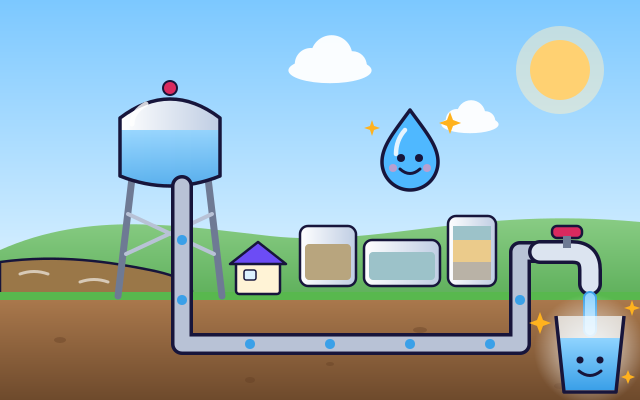
How does clean water reach our taps?
Follow water through treatment, storage, and underground pipes. Explore the removal of visible and microscopic contaminants, then connect a neighborhood's water supply.
#59
Buildings & city systems
How does clean water reach our taps?
Follow water through treatment, storage, and underground pipes. Explore the removal of visible and microscopic contaminants, then connect a neighborhood's water supply.
Keep exploring
Games to play next
- Bridge LabBuild a bridge from beams, brace it with triangles, and stay on budget.
- Area ArchitectDesign rooms that hit the area and perimeter on the blueprint.
- River MysterySomething changed the river. Sample sites with a limited budget, follow the evidence and find where the change begins.
Guide for grown-ups
- How to start homeschooling: a step-by-step guide for familiesA guide for parents · 7 min read
Science games by grade
Science worksheets by grade
- Preschool Science Worksheets
- Pre-K Science Worksheets
- Kindergarten Science Worksheets
- 1st Grade Science Worksheets
- 2nd Grade Science Worksheets
- 3rd Grade Science Worksheets
- 4th Grade Science Worksheets
- 5th Grade Science Worksheets
- 6th Grade Science Worksheets
- 7th Grade Science Worksheets
- 8th Grade Science Worksheets