Why do ocean tides rise and fall?
The Moon's pull, with a little help from the Sun, stretches the oceans into two bulges, and Earth spins through them.
The big idea: The Moon pulls hardest on the side of Earth nearest to it and weakest on the far side. That stretches the oceans into two bulges. As Earth spins, each beach passes through both bulges, so most places get two high tides a day.
It's like
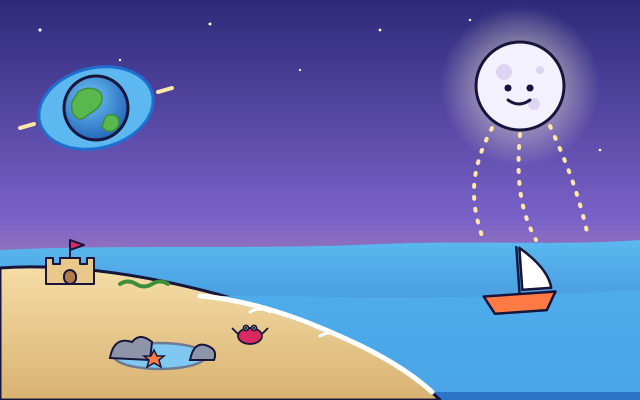
The interactive parts didn't load. The explanations below still work; try reloading the page.
The Moon, the Sun and the tides
- At most beaches the sea slowly rises up the sand and then goes back down, about twice a day. High tide and low tide. But why?
- The Moon's gravity pulls on everything on Earth. Water can flow, so the ocean on the side nearest the Moon heaps up into a bulge.
- Surprise: there is a second bulge on the far side! The Moon pulls the near water most, Earth's middle less, and the far water least, so the oceans stretch out both ways.
- Earth spins once a day, carrying each beach through both bulges. In a bulge it is high tide. Between them it is low tide. That's two high tides a day.
- The Sun pulls on the oceans too, about half as strongly as the Moon. When the Sun, Moon and Earth line up, at new moon and full moon, the bulges add up: spring tides, the biggest tides.
- At half moon, the Sun and Moon pull at right angles. The Sun's bulge partly fills in the Moon's low spots, so the tides are small. These are neap tides.
What makes a tide
On the left is the Earth from far above the North Pole. On the right is a beach. Tap each part.
- Moon. The Moon is our closest neighbor in space. Its gravity is the main cause of the tides.
- Sun. The Sun is huge, but very far away, so its effect on the tides is only about half of the Moon's.
- Near-side bulge. The ocean nearest the Moon is pulled the most, so it heaps up into a bulge. Beaches under it have high tide.
- Far-side bulge. On the far side the water is pulled the least, so it gets left behind a little. That makes a second bulge and a second high tide.
- Earth's spin. Earth spins once a day, so every beach travels through both bulges and both low spots. That's why tides come and go.
- High tide line. At high tide the sea reaches far up the beach. It leaves a line of seaweed and shells to show how high it came.
- Low tide. At low tide the sea pulls back, uncovering wet sand, rocks and seaweed. You can explore places that were underwater!
- Tide pool. Tide pools are puddles left in the rocks at low tide. Crabs, snails, starfish and anemones live there, waiting for the sea to come back.
Ocean model: Moon, Sun and bulges
Drag the Moon and the Sun, or pick a Moon phase. Spin the Earth and watch the beach. When are the tides biggest and smallest?
Experiment: When are the tides biggest?
- Pick New moon. Look at the tide size.
- Pick First quarter. Compare.
- Try Full moon. What do new moon and full moon have in common?
What we found: The tides are biggest when the Sun, Moon and Earth line up, at new moon and full moon. Then the Sun's bulges add to the Moon's: spring tides. At a right angle, at half moon, they partly cancel: small neap tides.
Turn on JavaScript to try it yourself.
Tide-pool trip
Your class wants to explore the tide pools at the lowest possible low tide. Choose the Moon's position and the time, then press Go to the beach!
How the Moon and Sun make tides
Gravity is a pull that every object has on every other object. The Moon's gravity pulls on the whole Earth, but it pulls hardest on the side nearest to it and least on the side farthest away, because gravity gets weaker with distance.
Water can flow, so the oceans respond. On the side facing the Moon, the water is pulled toward the Moon and bulges out. On the far side, the water is pulled less than the rest of Earth, so it is left behind in a second bulge. In between, the water is lower.
Earth spins once a day, so a beach moves through both bulges and both low places. When it is under a bulge, it is high tide. When it is between them, it is low tide. Because the Moon also moves along its orbit, high tides come about 50 minutes later each day.
The Sun makes tides too, about half as big as the Moon's. When the Sun and Moon line up, at new and full moon, we get big spring tides. When they are at right angles, at half moon, we get small neap tides. The shapes of coasts and bays make tides bigger or smaller in different places.
Key words
- High tide
- When the sea reaches its highest level on the shore.
- Low tide
- When the sea reaches its lowest level on the shore.
- Tidal range
- The difference in height between high tide and low tide.
- Spring tide
- An extra big tide at new moon and full moon.
- Neap tide
- A small tide at half moon.
- Tidal force
- The stretching effect from the Moon pulling harder on one side of Earth than the other.
Check your thinking
-
What is the main cause of ocean tides?
Show the answer
The Moon's gravity. The Moon's gravity stretches the oceans into bulges.
-
Why do most beaches get two high tides a day?
Show the answer
Earth spins through two bulges, one on each side. There is a bulge facing the Moon and one on the far side. Earth turns through both every day.
-
When do spring tides happen?
Show the answer
At new moon and full moon. At new and full moon the Sun and Moon line up and their pulls add together.
-
Why is there a bulge on the far side of Earth from the Moon?
Show the answer
The far water is pulled least, so it gets left behind. The Moon pulls Earth's middle more than the far water, so the far water lags behind as a bulge.
-
If the Moon were twice as far away, how would its tidal effect change?
Show the answer
It would be about one eighth as strong. Tidal force falls off with distance cubed: (1/2)³ = 1/8.
-
What can you find in a tide pool at low tide?
Show the answer
Crabs and starfish. Little sea animals live in pools left behind when the tide goes out.
You're a Earth & weather expert!
You watched, looked inside, tried it, solved the challenge and went deeper. Pick another question below, or switch the age at the top to see this topic another way.
More about earth & weather
 #446
Earth & weather
How do snowflakes form?
Grow virtual ice crystals under different conditions and compare their branching patterns.
#446
Earth & weather
How do snowflakes form?
Grow virtual ice crystals under different conditions and compare their branching patterns.
 #447
Earth & weather
How do hailstones grow?
Follow an ice particle through a storm and watch additional layers accumulate.
#447
Earth & weather
How do hailstones grow?
Follow an ice particle through a storm and watch additional layers accumulate.
 #448
Earth & weather
How does fog form near the ground?
Change air temperature and moisture and watch tiny droplets appear.
#448
Earth & weather
How does fog form near the ground?
Change air temperature and moisture and watch tiny droplets appear.
 #449
Earth & weather
How does dew appear on grass?
Cool a model surface and follow water vapor condensing into droplets.
#449
Earth & weather
How does dew appear on grass?
Cool a model surface and follow water vapor condensing into droplets.
Keep exploring
Games to play next
- Seasons and SkiesFrom days of the week to Earth's tilt: dress for the weather, read the sky and discover why seasons happen.
- Globe ExplorerSpin a real 3D globe, flip to the flat map, and find continents, oceans and countries.
- Weather LabPredict the weather in a box, then run a fair test to find out why.
Guide for grown-ups
- How to start homeschooling: a step-by-step guide for familiesA guide for parents · 7 min read
Science games by grade
Science worksheets by grade
- Preschool Science Worksheets
- Pre-K Science Worksheets
- Kindergarten Science Worksheets
- 1st Grade Science Worksheets
- 2nd Grade Science Worksheets
- 3rd Grade Science Worksheets
- 4th Grade Science Worksheets
- 5th Grade Science Worksheets
- 6th Grade Science Worksheets
- 7th Grade Science Worksheets
- 8th Grade Science Worksheets