How do ventilation systems replace stale air?
Guide stale air out and fresh air in through fans, a filter and a clever box that saves the heat.
The big idea: People, cooking and showers make indoor air stale and damp. A ventilation system uses one fan to push that air out and another to bring filtered fresh air in, and it passes the heat from one to the other.
It's like breathing through a scarf on a cold day. The scarf catches the warmth of the air you breathe out and gives it to the cold air you breathe in.
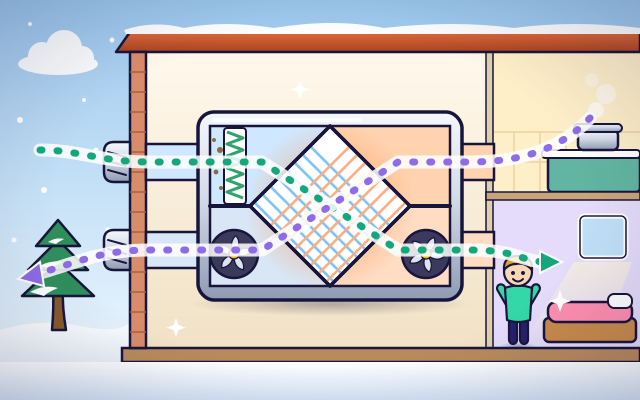
The interactive parts didn't load. The explanations below still work; try reloading the page.
Old air out, fresh air in
- In a closed room, every breath uses a little oxygen and adds carbon dioxide and moisture. After a while the air feels stuffy and people get sleepy.
- Opening a window lets fresh air in and stale air out. In winter it also lets the heat out, so the room turns cold and the heater has to work hard.
- A ventilation system does the job gently, all day. One fan pulls stale air from the kitchen and blows it outside. A second fan brings the same amount of fresh air to the bedrooms.
- Before the fresh air goes any farther it passes through a filter: a folded sheet of fine fibers that traps dust, pollen and insects.
- Inside the box the two airstreams pass through a stack of thin plates. They never touch or mix, but heat flows through the plates from the warm outgoing air into the cold incoming air.
- The fresh air arrives clean and already warmed, and the stale air leaves with most of its heat taken back. The house breathes all day without getting cold.
Look inside a heat-recovery ventilator
Tap each part of the box. Follow the fresh air and the stale air as they cross.
- Fresh air intake. This duct comes from a hood on the outside wall. Cold, fresh outdoor air is pulled in through it.
- Filter. The folded filter traps dust, pollen and bugs before the air reaches the rest of the box. It needs cleaning or changing a few times a year.
- Heat exchanger core. A stack of thin plates. Stale air flows through every other gap and fresh air through the gaps between. Heat crosses the plates, but the air never mixes.
- Supply fan. This fan pulls fresh air through the filter and the core, then pushes it along ducts to the bedrooms and living room.
- Stale air duct. This duct brings warm, damp, stale air from the kitchen and bathroom, where most steam and smells are made.
- Exhaust fan. This fan pulls the stale air through the core, where it gives up its heat, and then blows it outside.
- Exhaust outlet. The stale air leaves through this duct to a hood outside. It has already given most of its heat to the fresh air.
Guide the air through the box
Tap the fans to switch them on. Then tap the filter and the heat-exchanger core to take them out and put them back. What changes?
Experiment: It is freezing outside and the fans are on. What does the heat-exchanger core do to the fresh air?
- Tap both fans. Watch the purple stale air and the green fresh air.
- Look at the color of the duct that carries fresh air to the bedroom.
- Tap the core to pull it out. Look at that duct again, and at Ada.
What we found: With the core in place, the fresh air arrived warm, because heat crossed the thin plates from the outgoing air. With the core out, the fresh air came in icy cold. The two airstreams never mixed.
Turn on JavaScript to try it yourself.
Connect the ducts
Four ducts need connecting. Tap a duct end, then tap a port on the box. Fresh air must reach the bedroom and kitchen air must go outside. Then switch on.
Why homes need to breathe
Every time you breathe out, you add a little carbon dioxide and water to the air. Cooking, showers, wet laundry, paint and furniture add steam, smells and dust. In a home that is sealed up tight to save heat, all of that stays inside.
Ventilation means swapping indoor air for outdoor air. The simplest way is to open a window, and on a mild day that works well. In winter, though, an open window throws away the heat you paid for.
A heat-recovery ventilator solves this with two fans and a heat exchanger. One fan sends stale air out, the other brings fresh air in, and the two streams pass each other inside a stack of thin plates. Heat always flows from warm things to cold things, so it crosses the plates into the cold fresh air. The air itself stays on its own side, so smells do not come back in.
The scarf comparison is not perfect. With a scarf, your breath goes in and out through the same cloth, one after the other. In the ventilator both streams flow at once, side by side, which is why it needs two fans and two sets of ducts.
Key words
- Ventilation
- Replacing indoor air with outdoor air.
- Stale air
- Indoor air that has collected breath, steam, smells and dust.
- Heat exchanger
- A part that passes heat from one stream of air to another without mixing them.
- Carbon dioxide
- A gas that people and animals breathe out. A high level indoors shows that the air needs changing.
- Duct
- A tube or channel that carries air around a building.
- Efficiency
- How much of the heat the box manages to save.
Check your thinking
-
Why does a ventilation system have two fans?
Show the answer
One sends stale air out and one brings fresh air in. Air that leaves has to be replaced, so one fan handles each direction.
-
What is the filter for?
Show the answer
Trapping dust and pollen in the fresh air. Its fine fibers trap particles so the air that reaches the rooms is clean.
-
In the heat exchanger, what passes from the stale air to the fresh air?
Show the answer
Only heat. The plates let heat through but keep the two airstreams apart.
-
It is winter. What happens if you take the core out but leave the fans on?
Show the answer
The fresh air comes in cold and the room cools down. Without the core there is nothing to pass the heat across, so the outdoor air arrives as cold as it started.
-
Four people share a room. Which airflow keeps carbon dioxide near 920 ppm (outdoors is 420 ppm)?
Show the answer
About 40 L/s. 420 + 4 × 5,000 ÷ 40 = 920 ppm. Less airflow leaves much more carbon dioxide in the room.
-
Why are the stale-air ducts usually in the kitchen and bathroom?
Show the answer
That is where most steam and smells are made. Taking air out where it is dampest and smelliest stops it from spreading, and draws fresh air through the rest of the home.
You're a Home systems expert!
You watched, looked inside, tried it, solved the challenge and went deeper. Pick another question below, or switch the age at the top to see this topic another way.
More about home systems
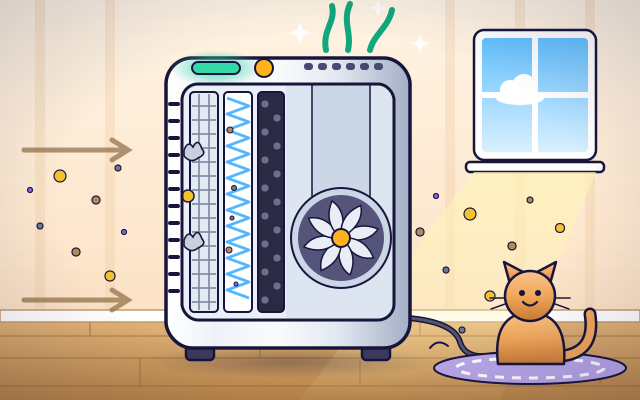 #188
Home systems
How do air purifiers remove particles?
Follow air through filters and compare capture of differently sized particles.
#188
Home systems
How do air purifiers remove particles?
Follow air through filters and compare capture of differently sized particles.
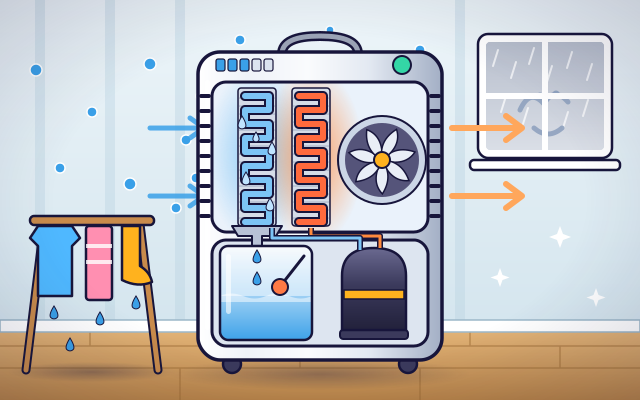 #189
Home systems
How does a dehumidifier remove moisture?
Watch water condense as moist air passes over a cold coil.
#189
Home systems
How does a dehumidifier remove moisture?
Watch water condense as moist air passes over a cold coil.
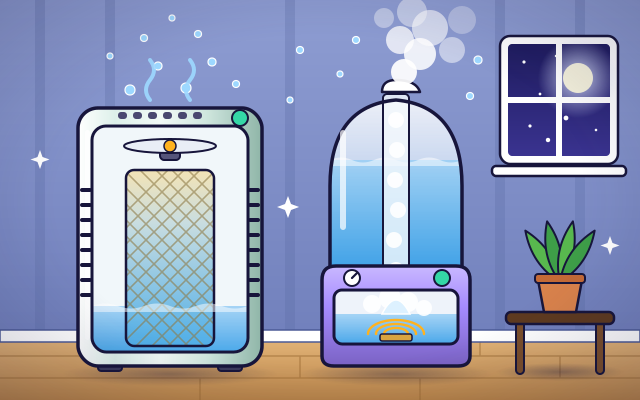 #190
Home systems
How does a humidifier add moisture?
Compare evaporative and ultrasonic designs and follow water into the surrounding air.
#190
Home systems
How does a humidifier add moisture?
Compare evaporative and ultrasonic designs and follow water into the surrounding air.
 #191
Home systems
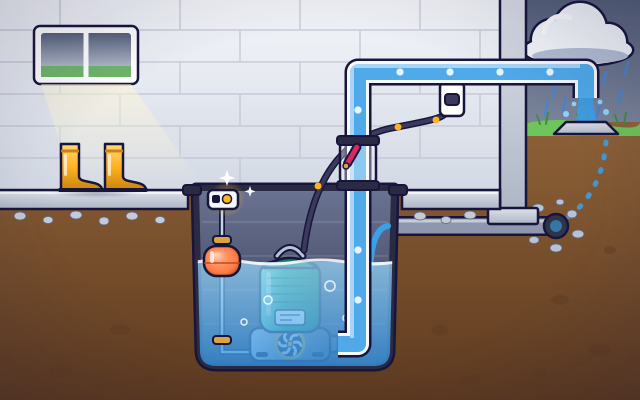
How does a sump pump keep a basement dry?
Raise water in a model sump and watch a float activate the pump.
#191
Home systems
How does a sump pump keep a basement dry?
Raise water in a model sump and watch a float activate the pump.
Keep exploring
Games to play next
- Machine RepairFix levers, pulleys, gears and ramps so every contraption works.
- Circuit Workshop 3DWire up batteries, bulbs and switches on a 3D workbench.
- Weather LabPredict the weather in a box, then run a fair test to find out why.
Guide for grown-ups
- How to start homeschooling: a step-by-step guide for familiesA guide for parents · 7 min read
Science games by grade
Science worksheets by grade
- Preschool Science Worksheets
- Pre-K Science Worksheets
- Kindergarten Science Worksheets
- 1st Grade Science Worksheets
- 2nd Grade Science Worksheets
- 3rd Grade Science Worksheets
- 4th Grade Science Worksheets
- 5th Grade Science Worksheets
- 6th Grade Science Worksheets
- 7th Grade Science Worksheets
- 8th Grade Science Worksheets