How does a water heater supply hot water?
Follow cold water into a heater and out to the tap, and compare a big storage tank with a small tankless box.
The big idea: A tank heater warms a big store of water and keeps it ready. A tankless heater warms water only while it flows past. One can run out; the other can only do so much at once.
It's like a thermos and a kettle. A tank is a giant thermos, always full of hot water; a tankless heater is a kettle that heats water just when you need it.
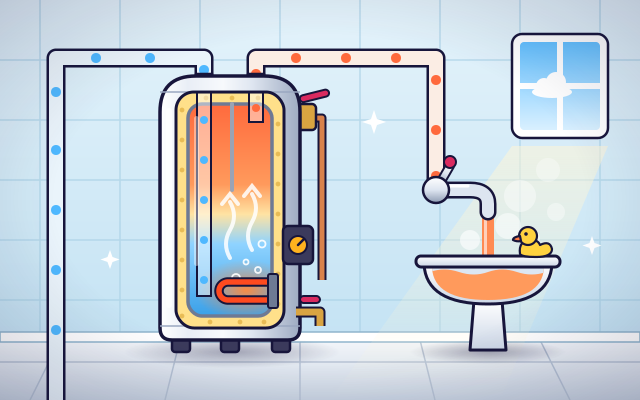
The interactive parts didn't load. The explanations below still work; try reloading the page.
From cold pipe to warm tap
- Turn the hot tap and warm water arrives in seconds. Yet water enters every home cold, through a pipe under the street. Something in the house heats it.
- Most homes have a tall storage tank. Cold water enters at the top but runs down a long pipe, called a dip tube, so it arrives at the very bottom.
- A heating element, or a gas burner, warms the water at the bottom. Warm water is lighter than cold water, so it rises and the hottest water gathers at the top.
- Open a tap and hot water leaves through a pipe at the top. At the same moment cold water flows in at the bottom. The tank always stays full.
- Use hot water faster than the heater can make it and the hot layer shrinks. When it is gone, the tap runs cold and the tank needs time to recover.
- A tankless heater stores nothing. When a tap opens, a strong burner switches on and heats the water as it races through a coiled pipe. It never runs out, but it can only heat so much at once.
Look inside a tank water heater
Tap each part of the tank. Watch what it does when you find it.
- Cold inlet and dip tube. Cold water comes in at the top, then runs down this long tube so it lands at the bottom of the tank, right beside the heater.
- Heating element. Electricity makes this metal loop hot, like the loop in a kettle. It sits low in the tank, where the coldest water is. Gas heaters use a flame under the tank instead.
- Thermostat. The thermostat senses how hot the water is. It switches the heater on when the water cools and off when it is hot enough, so the tank never overheats.
- Insulation jacket. Between the inner tank and the outer shell is a thick layer of foam. It works like a winter coat, slowing the heat that tries to leak out.
- Hot outlet. This short pipe takes water from the very top of the tank, where the hottest water gathers, and sends it to the taps.
- Safety relief valve. Heated water takes up more room and pushes on the tank. If the push or the heat ever gets too high, this valve opens by itself and lets a little water out safely.
- Drain valve. Bits of mineral from the water settle at the bottom over the years. A plumber opens this valve to flush them out.
Tank against tankless
Tap the faucets to open one, two or three at once. Watch the hot layer in the tank and the temperature from the tankless heater.
Experiment: Three taps run at once for a long time. What happens at each heater?
- Tap one faucet. Watch both heaters for a few seconds.
- Open all three faucets. Watch the red layer in the tank.
- Look at the water coming out of the tankless heater. Is it still hot?
What we found: The tank gave lots of hot water at once, but its hot layer was used up and the taps ran cold. The tankless heater never ran out, yet with three taps open the water raced through too fast to get properly hot.
Turn on JavaScript to try it yourself.
The right heater for each home
Two homes need hot water in different ways. Pick a tank or a tankless heater for each one, then run the morning. Everyone must get warm water.
How homes get hot water
Water comes into your home cold. To make it warm, a heater has to give it energy, and water needs a lot of energy to warm up. That is why a kettle takes minutes, not seconds, to boil.
A tank heater solves this by starting early. It heats a big store of water slowly and keeps it hot inside a thick coat of insulation. When you open a tap, hot water leaves the top of the tank and cold water flows into the bottom through the dip tube. Hot water is lighter than cold, so the two stay in layers, hot above cold, like oil floating on water.
If lots of people shower in a row, the hot layer gets used up faster than the heater can replace it. Then the water runs cold and everyone has to wait.
A tankless heater has no store at all. A sensor notices water starting to flow, and a very strong burner or element heats the water in the few seconds it spends inside a coiled pipe. It can keep going all day. But if too many taps open together, the water rushes through too quickly to get hot. Here the thermos and kettle comparison breaks down a little: a real tank refills itself with cold water the moment you pour.
Key words
- Dip tube
- A long tube that carries incoming cold water to the bottom of the tank.
- Thermostat
- A switch that senses temperature and turns the heater on or off.
- Stratification
- Hot water floating in a layer on top of cold water.
- Heat exchanger
- A part that lets heat pass from a flame or element into water without the two touching.
- Specific heat capacity
- How much energy it takes to warm something up. Water needs a lot.
- Standby loss
- Heat that leaks out of stored hot water while nobody is using it.
Check your thinking
-
Where is the hottest water in a tank heater?
Show the answer
At the top, because warm water rises. Warm water is lighter than cold water, so it floats up and gathers at the top.
-
Why can a tank heater run out of hot water?
Show the answer
People can use the hot water faster than the heater makes it. The tank stays full of water, but the hot part is used up and the heater warms the new cold water only slowly.
-
What happens if you open too many taps on a tankless heater?
Show the answer
The water comes out lukewarm. The water rushes through too fast for the burner to heat it fully.
-
What does the dip tube do?
Show the answer
It sends cold water to the bottom so it does not mix with the hot water. Keeping the cold water low leaves the hot layer at the top ready to use.
-
Which home is the best match for a tankless heater?
Show the answer
Six people who shower one after another. A tankless heater never runs out, so a long line of showers is easy. Its limit is how much it can heat at one moment.
-
Why does a storage tank waste some energy even when nobody uses hot water?
Show the answer
Heat slowly leaks through the insulation, so the heater must top it up. This standby loss is the cost of keeping a store of hot water ready all day.
You're a Home systems expert!
You watched, looked inside, tried it, solved the challenge and went deeper. Pick another question below, or switch the age at the top to see this topic another way.
More about home systems
 #187
Home systems
How do ventilation systems replace stale air?
Guide fresh and outgoing air through fans, filters, and a heat-recovery system.
#187
Home systems
How do ventilation systems replace stale air?
Guide fresh and outgoing air through fans, filters, and a heat-recovery system.
 #188
Home systems
How do air purifiers remove particles?
Follow air through filters and compare capture of differently sized particles.
#188
Home systems
How do air purifiers remove particles?
Follow air through filters and compare capture of differently sized particles.
 #189
Home systems
How does a dehumidifier remove moisture?
Watch water condense as moist air passes over a cold coil.
#189
Home systems
How does a dehumidifier remove moisture?
Watch water condense as moist air passes over a cold coil.
 #190
Home systems
How does a humidifier add moisture?
Compare evaporative and ultrasonic designs and follow water into the surrounding air.
#190
Home systems
How does a humidifier add moisture?
Compare evaporative and ultrasonic designs and follow water into the surrounding air.
Keep exploring
Games to play next
- Machine RepairFix levers, pulleys, gears and ramps so every contraption works.
- Circuit Workshop 3DWire up batteries, bulbs and switches on a 3D workbench.
- Weather LabPredict the weather in a box, then run a fair test to find out why.
Guide for grown-ups
- How to start homeschooling: a step-by-step guide for familiesA guide for parents · 7 min read
Science games by grade
Science worksheets by grade
- Preschool Science Worksheets
- Pre-K Science Worksheets
- Kindergarten Science Worksheets
- 1st Grade Science Worksheets
- 2nd Grade Science Worksheets
- 3rd Grade Science Worksheets
- 4th Grade Science Worksheets
- 5th Grade Science Worksheets
- 6th Grade Science Worksheets
- 7th Grade Science Worksheets
- 8th Grade Science Worksheets