
Animal
Emperor scorpion
The emperor scorpion is a big, shiny black scorpion from Africa. It has two huge claws and a curly tail. Mother scorpions carry their babies on their backs!
The emperor scorpion is one of the biggest scorpions in the world, up to about 20 centimeters long. It lives in the warm, humid forests of West Africa, where it digs burrows and hunts insects such as termites at night. Mothers give birth to live young and carry them on their backs. Like other scorpions, it glows blue-green under ultraviolet light.
Pandinus imperator (Scorpionidae) is a large, subsocial forest scorpion of West Africa that reaches about 20 centimeters. It subdues prey mainly with its powerful pedipalps, gives birth to live young after a long gestation and shows extended maternal care. Its venom is mild; heavy collection for the pet trade led to its listing on CITES Appendix II, though it has no IUCN assessment.
Photo: "Mike" Michael L. Baird, CC BY 2.0, via Wikimedia Commons
Meet the emperor scorpion
The emperor scorpion is a big, shiny black scorpion.
It has two giant claws at the front and a long tail that curls up over its back. It is shy and likes to hide in its burrow.
The emperor scorpion is one of the largest scorpions in the world. Big adults can be about 20 centimeters long, about as long as a pencil, and weigh up to about 30 grams.
It is shiny black, with two enormous pincers called pedipalps and a long tail that ends in a reddish-brown stinger. Despite looking fierce, emperor scorpions are fairly timid. When something bothers them, they usually run away rather than fight.
Pandinus imperator belongs to the Scorpionidae. The Scorpion Files, maintained by NTNU's university library, gives lengths up to 20 centimeters and weights up to 30 grams, with pregnant females exceeding 50 grams. The body is black, with very powerful, granular pedipalps and cauda and a reddish-brown telson in adults.
The Animal Diversity Web describes the species as rather timid by nature: threatened individuals usually flee, and only when cornered do they adopt a defensive posture with the stinger raised. The Scorpion Files reports subsociality, with mothers and offspring or siblings living together (Mahsberg 1990).
Quick facts
- Group
- Invertebrate
- Length
- up to 20 cm
- Weight
- up to 30 g
- Lifespan in the wild
- 5 to 8 years
Where it lives
Emperor scorpions live in warm, wet forests in Africa.
They dig burrows in the ground. They hide under leaves and logs in the daytime.
Emperor scorpions live in the hot, humid forests and rainforests of West Africa, in countries such as Côte d'Ivoire, Ghana, Togo, Nigeria, Guinea and Sierra Leone. They are also reported from the Democratic Republic of the Congo.
They live in burrows, either empty ones they find or ones they dig themselves, up to about 30 centimeters long. They also shelter under fallen leaves and forest debris, along stream banks and in termite mounds.
The Scorpion Files lists Côte d'Ivoire, Ghana, Guinea, Guinea-Bissau, Nigeria, Togo and the Democratic Republic of the Congo, noting the species is probably present in other countries of the region; the Animal Diversity Web adds Sierra Leone and names the forests of Nigeria, Togo, Sierra Leone, Ghana and "the Congo region". GBIF also holds records from Liberia and Benin, which are not shaded here because these sources do not name them.
Habitat is tropical forest and rainforest with high humidity. Burrows, empty or self-dug, reach about 30 centimeters (Scorpion Files); the Animal Diversity Web adds leaf litter, forest debris, stream banks and termite mounds.
Continent
Did you know?
Baby emperor scorpions ride on their mother's back.
Emperor scorpion babies are born alive and ride on their mother's back until they can take care of themselves.
Newborns are carried on the mother's back and depend on her for food and protection.
Where can you find this animal?
- Lives here naturally · Countries and seas named by a scientific source
- Sightings recorded · Records of wild sightings (GBIF)
Lives here naturally · Countries and seas named by a scientific source
Hot, humid forests and rainforests of West Africa (Côte d'Ivoire, Ghana, Guinea, Guinea-Bissau, Sierra Leone, Togo, Nigeria), with reports from the Democratic Republic of the Congo. It probably lives in other countries of the region too (records from Liberia and Benin are not shaded). It lives only in suitable forest within each country shown.
Places: Côte d'Ivoire, Ghana, Guinea, Guinea-Bissau, Nigeria, Togo, Sierra Leone and DR Congo.
Source: https://www.ntnu.no/ub/scorpion-files/p_imperator.htm · checked October 2026
Sightings recorded · Records of wild sightings (GBIF)
Counts of GBIF records of wild observations (human and machine) and preserved specimens. Records include introduced populations, vagrants, escaped or released animals and misidentifications, so a country with records is not necessarily part of the native range.
Wild sightings have been recorded in Côte d'Ivoire, Ghana, Nigeria, Togo, Liberia, Guinea, Sierra Leone, Benin and 11 more places.
Source: gbif · checked October 2026
Range maps show where scientists say an animal lives, often country by country. An animal may live in only part of a country shown, and sightings records can include animals that wandered far from home.
What it eats
Emperor scorpions eat insects, like termites.
They hunt at night. They grab their food with their big claws.
Emperor scorpions come out at night to hunt. They mostly eat insects and other small creatures without backbones, especially termites, and now and then a small animal with a backbone.
Grown-up emperor scorpions usually do not use their stingers to catch food. Instead, they hold and tear their prey with their powerful claws. Young scorpions, whose claws are still small, use their stingers more.
The diet is insects and other arthropods, commonly termites, with occasional small vertebrates. Adults generally subdue and tear prey with their pedipalps rather than stinging, while juveniles depend more on the stinger (Animal Diversity Web, citing Casper 1985).
Emperor scorpions are in turn eaten by birds, bats, mammals and spiders.
Did you know?
Scorpions glow blue-green under a special purple light.
Like other scorpions, the emperor scorpion glows a bright blue-green under ultraviolet light.
Scorpions, including P. imperator, fluoresce blue-green under ultraviolet light.
Claws, tail and a glowing coat
An emperor scorpion has eight legs and two big claws.
Its tail has a stinger at the end. Shine a special purple light on it, and it glows blue-green!
Like other scorpions, the emperor scorpion has eight walking legs, two large pincers at the front and a tail made of segments ending in a stinger. Its eyesight is very poor, so it finds its way with sensitive body hairs and with special comb-like parts under its body, called pectines, that feel the ground.
Scorpions have a surprise: under ultraviolet light, which people sometimes call black light, they glow a bright blue-green.
The body comprises the prosoma, a broad mesosoma and the segmented metasoma (tail) ending in the telson and sting. Eyesight is poor; tactile hairs and the pectines, comb-like ventral sense organs that are larger in males, detect terrain and prey (Animal Diversity Web). Like other scorpions, it fluoresces blue-green under ultraviolet light.
The venom is mild. The Scorpion Files describes the sting as painful but harmless for healthy humans, and warns that the strong pedipalps can give very painful pinches; it rarely stings, though young animals and mothers with young are more prone to.
Babies on board
Mother emperor scorpions do not lay eggs. The babies are born alive!
The babies climb onto their mother's back and ride there. As they grow, they shed their skin many times.
Emperor scorpions give birth to live young after a pregnancy of about 9 months, usually 10 to 12 babies at a time. The tiny, soft babies climb onto their mother's back, where she carries and protects them until they can look after themselves.
Young scorpions look like small adults. They grow by molting, shedding their hard outer skin several times. They are grown up at about 4 years old, and in captivity emperor scorpions live about 5 to 8 years.
P. imperator is viviparous. The Animal Diversity Web gives an average gestation of about 9 months and litters of 10 to 12, with breeding year-round and sexual maturity at about 4 years. Courtship involves the male grasping the female's pedipalps; newborns are carried on the mother's back and depend on her for food and protection, and females are more defensive after giving birth.
Juveniles resemble adults at every instar and pass through several molts. Captive animals live 5 to 8 years; wild life spans are likely shorter. The Scorpion Files notes that mothers and young can stay together as a family (subsociality).
Shy night walkers
Emperor scorpions sleep in the day and come out at night.
Sometimes several live close together, like a family.
Emperor scorpions are nocturnal: they rarely come out before dark. During the day they stay in their burrows or under leaves and logs.
Unlike many scorpions, emperor scorpions can be social. Scientists have seen groups of up to 15 living together, and mothers and their young may share a home.
The species is nocturnal and rarely active before nightfall. It is social, with colonies of up to 15 individuals observed, and cannibalism is rare (Animal Diversity Web). Its walking gait is unusual, extending the femur-patella and patella-tibia joints at the same time.
Did you know?
Grown-up emperor scorpions use their claws, not their stingers, to catch food.
Adult emperor scorpions usually catch food with their big claws; young ones use their stingers more.
Adults generally tear prey with the pedipalps, while juveniles rely on the sting (Casper 1985, via the Animal Diversity Web).
Protected from over-collecting
Many emperor scorpions were taken from the wild to be pets.
Now there are rules to make sure not too many are taken.
Emperor scorpions are popular pets, and many have been collected from the wild in West Africa, especially from Ghana and Togo. To stop people taking too many, the emperor scorpion is protected by an international agreement called CITES, which controls how many can be sold between countries.
Scientists have not yet given it an IUCN conservation status. Pets bred by people, rather than taken from the wild, help protect wild scorpions.
Pandinus imperator has not been assessed for the IUCN Red List (Not Evaluated). It is listed on CITES Appendix II, along with two other Pandinus species, to prevent over-collection; the Scorpion Files cites an IUCN/SSC Trade Programme estimate of about 100,000 animals exported from West Africa in 1995 and 1996, and the Animal Diversity Web notes many are imported from Ghana and Togo.
It breeds readily in captivity. Its venom is also studied: a peptide named scorpine, isolated from it, appears to have antimalarial and antibacterial properties (Animal Diversity Web).
Amazing facts
-
Scorpions glow blue-green under a special purple light.
Like other scorpions, the emperor scorpion glows a bright blue-green under ultraviolet light.
Scorpions, including P. imperator, fluoresce blue-green under ultraviolet light.
-
Baby emperor scorpions ride on their mother's back.
Emperor scorpion babies are born alive and ride on their mother's back until they can take care of themselves.
Newborns are carried on the mother's back and depend on her for food and protection.
-
Grown-up emperor scorpions use their claws, not their stingers, to catch food.
Adult emperor scorpions usually catch food with their big claws; young ones use their stingers more.
Adults generally tear prey with the pedipalps, while juveniles rely on the sting (Casper 1985, via the Animal Diversity Web).
Words to know
- pedipalps
- the two big claws at the front of a scorpion
- telson
- the last part of a scorpion's tail, which holds the stinger
- nocturnal
- active at night
- molt
- to shed an old hard outer skin so the body can grow
- ultraviolet light
- a kind of light people cannot see, which makes some things glow
- CITES
- an agreement between countries that controls trade in wild animals and plants
Discovery challenge
-
Where do baby emperor scorpions ride?
Where does a mother emperor scorpion carry her newborn babies?
How do P. imperator mothers care for their newborn young?
- On her back
- In a nest of leaves
- In her claws
Show the answer
On her back
They ride on their mother's back.
The babies climb onto her back and ride there until they can look after themselves.
Newborns are carried on the mother's back and depend on her for food and protection.
-
What does a grown-up emperor scorpion use to catch food?
What do adult emperor scorpions mostly use to catch their prey?
How do adult P. imperator usually subdue prey?
- Its big claws
- A sticky web
- Its long tongue
Show the answer
Its big claws
It grabs food with its big claws.
Adults hold and tear prey with their powerful claws; young scorpions use their stingers more.
With the pedipalps; juveniles depend more on the sting.
-
What color do scorpions glow under a special light?
What happens when you shine ultraviolet light on an emperor scorpion?
How do scorpions respond optically to ultraviolet light?
- They glow blue-green
- They turn invisible
- Nothing happens
Show the answer
They glow blue-green
They glow a bright blue-green!
They glow a bright blue-green, like other scorpions.
They fluoresce blue-green.
-
When do emperor scorpions come out?
When are emperor scorpions most active?
What is the emperor scorpion's activity pattern?
- At night
- Only at noon
- Only in snow
Show the answer
At night
They come out at night.
They are nocturnal and rarely come out before dark.
Nocturnal; rarely active before nightfall.
Places where you might see it
-
 Watch
 Country
Ghana
Ghana is a country in West Africa on the Gulf of Guinea. It has a coast of sandy bays, a belt of rainforest and wide northern savannas, and one of the world's largest artificial lakes, Lake Volta. In 1957 it became independent, and its capital is Accra.
-
 Watch
 Country
Togo
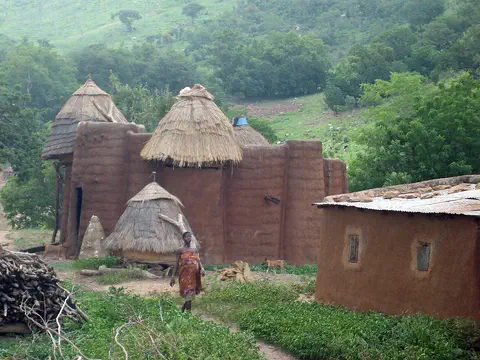
Togo is a small, narrow country in West Africa. It has only 51 kilometers of coast on the Gulf of Guinea but stretches about 515 kilometers inland, from beaches and lagoons to the Togo Mountains and northern savanna. About 8.6 million people lived there in 2025, and Lomé is the capital and main port.
-
 Watch
 Country
Nigeria
Nigeria is a large country in West Africa, named after the Niger River. It has rainforests in the south and dry grasslands in the north, and it is Africa's most populous country, with about 238 million people in 2025 who speak hundreds of languages.
Explore next
-
 Watch
Animal
Giant African millipede
The giant African millipede is one of the largest millipedes in the world, usually 16 to 28 centimeters long. It lives in the lowlands of East Africa, from Kenya to Mozambique, where it eats dead plants and helps turn them back into soil. Like all millipedes, it has two pairs of legs on most body rings and adds rings and legs as it grows.
-
 Watch
Animal
Goliath birdeater
The Goliath birdeater is a giant tarantula from the rainforests of northern South America. With legs spreading about 28 centimeters and a weight of up to about 170 grams, it is described as the heaviest spider in the world. Despite its name, it eats mostly worms and insects, not birds.
-
Watch
Country
Ghana
Ghana is a country in West Africa on the Gulf of Guinea. It has a coast of sandy bays, a belt of rainforest and wide northern savannas, and one of the world's largest artificial lakes, Lake Volta. In 1957 it became independent, and its capital is Accra.
-
Watch
Country
Togo
Togo is a small, narrow country in West Africa. It has only 51 kilometers of coast on the Gulf of Guinea but stretches about 515 kilometers inland, from beaches and lagoons to the Togo Mountains and northern savanna. About 8.6 million people lived there in 2025, and Lomé is the capital and main port.
-
Watch
Country
Nigeria
Nigeria is a large country in West Africa, named after the Niger River. It has rainforests in the south and dry grasslands in the north, and it is Africa's most populous country, with about 238 million people in 2025 who speak hundreds of languages.
-
 Watch
Animal
Mexican red-knee tarantula
The Mexican red-knee tarantula is a large, calm spider with black legs and bright orange-red patches at its leg joints. It lives only in a small part of western Mexico, where it hides in burrows by day and waits at the entrance for food at night. Because so many were taken for the pet trade and its forest is shrinking, it is listed as Vulnerable.
-
 Watch
Animal
American lobster
The American lobster is a big crustacean that lives on the rocky sea floor of the northwest Atlantic Ocean. It has two very different claws, one for crushing and one for tearing, and it must climb out of its hard shell again and again to grow.
-
 Watch
3D
Animal
Antarctic krill
Antarctic krill are small, shrimp-like crustaceans about 6 centimeters long that live in the icy Southern Ocean around Antarctica. They gather in enormous swarms, and almost all the bigger animals of the Antarctic, from penguins to blue whales, depend on them for food.
For parents & teachers
What children will learn
- Compare a scorpion's body with a spider's and an insect's.
- Describe how emperor scorpions care for their young.
- Explain why some animals are protected from being traded in large numbers.
- Understand that animals that look fierce, like this scorpion, are often shy.
Recommended ages: 3 to 17 · About 15 minutes
Talk about it
- Why might a scorpion with huge claws not need to use its stinger often?
- What are the good and bad sides of keeping wild animals as pets?
- Why might living in a family group help young scorpions?
Try at home or in class
- Measure 20 centimeters on a ruler and compare it with a pencil or your hand.
- Make a scorpion out of clay and label its claws, legs, tail and stinger.
Key vocabulary: pedipalps, telson, nocturnal, molt, ultraviolet light, CITES
Where these facts come from
- GBIF Backbone Taxonomy and GBIF Occurrence Search , Global Biodiversity Information Facility (CC0 1.0 (backbone); occurrence counts are facts derived from records under CC0, CC BY and CC BY-NC)
- Wikidata , Wikimedia Foundation (CC0 1.0)
- Pandinus imperator (Li and Parikh) , Animal Diversity Web, University of Michigan Museum of Zoology
- The Scorpion Files: Pandinus imperator (Jan Ove Rein) , NTNU University Library, Norwegian University of Science and Technology
- Wikimedia Commons , Wikimedia Foundation (Per file: Public domain, CC0, CC BY or CC BY-SA only (credited on each page))
Checked, not yet human-reviewed. Last updated October 27, 2026. Spotted a mistake? Tell us.