
Animal
Greenland shark
The Greenland shark is a big, slow shark that lives in very cold, deep water. Scientists think it can live for hundreds of years!
The Greenland shark is a huge, slow-moving shark of the cold North Atlantic and Arctic Ocean. It grows very slowly in the cold, and in 2016 scientists used the lenses of its eyes to estimate that it can live for at least 272 years, longer than any other animal with a backbone that we know of.
Somniosus microcephalus is a large sleeper shark of Arctic and boreal Atlantic waters, from the surface to at least 2,647 meters. Eye-lens radiocarbon dating (Nielsen and colleagues, Science, 2016) indicated a lifespan of at least 272 years and estimated the largest shark studied at 392 ± 120 years. Centuries of liver-oil fishing and ongoing bycatch led the IUCN to list it as Vulnerable in 2020.
Photo: NOAA Okeanos Explorer Program, public domain, via Wikimedia Commons
Meet the Greenland shark
The Greenland shark is big, gray and slow.
It lives in icy cold water near the Arctic. It has a short, round nose, tiny eyes and small fins. It might be the oldest animal with a backbone!
The Greenland shark is one of the biggest fish in the cold northern seas. Most adults are about 2.4 to 4.3 meters long, about as long as a car, and the largest reach about 6.4 meters. Females grow bigger than males.
It has a heavy, thick body, a short rounded snout, very small eyes and small fins, and its skin is gray, brown or black, sometimes with dark lines or white spots. Its scientific name means "sleepy small-head," because it moves so slowly.
Somniosus microcephalus belongs to the Somniosidae, the sleeper sharks, in the class Chondrichthyes. The Florida Museum describes a large, heavy-set body, short rounded snout, thin lips, very small eyes, small dorsal and pectoral fins without spines, and small gill openings set low on the head; typical adults are 244 to 427 centimeters long, with a maximum of about 640 centimeters (possibly 730), and females are the larger sex.
The genus name refers to sleep, describing its sluggish movement, and microcephalus means "small head." Its upper teeth are thin and smooth, while the lower teeth are broad, square and interlocking, 50 to 52 in number.
Quick facts
- Group
- Fish
- Length
- 2.44 to 4.27 m
- Lifespan in the wild
- from 272 years
Where it lives
Greenland sharks live in the cold North Atlantic and Arctic Ocean.
They swim near the icy surface or far down in the dark deep sea.
Greenland sharks live in the cold waters of the North Atlantic and the Arctic Ocean, from Canada and Greenland to Iceland, Norway and the Barents Sea off Russia. A few have been recorded farther south.
They can swim near the surface or go very deep: one was found more than 2,600 meters down. In Baffin Bay, between Canada and Greenland, they are mostly found 300 to 500 meters deep. In summer they tend to move into coastal waters and fjords, and in winter farther offshore.
The IUCN (assessed 2019, published 2020) gives a North Atlantic range from the USA and Canada to Greenland in the west and from Portugal to the Barents and East Siberian Seas in the east, though genetic work suggests the true range may be narrower (Canada, Greenland, Iceland, the Faroe Islands and Norway, with occasional records farther south). Western Atlantic records, including some from the Gulf of Mexico, show signs of hybridization with the Pacific sleeper shark.
It lives on continental and insular shelves and upper slopes, near the bottom and in mid-water, from the surface to at least 2,647 meters, mostly at 300 to 500 meters in Baffin Bay. It tends to move inshore in summer and offshore in winter. The Florida Museum reports water temperatures of about 1 to 12 °C.
Its habitats


Where can you find this animal?
- Lives here naturally · Countries and seas named by a scientific source
- Sightings recorded · Records of wild sightings (GBIF)
Lives here naturally · Countries and seas named by a scientific source
Cold waters of the North Atlantic and the Arctic Ocean: from the United States and Canada to Greenland in the west and from Portugal to the Barents and East Siberian Seas in the east, on shelves and slopes from the surface to more than 2,600 meters. Genetic studies suggest the core range is narrower (Canada, Greenland, Iceland, the Faroe Islands and Norway). Shading is by whole ocean, so it covers
Places: Arctic Ocean and Atlantic Ocean.
Source: iucn-red-list · checked October 2026
Sightings recorded · Records of wild sightings (GBIF)
Counts of GBIF records of wild observations (human and machine) and preserved specimens. Records include introduced populations, vagrants, escaped or released animals and misidentifications, so a country with records is not necessarily part of the native range.
Wild sightings have been recorded in Canada, UK, Greenland, Norway, Iceland, Sweden, Denmark, Russia and 15 more places.
Source: gbif · checked October 2026
Range maps show where scientists say an animal lives, often country by country. An animal may live in only part of a country shown, and sightings records can include animals that wandered far from home.
What it eats
Greenland sharks eat fish and other sea animals.
They also eat food that has sunk to the bottom. They are not fussy eaters!
Greenland sharks eat a huge variety of food. Fish are the most common: herring, capelin, char, cod and their relatives, redfish, flounders, skates, eels and even small sharks. They also catch seals and porpoises, even though they are known as slow, sluggish sharks.
They are also scavengers that eat dead animals they find, and they often gather around fishing boats.
The Florida Museum lists small sharks, skates, eels, herring, capelin, char, gadoids, redfish, sculpins, lumpfish, wolffish and flounders as common prey. Seals and porpoises are often taken despite the shark's sluggish reputation. A few specimens have contained the remains of land mammals, including a whole reindeer.
Greenland sharks also scavenge carrion, are attracted to strong-smelling meat and often congregate in large numbers around fishing operations.
Did you know?
Tiny animals often live on the Greenland shark's eyes.
Many Greenland sharks have a small copepod clinging to one eye, which can blur their vision, but the sharks do not rely on sharp eyesight.
The copepod Ommatokoita elongata commonly attaches to one cornea, causing lesions; the claim that it glows to attract prey has no scientific support.
A slow, cold-water body
The Greenland shark is built for cold water.
It swims very slowly. Its eyes are very small. Smelly food, like dead animals, draws it in.
Everything about the Greenland shark is slow. The Florida Museum explains that the cold water it lives in slows its growth.
Its eyes are tiny, and many Greenland sharks carry a small animal called a copepod attached to one eye. It can damage the eye and make it harder to see, but the shark does not depend on sharp eyesight. Its skin is covered in small, cone-shaped denticles that point toward the tail.
The Florida Museum notes that the cold climate slows growth; in the 2016 Science study, only sharks 220 centimeters or shorter carried the radiocarbon signal of the early-1960s bomb pulse. Denticles are cone-shaped, curved toward the rear and arranged in close lengthwise columns.
A common parasite, the copepod Ommatokoita elongata, attaches to the eye, usually a single female on one eye, which causes corneal lesions and can impair vision; the shark appears not to rely on keen vision. The idea that the copepod glows and lures prey has no scientific support.
Hundreds of years old
Greenland sharks grow up very, very slowly.
Scientists think they need more than 100 years to grow up. Some may be hundreds of years old!
In 2016 a team of scientists led by Julius Nielsen measured radiocarbon, a natural form of carbon, in the very center of the eye lenses of 28 female Greenland sharks, and used it to estimate their ages.
They estimated that Greenland sharks live at least 272 years, and that females are probably not ready to have pups until they are at least about 150 years old. Mothers give birth to live pups about 40 to 100 centimeters long.
Nielsen and colleagues (Science, August 2016) radiocarbon-dated the eye-lens nuclei of 28 females 81 to 502 centimeters long. Only sharks of 220 centimeters or less showed the bomb-pulse signal from the early 1960s. They reported a lifespan of at least 272 years, an age at sexual maturity of at least 156 ± 22 years and an age of 392 ± 120 years for the largest (502 cm) shark, each given as the midpoint and extent of the 95.4 percent probability range, and concluded that the species is the longest-lived vertebrate known.
The IUCN notes that these estimates depend on assumptions about radiocarbon in deep water, which can widen the range of possible birth dates, and that some researchers think generation length is closer to that of other deep-water sharks (50 to 75 years). Reproduction is lecithotrophic viviparity: at least 2 and up to 10 pups, born at 40 to 100 centimeters; males mature at about 260 centimeters and females at about 400.
Slow and steady in the deep
Greenland sharks move slowly through the cold water.
In summer they come closer to the coast. In winter they swim farther out to sea.
Greenland sharks are famous for moving slowly; even their scientific name, Somniosus, refers to sleep. They travel between the coast and deeper water with the seasons, moving inshore in summer and offshore in winter.
In some places, many young Greenland sharks gather in summer. Adults are much harder to find, and scientists still know little about where the biggest sharks spend their time.
The species moves inshore into coastal areas in summer and offshore in winter (IUCN). In unfished areas of the eastern Canadian Arctic Archipelago, summer densities of 0.4 to 15.5 sharks per square kilometer have been estimated, mainly juveniles averaging 2.48 meters, with a notable absence of adults.
Around West Greenland, trawl surveys caught only 106 sharks in 9,744 hauls from 1988 to 2011, yet swept-area estimates suggested about 100,000 individuals on the West Greenland shelf, a figure the IUCN calls highly uncertain. The Florida Museum notes that the International Shark Attack File holds only one report involving a Greenland shark, from about 1859, which was never investigated or proven; its cold, deep home is rarely visited by swimmers.
Did you know?
Some Greenland sharks may be hundreds of years old.
The biggest shark in the 2016 study was estimated to be 392 years old, give or take 120 years.
The largest shark studied (502 cm) was estimated at 392 ± 120 years (the midpoint and the extent of the 95.4 percent probability range).
Protecting an ancient shark
Greenland sharks grow up so slowly that they need extra care.
People are learning to let them go safely when they are caught by accident.
The IUCN lists the Greenland shark as Vulnerable. For hundreds of years people caught these sharks for the oil in their huge livers, which was burned in lamps. That fishing stopped in the middle of the 1900s.
Today about 3,500 are caught each year by accident in nets and on lines set for other fish. Because they take so long to grow up, even small losses matter. Special net gear and careful release help them escape alive, and melting sea ice is a new worry.
The IUCN assessed the species as Vulnerable A2bd (June 2019; published 2020; previously Near Threatened, 2006). Target fisheries for liver oil ran from the 13th century and peaked in the early 20th, with an estimated 58,000 sharks a year based on Norway's 1948 liver-oil production, then ended in the 1940s to 1960s with synthetic oils. Population reconstructions suggest a 30 to 49 percent decline over three generations (450 years with an assumed 150-year generation), within a wide range of 11.7 to 72.9 percent depending on generation length.
About 3,500 are now taken yearly as bycatch, a level the IUCN says may be enough to cause a decline, given a maximum population growth rate of 0.032 a year, nearly half the lowest previously calculated for any shark or ray. NAFO prohibits directed fishing, the EU has a zero catch limit for deep-sea sharks in parts of the northeast Atlantic, and the Nordmøre grate cut Canadian shrimp-trawl bycatch to under a tonne a year. Shrinking Arctic sea ice is opening new waters to fishing.
IUCN Red List
How is the greenland shark doing in the wild?
- Least Concern
- Near Threatened
- Vulnerable (this animal)
- Endangered
- Critically Endangered
- Extinct in the Wild
- Extinct
Vulnerable
At high risk of disappearing from the wild.
See the IUCN Red List assessment · The IUCN Red List of Threatened Species 2022.2
Amazing facts
-
Scientists used the shark's eyes to find out how old it was.
Scientists measured radiocarbon in the center of Greenland sharks' eye lenses to estimate how old they were.
Nielsen and colleagues radiocarbon-dated eye-lens nuclei, using the early-1960s bomb pulse from nuclear weapons testing as a time marker.
-
Some Greenland sharks may be hundreds of years old.
The biggest shark in the 2016 study was estimated to be 392 years old, give or take 120 years.
The largest shark studied (502 cm) was estimated at 392 ± 120 years (the midpoint and the extent of the 95.4 percent probability range).
-
Tiny animals often live on the Greenland shark's eyes.
Many Greenland sharks have a small copepod clinging to one eye, which can blur their vision, but the sharks do not rely on sharp eyesight.
The copepod Ommatokoita elongata commonly attaches to one cornea, causing lesions; the claim that it glows to attract prey has no scientific support.
-
Greenland sharks sometimes eat seals!
Even though they seem slow, Greenland sharks often eat seals and porpoises.
Marine mammals, including seals and porpoises, are frequent prey despite the shark's sluggishness (Florida Museum).
Words to know
- radiocarbon
- a natural form of carbon that scientists measure to work out how old something is
- lens
- the clear part inside an eye that focuses light
- scavenger
- an animal that eats dead animals it finds
- bycatch
- animals caught by accident when people fish for something else
- vertebrate
- an animal with a backbone
- fjord
- a long, narrow inlet of the sea between steep cliffs
Discovery challenge
-
How did scientists find out how old these sharks are?
What did scientists study to estimate the age of Greenland sharks?
Which method did Nielsen and colleagues (2016) use to estimate Greenland shark ages?
- They counted the shark's teeth
- They tested the lenses of the shark's eyes
- They weighed the sharks
Show the answer
They tested the lenses of the shark's eyes
They tested the inside of the sharks' eyes.
They measured radiocarbon in the center of the eye lens.
Radiocarbon dating of eye-lens nuclei, with the 1960s bomb pulse as a time marker.
-
Where do Greenland sharks live?
Where do Greenland sharks live?
Which waters make up the Greenland shark's range?
- Warm coral reefs
- Cold North Atlantic and Arctic waters
- Rivers in the rainforest
Show the answer
Cold North Atlantic and Arctic waters
They live in icy cold seas in the far north.
They live in the cold North Atlantic and Arctic Ocean, from the surface to the deep sea.
Arctic and boreal North Atlantic shelves and slopes, from the surface to at least 2,647 meters.
-
How old is a mother Greenland shark when she is grown up?
About how old are female Greenland sharks before they have pups?
What age at sexual maturity did the 2016 study estimate for females?
- About 2 years
- About 10 years
- More than 100 years
Show the answer
More than 100 years
They need more than 100 years to grow up!
The 2016 study estimated at least about 156 years, give or take 22 years.
At least 156 ± 22 years, at a length of about 400 centimeters.
-
What is a danger for Greenland sharks today?
What is the main threat to Greenland sharks today?
What is the main ongoing source of fishing mortality for Greenland sharks?
- Being caught by accident in fishing gear
- Being eaten by polar bears
- Too much warm sunshine
Show the answer
Being caught by accident in fishing gear
Some get caught by mistake in fishing nets and lines.
About 3,500 a year are caught by accident in nets and lines set for other fish.
Bycatch in trawl, longline and gillnet fisheries, about 3,500 individuals a year.
Places where you might see it
Explore next
-
 Watch
3D
Animal
Narwhal
The narwhal is a toothed whale of the icy Arctic Ocean. Most males have a long, spiral tusk that is really a tooth growing forward out of the front of the jaw, and it can be up to about 3 meters long. Narwhals dive deep under the sea ice to catch fish, squid and shrimp.
-
 Watch
3D
Animal
Bowhead whale
The bowhead whale is a giant baleen whale that spends its whole life in cold Arctic waters. Its enormous bow-shaped head can push through sea ice, its blubber is thicker than any other whale's, and some bowheads may live for more than 200 years.
-
 Watch
3D
Animal
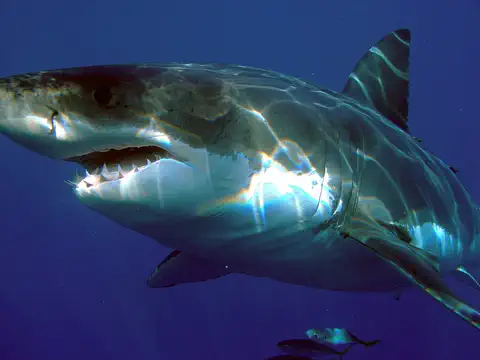
Great white shark
The great white shark is the largest of the mackerel sharks: a strong, torpedo-shaped fish with a gray back and a white belly. It hunts fish, seals and sea lions, and it is partly warm-blooded, which helps it stay active in cool water.
-
 Watch
 Country
Iceland
Iceland is an island country in the North Atlantic, close to the Arctic Circle. It sits on the border between two giant plates of Earth's crust and has about 200 volcanoes, many hot springs and huge glaciers, and about 396,500 people lived there in mid-2026.
-
 Watch
Animal
Alligator gar
The alligator gar is one of the largest freshwater fish in North America. It has a broad snout lined with teeth, armor-like scales, and a swim bladder that works like a lung, so it can gulp air in warm, still water. It lives in the big rivers, swamps and bayous of the southern United States, Mexico and Central America.
-
 Watch
Animal
Arapaima
The arapaima is one of the biggest freshwater fish in the world, longer than a grown-up is tall. It lives in the warm, slow rivers and flooded lakes of the Amazon, and it must swim up to the surface to gulp air every few minutes.
-
 Watch
Animal
Atlantic bluefin tuna
The Atlantic bluefin tuna is the largest of all tunas: big ones can be about 4 meters long. Its torpedo-shaped body is built for long journeys, and it can keep its body warmer than the water around it. Bluefin tuna were badly overfished, but with fishing limits set by countries working together, the numbers caught are now controlled.
-
 Watch
3D
Animal
Atlantic cod
The Atlantic cod is a large, speckled fish of the cold North Atlantic. It has a whisker-like barbel on its chin and three fins along its back. For hundreds of years people have caught cod for food, so many that some cod populations crashed and are still being rebuilt today.
For parents & teachers
What children will learn
- Describe where Greenland sharks live and how cold water affects their growth.
- Explain how eye-lens radiocarbon dating was used to estimate their age, and why the estimates carry uncertainty.
- Explain why a slow-growing, late-maturing species is easily harmed by fishing.
- Describe how fishing practices can be changed to reduce bycatch.
Recommended ages: 3 to 17 · About 15 minutes
Talk about it
- What events in history might a 272-year-old shark have lived through?
- Why do scientists give an age like 392 ± 120 years instead of one exact number?
- Why might an animal that grows slowly be hurt more by accidental catches?
Try at home or in class
- Draw a timeline of 400 years and mark your own birth year, the year 2016 and where a 392-year-old shark's birth would fall.
- Measure 4.3 meters on the floor with tape and compare it with the length of a car.
Key vocabulary: radiocarbon, lens, scavenger, bycatch, vertebrate, fjord
Where these facts come from
- The IUCN Red List of Threatened Species , International Union for Conservation of Nature (IUCN terms of use (no redistribution of Red List data or range maps))
- GBIF Backbone Taxonomy and GBIF Occurrence Search , Global Biodiversity Information Facility (CC0 1.0 (backbone); occurrence counts are facts derived from records under CC0, CC BY and CC BY-NC)
- Wikimedia Commons , Wikimedia Foundation (Per file: Public domain, CC0, CC BY or CC BY-SA only (credited on each page))
- Somniosus microcephalus (Greenland Shark), IUCN Red List assessment 2020 , IUCN
- Nielsen et al. 2016. Eye lens radiocarbon reveals centuries of longevity in the Greenland shark (Somniosus microcephalus). Science 353(6300):702-704 (abstract, PubMed 27516602) , U.S. National Library of Medicine (PubMed)
- Greenland shark (Somniosus microcephalus) , Florida Museum of Natural History
- Wikidata , Wikimedia Foundation (CC0 1.0)
Checked, not yet human-reviewed. Last updated October 27, 2026. Spotted a mistake? Tell us.
Picture credits
- Photo: NOAA Okeanos Explorer Program, public domain, via Wikimedia Commons · source