
Arctic
Animals that live in the arctic. Tap one to meet it.
22 to explore
-
 Watch
Animal
Arctic fox
The Arctic fox lives on the frozen tundra around the North Pole. Its coat changes color with the seasons, white or blue-gray in winter and brown or gray in summer, and it has short ears, a short nose and furry feet to keep the cold out. It eats lemmings, birds and leftovers from polar bears.
-
 Watch
Animal
Arctic tern
The Arctic tern is a small, graceful seabird with a black cap, a red bill and red legs. Every year it flies from its nesting grounds in the Arctic to the edge of the ice around Antarctica and back again. Scientists who tracked terns from Greenland and Iceland found that they flew an average of 70,900 kilometers in one year.
-
 Watch
3D
Animal
Atlantic puffin
The Atlantic puffin is a small seabird of the North Atlantic, often called the clown of the sea because of its huge, colorful bill. It spends most of its life far out on the ocean and comes ashore only in summer to nest in burrows on islands and cliff tops. Underwater, its small wings work like flippers.
-
 Watch
Animal
Bar-tailed godwit
The bar-tailed godwit is a long-billed shorebird that breeds on Arctic tundra and spends the rest of the year on mudflats far to the south. Godwits from Alaska fly non-stop across the Pacific Ocean to New Zealand and Australia, and one young bird tracked in 2022 flew at least 13,560 kilometers without landing.
-
 Watch
Animal
Beluga whale
The beluga whale is a small white whale of the Arctic. It has no fin on its back, a soft, round forehead it can change shape, and a neck that bends, and it makes so many whistles, chirps and clicks that sailors called it the canary of the sea.
-
 Watch
3D
Animal
Bowhead whale
The bowhead whale is a giant baleen whale that spends its whole life in cold Arctic waters. Its enormous bow-shaped head can push through sea ice, its blubber is thicker than any other whale's, and some bowheads may live for more than 200 years.
-
 Watch
3D
Animal
Common murre
The common murre is a seabird of cold northern oceans that looks a little like a flying penguin. It dives deep to chase fish, nests in huge crowds on cliff ledges, and its chicks flutter down from the cliff to the sea before they can even fly.
-
 Watch
Animal
Common raven
The common raven is the biggest member of the crow family and the largest songbird. It lives across most of the Northern Hemisphere, from deserts to Arctic tundra. Ravens eat almost anything, play games in the air, and have solved puzzles that scientists designed to test how well they can plan ahead.
-
 Watch
Animal
Gray whale
The gray whale is a baleen whale of the North Pacific Ocean. It sucks up mud from the seafloor to catch tiny animals, and it makes one of the longest yearly journeys of any mammal: about 16,000 kilometers there and back between Arctic feeding seas and shallow lagoons in Mexico.
-
 Watch
3D
Animal
Gray wolf
The gray wolf is the largest member of the dog family and the wild ancestor of pet dogs. Wolves live in family packs that hunt big animals like elk and moose together, and their howls can carry about 10 kilometers. After being wiped out in many places, wolves are coming back in parts of North America and Europe.
-
 Watch
Animal
Greenland shark
The Greenland shark is a huge, slow-moving shark of the cold North Atlantic and Arctic Ocean. It grows very slowly in the cold, and in 2016 scientists used the lenses of its eyes to estimate that it can live for at least 272 years, longer than any other animal with a backbone that we know of.
-
 Watch
3D
Animal
Harbor seal
The harbor seal lives along the northern coasts of North America, Europe and Asia, and it is one of the most common marine mammals on the east and west coasts of the United States. It has spotted fur, a dog-like face and no ear flaps, and it wriggles like a caterpillar on land. Its pups can swim within minutes of being born.
-
 Watch
Animal
Lion's mane jellyfish
The lion's mane jellyfish is one of the biggest jellyfish in the world. Its bell is usually 30 to 50 centimeters across, but in very cold seas it can grow to about 2 meters, and hundreds of long, hair-like tentacles trail beneath it to catch food.
-
 Watch
Animal
Muskox
Muskoxen are shaggy Arctic grazers with long coats that nearly reach the ground and a super-warm underwool called qiviut. Herds protect their calves by standing in a ring with their horns facing out. Despite the name, they are more closely related to goats and sheep than to oxen.
-
 Watch
3D
Animal
Narwhal
The narwhal is a toothed whale of the icy Arctic Ocean. Most males have a long, spiral tusk that is really a tooth growing forward out of the front of the jaw, and it can be up to about 3 meters long. Narwhals dive deep under the sea ice to catch fish, squid and shrimp.
-
 Watch
3D
Animal
Orca
The orca, also called the killer whale, is the largest member of the dolphin family and the ocean's top predator. Orcas live in every ocean, in close family groups called pods, made up of orcas related through their mothers. Each group has its own favorite foods, hunting tricks and even its own calls, which young orcas learn from their families.
-
 Watch
Animal
Polar bear
The polar bear is a huge bear that lives on the frozen sea of the Arctic. Thick fur and a layer of fat keep it warm, its amazing nose finds seals under the snow, and it can swim for many hours. It needs sea ice to hunt, so a warming Arctic is a big problem for it.
-
 Watch
3D
Animal
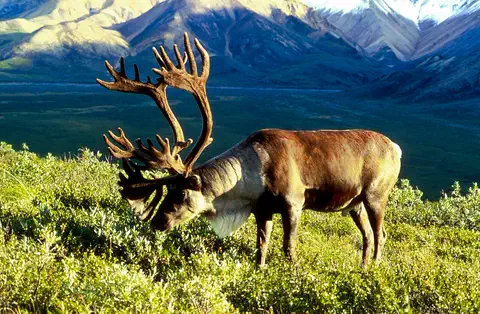
Reindeer
Reindeer, called caribou in North America, are deer of the Arctic tundra and northern forests. They are the only deer in which females grow antlers too. Some herds walk thousands of kilometers a year, and people in northern Europe and Asia have herded reindeer for a very long time.
-
 Watch
Animal
Snowy owl
The snowy owl is a large white owl that nests on the Arctic tundra. Unlike most owls it hunts in daylight, and in the endless light of an Arctic summer it may hunt at any hour. Lemmings are its favorite food.
-
 Watch
3D
Animal
Stoat
The stoat is a small, slender hunter with a long body, short legs and a black-tipped tail. It lives across the northern parts of Europe, Asia and North America, and in snowy places some stoats turn white in winter.
-
 Watch
3D
Animal
Walrus
The walrus is a huge Arctic sea mammal with long ivory tusks and a thick mustache of whiskers. It feels for clams on the sea floor, sucks out the soft part, and rests in big, noisy groups on sea ice and beaches.
-
 Watch
Animal
Wolverine
The wolverine is a strong, stocky member of the weasel family that lives in the cold north of North America, Europe and Asia. It travels huge distances, eats almost anything it can find, and digs dens in deep snow for its babies. Its fierce reputation is often exaggerated: it avoids wolves and bears.