Animal
Great white shark
The great white shark is a big fish with a pointed nose and a white belly. It swims in cool and warm seas all around the world.
The great white shark is the largest of the mackerel sharks: a strong, torpedo-shaped fish with a gray back and a white belly. It hunts fish, seals and sea lions, and it is partly warm-blooded, which helps it stay active in cool water.
Carcharodon carcharias, the white shark, is a partly warm-blooded apex predator of temperate and subtropical seas worldwide. It grows slowly and matures late, at about 26 years for males and 33 for females, a life history NOAA says leaves it vulnerable to human impacts. The IUCN lists it globally as Vulnerable.
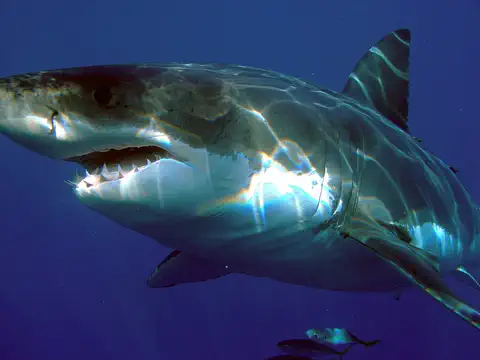
Photo: Sharkdiver.com, public domain, via Wikimedia Commons
Meet the great white shark
The great white shark is a big fish.
It is gray on top and white underneath. It has a pointed nose, a tall fin on its back and a tail shaped like a curved moon. It swims in seas all over the world.
The great white shark is a fish, and the biggest member of a shark family called the mackerel sharks. Its body is shaped like a torpedo: thick in the middle and pointed at the nose.
Its name comes from its white belly; its back is dark gray to brown. Great whites are among the best-studied sharks on Earth, yet scientists still have big questions about how many there are, how they grow and where they travel.
Carcharodon carcharias is the largest member of the mackerel sharks (family Lamnidae), which also includes the makos, the porbeagle and the salmon shark. Like its relatives it has a fusiform (torpedo-shaped) body, a conical snout and a prominent keel at the base of a crescent-shaped, or lunate, tail.
Modeling suggests the largest individuals reach about 6 meters in total length, possibly 6.4 meters, and NOAA gives weights of up to 4,500 pounds (about 2,000 kilograms). Although its populations off both coasts of the United States are among the best studied of any shark, NOAA notes that basic questions about the species' abundance, life history, habitats and movements remain unanswered.
Quick facts
- Group
- Fish
- Length
- up to 6 m
- Weight
- up to 2,000 kg
- Lifespan in the wild
- 30 to 70 years
Where it lives
Great white sharks live in the sea.
They like water that is not too hot and not too cold. Young sharks stay near the coast. Big sharks swim near rocky islands and far out in the open ocean.
Great whites live in temperate and subtropical seas around the world: mostly waters that are cool to warm rather than icy or tropical. NOAA says they often migrate with the seasons to stay in water of about 10 to 27 °C (50 to 80 °F).
Pups and young sharks stay in shallow, warmer water near the coast. As they grow, they split their time between the open ocean and the islands and shores where seals and sea lions rest.
The white shark occurs worldwide in temperate and subtropical waters, with a few large individuals recorded in the tropics and occasional visits to cold northern waters off Alaska and Canada. The Florida Museum traces its range from Newfoundland to Florida, the northern Gulf of Mexico and Cuba, and from Brazil to Argentina in the western Atlantic, from France to South Africa (including the Mediterranean) in the eastern Atlantic, from the Red Sea to South Africa in the Indian Ocean, and from Siberia to New Zealand, around Hawaii, from Alaska to the Gulf of California and from Panama to Chile in the Pacific.
Habitat shifts with age. Juveniles use warm, shallow continental-shelf waters, with known nursery areas off southern California and Long Island, New York. Adults divide their time between seal and sea lion colonies and the open ocean, and have been recorded deeper than 1,300 meters.
Its habitat

Where can you find this animal?
- Lives here naturally · Countries and seas named by a scientific source
- Sightings recorded · Records of wild sightings (GBIF)
Lives here naturally · Countries and seas named by a scientific source
Temperate and subtropical seas worldwide, from coasts and continental shelves to the open ocean, with occasional visits to tropical and cold northern waters. Shading is by whole ocean, so it is much wider than where great whites actually spend their time.
Places: Pacific Ocean, Atlantic Ocean and Indian Ocean.
Source: https://www.fisheries.noaa.gov/species/white-shark · checked October 2026
Sightings recorded · Records of wild sightings (GBIF)
Counts of GBIF records of wild observations (human and machine) and preserved specimens. Records include introduced populations, vagrants, escaped or released animals and misidentifications, so a country with records is not necessarily part of the native range.
Wild sightings have been recorded in Australia, United States, New Zealand, Brazil, South Africa, New Caledonia, Mexico, UK and 38 more places.
Source: gbif · checked October 2026
Range maps show where scientists say an animal lives, often country by country. An animal may live in only part of a country shown, and sightings records can include animals that wandered far from home.
What it eats
Great white sharks eat other animals.
Young sharks catch fish, squid and small sharks. Big sharks also catch seals and sea lions. Sometimes they eat from a whale that has already died.
Great whites are predators, and what they eat changes as they grow. Young sharks mostly eat fish that live near the seafloor, smaller sharks and rays, and schooling fish and squid.
Bigger sharks gather near seal and sea lion colonies to feed, and they sometimes scavenge, or feed on, dead whales. As an apex predator at the top of the food chain, the great white plays an important part in ocean life.
The white shark is an opportunistic apex predator. NOAA describes juveniles feeding mainly on bottom fish, smaller sharks and rays, schooling fish and squid, while larger sharks gather around seal and sea lion rookeries and occasionally scavenge whale carcasses. The Florida Museum adds dolphins, elephant seals and mobulid rays to the important prey, with sea turtles eaten only sporadically.
Observations at whale carcasses show white sharks feeding selectively on blubber rather than muscle, with the largest sharks dominating, which researchers read as a preference for energy-rich food. Teeth change with age: juveniles under about 1.8 meters have small side cusps, and scientists believe the teeth broaden as the sharks shift toward large marine mammals.
Did you know?
Some great white sharks may live for 70 years or more.
Scientists used a dating method called bomb-carbon dating to show that great whites may live 70 years or more.
Bomb-carbon dating (Hamady and colleagues, 2014) suggests white sharks may live to 70 years or more; the oldest estimate in that study was 73 years, for its largest male.
A powerful body
A great white has a gray back and a white belly.
Its teeth are shaped like triangles, with jagged edges like a saw. Its body stays a little warmer than the water, so it can keep busy in cold seas.
A great white's upper teeth are broad triangles with jagged, saw-like edges, a little like a bread knife; the lower teeth are narrower. Its skin is covered in tiny tooth-like scales called denticles, which feel fairly smooth compared with many other sharks.
The great white is also partly warm-blooded. Its body can stay warmer than the water around it, so it can be a more active hunter in cool seas than cold-blooded fish.
The white shark is regionally endothermic: it can keep its internal body temperature above that of the surrounding water, which NOAA says lets it be a more active predator in cool seas than cold-blooded species.
The upper teeth are large, erect, broad and serrated; the lower teeth are more slender. The dermal denticles are minute and tightly packed, each with three ridges, so the skin is relatively smooth for a shark. The profile is completed by long gill slits that do not wrap around the head, a large triangular first dorsal fin, tiny second dorsal and anal fins, and a single keel at the base of the tail. Most individuals have a black oval blotch where each pectoral fin meets the body.
Growing up
Baby great white sharks grow inside their mother.
They are born ready to swim. A newborn is at least as long as a young child is tall. Great whites grow up very, very slowly.
Great white pups grow inside their mother and are born alive, about 1.09 to 1.65 meters long, so even a newborn is at least as long as a young child is tall. Before birth they feed on unfertilized eggs inside their mother. Scientists think a pregnancy lasts a year or more, and that a female gives birth every two or three years.
Great whites grow slowly. NOAA says males are grown up at about 26 years old and females at about 33.
Reproduction is viviparous and oophagous: embryos hatch inside the uterus and are nourished by eating unfertilized eggs until the female gives birth to live young. The Florida Museum notes that embryos also swallow their own teeth, perhaps to reuse the calcium and other minerals. Pups measure 109 to 165 centimeters at birth. Gestation has not been measured but is believed to last a year or more, and females give birth every two or three years. A pregnant female caught off North Cape, New Zealand, in 1991 carried seven full-term pups.
Maturity comes late, at about 26 years for males and 33 for females, and estimates of maximum age range from 30 to over 70 years. The IUCN gives a generation length of 53 years, and NOAA notes that this low productivity makes the species vulnerable to declines from human impacts.
Travels and body language
Great white sharks can swim a very long way.
Some big sharks cross whole oceans. When two sharks swim toward each other, one may turn away to give the other space.
Scientists fit some great whites with tags that track where they go. The tags show that great whites may stay along one stretch of coast, travel up and down a whole region, or cross an ocean; the bigger sharks make the longest journeys.
Great whites have body language too. Two sharks may swim side by side, keeping a set distance apart, and a shark competing for food may slap the water with its tail to warn another shark away.
Tag-and-release studies in the United States, South Africa and Australia show movements on local, regional and intercontinental scales, with larger individuals crossing ocean basins. Seasonal shifts in where sharks gather appear to follow water temperature, and NOAA notes seasonal aggregations at key coastal feeding areas, which make the species easier to study.
Researchers interpret two behaviors, timed turns away when sharks approach each other and parallel swimming at a fixed distance, as ways of keeping personal space. When two sharks target the same food they use displays: tail-slapping that throws water toward the rival, and tilting, rolling on one side with exaggerated tail beats. The pattern breach, propelling two-thirds of the body out of the water and landing flat with a large splash, may be a stronger signal, or may help remove parasites or attract a mate; its purpose is not settled.

Sharks and people
Sharks almost never bite people.
The ocean is the shark's home. Scientists study great whites and learn how to keep them safe.
Great whites appear often in films and have a fearsome reputation, but shark bites on people are rare. In 2025 the International Shark Attack File, a scientific record kept at the Florida Museum, confirmed 65 unprovoked shark bites on people in the whole world, counting every kind of shark.
The great white is one of the most widely protected sharks. Scientists tag and track great whites to learn where they go and how their numbers are changing.
NOAA calls the white shark iconic, partly because it lives close to shore and appears often in films and documentaries, and contrasts its fearsome reputation with its real vulnerability. In 2025 the International Shark Attack File confirmed 65 unprovoked bites by all shark species worldwide, plus 29 provoked bites, in which a person started the interaction, for example by touching or feeding a shark. The Florida Museum credits white sharks with more fatal bites than any other species and attributes this to their size, power and feeding behavior; bites of any kind remain rare.
Why bites happen is debated. One idea is that surfers and divers seen from below resemble seals, but the Florida Museum points out that white sharks also strike objects that look nothing like seals, and suggests they may grasp unfamiliar objects to judge whether they are food.
Did you know?
A great white's body stays warmer than the water around it.
Great whites are partly warm-blooded, so they can stay active hunters even in cool seas.
Regional endothermy lets the white shark keep its internal temperature above that of the surrounding water, an advantage over cold-blooded predators in cool seas.
Protecting great whites
There are fewer great white sharks than there used to be.
Some get caught in fishing nets by accident. Many countries now protect great whites, so more of them can grow up.
The IUCN lists the great white shark as Vulnerable, and its numbers worldwide are falling. The main threat is fishing: sharks are caught by accident on hooks and in nets meant for other fish, and their jaws, teeth and fins are sold.
There is good news too. In United States waters, fishers may not keep a great white and must release it. NOAA reports that numbers in the northwest Atlantic have been rising since these protections began in the 1990s.
The 2018 global IUCN assessment (published 2019, amended 2022) lists Carcharodon carcharias as Vulnerable under criteria A2bd, with a decreasing population; the threat it names is fishing and harvesting of aquatic resources. The Florida Museum describes white sharks caught in gill nets, purse seines, longlines and other gear and traded for their jaws, teeth, fins, meat, skin and liver oil. A separate IUCN regional assessment (2016) lists the Mediterranean population as Critically Endangered.
Protection is widespread. The species has been on Appendix II of CITES since 2002 and is also on Appendix II of the Convention on Migratory Species, and South Africa, Australia and the United States protect it. NOAA reports increasing abundance in the northwest Atlantic since protections began in the 1990s, and concluded that the northeastern Pacific population appears to be increasing and is not at risk of becoming endangered in U.S. waters.
IUCN Red List
How is the great white shark doing in the wild?
- Least Concern
- Near Threatened
- Vulnerable (this animal)
- Endangered
- Critically Endangered
- Extinct in the Wild
- Extinct
Vulnerable
At high risk of disappearing from the wild.
See the IUCN Red List assessment · The IUCN Red List of Threatened Species 2022.2
Amazing facts
-
Some great white sharks may live for 70 years or more.
Scientists used a dating method called bomb-carbon dating to show that great whites may live 70 years or more.
Bomb-carbon dating (Hamady and colleagues, 2014) suggests white sharks may live to 70 years or more; the oldest estimate in that study was 73 years, for its largest male.
-
Baby great whites are born more than a meter long.
A newborn great white is already 1.09 to 1.65 meters long, at least as long as a young child is tall.
Pups measure 109 to 165 centimeters at birth, having fed on unfertilized eggs in the uterus before they were born.
-
A great white's body stays warmer than the water around it.
Great whites are partly warm-blooded, so they can stay active hunters even in cool seas.
Regional endothermy lets the white shark keep its internal temperature above that of the surrounding water, an advantage over cold-blooded predators in cool seas.
-
Sharks can tell each other to move away by slapping the water with their tails.
When two great whites want the same food, one may slap the water with its tail to splash the other and warn it away.
Tail-slapping, which propels water toward a competing shark, and tilting are displays white sharks use when two individuals target the same food.
Words to know
- apex predator
- a hunter at the top of its food chain, with very few predators of its own
- denticles
- tiny tooth-like scales that cover a shark's skin
- serrated
- having a jagged, saw-like edge
- temperate
- neither very hot nor very cold
- scavenge
- to feed on an animal that has already died
- bycatch
- animals caught by accident in fishing gear meant for other fish
Discovery challenge
-
Which part of a great white shark is white?
Which part of the great white shark gives it its name?
Which feature gives the white shark its common name?
- Its belly
- Its teeth
- Its back fin
Show the answer
Its belly
A great white has a white belly and a gray back.
The great white is named for its white underside; its back is dark gray to brown.
The name refers to the pale ventral surface, sharply divided from the dark gray to brown dorsal surface.
-
What do young great white sharks eat?
Which of these is a main food of young great whites?
According to NOAA, what do juvenile white sharks mainly eat?
- Grass and seaweed
- Fish, squid and small sharks
- Nothing at all
Show the answer
Fish, squid and small sharks
Young great whites catch fish, squid and small sharks.
Young great whites eat fish from near the seafloor, small sharks and rays, and schooling fish and squid. Bigger sharks add seals and sea lions.
Juveniles feed mainly on bottom fish, smaller sharks and rays, schooling fish and squid; larger sharks increasingly take marine mammals.
-
How can a great white keep busy in cold water?
How can a great white stay an active hunter in cool water?
What does regional endothermy mean for the white shark?
- It grows thick fur
- It sleeps all winter
- Its body stays warmer than the water
Show the answer
Its body stays warmer than the water
A great white's body stays a little warmer than the water around it.
Great whites are partly warm-blooded, so their bodies can stay warmer than the water.
It can keep its internal body temperature above that of the surrounding water, so it can be more active in cool seas than cold-blooded species.
-
Do sharks bite people a lot?
How often do sharks bite people?
In 2025 scientists confirmed 65 unprovoked shark bites on people worldwide. Which word best describes shark bites?
- Rarely
- Every day at every beach
- All the time
Show the answer
Rarely
Sharks almost never bite people.
Shark bites are rare: in 2025 scientists confirmed 65 unprovoked bites in the whole world, counting every kind of shark.
The International Shark Attack File confirmed 65 unprovoked bites by all shark species worldwide in 2025.
Places where you might see it
-
 Watch
 Country
South Africa
South Africa is the southernmost country in Africa, with the Atlantic Ocean on one side and the Indian Ocean on the other. A high plateau covers most of it, about 63.5 million people (2026) live there, and it has 12 official languages and three capital cities.
-
 Watch
 Country
Australia
Australia is a country and the smallest continent, surrounded by ocean in the Southern Hemisphere. Much of its middle is dry and flat, most people live near the coast, and its animals include kangaroos, koalas and the platypus, a mammal that lays eggs.
-
 Watch
 Country
Mexico
Mexico is a large country in southern North America, between the Pacific Ocean and the Gulf of Mexico. It has smoking volcanoes, ancient cities built by the Maya and other peoples, and about 132 million people, many of them in and around Mexico City.
Experiments to try
Explore next
-
 Watch
3D
Animal
Shortfin mako shark
The shortfin mako is a sleek, metallic-blue shark that roams warm and mild oceans all over the world. Scientists call it the fastest shark: it can sprint at up to about 70 kilometers an hour and even leap out of the water. It hunts fast fish such as tuna and swordfish, and it is now endangered.
-
 Watch
3D
Animal
Tiger shark
The tiger shark is one of the biggest sharks in the sea. Young tiger sharks have dark spots and stripes like a tiger, which fade as they grow. It eats an amazing range of food, and it travels long distances between warm and cooler seas.
-
 Watch
3D
Animal
Whale shark
The whale shark is the largest fish in the world. This gentle giant swims through warm seas with its huge mouth open, filtering tiny plankton and small fish from the water, and every whale shark has its own pattern of pale spots.
-
 Watch
Animal
California sea lion
The California sea lion is an 'eared seal' of the west coast of North America. It is clever, playful and very noisy, with a bark like a dog's. Unlike true seals, it has ear flaps and can turn its back flippers forward to walk on land. Its numbers have grown a lot since it was protected.
-
 Watch
3D
Animal
Orca
The orca, also called the killer whale, is the largest member of the dolphin family and the ocean's top predator. Orcas live in every ocean, in close family groups called pods, made up of orcas related through their mothers. Each group has its own favorite foods, hunting tricks and even its own calls, which young orcas learn from their families.
-
Watch
Country
South Africa
South Africa is the southernmost country in Africa, with the Atlantic Ocean on one side and the Indian Ocean on the other. A high plateau covers most of it, about 63.5 million people (2026) live there, and it has 12 official languages and three capital cities.
-
Watch
Country
Australia
Australia is a country and the smallest continent, surrounded by ocean in the Southern Hemisphere. Much of its middle is dry and flat, most people live near the coast, and its animals include kangaroos, koalas and the platypus, a mammal that lays eggs.
-
Watch
Country
Mexico
Mexico is a large country in southern North America, between the Pacific Ocean and the Gulf of Mexico. It has smoking volcanoes, ancient cities built by the Maya and other peoples, and about 132 million people, many of them in and around Mexico City.
For parents & teachers
What children will learn
- Describe the great white shark's main features and how its partly warm body helps it hunt in cool water.
- Explain how its diet changes from young sharks to adults.
- Understand why a slow life history makes the species vulnerable to fishing.
- Recognize that shark bites on people are rare, using real numbers.
Recommended ages: 3 to 17 · About 15 minutes
Talk about it
- Why might films make sharks seem more dangerous than they really are?
- Why would an animal that takes about 30 years to grow up find it hard to recover when many are caught?
- How do scientists learn where sharks travel without following them?
Try at home or in class
- Measure 6 meters along a hallway or sidewalk with a tape measure to see how long the largest great whites grow.
- Shape a lump of modeling clay into a torpedo and a flat block, then push each through a basin of water to feel which moves more easily.
Key vocabulary: apex predator, denticles, serrated, temperate, scavenge, bycatch
Where these facts come from
- The IUCN Red List of Threatened Species , International Union for Conservation of Nature (IUCN terms of use (no redistribution of Red List data or range maps))
- GBIF Backbone Taxonomy and GBIF Occurrence Search , Global Biodiversity Information Facility (CC0 1.0 (backbone); occurrence counts are facts derived from records under CC0, CC BY and CC BY-NC)
- Carcharodon carcharias (White Shark), 2018 global assessment (amended version, 2022) , IUCN Red List of Threatened Species
- Vertebral Bomb Carbon Dating Suggests Extreme Longevity in White Sharks (Hamady and others, 2014) , PLOS ONE
- Carcharodon carcharias, 2016 Mediterranean regional assessment , IUCN Red List of Threatened Species
- White Shark , NOAA Fisheries
- White Shark (Carcharodon carcharias) species profile , Florida Museum of Natural History
- Yearly Worldwide Shark Attack Summary , International Shark Attack File, Florida Museum of Natural History
- Wikidata , Wikimedia Foundation (CC0 1.0)
- Wikimedia Commons , Wikimedia Foundation (Per file: Public domain, CC0, CC BY or CC BY-SA only (credited on each page))
Checked, not yet human-reviewed. Last updated October 27, 2026. Spotted a mistake? Tell us.