
Animal
Atlantic cod
The Atlantic cod is a speckled fish with a little whisker on its chin. It lives near the bottom of the cold North Atlantic Ocean.
The Atlantic cod is a large, speckled fish of the cold North Atlantic. It has a whisker-like barbel on its chin and three fins along its back. For hundreds of years people have caught cod for food, so many that some cod populations crashed and are still being rebuilt today.
Gadus morhua, a member of the cod family Gadidae, is a cold-water, mostly bottom-living predator of North Atlantic continental shelves. It has supported some of the world's largest fisheries; overfishing in the late twentieth century depleted stocks, most famously off Newfoundland and Labrador. Its global IUCN listing, Vulnerable, dates from 1996 and is flagged as needing an update.
Photo: Wilhelm Thomas Fiege, CC BY-SA 4.0, via Wikimedia Commons
Meet the Atlantic cod
The Atlantic cod is a big fish that lives in cold seas.
It is covered in tiny spots. It has a little whisker under its chin. People have fished for cod for a very long time.
The Atlantic cod is a heavy-bodied fish with a big head and a blunt snout. Under its lower jaw hangs a single whisker-like feeler called a barbel, a bit like a catfish's. Most cod are 30 centimeters to 1 meter long, but the biggest can reach about 2 meters.
Cod can be yellowish-green, red or olive, usually with darker speckles, and they can change color easily. People have fished for cod for centuries. Cape Cod in Massachusetts was named after the fish, because there were so many cod there.
Gadus morhua belongs to the cod family Gadidae in the order Gadiformes; the IUCN places it in the class Actinopterygii, the ray-finned fishes. It is heavy-bodied with a large head, a blunt snout and a large chin barbel. According to the FAO description used by the Virginia Institute of Marine Science, adults are commonly 30 to 100 centimeters and can reach about 2 meters and 90 kilograms, while western Atlantic fish average only about 60 centimeters and 2 to 3 kilograms.
NOAA Fisheries notes that early explorers named Cape Cod for its abundance of cod, and that Gloucester, Massachusetts, was founded by a colonial charter meant to profit from cod fishing. The Virginia Institute of Marine Science gives global landings of about 141 million tonnes from 1950 to 2024.
Quick facts
- Group
- Fish
- Length
- 0.3 to 1 m
- Weight
- up to 35 kg
- Lifespan in the wild
- from 20 years
Where it lives
Atlantic cod live in the cold North Atlantic Ocean.
They swim near the sea floor, close to rocks and ledges. They like chilly water.
Atlantic cod live in the cold northern part of the Atlantic Ocean, from North Carolina and Greenland across to Iceland, northern Europe and the Barents Sea in the Arctic.
They mostly live near the sea floor over the continental shelf, the shallow edge of the ocean around the continents. They like rocky slopes and ledges and bottoms covered in gravel and sand rather than soft mud. Cod prefer very cold water, about 0 to 5 degrees Celsius.
The species is a boreal North Atlantic fish ranging from North Carolina to Greenland, Iceland, northern Europe and into the Barents Sea, including Novaya Zemlya and Spitsbergen; it is uncommon south of New York and New Jersey. In U.S. waters it is most common on Georges Bank and in the western Gulf of Maine.
Cod are mainly demersal, living near the bottom along rocky slopes and ledges over coarse sediments, but become pelagic, moving up into open water, when feeding and spawning. Most live on the continental shelf at 150 to 200 meters, with records beyond 600 meters, and NOAA gives depths of about 30 to 500 feet (9 to 150 meters) off New England. They prefer 0 to 5 degrees Celsius but are found in water up to 15 degrees.
Did you know?
A place in America is named after the cod.
Cape Cod in Massachusetts was named by early explorers because cod were so plentiful there.
NOAA Fisheries notes that early explorers named Cape Cod for the abundance of cod, and that Gloucester was founded under a colonial charter to profit from cod fishing.
Where can you find this animal?
- Lives here naturally · Countries and seas named by a scientific source
- Sightings recorded · Records of wild sightings (GBIF)
Lives here naturally · Countries and seas named by a scientific source
Cold continental-shelf waters of the North Atlantic, from North Carolina to Greenland, Iceland and northern Europe, and into the Barents Sea of the Arctic Ocean. Shading is by whole ocean, so it is much wider than where cod actually live; they do not live in the South Atlantic or the central Arctic.
Places: Atlantic Ocean and Arctic Ocean.
Source: iucn-red-list · checked October 2026
Sightings recorded · Records of wild sightings (GBIF)
Counts of GBIF records of wild observations (human and machine) and preserved specimens. Records include introduced populations, vagrants, escaped or released animals and misidentifications, so a country with records is not necessarily part of the native range.
Wild sightings have been recorded in Canada, Belgium, Poland, United States, UK, Norway, Sweden, Denmark and 24 more places.
Source: gbif · checked October 2026
Range maps show where scientists say an animal lives, often country by country. An animal may live in only part of a country shown, and sightings records can include animals that wandered far from home.
What it eats
Cod eat other sea animals.
They hunt small fish and other creatures that live near the sea floor.
Atlantic cod are top predators near the sea floor. They eat many kinds of invertebrates, which are animals without backbones, and many kinds of fish.
Cod often leave the bottom and swim up into open water when they are feeding. Off Newfoundland and Labrador, one of their most important foods is capelin, a small fish that swims in big schools.
NOAA Fisheries describes Atlantic cod as top predators of the bottom-living (demersal) community, feeding on a variety of invertebrates and fishes. The FAO account notes that although cod are mainly demersal, they become pelagic when feeding, following prey up into the water column.
Off Newfoundland and Labrador, Oceans North notes that capelin, a small schooling fish, are a major prey of northern cod, and that the reference points used to assess the two stocks are linked.
Did you know?
Cod have a whisker under their chin, like a catfish.
The whisker under a cod's chin is called a barbel, like the whiskers of a catfish.
The cod's single chin barbel is a whisker-like organ comparable to a catfish's barbels.
A cod up close
A cod has big eyes and a whisker on its chin.
It has three fins on its back. A pale line runs along each side of its body.
Look closely at a cod and you can spot its features. It has large eyes, a big mouth and a barbel under its chin. Along its back it has three separate fins, and underneath it has two more.
A pale stripe runs along each side of its body from head to tail. This is the lateral line, a sense organ that feels movements in the water. Its belly is light-colored and usually has no spots.
The FAO description gives a long dorsal fin divided into three parts, an anal fin in two parts, pointed pectoral fins, short pelvic fins set forward under the throat (thoracic), and a truncate to slightly forked tail. The mouth is large, with the lower jaw slightly shorter than the upper and teeth on the vomer, and the chin barbel is large.
NOAA describes a light, usually spotless belly and an obvious lateral line along each side. Color varies from yellowish-green to red and olive, usually with darker speckles on the head, fins, tail and body, and individuals can change color readily.
Millions of eggs
A mother cod lays millions of tiny eggs.
Cod lay their eggs near the sea floor in winter and early spring. Baby cod grow up to have babies when they are two or three years old.
Atlantic cod spawn near the ocean floor from winter to early spring. A large female can produce 3 to 9 million eggs at one time.
They can start having young of their own when they are 2 to 3 years old and about 30 to 40 centimeters long. Cod can live for more than 20 years.
Cod spawn near the bottom from winter to early spring, and NOAA Fisheries reports that larger females can produce 3 to 9 million eggs in a spawning season. Fish can mature at 2 to 3 years, at 12 to 16 inches (about 30 to 40 centimeters), and may live more than 20 years.
Rebuilding a depleted stock depends on recruitment, the number of young fish surviving to join the population. NOAA reports that over the past 20 years recruitment has varied for the Gulf of Maine stock and has been well below average for the Georges Bank stock, and NOAA calls recruitment a primary source of rebuilding potential.
Life near the sea floor
Cod spend most of their time near the bottom of the sea.
They swim up higher to feed and to lay their eggs. They can change color.
Cod spend most of their lives near the sea floor, around rocky slopes and ledges. When they feed or spawn, they rise into open water.
They are also good at changing color. Their skin can shift between yellowish-green, red and olive. To protect cod while they spawn, some fishing areas are closed during certain seasons.
Behavior combines a demersal lifestyle near rough bottoms with pelagic phases for feeding and spawning. Individuals can change color readily, from yellowish-green to red and olive.
U.S. management uses year-round and seasonal area closures to protect spawning fish and habitat. NOAA Fisheries attributes the low numbers in U.S. stocks to high fishing pressure through the latter part of the twentieth century; today they hold fewer fish than their average over the past four decades.
Did you know?
A big mother cod can lay millions of eggs.
A large female Atlantic cod can produce 3 to 9 million eggs when she spawns.
Larger females can produce 3 to 9 million eggs in a spawning event, according to NOAA Fisheries.
Rebuilding the cod
People caught too many cod.
In some places there are very few left. Now there are rules to help the cod come back.
In the late 1900s, fishing boats caught so many cod that some cod populations crashed. In 1992 Canada stopped most cod fishing off Newfoundland and Labrador, and many people lost their jobs.
Today, in the United States, cod are protected by rules: limits on how many can be kept, minimum sizes so young fish can grow up, and areas and seasons closed to fishing. The cod are still being rebuilt, and scientists keep checking how they are doing.
The IUCN's global assessment (1996) lists the Atlantic cod as Vulnerable under criterion A1bd and is flagged as needing an update; a 2013 European regional assessment lists it as Least Concern with an increasing trend in European waters. In the United States, NOAA Fisheries' 2021 stock assessments found both the Gulf of Maine and Georges Bank stocks overfished and subject to overfishing, and rebuilding plans target 2033 and 2026.
Off Newfoundland and Labrador, the northern cod fishery was closed under a moratorium in 1992, one of the biggest job losses in Canadian history. A limited stewardship fishery began in 2006, and in June 2024 Fisheries and Oceans Canada announced the end of the moratorium and reopened a commercial fishery, with a Canadian catch limit of 18,000 tonnes for that season. Conservation groups such as Oceans North criticized the decision, arguing the stock remains far from healthy.
IUCN Red List
How is the atlantic cod doing in the wild?
- Least Concern
- Near Threatened
- Vulnerable (this animal)
- Endangered
- Critically Endangered
- Extinct in the Wild
- Extinct
Vulnerable
At high risk of disappearing from the wild.
See the IUCN Red List assessment · The IUCN Red List of Threatened Species 2022.2
Amazing facts
-
A place in America is named after the cod.
Cape Cod in Massachusetts was named by early explorers because cod were so plentiful there.
NOAA Fisheries notes that early explorers named Cape Cod for the abundance of cod, and that Gloucester was founded under a colonial charter to profit from cod fishing.
-
Cod can change color.
An Atlantic cod can change color readily, from yellowish-green to red or olive.
Coloration ranges from light yellowish-green to red and olive, and individuals can change color readily.
-
A big mother cod can lay millions of eggs.
A large female Atlantic cod can produce 3 to 9 million eggs when she spawns.
Larger females can produce 3 to 9 million eggs in a spawning event, according to NOAA Fisheries.
-
Cod have a whisker under their chin, like a catfish.
The whisker under a cod's chin is called a barbel, like the whiskers of a catfish.
The cod's single chin barbel is a whisker-like organ comparable to a catfish's barbels.
Words to know
- barbel
- a whisker-like feeler near a fish's mouth
- lateral line
- a line along a fish's side that senses movements in the water
- spawn
- to release eggs and sperm into the water to make baby fish
- continental shelf
- the shallow sea floor around the edge of a continent
- overfishing
- catching fish faster than they can have young to replace them
- moratorium
- an official pause, such as a stop on fishing
Discovery challenge
-
What does a cod have under its chin?
What is the whisker under a cod's chin called?
What is the whisker-like organ under a cod's lower jaw called?
- A barbel
- A horn
- A beak
Show the answer
A barbel
It is a whisker called a barbel.
It is called a barbel, a whisker-like feeler like a catfish's.
A chin barbel: a single, large, whisker-like organ beneath the lower jaw.
-
Do cod like warm water or cold water?
What kind of water do Atlantic cod prefer?
Which water temperature range do Atlantic cod prefer?
- Hot water
- Cold water
- Fresh river water
Show the answer
Cold water
Cod like cold water.
Cod prefer very cold sea water, about 0 to 5 degrees Celsius.
They prefer 0 to 5 degrees Celsius, though they occur in water up to about 15 degrees.
-
Why are there fewer cod in some places?
Why did some Atlantic cod populations crash?
What caused the depletion of many Atlantic cod stocks in the late twentieth century?
- People caught too many
- They all moved to the moon
- They turned into sharks
Show the answer
People caught too many
People caught too many cod.
Heavy fishing in the late 1900s caught cod faster than they could have young to replace them.
High fishing pressure through the late twentieth century depleted stocks, leading to Canada's 1992 moratorium and U.S. rebuilding plans.
-
How many fins does a cod have on its back?
How many parts is a cod's back fin divided into?
Into how many parts is the Atlantic cod's dorsal fin divided?
- One
- Three
- Ten
Show the answer
Three
A cod has three fins on its back.
Its back fin is split into three parts, so it looks like three fins.
The long dorsal fin is divided into three parts, and the anal fin into two.
Places where you might see it
-
 Watch
 Country
Canada
Canada is the second-largest country in the world, stretching across the north of North America from the Atlantic to the Pacific and up into the Arctic. It has the Rocky Mountains, thousands of islands and about 42 million people, who speak English, French and many other languages.
-
 Watch
 Country
Norway
Norway stretches along the western side of the Scandinavian Peninsula, far into the Arctic. Deep, narrow inlets of the sea called fjords cut into its mountains, and about 5.6 million people live there, many of them near Oslo, the capital.
-
 Watch
 Country
Iceland
Iceland is an island country in the North Atlantic, close to the Arctic Circle. It sits on the border between two giant plates of Earth's crust and has about 200 volcanoes, many hot springs and huge glaciers, and about 396,500 people lived there in mid-2026.
Experiments to try
Explore next
-
 Watch
Animal
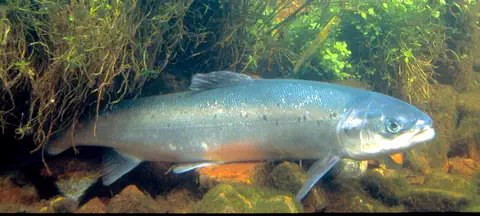
Atlantic salmon
The Atlantic salmon hatches in a river, swims out to the North Atlantic Ocean to feed and grow, then returns to the very river where it was born to lay its eggs. Along the way it changes color and shape several times.
-
 Watch
3D
Animal
Atlantic puffin
The Atlantic puffin is a small seabird of the North Atlantic, often called the clown of the sea because of its huge, colorful bill. It spends most of its life far out on the ocean and comes ashore only in summer to nest in burrows on islands and cliff tops. Underwater, its small wings work like flippers.
-
 Watch
3D
Animal
Harbor seal
The harbor seal lives along the northern coasts of North America, Europe and Asia, and it is one of the most common marine mammals on the east and west coasts of the United States. It has spotted fur, a dog-like face and no ear flaps, and it wriggles like a caterpillar on land. Its pups can swim within minutes of being born.
-
Watch
Country
Canada
Canada is the second-largest country in the world, stretching across the north of North America from the Atlantic to the Pacific and up into the Arctic. It has the Rocky Mountains, thousands of islands and about 42 million people, who speak English, French and many other languages.
-
Watch
Country
Norway
Norway stretches along the western side of the Scandinavian Peninsula, far into the Arctic. Deep, narrow inlets of the sea called fjords cut into its mountains, and about 5.6 million people live there, many of them near Oslo, the capital.
-
Watch
Country
Iceland
Iceland is an island country in the North Atlantic, close to the Arctic Circle. It sits on the border between two giant plates of Earth's crust and has about 200 volcanoes, many hot springs and huge glaciers, and about 396,500 people lived there in mid-2026.
- Watch Try it What If? Lab What if fish had no swim bladder? Most bony fish carry a gas-filled pouch called a swim bladder. It makes the fish almost exactly as heavy for its size as the water around it, so it can stay at one depth without sinking or floating up. Use a floating-and-sinking model to see what happens when the gas is taken away.
-
 Watch
3D
Animal
Common murre
The common murre is a seabird of cold northern oceans that looks a little like a flying penguin. It dives deep to chase fish, nests in huge crowds on cliff ledges, and its chicks flutter down from the cliff to the sea before they can even fly.
For parents & teachers
What children will learn
- Identify the Atlantic cod's main features, including its chin barbel, three-part dorsal fin and lateral line.
- Describe where cod live and why cold continental-shelf water matters to them.
- Explain how overfishing led to the collapse of some cod stocks.
- Describe how fishing rules such as catch limits and closed areas help rebuild fish populations.
Recommended ages: 3 to 17 · About 15 minutes
Talk about it
- Cod were once so plentiful that a cape was named after them. How could such a common fish become scarce?
- When a fishery closes, the fish get a rest but fishing families lose work. How could both be helped?
- Why do size limits protect young fish?
Try at home or in class
- Play a fishing game with a bowl of dried beans as 'fish': each round, take some out, then add one new bean for every two left. See what happens when you take too many.
- Look at a map of the North Atlantic and find Cape Cod, Newfoundland and Labrador, Iceland and Norway, all famous cod places.
Key vocabulary: barbel, lateral line, spawn, continental shelf, overfishing, moratorium
Where these facts come from
- The IUCN Red List of Threatened Species , International Union for Conservation of Nature (IUCN terms of use (no redistribution of Red List data or range maps))
- GBIF Backbone Taxonomy and GBIF Occurrence Search , Global Biodiversity Information Facility (CC0 1.0 (backbone); occurrence counts are facts derived from records under CC0, CC BY and CC BY-NC)
- Gadus morhua (Atlantic Cod), 1996 global assessment , IUCN Red List of Threatened Species
- Gadus morhua (Atlantic Cod), 2013 European regional assessment , IUCN Red List of Threatened Species
- Atlantic Cod , NOAA Fisheries
- Atlantic cod (species of interest, from FAO species identification guides) , Virginia Institute of Marine Science
- Northern cod decision repeats mistakes of the past , Oceans North
- Management decision for Newfoundland and Labrador's Northern cod Stewardship Fishery , Fisheries and Oceans Canada
- The Government of Canada announces the historic return of the commercial Northern cod fishery in Newfoundland and Labrador , Fisheries and Oceans Canada
- Wikidata , Wikimedia Foundation (CC0 1.0)
- Wikimedia Commons , Wikimedia Foundation (Per file: Public domain, CC0, CC BY or CC BY-SA only (credited on each page))
Checked, not yet human-reviewed. Last updated October 27, 2026. Spotted a mistake? Tell us.