
Animal
Moon jellyfish
The moon jellyfish is a see-through sea animal shaped like a bell. You can see four rings inside it, like a clover.
The moon jellyfish is a clear, saucer-shaped jelly found in coastal seas around the world. It has no eyes, brain or heart, and it is about 95 percent water. Four horseshoe-shaped rings show through its bell, and short stinging tentacles fringe its edge to catch tiny plankton.
Aurelia aurita is a scyphozoan cnidarian of temperate and tropical seas in every ocean but the Arctic. Its life cycle alternates between a sexual medusa and an asexual, bottom-living polyp that buds off ephyrae by strobilation. It feeds on zooplankton by ciliary currents and nematocysts, and forms large blooms that can clog power-plant water intakes.
Photo: Malene (uploader), CC BY-SA 3.0, via Wikimedia Commons
Meet the moon jellyfish
The moon jellyfish is round and see-through, like a glass bowl.
You can see four rings inside it. It has short, frilly tentacles all around its edge. It floats and pulses through the sea.
The moon jellyfish, or moon jelly, is a soft, clear animal shaped like a shallow dome or saucer, usually 10 to 35 centimeters across. It is made of about 95 percent water and has no eyes, no brain and no heart.
Look through its bell and you will see four horseshoe-shaped rings: these are its reproductive organs. A fringe of short tentacles hangs around the rim, and four longer oral arms hang from the middle underneath. Jellyfish belong to the cnidarians, the same group as corals and sea anemones.
Aurelia aurita is a scyphozoan in the phylum Cnidaria, the group that also includes corals and sea anemones. Its radially symmetric, translucent bell is usually 10 to 35 centimeters across (ADW), and Georgia Aquarium reports bells up to 61 centimeters.
The four horseshoe-shaped gonads visible through the bell are its most recognizable feature. Short marginal tentacles about 1 to 5 centimeters long fringe the bell, and four oral arms bearing nematocysts hang from the center of the underside. The Aquarium of the Pacific notes the animal has no pigment of its own; it may look colored from the food it has eaten.
Quick facts
- Group
- Invertebrate
- Length
- 10 to 35 cm
- Lifespan in the wild
- 8 to 12 months
Where it lives
Moon jellyfish live in the sea all around the world.
They like warm and cool water near the coast. They do not like the icy seas near the North and South Poles.
Moon jellyfish live in the Atlantic, Pacific and Indian Oceans, mostly in coastal waters. They are found along the coasts of nearly all of North and South America, most of Europe and Asia, and probably all of Australia. They are absent from much of Africa's coast and are not usually found in the cold Arctic and Antarctic.
They drift near the surface but can be found as deep as 1,000 meters. They prefer water of about 6 to 19 degrees Celsius and can even live where the sea is less salty than usual.
Animal Diversity Web describes a cosmopolitan range in three of the four oceans (all but the Arctic), including coastal waters of nearly all of the Americas, most of Eurasia, southern Greenland and probably all Australian coasts, but absent from much of Africa apart from waters around Madagascar. The Aquarium of the Pacific adds that it is not typically found in the Arctic or Antarctic.
It occurs from the surface to about 1,000 meters, in water of about 6 to 19 °C, and tolerates salinity as low as 0.6 percent. Temperature and salinity affect its shape, size and reproduction. The Aquarium of the Pacific notes that scientists think it may thrive where human activity has removed some of its predators.

Where can you find this animal?
- Lives here naturally · Countries and seas named by a scientific source
- Sightings recorded · Records of wild sightings (GBIF)
Lives here naturally · Countries and seas named by a scientific source
Coastal and surface waters of the Atlantic, Pacific and Indian Oceans, from about 6 to 19 °C, along nearly all American coasts, most of Europe and Asia and probably all of Australia, but absent from much of Africa's coast. Not usually found in the Arctic or Antarctic.
Places: Atlantic Ocean, Pacific Ocean and Indian Ocean.
Source: https://animaldiversity.org/accounts/Aurelia_aurita/ · checked October 2026
Sightings recorded · Records of wild sightings (GBIF)
Counts of GBIF records of wild observations (human and machine) and preserved specimens. Records include introduced populations, vagrants, escaped or released animals and misidentifications, so a country with records is not necessarily part of the native range.
Wild sightings have been recorded in Netherlands, Norway, UK, Sweden, Germany, United States, Ireland, Poland and 49 more places.
Source: gbif · checked October 2026
Range maps show where scientists say an animal lives, often country by country. An animal may live in only part of a country shown, and sightings records can include animals that wandered far from home.
A plankton catcher
Moon jellyfish eat tiny animals that float in the sea.
Sticky slime and tiny stingers catch the food. Then the food slides to the jelly's middle.
Moon jellyfish are carnivores that eat plankton, tiny animals that drift in the water, such as little shrimp-like copepods, fish eggs and larvae, and small jellyfish.
They have a clever way of eating. Tiny hairs called cilia on the bell sweep food, stuck in mucus, to the rim. The four oral arms collect it there and carry it to the stomach in the middle of the bell. Moon jellies swim slowly and level near the surface, so their tentacles cover a wide area to catch food.
Moon jellies are carnivores that feed on organisms small enough to be entangled: zooplankton including copepods, small molluscs, fish eggs and larvae, and smaller jellyfish (ADW, Georgia Aquarium). Georgia Aquarium describes food caught on the upper and lower bell surfaces being carried in mucus by cilia to the margin, gathered in small pockets and transferred by the tips of the oral arms to the gastrovascular cavity.
Pulsing keeps the bell horizontal near the surface, maximizing tentacle spread (ADW, Aquarium of the Pacific). In the Aquarium of the Pacific's tanks they are fed brine shrimp three times a day, after which their ring canals turn orange.
Did you know?
A moon jelly can change color after eating.
Moon jellies have no color of their own. After eating brine shrimp, their insides can turn orange.
Lacking pigment, they take on the color of food; ring canals turn orange after brine shrimp meals.
No brain, but plenty of senses
A moon jellyfish has no brain and no heart.
But it can tell light from dark. It can tell which way is up. It is almost all water.
A moon jellyfish has no eyes, brain or heart, yet it can sense light and dark, smell, taste, and tell which way is up. Small sense organs called rhopalia sit around the rim of the bell. Some contain tiny grains that help the jelly feel gravity and stay upright, and light-sensing spots help it notice changes in light.
Its tentacles carry stinging cells called cnidocytes, which help it catch food and defend itself. Scientists have even sent moon jellies to space to learn how weightlessness affects them as they grow.
Despite having no brain, eyes or heart, A. aurita senses light, chemicals and gravity (Aquarium of the Pacific). Rhopalia around the bell margin carry statocysts with statoliths that sense gravity and maintain orientation, and Georgia Aquarium notes light-sensing ocelli (ADW, Georgia Aquarium). ADW suggests chemical communication, though research is limited.
Prey is captured with cnidocytes, also called nematocysts, on the tentacles and oral arms. Since the early 1990s moon jellies have been raised in space to study how microgravity affects development from polyp to medusa; the Aquarium of the Pacific reports that their sense of gravity seemed impaired.
A life in two shapes
A moon jellyfish starts as a tiny swimming larva.
It sticks to a rock and becomes a little polyp. The polyp makes baby jellies that swim away. They grow into big moon jellies.
Moon jellyfish live their lives in two very different shapes. Males release sperm into the water, females gather it, and the young develop on the female's oral arms. They swim off as tiny larvae called planulae, which swim for about 10 days before sticking to a hard surface.
There each larva becomes a polyp, a small tube that stays in one place. A polyp can bud off copies of itself. Later it stacks up into disks that pop off one by one as baby jellies called ephyrae. These grow into adult moon jellies in about 4 to 6 months.
Males release sperm into the water, and females take it into their gastric pouches, where eggs are fertilized (ADW); embryos develop in grooves on the female's oral arms (Georgia Aquarium). Ciliated planulae swim for about 10 days on average before attaching to a hard surface as benthic polyps, which bud daughter polyps asexually.
Polyps then strobilate, segmenting into a stack of disks that detach as free-swimming ephyrae, usually between winter and spring. Ephyrae grow into medusae in about 4 to 6 months under good conditions, maturing at 4 to 12 months. Medusae live about 8 to 12 months on average, up to 2 years in the wild, and typically shrink and die after spawning; polyps in aquariums have lived up to 25 years.
Drifting in blooms
Moon jellyfish float along with the sea.
Sometimes there are lots and lots of them in one place. This is called a bloom.
Moon jellyfish are planktonic: they mostly drift with the currents, pulsing their bells to stay near the surface. They have no social groups, no territories and no courtship.
But sometimes huge numbers appear in one place, called a bloom. Blooms depend on water temperature, food, oxygen and saltiness. Scientists have linked moon jelly blooms to changing coastlines, overfishing of the animals that eat them, and climate change. Blooms can clog the water intakes of coastal power plants and affect fishing.
ADW reports no home ranges, territories, social structure or courtship. Medusae pulse to stay horizontal near the surface; when oxygen is low, they engage in nutritional loading, and populations flourish when prey is abundant.
Large blooms occur worldwide in response to temperature, prey, oxygen and salinity. The Aquarium of the Pacific attributes blooms to changing coastlines, overfishing of predators and climate change, and notes they can clog cooling intakes of coastal power plants and affect fisheries. ADW lists predators including shorebirds and their relatives (Charadriiformes), other jellyfish, chum salmon, butterfish, sunfish and leatherback sea turtles.
Did you know?
Moon jellies have been to space!
Since the early 1990s, scientists have sent moon jellies into space to study how weightlessness affects them as they grow.
Moon jellies raised in microgravity showed an apparently impaired sense of gravity (Aquarium of the Pacific).
Jellies, turtles and plastic
Moon jellyfish are not in danger. There are lots of them.
Sea turtles eat them. Plastic bags in the sea can look like jellies, so keep plastic out of the ocean.
Moon jellyfish have not been assessed by the IUCN, but they are abundant throughout the world's oceans. They are an important food for leatherback sea turtles and several other sea turtles.
That is why plastic is such a problem. Floating plastic bags look a lot like moon jellies, and many sea animals die each year after swallowing bags they mistook for jellies. Keeping plastic out of the sea helps turtles and the many animals that eat jellyfish.
Aurelia aurita has not been evaluated by the IUCN (Not Evaluated in GBIF's copy of the Red List). It is abundant worldwide, and in some places human changes may favor it, as removing predators and altering coastlines are linked to blooms.
It is a principal food of leatherbacks and several other sea turtles (Georgia Aquarium). Georgia Aquarium notes that many marine animals die every year after ingesting floating plastic bags mistaken for moon jellies or other jellies.
Did you know?
Baby moon jellies grow on a little polyp, like buds.
A moon jelly polyp stacks up into disks that pop off one by one as baby jellies.
Strobilation segments the polyp into disks released as ephyrae; aquarium polyps have lived up to 25 years (ADW).
Amazing facts
-
Moon jellies have been to space!
Since the early 1990s, scientists have sent moon jellies into space to study how weightlessness affects them as they grow.
Moon jellies raised in microgravity showed an apparently impaired sense of gravity (Aquarium of the Pacific).
-
A moon jelly is almost all water.
About 95 percent of a moon jelly's body is water.
The body is approximately 95 percent water (Aquarium of the Pacific).
-
A moon jelly can change color after eating.
Moon jellies have no color of their own. After eating brine shrimp, their insides can turn orange.
Lacking pigment, they take on the color of food; ring canals turn orange after brine shrimp meals.
-
Baby moon jellies grow on a little polyp, like buds.
A moon jelly polyp stacks up into disks that pop off one by one as baby jellies.
Strobilation segments the polyp into disks released as ephyrae; aquarium polyps have lived up to 25 years (ADW).
Words to know
- cnidarian
- a group of soft sea animals with stinging cells, such as jellyfish and corals
- plankton
- tiny living things that drift in the water
- polyp
- a small, tube-shaped stage that stays stuck in one place
- medusa
- the bell-shaped, swimming stage of a jellyfish
- ephyra
- a baby jellyfish that has just broken off a polyp
- bloom
- a huge number of jellyfish in one place
Discovery challenge
-
How many rings can you see inside a moon jelly?
How many horseshoe-shaped rings show through a moon jelly's bell?
How many gonads are visible through the bell of Aurelia aurita?
- Two
- Four
- Ten
Show the answer
Four
There are four rings, like a four-leaf clover.
There are four horseshoe-shaped rings, which are its reproductive organs.
Four horseshoe-shaped gonads.
-
What does a moon jelly not have?
Which of these does a moon jellyfish NOT have?
Which organ is absent in the moon jellyfish?
- A brain
- Tentacles
- A bell
Show the answer
A brain
A moon jelly has no brain.
It has no eyes, brain or heart, but it has tentacles and a bell.
It lacks a brain (and eyes and heart), yet senses light, chemicals and gravity.
-
What do moon jellies eat?
What is the main food of moon jellyfish?
On what does Aurelia aurita mainly feed?
- Tiny plankton
- Big fish
- Seaweed
Show the answer
Tiny plankton
They eat tiny animals floating in the sea.
They eat plankton such as copepods, fish eggs and larvae.
Zooplankton, gathered by ciliary currents and nematocysts.
-
What is a baby moon jelly stuck to a rock called?
What is the stage of a moon jelly that stays attached to a hard surface called?
Which life stage of Aurelia reproduces asexually by budding and strobilation?
- A polyp
- A tadpole
- A caterpillar
Show the answer
A polyp
It is called a polyp.
The attached stage is a polyp, which later releases baby jellies called ephyrae.
The benthic polyp buds daughter polyps and strobilates to release ephyrae.
Explore next
-
 Watch
Animal
Lion's mane jellyfish
The lion's mane jellyfish is one of the biggest jellyfish in the world. Its bell is usually 30 to 50 centimeters across, but in very cold seas it can grow to about 2 meters, and hundreds of long, hair-like tentacles trail beneath it to catch food.
-
 Watch
Animal
Portuguese man o' war
The Portuguese man o' war is not a true jellyfish. It is a siphonophore: a colony of many tiny, identical animals, each with its own job. A gas-filled float with a crest catches the wind like a sail, while long stinging tentacles below catch fish.
-
 Watch
Animal
Magnificent sea anemone
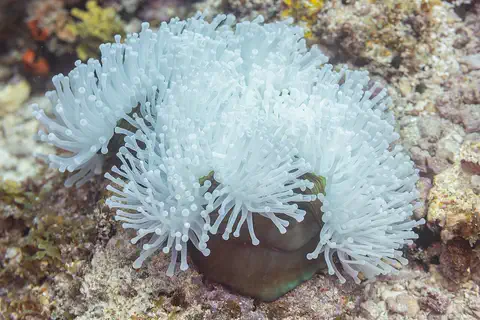
The magnificent sea anemone is a large sea anemone of warm Indian and Pacific Ocean reefs. Its body is a soft column topped with hundreds of finger-shaped tentacles, and it often perches on top of rocks in plain view. Many kinds of clownfish live safely among its stinging tentacles.
-
 Watch
Animal
Leatherback sea turtle
The leatherback sea turtle is the largest turtle on Earth. Instead of a hard shell it has tough, rubbery skin over a layer of tiny bones. It eats jellyfish, dives deeper than any other turtle and swims thousands of kilometers between feeding waters and the beaches where it lays its eggs.
-
 Watch
3D
Animal
Common octopus
The common octopus is a soft-bodied mollusc with eight sucker-lined arms. It lives in coastal waters, hides in a den by day, hunts snails and clams at night, and can change its color, skin texture and shape to vanish against rocks or sand. It lives only one to two years.
-
 Watch
Animal
Blue dragon
The blue dragon is a sea slug only about 3 centimeters long that floats upside down on the ocean's surface, held up by a bubble of gas in its stomach. It eats stinging animals such as the Portuguese man o' war and keeps their stinging cells in its own finger-like tips.
-
 Watch
3D
Animal
Ocean sunfish
The ocean sunfish, or mola, is one of the heaviest bony fish in the world. Its body is tall, round and flat, with a long fin on top, another underneath, and a strange frilly edge instead of a tail. It dives deep to eat jellyfish and is often seen resting at the surface, perhaps to warm up.
-
 Watch
Animal
Immortal jellyfish
The immortal jellyfish is a tiny sea jelly only about 3 millimeters across. Most jellyfish die after they grow up and make babies, but this one can do something amazing: a starving adult can turn back into a polyp, the young stage, and grow up all over again. It can still be eaten or get sick, so it does not really live forever.
For parents & teachers
What children will learn
- Describe the moon jellyfish's body and how it senses without a brain.
- Explain the two-stage life cycle of polyp and medusa.
- Describe how moon jellies catch plankton.
- Discuss why jellyfish blooms happen and why plastic in the sea harms jelly-eating animals.
Recommended ages: 3 to 17 · About 12 minutes
Talk about it
- How can an animal sense its world without a brain?
- Why might a polyp living on a rock be a good way to survive bad times?
- What can families do to keep plastic out of the ocean?
Try at home or in class
- Fill a clear zip bag with water and a few drops of food coloring to see how a body made mostly of water can look see-through.
- Draw the moon jelly life cycle as a circle: planula, polyp, strobila, ephyra, medusa.
Key vocabulary: cnidarian, plankton, polyp, medusa, ephyra, bloom
Where these facts come from
- GBIF Backbone Taxonomy and GBIF Occurrence Search , Global Biodiversity Information Facility (CC0 1.0 (backbone); occurrence counts are facts derived from records under CC0, CC BY and CC BY-NC)
- Aurelia aurita (moon jelly) , Animal Diversity Web, University of Michigan Museum of Zoology
- Moon jelly , Aquarium of the Pacific
- Moon jelly , Georgia Aquarium
- Wikidata , Wikimedia Foundation (CC0 1.0)
- Wikimedia Commons , Wikimedia Foundation (Per file: Public domain, CC0, CC BY or CC BY-SA only (credited on each page))
Checked, not yet human-reviewed. Last updated October 28, 2026. Spotted a mistake? Tell us.