
Animal
Ocean sunfish
The ocean sunfish is a huge, round, flat fish. It has no real tail. It likes to lie at the top of the sea in the sunshine.
The ocean sunfish, or mola, is one of the heaviest bony fish in the world. Its body is tall, round and flat, with a long fin on top, another underneath, and a strange frilly edge instead of a tail. It dives deep to eat jellyfish and is often seen resting at the surface, perhaps to warm up.
Mola mola, of the family Molidae, is a giant open-ocean fish with a truncated body, fused beak-like teeth and a rudder-like clavus in place of a tail fin. Females may produce up to 300 million eggs. It forages on gelatinous prey at depth and rewarms at the surface. The IUCN's global assessment lists it as Vulnerable, mainly because of bycatch.
Photo: U.S. National Oceanic and Atmospheric Administration, public domain, via Wikimedia Commons
Meet the ocean sunfish
The ocean sunfish is a giant fish.
It is round and flat, like a huge plate. It has a tall fin on top and one underneath. It has no real tail, just a wavy edge at the back.
The ocean sunfish looks as if someone forgot to finish its tail. Its body is tall, round and flat, with one long fin sticking up from its back and another sticking down from its belly. At the back, instead of a tail, it has a wavy, frilly edge.
It is also a giant. Ocean sunfish can grow to over 3 meters long and weigh more than 2,500 kilograms. The Gulf of Mexico Fishery Management Council says an average adult weighs about 1,000 kilograms, more than any other bony fish. Its scientific name, Mola, is the Latin word for a millstone, a big round stone once used to grind grain.
Mola mola belongs to the family Molidae, which the Australian Museum describes as the largest bony fishes in the world. It grows to at least 3.3 meters in total length, possibly 4 meters, and over 2,500 kilograms; the Gulf of Mexico Fishery Management Council gives an average adult weight of about 2,200 pounds (1,000 kilograms).
The genus name comes from the Latin for millstone, after its round shape. It belongs to the order Tetraodontiformes. The family includes several look-alike species: the Australian Museum lists five sunfishes in Australian waters alone, including Mola alexandrini and the hoodwinker sunfish, Mola tecta, described in 2018, which are told apart partly by the shape of the clavus.
Quick facts
- Group
- Fish
- Length
- up to 3.3 m
- Weight
- up to 2,500 kg
Where it lives
Ocean sunfish live far out in the open sea.
They swim in oceans all around the world. Sometimes they come near the coast.
Ocean sunfish live in the open ocean, in temperate and warm seas around the world. They are found in the Atlantic, Pacific and Indian Oceans, and only now and then come close to shore.
They travel up and down through the water. They dive into the cold, dark depths to feed, then return to the sunny surface to warm up. People often see them lying flat at the surface, or spot their tall back fin sticking out of the water and mistake them for sharks.
The ocean sunfish is oceanic, occurring in temperate and tropical seas worldwide and only occasionally coming inshore. In Australia, for example, the Australian Museum records it from the central coast of New South Wales to Tasmania and west to Mandurah in Western Australia.
The IUCN global assessment lists a depth range of 0 to 400 meters. Much of its life is spent moving vertically: it descends into cold, deep water to forage and returns to the surface, where its large dorsal fin can break the water and lead people to mistake it for a shark.
Its habitat

Where can you find this animal?
- Lives here naturally · Countries and seas named by a scientific source
- Sightings recorded · Records of wild sightings (GBIF)
Lives here naturally · Countries and seas named by a scientific source
Open temperate and tropical seas worldwide, from the surface to about 400 meters (IUCN; tagged fish have dived to 844 meters), occasionally coming close to shore. Shading is by whole ocean.
Places: Atlantic Ocean, Indian Ocean and Pacific Ocean.
Source: iucn-red-list · checked October 2026
Sightings recorded · Records of wild sightings (GBIF)
Counts of GBIF records of wild observations (human and machine) and preserved specimens. Records include introduced populations, vagrants, escaped or released animals and misidentifications, so a country with records is not necessarily part of the native range.
Wild sightings have been recorded in United States, France, Canada, Spain, Australia, Ireland, UK, Italy and 64 more places.
Source: gbif · checked October 2026
Range maps show where scientists say an animal lives, often country by country. An animal may live in only part of a country shown, and sightings records can include animals that wandered far from home.
A jellyfish feast
Ocean sunfish eat jellyfish.
They also eat other soft, wobbly sea animals. Sometimes they eat small fish and shrimp too.
Ocean sunfish eat jellyfish and other soft, see-through sea animals, such as salps and comb jellies. Now and then they also eat small crustaceans and fish.
Its mouth is small for its size, and its teeth are joined together into a hard, beak-like plate in each jaw.
The Australian Museum lists jellyfish, salps and ctenophores as the main diet, with occasional small crustaceans and fishes. Research it cites (Nakamura, Goto and Sato, 2015) found that ocean sunfish make deep excursions to forage for siphonophores, colonial animals related to jellyfish, and rewarm at the surface afterward, which may help explain their famous basking.
The mouth is small relative to the body, and the teeth in each jaw are fused into a single plate.
Did you know?
People sometimes think a sunfish's fin is a shark's fin.
When an ocean sunfish's tall back fin sticks out of the water, people sometimes mistake it for a shark.
The large dorsal fin breaking the surface often causes sunfish to be mistaken for sharks.
A fish without a tail
The ocean sunfish has no tail fin.
It swims by flapping its tall top fin and its bottom fin. They move back and forth together, like oars.
Most fish swim by sweeping their tail. The ocean sunfish does not have a true tail fin. Instead, the back of its body ends in a frilly flap called the clavus, from the Latin word for rudder.
To swim, it flaps its tall dorsal fin on top and its anal fin underneath. Both fins swing to the same side at the same time, back and forth, pushing the big fish through the water. It also has small side fins behind its eye.
Molas have no caudal fin. In its place is the clavus (Latin for rudder). Mola mola is identified by a wavy, frilly clavus edge with 11 to 14 clavus fin rays and by conical body scales; Mola alexandrini has a rounded clavus without an indent, and Mola tecta a rounded clavus with an indent.
Propulsion comes from the tall dorsal and anal fins, which the Australian Museum describes moving back and forth together in the same direction at the same time. The small pectoral fins sit behind the eye, and the teeth are fused into beak-like plates.
From a tiny egg to a giant
A mother ocean sunfish lays more eggs than almost any animal.
The eggs are tiny and float in the sea. Babies hatch very small and grow into giants.
Ocean sunfish lay an astonishing number of eggs. A single female can produce up to 300 million tiny eggs that float in the water. The parents release eggs and sperm into the sea, and the eggs are fertilized there.
The babies that hatch are tiny. Scientists still know very little about how young sunfish grow up, and it is hard to tell which kind of sunfish a baby is just by looking at it.
Sunfishes are extraordinarily fecund: a single adult female can produce up to 300 million small, buoyant eggs, and the Gulf of Mexico Fishery Management Council says females produce more eggs than any other known vertebrate. Fertilization is external, when eggs and sperm are shed into the water.
Early life history is poorly known. The Australian Museum explains that the features used to identify adult sunfish species are not visible in larvae, and researchers are using DNA analysis alongside body features to work out which larvae belong to which species. The IUCN gives a generation length of 8 to 10 years.
Sunbathing at the surface
Ocean sunfish lie on their side at the top of the sea.
Scientists think they are warming up after diving into cold, deep water.
Ocean sunfish are famous for lying on their side at the surface of the sea, as if sunbathing. This is called basking.
Many scientists think basking helps them warm up. Sunfish dive into cold, deep water to hunt for jellyfish-like animals, and their bodies cool down. Back at the warm surface, they may lie sideways to heat up again before the next dive. Not every study agrees, so scientists are still finding out.
Basking is the sunfish's best-known behavior. The Gulf of Mexico Fishery Management Council describes ocean sunfish lying sideways at the surface to warm up after long, deep dives into cold, dark water, and a 2015 study listed by the Australian Museum (Nakamura, Goto and Sato) is titled 'Ocean sunfish rewarm at the surface after deep excursions to forage for siphonophores.' The museum also quotes a 2010 tagging study in the northwest Atlantic (Potter and Howell) that found no link between time spent in cold water and time spent near the surface, and so no evidence there that basking is a way of warming up. Those tagged fish spent over 80 percent of their time in the top 200 meters, and the deepest dive recorded was 844 meters.
Ocean sunfish usually live far offshore, and only occasionally come inshore. Because the large dorsal fin can break the water as a sunfish swims, sightings are sometimes mistaken for sharks.
Did you know?
The name mola means a big, round grinding stone.
The ocean sunfish's scientific name, Mola, comes from the Latin word for millstone, because of its round shape.
Mola is Latin for millstone, a reference to the fish's rounded, disk-like shape.
Protecting ocean sunfish
There are fewer ocean sunfish than before.
Many get caught in fishing nets by mistake. Ships sometimes bump into them too.
The ocean sunfish is listed as Vulnerable, and its numbers are going down. The biggest problem is fishing: many sunfish are caught by accident in nets and on long fishing lines set for other fish.
Because sunfish rest at the surface, they can also be hit by ships. Scientists have studied where sunfish are caught by accident, to understand the problem better.
The IUCN's global assessment (June 2011, published 2015) lists Mola mola as Vulnerable under criterion A4bd, with a decreasing population; fishing is the listed threat, much of it as bycatch. The assessment is flagged as needing an update, and a separate European regional assessment (2013) lists the species as Data Deficient.
Research cited by the Australian Museum (Nyegaard and colleagues, 2018) studied sunfish bycatch in the southwest Pacific, and the museum notes that sunfish are also struck by ships, as when a steamer off Sydney found a 3.1-meter sunfish jammed in its propeller in 1908.
IUCN Red List
How is the ocean sunfish doing in the wild?
- Least Concern
- Near Threatened
- Vulnerable (this animal)
- Endangered
- Critically Endangered
- Extinct in the Wild
- Extinct
Vulnerable
At high risk of disappearing from the wild.
See the IUCN Red List assessment · The IUCN Red List of Threatened Species 2022.2
Amazing facts
-
The name mola means a big, round grinding stone.
The ocean sunfish's scientific name, Mola, comes from the Latin word for millstone, because of its round shape.
Mola is Latin for millstone, a reference to the fish's rounded, disk-like shape.
-
A sunfish mom can lay millions and millions of eggs.
One female ocean sunfish can produce up to 300 million eggs.
A single adult female can produce up to 300 million small buoyant eggs, which the Gulf of Mexico Fishery Management Council calls more than any other known vertebrate.
-
People sometimes think a sunfish's fin is a shark's fin.
When an ocean sunfish's tall back fin sticks out of the water, people sometimes mistake it for a shark.
The large dorsal fin breaking the surface often causes sunfish to be mistaken for sharks.
-
Sunfish teeth are joined together like a beak.
The teeth in each of a sunfish's jaws are joined together into one hard plate, like a beak.
The teeth in each jaw are fused into a single plate, and the mouth is small compared with the body.
Words to know
- clavus
- the frilly flap at the back of a sunfish, where a tail would be
- basking
- lying in the warmth of the sun
- dorsal fin
- a fin on a fish's back
- anal fin
- a fin on the underside of a fish, toward the back
- bycatch
- animals caught by accident in fishing gear meant for other fish
- salp
- a soft, see-through sea animal that drifts in the open ocean
Discovery challenge
-
What does the ocean sunfish have instead of a tail?
What does the ocean sunfish have instead of a tail fin?
What structure replaces the caudal fin in the ocean sunfish?
- A wavy flap called the clavus
- Two long legs
- A curly tail like a pig
Show the answer
A wavy flap called the clavus
It has a wavy flap called the clavus. It helps it steer.
The clavus, a stiff, frilly flap, takes the place of a tail and works like a rudder.
The clavus, with a wavy edge and 11 to 14 rays in Mola mola, replaces the caudal fin and acts as a rudder.
-
What do ocean sunfish eat?
What is the ocean sunfish's main food?
Which kind of prey makes up most of the ocean sunfish's diet?
- Jellyfish and other soft sea animals
- Grass
- Big sharks
Show the answer
Jellyfish and other soft sea animals
Ocean sunfish eat jellyfish and other soft sea animals.
They eat jellyfish, salps and comb jellies, and sometimes small crustaceans and fish.
Gelatinous zooplankton: jellyfish, salps, ctenophores and siphonophores, with occasional crustaceans and fishes.
-
Why do scientists think sunfish lie at the top of the sea?
Why do scientists think ocean sunfish bask at the surface?
Which explanation for surface basking does a 2015 study of ocean sunfish support?
- To sleep in a bed
- To warm up after deep, cold dives
- To build a nest
Show the answer
To warm up after deep, cold dives
Scientists think they warm up after diving into cold water.
They dive into cold, deep water to feed, then warm up in the sun at the surface.
Nakamura, Goto and Sato (2015) report surface rewarming after deep, cold foraging dives for siphonophores, though a 2010 northwest Atlantic tagging study found no evidence that basking is used for warming.
-
How does an ocean sunfish swim?
Which fins does an ocean sunfish use to swim?
How does the ocean sunfish produce thrust?
- By flapping its top and bottom fins
- By wagging a long tail
- By walking on the sea floor
Show the answer
By flapping its top and bottom fins
It flaps its tall top fin and its long bottom fin together.
It swings its dorsal fin and anal fin to the same side at the same time.
The dorsal and anal fins beat in the same direction at the same time; there is no caudal fin to provide thrust.
Places where you might see it
Explore next
-
 Watch
Animal
Moon jellyfish
The moon jellyfish is a clear, saucer-shaped jelly found in coastal seas around the world. It has no eyes, brain or heart, and it is about 95 percent water. Four horseshoe-shaped rings show through its bell, and short stinging tentacles fringe its edge to catch tiny plankton.
-
 Watch
3D
Animal
Basking shark
The basking shark is the second-biggest fish in the world, after the whale shark. It swims slowly near the surface with its enormous mouth open, sieving tiny floating animals called zooplankton out of the water. It is gentle and lives mainly in cool seas.
-
 Watch
Animal
Leatherback sea turtle
The leatherback sea turtle is the largest turtle on Earth. Instead of a hard shell it has tough, rubbery skin over a layer of tiny bones. It eats jellyfish, dives deeper than any other turtle and swims thousands of kilometers between feeding waters and the beaches where it lays its eggs.
-
 Watch
3D
Animal
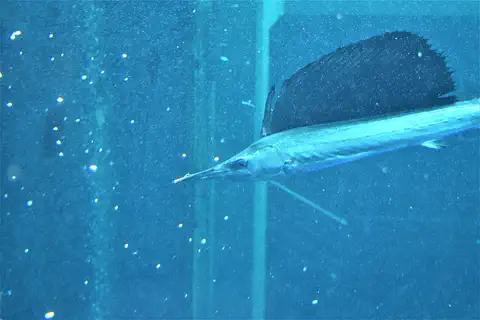
Indo-Pacific sailfish
The sailfish is a long, sleek ocean fish with a tall, sail-like fin on its back and a long, spear-shaped upper jaw called a bill. It hunts schools of small fish in warm seas, folding its sail away to speed up and raising it to make sharp turns.
-
 Watch
 Country
Australia
Australia is a country and the smallest continent, surrounded by ocean in the Southern Hemisphere. Much of its middle is dry and flat, most people live near the coast, and its animals include kangaroos, koalas and the platypus, a mammal that lays eggs.
-
 Watch
Animal
Emperor angelfish
The emperor angelfish is a striped reef fish from the Indian and Pacific Oceans. Adults are blue with bright yellow stripes, a yellow tail and a dark mask across the eyes. Young ones are dark blue with white and blue rings, and they change color as they grow. Emperor angelfish nibble sponges on the reef.
-
 Watch
Animal
Alligator gar
The alligator gar is one of the largest freshwater fish in North America. It has a broad snout lined with teeth, armor-like scales, and a swim bladder that works like a lung, so it can gulp air in warm, still water. It lives in the big rivers, swamps and bayous of the southern United States, Mexico and Central America.
-
 Watch
Animal
Arapaima
The arapaima is one of the biggest freshwater fish in the world, longer than a grown-up is tall. It lives in the warm, slow rivers and flooded lakes of the Amazon, and it must swim up to the surface to gulp air every few minutes.
For parents & teachers
What children will learn
- Describe the ocean sunfish's unusual body, including the clavus that replaces a tail.
- Explain how it swims using its dorsal and anal fins.
- Explain the idea that basking at the surface warms sunfish after deep feeding dives, and why scientists still debate it.
- Explain why bycatch threatens a slow-moving open-ocean fish.
Recommended ages: 3 to 17 · About 15 minutes
Talk about it
- Jellyfish are soft and watery. How might eating them be different from eating fish?
- Why do you think a fish might lay 300 million eggs?
- What could fishing boats do to catch fewer sunfish by accident?
Try at home or in class
- Cut a large round fish shape from cardboard, add a tall fin on top and a long fin below, and try flapping both fins to the same side at the same time.
- Put a little warm water and a little cold water in two bowls and dip a finger in each, then talk about why a sunfish might want to warm up after a cold, deep dive.
Key vocabulary: clavus, basking, dorsal fin, anal fin, bycatch, salp
Where these facts come from
- The IUCN Red List of Threatened Species , International Union for Conservation of Nature (IUCN terms of use (no redistribution of Red List data or range maps))
- GBIF Backbone Taxonomy and GBIF Occurrence Search , Global Biodiversity Information Facility (CC0 1.0 (backbone); occurrence counts are facts derived from records under CC0, CC BY and CC BY-NC)
- Mola mola (Ocean Sunfish), 2011 global assessment , IUCN Red List of Threatened Species
- Ocean Sunfish, Mola mola , Australian Museum
- Ocean sunfish (Mola mola), Ecosystems of the Deep , Gulf of Mexico Fishery Management Council
- Wikidata , Wikimedia Foundation (CC0 1.0)
- Wikimedia Commons , Wikimedia Foundation (Per file: Public domain, CC0, CC BY or CC BY-SA only (credited on each page))
Checked, not yet human-reviewed. Last updated October 28, 2026. Spotted a mistake? Tell us.