
Animal
Leatherback sea turtle
The leatherback is the biggest turtle in the world. It has tough, rubbery skin instead of a hard shell, and it swims across whole oceans.
The leatherback sea turtle is the largest turtle on Earth. Instead of a hard shell it has tough, rubbery skin over a layer of tiny bones. It eats jellyfish, dives deeper than any other turtle and swims thousands of kilometers between feeding waters and the beaches where it lays its eggs.
Dermochelys coriacea is the largest living turtle and the only sea turtle without scales or a hard shell. It has the widest distribution of any reptile, feeds on gelatinous animals from the tropics to the edges of subarctic waters, and is listed as Vulnerable worldwide, with its Pacific populations the most at risk of extinction.
Photo: Julien Renoult, CC BY 4.0, via Wikimedia Commons
Meet the leatherback
The leatherback is the biggest turtle in the world.
It is dark, with pale spots. Its back is covered in tough, rubbery skin, like leather, not a hard shell. It lives out in the big, deep ocean.
The leatherback is the largest turtle on Earth. A typical adult is about 1.5 to 1.8 meters long, as long as a grown-up is tall, and weighs about as much as five or six grown-ups put together.
It gets its name from its back. Other sea turtles have hard shells covered in scales, but the leatherback has tough, rubbery skin. Turtles shaped very like it were already swimming the seas when dinosaurs lived.
Dermochelys coriacea is the largest living turtle and one of the largest living reptiles. NOAA Fisheries gives adults as about 1.5 to 1.8 meters long and 340 to 450 kilograms; Britannica gives the biggest adults as up to about 2.4 meters and 900 kilograms.
It is the only member of its family, Dermochelyidae, and differs from every other sea turtle (family Cheloniidae): adults have no horny scales and no hard, plated shell. NOAA notes that it has existed in its current form since the age of the dinosaurs.
Quick facts
- Group
- Reptile
- Length
- 1.5 to 1.8 m
- Weight
- 340 to 450 kg
- Lifespan in the wild
- 45 to 50 years
Where it lives
Leatherbacks live in the Atlantic, Pacific and Indian Oceans.
They swim far out at sea. Mother turtles come to warm, sandy beaches to lay their eggs.
Leatherbacks live in the Atlantic, Pacific and Indian Oceans. They are found over a wider part of the world than any other reptile, from warm tropical seas to chilly waters off Canada.
Most of their lives are spent far from land. Females come ashore only to lay eggs, mostly on tropical beaches. Some of the biggest nesting beaches left are in Trinidad and Tobago in the Caribbean and Gabon in Africa.
The leatherback has the widest global distribution of any reptile. It occurs in the Atlantic, Pacific and Indian Oceans, from the tropics through temperate seas to the edges of subarctic water; Animal Diversity Web records it as far north as Newfoundland, Labrador and Norway and as far south as Argentina and South Africa. NOAA describes turtles tagged on feeding grounds off Nova Scotia, Canada, and tracked to Caribbean nesting beaches.
Nesting is mainly on tropical and subtropical beaches. NOAA names the largest remaining nesting aggregations as Trinidad and Tobago in the Northwest Atlantic and Gabon in the Southeast Atlantic. Western Pacific turtles nest in Indonesia, Papua New Guinea and the Solomon Islands, while Eastern Pacific turtles nest mainly in Mexico and Costa Rica. The map shows the oceans where leatherbacks live, not a nesting beach on every coast.
Its habitat

Where can you find this animal?
- Lives here naturally · Countries and seas named by a scientific source
- Sightings recorded · Records of wild sightings (GBIF)
Lives here naturally · Countries and seas named by a scientific source
Open ocean in the Atlantic, Pacific and Indian Oceans, from the tropics into cold, temperate waters. Females nest mainly on tropical and subtropical beaches; the largest nesting groups left are in Trinidad and Tobago and Gabon.
Places: Atlantic Ocean, Pacific Ocean and Indian Ocean.
Source: iucn-red-list · checked October 2026
Sightings recorded · Records of wild sightings (GBIF)
Counts of GBIF records of wild observations (human and machine) and preserved specimens. Records include introduced populations, vagrants, escaped or released animals and misidentifications, so a country with records is not necessarily part of the native range.
Wild sightings have been recorded in United States, South Africa, France, Ireland, Colombia, Mozambique, UK, Australia and 87 more places.
Source: gbif · checked October 2026
Range maps show where scientists say an animal lives, often country by country. An animal may live in only part of a country shown, and sightings records can include animals that wandered far from home.
What it eats
Leatherbacks love to eat jellyfish.
Jellyfish are soft and squishy. The turtle has a pointy, sharp-edged mouth that helps it grab them and hold on.
Leatherbacks eat mostly soft, see-through ocean animals such as jellyfish and salps, which drift in the open sea. Now and then they also eat squid, crustaceans (the animal group crabs belong to), fish or seaweed.
Jellyfish are slippery, so the leatherback's body is built to hold them. Instead of the crushing beak other sea turtles have, it has sharp-edged jaws with a pointed tip on each side, and its throat is lined with spines that point backward so food cannot slide out.
The leatherback is a specialist predator of gelatinous zooplankton, mainly jellyfish and salps; Britannica adds squid, crustaceans, fish and seaweed as occasional foods. Heaslip and colleagues call this a low-energy food, so a leatherback must eat a great deal of it. Turtles filmed with animal-borne cameras off Cape Breton Island, Nova Scotia, ate an estimated average of 330 kilograms of jellyfish a day, about 261 lion's mane jellyfish; if the turtles weighed about 455 kilograms, as the researchers assumed, that is roughly 73 percent of their body mass (Heaslip and colleagues, 2012).
Its feeding anatomy reflects this diet. NOAA describes pointed, tooth-like cusps and sharp-edged jaws in place of the crushing beak of hard-shelled sea turtles, and backward-pointing spines in the mouth and throat that keep soft prey from escaping. The same preference has a cost: floating plastic bags can look like jellyfish, and swallowing them harms the turtle.
Did you know?
Leatherbacks dive deeper than any other turtle.
A leatherback can dive about 1,200 meters down, deeper than any other turtle and deeper than most ocean mammals.
NOAA reports a deepest recorded dive of nearly 1,200 meters (about 4,000 feet), deeper than most marine mammals, with dives lasting up to 85 minutes.
An amazing body
The leatherback's back has seven long ridges, like stripes.
Its front flippers are very long. They work like big paddles in the water. A layer of fat helps keep the turtle warm in cold seas.
Under the leatherback's rubbery skin is a layer of tiny bones fitted together like a mosaic, with fat and connective tissue beneath. Seven ridges run from front to back, and the shell narrows to a blunt point at the tail end.
Its front flippers are longer, for its size, than any other sea turtle's. The leatherback can also stay warm in cold water. Its huge body, a layer of fat and a special network of blood vessels help it make and hold in heat, so it can feed in cold seas.
NOAA describes the carapace as small, interlocking dermal bones beneath the skin, overlying connective tissue and fat and then the deeper skeleton. Seven longitudinal ridges run its length and it tapers to a blunt point; NOAA says this carapace and the large flippers make the leatherback well equipped for long foraging migrations. The front flippers are proportionally longer than in any other sea turtle; the hind flippers are paddle-shaped.
Leatherbacks stay warm even in cold water. Britannica attributes this to large body size and an insulating fat layer, which let them produce and keep body heat, and to a specialized network of blood vessels that helps them stay warm in colder water. They are also extraordinary divers: NOAA reports dives to about 1,200 meters (nearly 4,000 feet) and dives lasting up to 85 minutes.
Growing up
A mother leatherback crawls up a beach at night.
She digs a deep hole and lays about 100 round eggs. After about two months, tiny baby turtles hatch and hurry to the sea.
Female leatherbacks come ashore at night on warm beaches. Each one digs a deep nest with her back flippers and lays about 100 eggs, each about the size of a billiard ball. She may nest several times in one season, about 8 to 12 days apart, and then not again for 2 to 4 years.
The eggs hatch after about two months. The warmth of the sand decides whether more babies are male or female. The hatchlings dig out and crawl to the sea on their own.
Females nest at night on tropical and subtropical beaches, excavating a large body pit and then a deep egg chamber with their hind flippers. NOAA reports clutches of about 100 eggs laid several times per season at 8- to 12-day intervals, with females returning to nest every 2 to 4 years; in the United States and the Caribbean the season runs from March to July.
Incubation takes about two months. As in all sea turtles, sex is set by nest temperature (temperature-dependent sex determination), so warming sand can shift hatchling sex ratios. Leatherbacks grow faster than hard-shelled turtles, but age at maturity is uncertain, with estimates of 9 to 20 years. Longevity is also poorly known: NOAA's estimates are 45 to 50 years or more.

Ocean travelers
Leatherbacks are super travelers.
They swim across whole oceans to find jellyfish. Then they swim all the way back to warm beaches to lay eggs.
Leatherbacks make the longest journeys of any sea turtle. Some swim more than 16,000 kilometers in a year, traveling between feeding waters and nesting beaches. Scientists follow them with small satellite tags.
They are amazing divers too. A leatherback can dive about 1,200 meters down, deeper than any other turtle, and stay under for more than an hour before it comes up to breathe.
Leatherbacks undertake the longest migrations between breeding and feeding areas of any sea turtle. NOAA reports some averaging about 6,000 kilometers (3,700 miles) each way and some covering more than 16,000 kilometers (10,000 miles) in a year.
Satellite tagging has revealed how complex these routes are. Western Pacific turtles nest in Indonesia, Papua New Guinea and the Solomon Islands and cross the ocean to feed off the Pacific coast of North America. NOAA notes that summer and winter nesters from the same region follow different routes, toward northern or southern foraging grounds. Why they dive to about 1,200 meters is not fully known. Smithsonian Ocean reports a 2008 study suggesting the dives work as scouting trips: their jellyfish prey moves deep during the day and rises at night.
Did you know?
The warmth of the sand decides if baby turtles are boys or girls.
The temperature of the sand around a nest decides whether more of the babies hatch as males or females.
Sea turtles have temperature-dependent sex determination, so rising sand temperatures can skew hatchling sex ratios, one way a changing climate affects them.
Helping leatherbacks
There are fewer leatherbacks than there used to be.
People help by keeping beaches dark at night and picking up plastic. Rangers and volunteers watch over nests so the babies can reach the sea.
Leatherbacks are listed as vulnerable worldwide, and some groups in the Pacific Ocean are in serious trouble. The biggest danger is getting caught by accident in fishing nets and lines. Taking eggs, losing nesting beaches and eating plastic by mistake also harm them.
You can help: use less plastic, and when you visit a nesting beach, keep lights off, fill in holes and stay well back from turtles and nests. Some of the most important beaches are protected by rangers and local people.
The IUCN Red List assessed the leatherback globally as Vulnerable in 2013. NOAA estimates the global population has declined about 40 percent over three generations, and the species is listed as endangered under the U.S. Endangered Species Act. Pacific populations are most at risk: nesting in the Eastern Pacific has fallen by more than 90 percent over three generations, and in Malaysia it went from about 10,000 nests in 1953 to fewer than one or two a year since 2003.
NOAA identifies bycatch in gillnets, trawls, longlines and buoy lines as the main global threat, followed by hunting and egg collection, loss of nesting beaches, artificial lighting, marine debris and changing ocean conditions. Responses include safer fishing gear, ranger patrols and community programs that protect nesting beaches (NOAA highlights partners in Indonesia and the Solomon Islands), and keeping beaches dark at night.
IUCN Red List
How is the leatherback sea turtle doing in the wild?
- Least Concern
- Near Threatened
- Vulnerable (this animal)
- Endangered
- Critically Endangered
- Extinct in the Wild
- Extinct
Vulnerable
At high risk of disappearing from the wild.
See the IUCN Red List assessment · The IUCN Red List of Threatened Species 2022.2
Amazing facts
-
The leatherback is the only sea turtle without a hard shell.
The leatherback is the only sea turtle with no hard shell and no scales. Its back is covered in tough, rubbery skin.
Leatherbacks lack both the horny scutes and the rigid plated shell of other sea turtles; their carapace is a mosaic of small dermal bones under leathery skin.
-
Leatherbacks dive deeper than any other turtle.
A leatherback can dive about 1,200 meters down, deeper than any other turtle and deeper than most ocean mammals.
NOAA reports a deepest recorded dive of nearly 1,200 meters (about 4,000 feet), deeper than most marine mammals, with dives lasting up to 85 minutes.
-
Leatherback eggs are about as big as a billiard ball.
A mother leatherback lays about 100 eggs at a time, each about the size of a billiard ball.
Clutches average about 100 eggs, laid several times a season at intervals of 8 to 12 days.
-
The warmth of the sand decides if baby turtles are boys or girls.
The temperature of the sand around a nest decides whether more of the babies hatch as males or females.
Sea turtles have temperature-dependent sex determination, so rising sand temperatures can skew hatchling sex ratios, one way a changing climate affects them.
Words to know
- carapace
- the top part of a turtle's shell
- migration
- a long journey animals make between places, often every year
- hatchling
- a baby animal that has just come out of its egg
- bycatch
- animals caught by accident in fishing gear meant for other fish
- reptile
- an air-breathing animal with a backbone, such as a turtle, lizard or snake
- vulnerable
- facing a high risk of dying out in the wild
Discovery challenge
-
What is a leatherback's back like?
What makes the leatherback different from all other sea turtles?
Which feature is unique to the leatherback among living sea turtles?
- Hard and bumpy
- Soft and rubbery
- Furry and fluffy
Show the answer
Soft and rubbery
Its back is soft and rubbery, like leather.
It has tough, rubbery skin and no hard shell or scales.
It lacks scutes and a rigid plated shell; small dermal bones under leathery skin form the carapace.
-
What do leatherbacks like to eat?
What is the leatherback's main food?
Which prey do the backward-pointing spines in a leatherback's throat help it hold on to?
- Jellyfish
- Grass
- Nuts
Show the answer
Jellyfish
Leatherbacks love jellyfish!
They eat mostly jellyfish and other soft drifting animals.
The spines keep slippery gelatinous prey such as jellyfish from sliding back out.
-
Where do leatherback mothers lay their eggs?
Where do female leatherbacks lay their eggs?
Which describes leatherback nesting?
- In a tree
- On a sandy beach
- On floating ice
Show the answer
On a sandy beach
They dig a nest in the sand on a warm beach.
They crawl up tropical beaches at night and dig deep nests in the sand.
Females nest at night on tropical and subtropical beaches, laying about 100 eggs several times a season.
-
How can people help baby turtles on the beach?
Which of these helps nesting sea turtles?
Which action during nesting season helps nesting females and hatchlings?
- Keep beaches dark at night
- Leave big holes in the sand
- Shine bright lights on the sea
Show the answer
Keep beaches dark at night
Dark beaches help baby turtles find the sea.
Bright lights can confuse hatchlings and scare mothers away, so dark beaches help.
Artificial light deters females from nesting and disorients hatchlings heading for the sea.
Places where you might see it
Explore next
-
 Watch
Animal
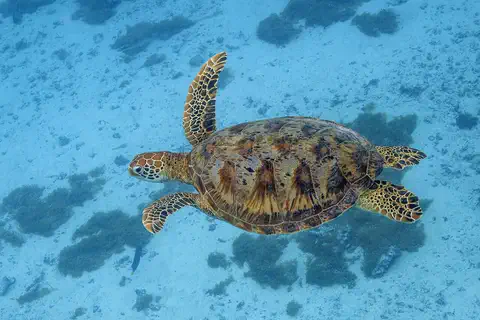
Green sea turtle
The green sea turtle is the largest sea turtle with a hard shell. It lives in warm seas around the world and, unlike other sea turtles, grown-ups eat mostly seagrass and algae. Females swim hundreds or even thousands of kilometers to lay their eggs on the beaches where they hatched long ago.
-
 Watch
Animal
Loggerhead sea turtle
The loggerhead sea turtle is named for its huge head and powerful jaws, which crush crabs, conchs and other hard-shelled animals. Babies hatch on sandy beaches, ride the open ocean for years and may cross an entire ocean before coming home to nest.
-
 Watch
3D
Animal
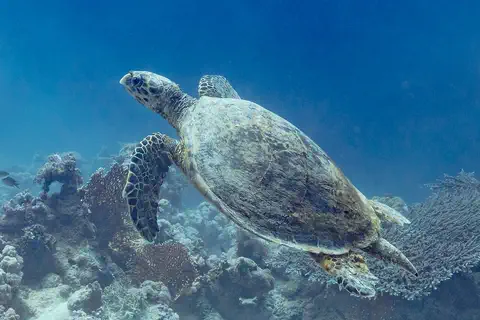
Hawksbill sea turtle
The hawksbill sea turtle lives in warm seas around the world, mostly near coral reefs. Its pointed, hawk-like beak reaches into cracks in the reef to find sponges, its favorite food. Its beautiful patterned shell once made it a target for hunters, and today it is critically endangered.
-
 Watch
 Country
Gabon
Gabon is a country on the Atlantic coast of Africa, right on the equator. About three-fourths of it is covered by dense rainforest, home to forest elephants, gorillas and mandrills. Most people live in towns and cities, and the 2026 census counted about 3.5 million people.
-
 Watch
Animal
Moon jellyfish
The moon jellyfish is a clear, saucer-shaped jelly found in coastal seas around the world. It has no eyes, brain or heart, and it is about 95 percent water. Four horseshoe-shaped rings show through its bell, and short stinging tentacles fringe its edge to catch tiny plankton.
-
 Watch
3D
Animal
Ocean sunfish
The ocean sunfish, or mola, is one of the heaviest bony fish in the world. Its body is tall, round and flat, with a long fin on top, another underneath, and a strange frilly edge instead of a tail. It dives deep to eat jellyfish and is often seen resting at the surface, perhaps to warm up.
-
 Watch
3D
Animal
Flatback sea turtle
The flatback sea turtle is named for its flat, smooth shell. It stays in shallow coastal seas around northern Australia, eats soft sea animals such as sea cucumbers and jellyfish, and nests only on Australian beaches, where its big hatchlings dash for the waves at night.
-
 Watch
Animal
Lion's mane jellyfish
The lion's mane jellyfish is one of the biggest jellyfish in the world. Its bell is usually 30 to 50 centimeters across, but in very cold seas it can grow to about 2 meters, and hundreds of long, hair-like tentacles trail beneath it to catch food.
For parents & teachers
What children will learn
- Describe how the leatherback differs from other sea turtles (no hard shell or scales, rubbery skin, ridged carapace).
- Explain how its body suits a diet of jellyfish and life in cold, deep water.
- Describe the sea turtle life cycle, from beach nest to ocean.
- Explain why the leatherback is Vulnerable and what helps it, including reducing plastic and keeping nesting beaches dark.
Recommended ages: 3 to 17 · About 15 minutes
Talk about it
- Why might a turtle that eats jellyfish need to travel so far?
- How could a plastic bag in the ocean be mistaken for food?
- Why do people turn off beach lights during turtle nesting season?
Try at home or in class
- Lay a 1.7 meter string on the floor and lie down beside it to see how long a leatherback is.
- Fill a clear bag with water and hold it next to a plastic bag in a bowl of water: talk about why a turtle might confuse them.
Key vocabulary: carapace, migration, hatchling, bycatch, reptile, vulnerable
Where these facts come from
- The IUCN Red List of Threatened Species , International Union for Conservation of Nature (IUCN terms of use (no redistribution of Red List data or range maps))
- GBIF Backbone Taxonomy and GBIF Occurrence Search , Global Biodiversity Information Facility (CC0 1.0 (backbone); occurrence counts are facts derived from records under CC0, CC BY and CC BY-NC)
- Wikidata , Wikimedia Foundation (CC0 1.0)
- Dermochelys coriacea (Leatherback Turtle), Red List assessment 2013 , IUCN Red List of Threatened Species
- Leatherback turtle , NOAA Fisheries
- Leatherback sea turtle (Dermochelys coriacea) , U.S. Fish and Wildlife Service
- Leatherback sea turtle , Encyclopaedia Britannica
- Dermochelys coriacea (leatherback sea turtle) , Animal Diversity Web, University of Michigan Museum of Zoology
- Jellyfish support high energy intake of leatherback sea turtles (Dermochelys coriacea): video evidence from animal-borne cameras (Heaslip et al., PLOS ONE, 2012) , PLOS ONE
- Sea turtles , Smithsonian Ocean, Smithsonian Institution
- Wikimedia Commons , Wikimedia Foundation (Per file: Public domain, CC0, CC BY or CC BY-SA only (credited on each page))
Checked, not yet human-reviewed. Last updated October 28, 2026. Spotted a mistake? Tell us.