Animal
Magnificent sea anemone
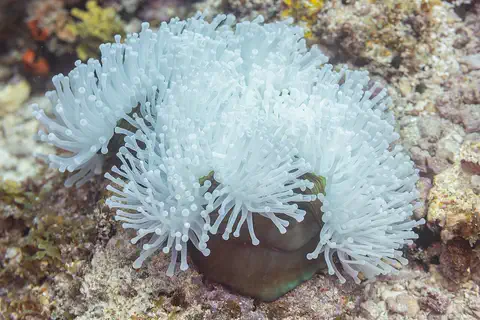
The magnificent sea anemone is a soft animal that looks like a flower. It lives on coral reefs, and clownfish make their home in its tentacles.
The magnificent sea anemone is a large sea anemone of warm Indian and Pacific Ocean reefs. Its body is a soft column topped with hundreds of finger-shaped tentacles, and it often perches on top of rocks in plain view. Many kinds of clownfish live safely among its stinging tentacles.
Radianthus magnifica (formerly Heteractis magnifica) is a clownfish-hosting sea anemone of the tropical Indo-Pacific, from the northern Red Sea to French Polynesia. Its oral disc can reach 1 m across; it hosts symbiotic algae, reproduces both sexually and by cloning, and, like corals, can bleach when the sea gets too warm.
Photo: Diego Delso, CC BY-SA 4.0, via Wikimedia Commons
Meet the magnificent sea anemone
The magnificent sea anemone looks like a big, soft flower. But it is an animal!
It has lots of wiggly tentacles with round tips. It holds on to a rock and waves its tentacles in the water. Clownfish like to live in it.
A sea anemone may look like a flower, but it is an animal, a relative of jellyfish and corals. The magnificent sea anemone is a big one: the round top of its body, called the oral disc, is usually 30 to 50 centimeters across, and the largest reach about 1 meter.
The oral disc is covered in densely packed, finger-shaped tentacles with blunt, rounded tips, up to 10 centimeters long. Unlike the other anemones that host clownfish, the magnificent sea anemone usually sits on top of rocks with its whole body in view, often showing off a brightly colored column underneath.
Radianthus magnifica (Quoy and Gaimard) is a sea anemone in the family Stichodactylidae. Titus and colleagues (Zootaxa, 2024) moved it from Heteractis to Radianthus and describe it as one of the most iconic clownfish-hosting anemones, with an oral disc up to 1 meter across; Animal Diversity Web gives a typical diameter of 300 to 500 millimeters.
Its tentacles are all alike, densely packed and digitiform, up to 100 millimeters long, sometimes split at the tip, and often with a small dot in the center of the blunt tip. They are typically tan, brown or green, sometimes purple with brightly colored tips. The column is usually vivid purple, magenta, red or orange, but can be tan or brown like the tentacles.
Quick facts
- Group
- Invertebrate
- Length
- 30 to 50 cm
Where it lives
Magnificent sea anemones live on coral reefs in warm seas.
They hold on to rocks, often in sunny, shallow water where the waves move.
Magnificent sea anemones live on tropical coral reefs in the Indian and Pacific Oceans, from the Red Sea to the islands of the central Pacific. They need fully tropical, warm water.
They attach to hard rock in open, prominent spots, especially on the outer slopes of reefs where waves and currents are strong. Some also live on calm patch reefs and on reef flats less than a meter deep.
Titus and colleagues (2024) give a range from the northern Red Sea (but not the Gulf of Aqaba) throughout the Indian Ocean and Coral Triangle to the central Pacific, at least as far east as French Polynesia and the Line Islands. It appears to need fully tropical water, not extending into the high-latitude subtropical waters of Japan or Australia, and seems absent from the Gulf of Aden, Gulf of Oman, Persian Gulf and much of the northern Arabian Sea.
It attaches its pedal disc to hard substrate in prominent positions, often on fore reefs, but is a habitat generalist that also occurs on calm patch reefs and reef flats under 1 meter deep. ADW gives depths of 1 to 50 meters and water of 24 to 32 °C. The map shades the Indian and Pacific Oceans, not the exact reefs.
Its habitat

Where can you find this animal?
- Lives here naturally · Countries and seas named by a scientific source
- Sightings recorded · Records of wild sightings (GBIF)
Lives here naturally · Countries and seas named by a scientific source
Tropical reefs from the northern Red Sea (not the Gulf of Aqaba) through the Indian Ocean and Coral Triangle to French Polynesia and the Line Islands. Absent from subtropical Japan and Australia, the Gulfs of Aden and Oman, the Persian Gulf and much of the northern Arabian Sea. Shading is by ocean, not the exact reefs.
Places: Indian Ocean and Pacific Ocean.
Source: https://publication.plazi.org/GgServer/xhtml/03818787645DFFD31BD2FE65FAE0770C · checked October 2026
Sightings recorded · Records of wild sightings (GBIF)
Counts of GBIF records of wild observations (human and machine) and preserved specimens. Records include introduced populations, vagrants, escaped or released animals and misidentifications, so a country with records is not necessarily part of the native range.
Wild sightings have been recorded in Indonesia, Thailand, Egypt, New Caledonia, Australia, Philippines, Malaysia, Tanzania and 27 more places.
Source: gbif · checked October 2026
Range maps show where scientists say an animal lives, often country by country. An animal may live in only part of a country shown, and sightings records can include animals that wandered far from home.
Sunlight and stings
The anemone catches small animals with its sticky, stinging tentacles.
It also has tiny helpers inside it. They use sunlight to make food and share it.
The magnificent sea anemone gets food in two ways. First, it hunts: when a small fish, shrimp or other small animal touches its tentacles, stinging cells fire and the tentacles pass the catch to the mouth in the middle of the oral disc.
Second, tiny algae live inside its body. Like plants, they use sunlight to make sugar, and they share some with the anemone. It can even creep slowly across the rock to reach more sunlight. Its clownfish partners help too: their waste gives the anemone useful nutrients.
ADW describes a carnivorous diet of small fish, shrimp, isopods, amphipods, mussels, sea urchins and plankton, captured by nematocysts and brought to the oral disc, plus glucose from photosynthesis by symbiotic algae living in its tissues. Nutrients such as nitrogen and sulfur absorbed from the waste of resident clownfish support its growth.
ADW adds that it can creep on its basal disc to reposition itself for more sunlight. Hobbs and colleagues (PLoS One, 2013) define bleaching as the loss of these symbiotic algae or their photosynthetic pigments.
Did you know?
Divers see this anemone more than any other clownfish home.
Because it sits out in the open on reef slopes, it is the clownfish-hosting anemone that scuba divers see most often.
Its conspicuous placement on fore reefs makes it the host anemone most encountered, and most photographed, by divers (Titus and colleagues, 2024).
Tentacles, disc and column
The anemone's body is like a soft tube.
The bottom sticks to a rock like a sucker. The top is covered in tentacles. When something scares it, it curls up into a ball!
An anemone's body is a simple tube called the column. Its bottom, the pedal disc, sticks to the rock like a suction cup, and its top, the oral disc, has the mouth in the middle, surrounded by tentacles.
The tentacles carry stinging cells for catching food and for defense. When it is disturbed, the magnificent sea anemone curls up into a ball, leaving only a small tuft of tentacles showing. It has no eyes or brain, just a net of nerves that lets it sense touch and chemicals in the water.
Titus and colleagues (2024) note that this is the only host anemone that regularly has its column and pedal disc fully exposed; in high-energy water the flared oral disc can hide both. Verrucae (small bumps) run in rows on the upper column and, unlike in some relatives, typically hold no debris. Disturbed animals, or possibly those that have just caught prey, curl into a ball with only a tuft of tentacles showing.
ADW notes that it has no eyes or centralized nervous system; nerve nets in the body wall control fast and slow responses to touch and chemicals, including the pre-feeding opening of the mouth.
Making more anemones
Some baby anemones grow from tiny eggs.
Others grow when an anemone splits in two! Then there are two anemones that are exactly the same.
Magnificent sea anemones can have young in two ways. In sexual reproduction, they release sperm and eggs into the water. A fertilized egg becomes a tiny swimming larva called a planula, which settles on the sea floor and grows into a new anemone.
They can also copy themselves. An anemone can split down the middle, or a piece of its foot can break off and grow into a new anemone. The copies are clones, so a rock can end up covered in dozens or even hundreds of identical anemones.
R. magnifica reproduces both sexually and asexually and occurs as solitary individuals or as clonal aggregations of dozens to hundreds (Titus and colleagues, 2024). ADW describes broadcast spawning with external fertilization producing ciliated planula larvae that settle and develop into polyps, and asexual reproduction by budding, binary fission or pedal laceration, mostly in winter.
ADW also reports that anemones hosting two orange-fin anemonefish (Amphiprion chrysopterus) split faster than those without them. How long magnificent sea anemones live in the wild is not known from these sources; Hobbs and colleagues describe host anemones in general as long-lived with low natural mortality.
Home of the clownfish
Clownfish live in the magnificent sea anemone's tentacles.
The tentacles do not sting them. The anemone keeps the clownfish safe, and the clownfish chase away animals that want to nibble the anemone.
The magnificent sea anemone is famous as a home for clownfish, also called anemonefish. ADW lists 12 kinds of clownfish that live in it, including the clown anemonefish and the orange clownfish. The clownfish are not hurt by its stings.
Both partners gain. The clownfish shelter among the tentacles with their young, safe from predators. In return they chase away animals that nibble the anemone, such as bristle worms, sometimes bring it bits of food, and their waste feeds it. Some small shrimp live under the oral disc too.
ADW lists 12 Amphiprion mutualists, including A. akallopisos, A. bicinctus, A. chrysopterus, A. clarkii, A. ocellaris, A. percula and A. perideraion. The fish are resistant to the anemone's nematocysts and gain protection for themselves and their eggs; the anemone gains defense against predators such as bristle worms, occasional food and nutrients from the fishes' waste. Titus and colleagues note that the shallowest anemones do not always host clownfish.
Hobbs and colleagues (2013) found that bleaching of host anemones can reduce the abundance and reproductive output of their anemonefishes, tying the fishes' future to the anemones'.
Did you know?
Lots of anemones on one rock can be copies of each other.
Magnificent sea anemones can clone themselves, making groups of dozens or even hundreds of identical anemones.
Asexual reproduction produces clonal aggregations of dozens to hundreds of individuals.
Warming seas
Magnificent sea anemones need warm, clean seas.
If the water gets too hot, they can turn pale. Anemones and their clownfish need seas that do not get too hot.
The magnificent sea anemone has not been assessed for the IUCN Red List. But like corals, it faces a growing problem: when the sea gets too warm, anemones can lose the tiny algae that live inside them and turn pale or white. This is called bleaching.
A study of reefs across the Indian and Pacific Oceans and the Red Sea found bleached anemones at 10 of 19 places, and during big heat waves 19 to 100 percent of the anemones surveyed were bleached. Bleaching can shrink anemones and leave fewer clownfish.
Radianthus magnifica has not been evaluated for the IUCN Red List (ADW: Not Evaluated; GBIF's Red List copy: Not Evaluated). Hobbs and colleagues (PLoS One, 2013) surveyed 13,896 host anemones of 10 species at 19 locations and confirmed bleaching in 7 species, including H. magnifica (for example 30 percent of 20 anemones at Christmas Island in 2005).
Overall 3.5 percent were bleached, but 19 to 100 percent during five major bleaching events linked to high water temperatures and coral bleaching. Because host anemones are long-lived with low natural mortality, the authors warn that more frequent and severe bleaching events could seriously threaten their populations unless they can acclimate or adapt.
Did you know?
Clownfish help feed their anemone.
Clownfish sometimes bring bits of food to their anemone, and their waste gives it nutrients.
The anemone absorbs nitrogen, sulfur and other nutrients from resident clownfish waste (ADW).
Amazing facts
-
A magnificent sea anemone can curl up into a ball!
When it is disturbed, a magnificent sea anemone curls into a ball with only a small tuft of tentacles showing.
Disturbed individuals, or possibly those that have just captured prey, curl into a ball leaving a small tuft of tentacles (Titus and colleagues, 2024).
-
Lots of anemones on one rock can be copies of each other.
Magnificent sea anemones can clone themselves, making groups of dozens or even hundreds of identical anemones.
Asexual reproduction produces clonal aggregations of dozens to hundreds of individuals.
-
Divers see this anemone more than any other clownfish home.
Because it sits out in the open on reef slopes, it is the clownfish-hosting anemone that scuba divers see most often.
Its conspicuous placement on fore reefs makes it the host anemone most encountered, and most photographed, by divers (Titus and colleagues, 2024).
-
Clownfish help feed their anemone.
Clownfish sometimes bring bits of food to their anemone, and their waste gives it nutrients.
The anemone absorbs nitrogen, sulfur and other nutrients from resident clownfish waste (ADW).
Words to know
- sea anemone
- a soft sea animal with a tube-shaped body and stinging tentacles, related to corals
- oral disc
- the top of an anemone, with the mouth in the middle
- column
- the tube-shaped body of an anemone
- mutualism
- a partnership in which both living things gain
- clone
- a living thing that is an exact genetic copy of another
- bleaching
- turning pale after losing the tiny algae that live inside
Discovery challenge
-
Is a sea anemone a plant or an animal?
What kind of living thing is the magnificent sea anemone?
To which group does Radianthus magnifica belong?
- A plant
- An animal related to corals and jellyfish
- A kind of fish
Show the answer
An animal related to corals and jellyfish
It looks like a flower, but it is an animal!
It is an animal, a cnidarian like corals and jellyfish.
A cnidarian sea anemone (Actiniaria, Stichodactylidae).
-
Which fish lives in the magnificent sea anemone?
Which fish is famous for living among this anemone's tentacles?
Which fishes form a mutualism with Radianthus magnifica?
- Sharks
- Clownfish
- Tuna
Show the answer
Clownfish
Clownfish live in its tentacles and are not stung.
Clownfish, also called anemonefish; ADW lists 12 kinds that live in it.
Anemonefishes (Amphiprion), 12 species according to ADW.
-
What helps the anemone make food from sunlight?
What lives inside the anemone and makes food from sunlight?
What supplies the anemone with sugar from photosynthesis?
- Tiny algae
- Clownfish eggs
- Sand
Show the answer
Tiny algae
Tiny algae inside it use sunlight to make food.
Tiny algae inside its body make sugar from sunlight and share it.
Symbiotic algae; losing them or their pigments is called bleaching.
-
What can happen to anemones when the sea gets too hot?
What can happen to an anemone when the sea gets too warm?
What did Hobbs and colleagues find in host anemones during warm-water events?
- They turn pale (bleach)
- They grow wings
- They turn into fish
Show the answer
They turn pale (bleach)
They can turn pale. This is called bleaching.
They can lose their algae and turn pale or white, which is called bleaching.
Bleaching in 19 to 100 percent of anemones surveyed during five major events, with reduced size and abundance in some species.
Places where you might see it
Explore next
-
 Watch
Animal
Ocellaris clownfish
The ocellaris clownfish is a small orange-and-white reef fish from the Indian and Pacific Oceans. It shelters among the stinging tentacles of a sea anemone, protected by a slimy coat, and every clownfish starts life as a male.
-
 Watch
Animal
Orange clownfish
The orange clownfish is a small, bright orange reef fish with three white bands edged in black. It lives in the warm western Pacific, from northern Australia to New Guinea and the Solomon Islands, always beside a sea anemone. A coat of slimy mucus keeps the anemone's stings from hurting it, and the fish and anemone help each other.
-
 Watch
Animal
Staghorn coral
Staghorn coral is a reef-building coral of Florida, the Bahamas and the Caribbean. Each colony is made of many tiny polyps that build a branching skeleton like a stag's antlers, and tiny algae living inside them give it food and color. Once one of the most common Caribbean corals, it is now critically endangered.
-
 Watch
Animal
Moon jellyfish
The moon jellyfish is a clear, saucer-shaped jelly found in coastal seas around the world. It has no eyes, brain or heart, and it is about 95 percent water. Four horseshoe-shaped rings show through its bell, and short stinging tentacles fringe its edge to catch tiny plankton.
-
 Watch
 Country
Tanzania
Tanzania is a country in East Africa, just south of the Equator, on the Indian Ocean. It has Mount Kilimanjaro, Africa's highest mountain, deep lakes in the East African Rift, and the Serengeti, where huge herds of wildebeest travel each year.
-
 Watch
Animal
Grooved brain coral
The grooved brain coral is a reef-building coral of the Caribbean, the Bahamas, southern Florida and Bermuda. Its tiny polyps live in long, winding valleys, which give the dome-shaped colony the look of a brain. A coral disease that spread from Florida since 2014 has hit it hard, and it is now critically endangered.
-
 Watch
Animal
Blue sea star
The blue sea star is easy to spot on Indian and Pacific Ocean reefs: bright blue, with five smooth, tube-shaped arms. It cleans up the reef by eating dead animals, tiny creatures and the thin film that grows on rocks, and it can grow back an arm it loses.
-
 Watch
Animal
American lobster
The American lobster is a big crustacean that lives on the rocky sea floor of the northwest Atlantic Ocean. It has two very different claws, one for crushing and one for tearing, and it must climb out of its hard shell again and again to grow.
For parents & teachers
What children will learn
- Explain that a sea anemone is an animal and describe its tentacles, oral disc and column.
- Describe the partnership between the magnificent sea anemone and clownfish.
- Explain how symbiotic algae help feed the anemone and what bleaching is.
- Describe sexual and asexual (clonal) reproduction.
Recommended ages: 3 to 17 · About 12 minutes
Talk about it
- How do the clownfish and the anemone each benefit from living together?
- Why might an anemone that relies on algae prefer bright, open places?
- How could warming seas affect both anemones and clownfish?
Try at home or in class
- Make a model anemone from a paper cup and pipe cleaners, and a clownfish from paper, to act out how the partners help each other.
- Measure 40 centimeters across a table to see how wide a typical magnificent sea anemone is.
Key vocabulary: sea anemone, oral disc, column, mutualism, clone, bleaching
Where these facts come from
- GBIF Backbone Taxonomy and GBIF Occurrence Search , Global Biodiversity Information Facility (CC0 1.0 (backbone); occurrence counts are facts derived from records under CC0, CC BY and CC BY-NC)
- Radianthus magnifica, in Titus et al. 2024, The clownfish-hosting sea anemones: updated nomenclature, biogeography, and practical field guide (Zootaxa 5506) , Plazi TreatmentBank
- Heteractis magnifica (magnificent sea anemone) , Animal Diversity Web, University of Michigan Museum of Zoology
- Taxonomic, spatial and temporal patterns of bleaching in anemones inhabited by anemonefishes (Hobbs et al., PLoS One 2013) , PLoS One, via PubMed Central
- Wikidata , Wikimedia Foundation (CC0 1.0)
- Wikimedia Commons , Wikimedia Foundation (Per file: Public domain, CC0, CC BY or CC BY-SA only (credited on each page))
Checked, not yet human-reviewed. Last updated October 28, 2026. Spotted a mistake? Tell us.