
Animal
Northern mockingbird
The northern mockingbird is a gray bird with a long tail. It can copy the songs of other birds, and even a barking dog!
The northern mockingbird is a slim gray songbird famous for copying sounds. It sings long strings of phrases, many borrowed from other birds, and sometimes sings all night. It lives in towns, farms and brushy places across the United States, Mexico and the Caribbean.
Mimus polyglottos is a North American songbird of the mockingbird and thrasher family with a large repertoire of songs, calls and imitations. It thrives in human-made habitats, defends its nest boldly, and is listed as Least Concern, though survey data show a slow decline.
Photo: Rhododendrites, CC BY-SA 4.0, via Wikimedia Commons
Meet the northern mockingbird
The mockingbird is a gray bird with a long tail.
It is a super singer. It can copy the songs of other birds. It can even copy a dog's bark! Press play to hear a real mockingbird sing.
The northern mockingbird is a slim, gray songbird about the size of an American robin, with a long tail and flashes of white on its wings and tail.
It is famous for its singing. A mockingbird sings long strings of phrases, repeating each one several times, and it often copies the songs of other birds and other sounds, such as a dog barking. Press play to hear a real mockingbird singing in Florida.
Mimus polyglottos is a member of the family Mimidae, the mockingbirds and thrashers. Adults are 20 to 25 centimeters long and weigh 45 to 57 grams. Both sexes are pale gray with white wing patches and white outer tail feathers; males are slightly larger.
Audubon describes the song as a long series of musical and grating phrases, each repeated three or more times, often including imitations of other birds. Animal Diversity Web credits the species with at least 39 songs and 50 call notes, plus mimicry of sounds such as dogs barking. The recording on this step is a male singing a wide range of songs in Tamiami, Florida.
Quick facts
- Group
- Bird
- Length
- 0.2 to 0.25 m
- Wingspan
- 0.3 to 0.35 m
- Weight
- 0.05 to 0.06 kg
Where it lives
Mockingbirds live in North America and on islands in the Caribbean Sea.
They like towns, parks, farms and bushy places. Many live right next to people.
Northern mockingbirds live across much of the United States and Mexico, in Canada in small numbers, and on Caribbean islands such as Cuba, Jamaica, Hispaniola, Puerto Rico and the Bahamas.
They like places with thick, low bushes next to open ground, such as short grass or bare soil. That makes towns and suburbs perfect: hedges and lawns! They also live on farms, at woodland edges, and in desert thickets in the West.
The IUCN's 2025 global assessment lists the species as resident in the United States, Canada, Mexico, the Bahamas, Cuba, the Dominican Republic, Haiti, Jamaica, Puerto Rico, the Turks and Caicos Islands and both sets of Virgin Islands, up to 3,100 meters.
It uses open habitats with shrubs: early successional growth, desert scrub, forest edge and grassland, and also parks, farms, gardens, cemeteries and urban areas with enough trees and shrubs. Movements are debated. The IUCN codes it as not a migrant; Audubon calls its migration poorly understood, with some birds moving south in fall; Animal Diversity Web says most northern breeders move south for the winter.
Continent
Its habitat

Where can you find this animal?
- Lives here naturally · Countries and seas named by a scientific source
- Sightings recorded · Records of wild sightings (GBIF)
Lives here naturally · Countries and seas named by a scientific source
Towns, suburbs, farms, brushy fields, woodland edges and desert thickets across much of the United States and Mexico, southern Canada and the Caribbean islands. In Canada they are scarce (about 12,000 birds by one estimate).
Places: United States, Canada, Mexico, Bahamas, Cuba, Dominican Rep., Haiti, Jamaica and 1 more places.
Source: iucn-red-list · checked October 2026
Sightings recorded · Records of wild sightings (GBIF)
Counts of GBIF records of wild observations (human and machine) and preserved specimens. Records include introduced populations, vagrants, escaped or released animals and misidentifications, so a country with records is not necessarily part of the native range.
Wild sightings have been recorded in United States, Mexico, Canada, Puerto Rico, Cuba, Bahamas, Dominican Rep., Jamaica and 17 more places.
Source: gbif · checked October 2026
Range maps show where scientists say an animal lives, often country by country. An animal may live in only part of a country shown, and sightings records can include animals that wandered far from home.
What it eats
Mockingbirds eat bugs and berries.
In summer they catch beetles, grasshoppers and caterpillars. In fall and winter they eat lots of berries and fruit.
Over a whole year, a mockingbird's meals are about half insects and other small creatures and half berries and fruit. In late spring and summer it eats lots of beetles, grasshoppers, caterpillars, ants and wasps, plus spiders, snails and earthworms.
In fall and winter it switches mainly to berries and wild fruit. Mockingbirds hunt by running across lawns or by watching from a low perch and dropping down to grab food.
Audubon describes an annual diet of roughly half arthropods and half fruit. In late spring and summer the birds feed heavily on insects, especially beetles, grasshoppers, caterpillars, ants and wasps, and also take spiders, snails, sowbugs, earthworms and, rarely, crayfish and small lizards. Fall and winter diets depend heavily on berries and wild fruits.
Most insects are caught on the ground while the bird walks or runs, or by dropping from a low perch. Running in the open, a mockingbird may stop every few feet and partly spread its wings, flashing the white wing patches.
Did you know?
A mockingbird can copy a dog's bark.
Mockingbirds can copy other birds' songs and even sounds like a dog barking.
Beyond at least 39 songs and 50 call notes of its own, the species imitates other birds and non-bird sounds such as barking dogs.
A slim gray singer
The mockingbird is gray on top and pale underneath.
It has a long tail. When it opens its wings, you can see big white patches.
A mockingbird is slim, with long legs and a long tail. Its back is gray and its belly is pale. When it flies or spreads its wings, big white patches flash on each wing, and white feathers show along the edges of its tail.
Its bill is black, long and slightly curved. Males and females look alike, though males are a little bigger. Young mockingbirds have spots on their chests.
Northern mockingbirds have long legs and tails and short, rounded wings (Animal Diversity Web). Upperparts are gray, underparts pale; a large white patch on each wing and white outer tail feathers are conspicuous in flight. The black bill is long and slightly decurved.
The sexes are similar: Animal Diversity Web gives males 22 to 25.5 centimeters and about 51 grams, females 20.8 to 23.5 centimeters and about 47 grams, with slightly darker tail feathers in females. Juveniles have spotted or streaked underparts and darker eyes than adults.
Growing up
Mockingbirds build nests in thick bushes.
The mother lays three or four eggs. Mom and dad both feed the babies. Mockingbirds can raise two or three families in one year!
In the South, mockingbirds start nesting by late winter. The male builds most of the base of twigs, and the female adds a soft lining of roots, moss, hair and plant fluff. The nest sits in a thick bush or tree, usually 1 to 3 meters up.
The female lays 3 or 4 bluish or greenish eggs with brown blotches and keeps them warm for 12 to 13 days. Both parents feed the chicks, which leave the nest about 12 days after hatching but can't fly well for about another week. Pairs raise 2 or 3 families a year.
Breeding starts early, by late winter in southern areas (Audubon). The nest has a bulky twig foundation, built mostly by the male, supporting an open cup of weeds, grass and leaves lined by the female with rootlets, moss, hair and plant down, usually 3 to 10 feet (about 1 to 3 meters) up in a dense shrub or tree.
Clutches are usually 3 or 4 eggs (2 to 6), incubated by the female for 12 to 13 days. Both parents feed the altricial nestlings, which leave at about 12 days but fly poorly for another week. Animal Diversity Web notes that the female often starts a new nest while the male keeps feeding the fledglings; pairs raise 2 or 3 broods a year (up to 4 by ADW's count), and young can breed at one year old.
The copycat singer
Mockingbirds sing all day in spring. Sometimes they sing all night too!
They are brave. They chase cats away from their nests.
Mockingbirds sing all day during the nesting season, and often all night as well, especially in bright spring moonlight. A male sings to defend his territory and to attract a mate, sometimes jumping a few feet into the air and flapping his wings as he sings.
Mockingbirds are bold nest guards. They will attack cats, dogs and even people who come too close to their nest.
Song is heard all day in the nesting season and often at night (Audubon; the Florida Department of State notes night singing especially under bright spring moonlight). Males sing to defend territory and attract mates, often leaping into the air with flapping wings; early courtship includes the male and female chasing each other rapidly around the territory.
Mockingbirds are solitary and territorial, and during nesting they attack animals as large as cats, dogs and humans near the nest. Its mimicry covers other birds' songs and also non-bird sounds such as barking dogs (Animal Diversity Web).
Did you know?
Mockingbirds are the state bird of five states.
The mockingbird is the state bird of Arkansas, Florida, Mississippi, Tennessee and Texas.
Florida made the mockingbird its state bird in 1927; it is also the state bird of Arkansas, Mississippi, Tennessee and Texas.
From cages to comeback
Long ago, people caught many mockingbirds to keep as pets.
Now that is against the law. Mockingbirds came back, and many live near people today.
From the late 1700s to the early 1900s, people caught many mockingbirds to sell as caged singing pets. They became rare in some northern places. After that trade was stopped, mockingbirds became common again.
Today there are about 43 million of them, and the IUCN lists them as Least Concern. But bird surveys show their numbers slowly falling, and scientists are not yet sure why. Mockingbirds are the state bird of Arkansas, Florida, Mississippi, Tennessee and Texas.
Trapping for the cagebird trade, from the late 1700s to the early 1900s, caused drastic declines in parts of the range; populations rebounded after the trade was banned, though the IUCN notes reports of illegal trade from Mexico and South America. The species has since spread north, especially in the northeastern United States; Audubon suggests planted multiflora rose may have helped.
The IUCN's 2025 global assessment lists it as Least Concern, with about 43 million birds (Partners in Flight 2020) and a Breeding Bird Survey decline of 13 to 18 percent over three generations. The causes are uncertain: possibly reforestation of farmland and larger farms with less edge habitat, and exposure to lead and other contaminants in human-dominated areas.
IUCN Red List
How is the northern mockingbird doing in the wild?
- Least Concern (this animal)
- Near Threatened
- Vulnerable
- Endangered
- Critically Endangered
- Extinct in the Wild
- Extinct
Least Concern
Not at risk of disappearing from the wild right now.
See the IUCN Red List assessment · The IUCN Red List of Threatened Species 2021.3
Amazing facts
-
Mockingbirds sometimes sing all night long.
Mockingbirds often sing at night, especially under bright spring moonlight.
Audubon notes that song is heard all day during nesting and often all night; the Florida Department of State links night singing with bright spring moonlight.
-
A mockingbird can copy a dog's bark.
Mockingbirds can copy other birds' songs and even sounds like a dog barking.
Beyond at least 39 songs and 50 call notes of its own, the species imitates other birds and non-bird sounds such as barking dogs.
-
Mockingbirds are the state bird of five states.
The mockingbird is the state bird of Arkansas, Florida, Mississippi, Tennessee and Texas.
Florida made the mockingbird its state bird in 1927; it is also the state bird of Arkansas, Mississippi, Tennessee and Texas.
-
Brave mockingbirds chase cats away from their nests.
Mockingbirds are bold: during nesting they will attack cats, dogs and even people who come too close.
Nesting mockingbirds attack intruders as large as cats, dogs and humans, part of a strongly territorial life.
Words to know
- mimic
- an animal that copies the sounds or looks of something else
- repertoire
- all the different songs and calls an animal can make
- territory
- an area an animal defends against others of its kind
- brood
- a family of chicks hatched from one set of eggs
- fledgling
- a young bird that has just left the nest
Discovery challenge
-
What is a mockingbird famous for?
What is the northern mockingbird best known for?
Which ability is the northern mockingbird best known for?
- Swimming under water
- Copying sounds
- Building nests on the ground
Show the answer
Copying sounds
Mockingbirds copy other birds' songs, and even a dog's bark!
Mockingbirds sing many songs and copy other birds and other sounds, such as barking dogs.
It mimics other species and sounds such as barking dogs, alongside a large repertoire of its own songs and calls.
-
What color is a mockingbird?
What does a northern mockingbird look like?
Which describes an adult northern mockingbird?
- Gray, with white patches on its wings
- Bright red all over
- Black with a yellow beak
Show the answer
Gray, with white patches on its wings
It is gray, with white patches on its wings.
It is slim and gray, with a long tail and white patches that flash on its wings.
Pale gray, slim and long-tailed, with white wing patches and white outer tail feathers.
-
What does a mockingbird do if a cat comes near its nest?
How does a mockingbird react to a cat near its nest?
How do nesting mockingbirds respond to cats near the nest?
- It chases the cat away
- It falls asleep
- It gives the nest to the cat
Show the answer
It chases the cat away
Mockingbirds are brave. They chase cats away.
Mockingbirds bravely attack cats, dogs and even people who get too close to their nest.
They are bold, territorial nest defenders that attack animals as large as cats, dogs and humans.
-
When do mockingbirds sing?
When can you hear mockingbirds singing in nesting season?
When do northern mockingbirds sing during the nesting season?
- Never
- All day, and often at night
- Only at noon
Show the answer
All day, and often at night
They sing all day, and sometimes all night!
During the nesting season they sing all day, and often all night as well.
Song is heard all day during the nesting season and regularly at night.
Places where you might see it
-
 Watch
 Country
United States
The United States is a large country in North America made of 50 states, from icy Alaska to the warm islands of Hawaii. It has the Grand Canyon, the Mississippi River and Yellowstone, and about 342 million people live there.
-
 Watch
 Country
Mexico
Mexico is a large country in southern North America, between the Pacific Ocean and the Gulf of Mexico. It has smoking volcanoes, ancient cities built by the Maya and other peoples, and about 132 million people, many of them in and around Mexico City.
Explore next
-
 Watch
Animal
Superb lyrebird
The superb lyrebird is a large, ground-living songbird of Australia's moist forests. It is a famous copycat: most of its song is made of sounds borrowed from other birds and even machines. The male has a spectacular tail that he throws over his head as he dances and sings.
-
 Watch
3D
Animal
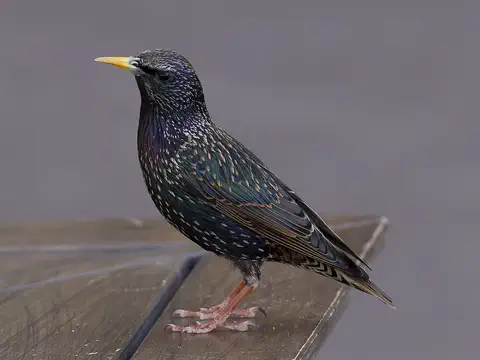
Common starling
The common starling, also called the European starling, is a glossy, spotted songbird from Europe, Asia and North Africa. It is a brilliant copycat that can imitate other birds and even car alarms, and in winter huge flocks swirl through the evening sky in shows called murmurations. People also carried starlings to North America, Australia and other places, where they now live in the wild.
-
 Watch
Animal
American goldfinch
The American goldfinch is a small finch that eats almost nothing but seeds. In summer the male is bright lemon yellow with a black cap and black wings, and in winter both males and females turn a soft olive brown. Goldfinches wait until late summer to build their nests.
-
 Watch
Animal
Northern cardinal
The northern cardinal is a crested songbird of eastern North America and Mexico. Males are brilliant red with a black face; females are warm brown with red touches. Cardinals crack seeds with their thick bills, stay in the same area all year, and both males and females sing.
-
Watch
Country
United States
The United States is a large country in North America made of 50 states, from icy Alaska to the warm islands of Hawaii. It has the Grand Canyon, the Mississippi River and Yellowstone, and about 342 million people live there.
-
Watch
Country
Mexico
Mexico is a large country in southern North America, between the Pacific Ocean and the Gulf of Mexico. It has smoking volcanoes, ancient cities built by the Maya and other peoples, and about 132 million people, many of them in and around Mexico City.
-
 Watch
Animal
Common nightingale
The common nightingale is a plain brown songbird with one of the most famous songs in the world. Males sing from thick bushes, often in the middle of the night, and every year the birds fly from Europe and Asia to Africa for the winter.
-
 Watch
Animal
Adélie penguin
The Adélie penguin is a medium-sized penguin, about 70 centimeters tall, with a black back, a white front and a bright white ring around each eye. It breeds in summer on rocky, ice-free ground all around Antarctica, building nests of pebbles, and spends the winter far out at sea among the pack ice.
For parents & teachers
What children will learn
- Describe how the northern mockingbird looks and how to recognize it.
- Explain what mimicry is and how mockingbirds use song.
- Describe the mockingbird's nesting and how often it raises young.
- Understand how the end of the cagebird trade helped mockingbirds recover.
Recommended ages: 3 to 17 · About 12 minutes
Talk about it
- Why might a bird copy the songs of other birds?
- Why do you think mockingbirds do well in towns and suburbs?
- Why was it a good idea to stop people keeping wild songbirds in cages?
Try at home or in class
- Play the mockingbird recording and count how many times it repeats a phrase before switching to a new one.
- Take turns being a mockingbird: one person makes a short sound, and the others copy it three times.
Key vocabulary: mimic, repertoire, territory, brood, fledgling
Where these facts come from
- The IUCN Red List of Threatened Species , International Union for Conservation of Nature (IUCN terms of use (no redistribution of Red List data or range maps))
- GBIF Backbone Taxonomy and GBIF Occurrence Search , Global Biodiversity Information Facility (CC0 1.0 (backbone); occurrence counts are facts derived from records under CC0, CC BY and CC BY-NC)
- Mimus polyglottos (Northern Mockingbird), global Red List assessment 2025 , IUCN Red List of Threatened Species
- Northern Mockingbird, Audubon Field Guide , National Audubon Society
- Mimus polyglottos (northern mockingbird) , Animal Diversity Web, University of Michigan Museum of Zoology
- State Bird: Mockingbird , Florida Department of State
- Wikidata , Wikimedia Foundation (CC0 1.0)
- Wikimedia Commons , Wikimedia Foundation (Per file: Public domain, CC0, CC BY or CC BY-SA only (credited on each page))
Checked, not yet human-reviewed. Last updated October 27, 2026. Spotted a mistake? Tell us.