
Animal
Adélie penguin
The Adélie penguin is a black and white penguin with a white ring around each eye. It builds a nest of pebbles on the rocky coast of Antarctica.
The Adélie penguin is a medium-sized penguin, about 70 centimeters tall, with a black back, a white front and a bright white ring around each eye. It breeds in summer on rocky, ice-free ground all around Antarctica, building nests of pebbles, and spends the winter far out at sea among the pack ice.
Pygoscelis adeliae is a medium-sized penguin that breeds around the entire Antarctic coast on ice-free rock and winters in the pack ice, feeding mainly on krill and fish. Listed as Least Concern, it numbers about 10 million mature birds and was increasing in the IUCN's 2020 assessment, though trends differ between regions.
Photo: Andrew Shiva / Wikipedia, CC BY-SA 4.0, via Wikimedia Commons
Meet the Adélie penguin
The Adélie penguin is a black and white penguin.
It has a black head and back and a white tummy. A white ring goes around each eye. It cannot fly, but it is a great swimmer.
The Adélie penguin is a medium-sized penguin. It stands about 70 centimeters tall and weighs 3 to 6 kilograms. It is black on its head and back and white on its front, and you can always spot it by the bright white ring around each eye.
It is much smaller than its neighbor the emperor penguin, the largest penguin. Males and females look alike and are about the same size. Its close relatives include the gentoo and chinstrap penguins.
Pygoscelis adeliae belongs to the genus Pygoscelis and is closely related to the gentoo and chinstrap penguins. The Australian Antarctic Division gives adults a standing height of about 70 centimeters and a weight of 3 to 6 kilograms; males and females are of similar size and hard to tell apart.
The plumage is simple: black head, throat and back, white underparts and a conspicuous white eye ring. The species was described after the French Antarctic expedition led by Jules Dumont d'Urville reached the coast in 1840; d'Urville named the land Adélie Land after his wife, and the expedition's scientists Jacques Hombron and Charles Jacquinot gave the penguin the same name.
Quick facts
- Group
- Bird
- Height
- 0.7 m
- Weight
- 3 to 6 kg
- Top speed
- up to 8 km/h
- Lifespan in the wild
- 10 to 20 years
Where it lives
Adélie penguins live all around Antarctica.
In summer they nest on rocky ground by the sea. In winter they swim far out among floating ice.
Adélie penguins breed all the way around the coast of Antarctica and on small nearby islands, wherever there is bare, exposed rock. Each summer they come ashore to raise their chicks.
In winter they leave the coast and live at sea in the pack ice, the broken, floating sea ice around Antarctica. Scientists tracking them have found that they can swim more than 1,200 kilometers from their breeding colony.
The IUCN's 2020 global assessment lists breeding populations in Antarctica and in the territory of South Georgia and the South Sandwich Islands, with stray birds recorded in Argentina, Australia, the Falkland Islands, the French Southern Territories, Heard Island and New Zealand. It forages at sea to depths of about 180 meters.
According to the Australian Antarctic Division, colonies occupy ice-free rocky ground around the entire Antarctic coast and on small offshore islands. Good habitat is snow-free, not too steep and not flat, with plenty of pebbles for nests. After breeding the birds disperse into the pack ice, and tracked Adélies have traveled more than 1,200 kilometers from their colonies. Much less is known about their winter lives than about the breeding season.
Continent
Its habitat

Where can you find this animal?
- Lives here naturally · Countries and seas named by a scientific source
- Sightings recorded · Records of wild sightings (GBIF)
Lives here naturally · Countries and seas named by a scientific source
Breeds on ice-free rocky coasts and small islands all around Antarctica, and in the territory of South Georgia and the South Sandwich Islands, which has no separate map shape; spends the winter at sea in the pack ice of the Southern Ocean. Stray birds occasionally reach South America, Australia and New Zealand.
Places: Antarctica and Southern Ocean.
Source: iucn-red-list · checked October 2026
Sightings recorded · Records of wild sightings (GBIF)
Counts of GBIF records of wild observations (human and machine) and preserved specimens. Records include introduced populations, vagrants, escaped or released animals and misidentifications, so a country with records is not necessarily part of the native range.
Wild sightings have been recorded in Antarctica, Australia, Argentina, New Zealand, Fr. Southern Lands, United States, UK, Norway and 13 more places.
Source: gbif · checked October 2026
Range maps show where scientists say an animal lives, often country by country. An animal may live in only part of a country shown, and sightings records can include animals that wandered far from home.
What it eats
Adélie penguins eat krill, which are tiny shrimp-like animals.
They also eat small fish. They dive under the water to catch their food.
Adélie penguins eat krill, small shrimp-like animals, along with fish and other tiny crustaceans called amphipods. What they eat depends on where they feed.
Near the colony, within about 20 kilometers, they catch mostly fish, amphipods and a small kind of krill called crystal krill. Farther out to sea they mostly eat Antarctic krill. Parents carry the food back in their stomachs and bring it up for their chicks: a meal can weigh 300 to 650 grams.
Diet varies with foraging location. The Australian Antarctic Division reports that meals caught within about 20 kilometers of the colony are mainly fish, amphipods and crystal krill (Euphausia crystallorophias), while offshore meals are mostly Antarctic krill (Euphausia superba). Meals fed to chicks range from about 300 to 650 grams depending on chick size.
The IUCN notes that Pygoscelis penguins are major consumers of Antarctic krill and move marine nutrients onto land in their guano. When pack ice has not yet broken up in spring, the nearest open water can be far away, and Adélies may have to walk more than 50 kilometers across the ice to reach the sea.
Did you know?
The Adélie penguin is named after a place, which was named after an explorer's wife.
Explorer Jules Dumont d'Urville named Adélie Land in Antarctica after his wife, and the penguin got its name from that land.
D'Urville's 1840 French expedition named Adélie Land after his wife; expedition scientists Hombron and Jacquinot applied the name to the penguin.
Swimmers and walkers
Adélie penguins swim fast with their flippers.
On land they waddle. On snow they slide on their tummies, like a sled!
Like all penguins, Adélies are excellent swimmers. Their wings are stiff flippers that push them through the water at 4 to 8 kilometers per hour.
They are great walkers too, traveling many kilometers across the ice to reach their colonies at an average of about 2.5 kilometers per hour. When there is enough snow on the ice, they flop onto their bellies and toboggan, sliding along the snow.
The flippers drive the Adélie through the water at about 4 to 8 kilometers per hour, and the IUCN gives foraging depths of up to about 180 meters.
On land and ice Adélies are determined long-distance walkers, averaging about 2.5 kilometers per hour over fast ice on the journey back to their colonies. Where snow covers the ice, they often switch to tobogganing on their bellies, which the Australian Antarctic Division describes as their preferred way of moving over snow.
A pebble nest
Adélie penguins build their nests out of pebbles.
The mother lays two eggs. Mom and Dad take turns keeping them warm. The fluffy chicks hatch in December.
In spring, Adélie penguins build nests of pebbles on sloping rocky ground, so melting snow runs away from the eggs. By mid-November there are usually two eggs. The parents take turns keeping them warm while the other goes to sea to feed.
The chicks hatch in December. At about three weeks old they huddle together in groups while both parents fetch food. In February they grow their adult feathers, and at 7 to 9 weeks they go to sea. Most return to breed when they are 3 to 5 years old.
Birds return to the same nest and, if possible, the same mate each spring. Nests are built from pebbles on sloping ground that drains meltwater; a study of 450 nests from camera images found that nests with more rocks, raised higher above wet ground, raised more chicks. Penguins often steal stones from their neighbors' nests.
Two eggs are usually laid by mid-November. Both parents incubate, the first two shifts lasting 11 to 14 days and later ones shorter. Chicks hatch in December and are guarded and fed in turns; on Béchervaise Island they gain about 80 grams a day. From about three weeks they gather in groups while both parents forage. They molt into adult plumage in February, go to sea at 7 to 9 weeks and usually return to breed at 3 to 5 years. Life expectancy is 10 to 20 years.

Life in a crowded colony
Adélie penguins nest close together in big groups.
They sometimes take pebbles from their neighbors' nests! Leopard seals and birds called skuas are dangers for them.
Adélie penguins nest in big, busy colonies. On Shirley Island near Australia's Casey station, about 40,000 breeding Adélies crowd onto less than one square kilometer.
Pebbles are precious, and Adélies often steal rocks from other penguins' nests when their owners are not looking. Their main predators are leopard seals, and skuas, which take eggs and chicks from the colony. Each penguin returns to the same nest, and the same partner, if it can.
Adélies are colonial breeders. The Windmill Islands near Casey station hold the third-largest population in East Antarctica, and Shirley Island alone supports about 40,000 breeding birds in less than one square kilometer. The IUCN's chinstrap penguin assessment notes that colonial penguins are more vulnerable to predators in very small colonies.
Nest stones are a limited resource, and stealing rocks from neighbors is common, as researchers studying 45,000 automatic-camera photos recorded. The main predators are leopard seals at sea and skuas, which take eggs and chicks. Because Adélies breed on land in summer, scientists know far more about this part of their lives than about winter in the pack ice.
Did you know?
A bigger pebble nest helps chicks survive.
Scientists found that Adélie nests with more rocks, raised higher off the wet ground, raise more chicks.
Analysis of 450 nests showed that nests built with more stones and raised above meltwater had higher breeding success.
Watching Adélie penguins
There are millions of Adélie penguins.
Scientists count them and watch them with cameras. In some places there are more, and in others fewer.
The Adélie penguin is listed as Least Concern. The IUCN's 2020 assessment estimates about 10 million adults, and overall their number was going up.
Near Australia's Casey station, colonies grew from about 30,000 breeding pairs in the 1950s to nearly 200,000 today. But near Mawson station, one large population fell by 43 percent in about ten years, the Australian Antarctic Division reported in 2022. Scientists count penguins from helicopters and photos, and automatic cameras watch colonies all year. The IUCN lists fishing, disturbance by people, pollution and habitat changes linked to climate as threats.
The IUCN's 2020 global assessment lists Pygoscelis adeliae as Least Concern, with about 10,000,000 mature individuals and an increasing trend. Listed threats include fishing and harvesting of marine resources, human disturbance from recreation and research work, pollution and climate-driven habitat shifting.
Trends vary locally. In the Windmill Islands, the Australian Antarctic Division reports growth from about 30,000 breeding pairs in the 1950s to nearly 200,000; there, colonies that have filled their available breeding habitat have stopped growing, while those with space left continue to increase. By contrast, the Australian Antarctic Division reported in 2022 that a large population off the Mawson coast had declined by 43 percent over the previous decade, a loss of about 154,000 breeding birds across 52 islands; its scientists think the fall was triggered by five years of extensive summer sea ice near the colonies in the mid-2000s. Long-term monitoring at Béchervaise Island near Mawson, aerial counts and year-round camera networks track how the penguins respond to changes in their ecosystem.
IUCN Red List
How is the adélie penguin doing in the wild?
- Least Concern (this animal)
- Near Threatened
- Vulnerable
- Endangered
- Critically Endangered
- Extinct in the Wild
- Extinct
Least Concern
Not at risk of disappearing from the wild right now.
See the IUCN Red List assessment · The IUCN Red List of Threatened Species 2021.3
Amazing facts
-
Adélie penguins steal pebbles from each other.
Pebbles are precious to Adélie penguins, and they often steal rocks from their neighbors' nests.
Stone theft from neighboring nests is common, recorded in a study of 45,000 colony camera images.
-
Adélie penguins slide on their tummies.
When there is snow on the ice, Adélie penguins flop onto their bellies and toboggan along.
On snow-covered ice, Adélies often prefer tobogganing on their bellies to walking.
-
The Adélie penguin is named after a place, which was named after an explorer's wife.
Explorer Jules Dumont d'Urville named Adélie Land in Antarctica after his wife, and the penguin got its name from that land.
D'Urville's 1840 French expedition named Adélie Land after his wife; expedition scientists Hombron and Jacquinot applied the name to the penguin.
-
A bigger pebble nest helps chicks survive.
Scientists found that Adélie nests with more rocks, raised higher off the wet ground, raise more chicks.
Analysis of 450 nests showed that nests built with more stones and raised above meltwater had higher breeding success.
Words to know
- colony
- a large group of animals of the same kind living close together
- pack ice
- large pieces of sea ice floating close together
- krill
- small, shrimp-like animals that live in the ocean
- flipper
- a flat, stiff wing or limb used for swimming
- toboggan
- to slide over snow on your belly or on a sled
- incubate
- to keep eggs warm until they hatch
Discovery challenge
-
What does an Adélie penguin use to build its nest?
What are Adélie penguin nests made of?
Which material do Adélie penguins use for their nests?
- Pebbles
- Sticks
- Mud and leaves
Show the answer
Pebbles
Pebbles! They even take pebbles from their neighbors.
Pebbles gathered on dry, sloping ground, so melting snow runs away from the eggs.
Pebbles; nests with more stones, raised above meltwater, have higher breeding success.
-
How can you spot an Adélie penguin?
Which feature makes an Adélie penguin easy to recognize?
What is the Adélie penguin's main field mark?
- A white ring around each eye
- Orange patches on its head
- A black band under its chin
Show the answer
A white ring around each eye
It has a white ring around each eye.
The bright white ring around each eye.
The white eye ring on an otherwise black head.
-
When do Adélie penguins have their chicks?
In which season do Adélie penguins raise their chicks?
When does the Adélie penguin breed?
- In the Antarctic summer
- In the dark Antarctic winter
- They never have chicks
Show the answer
In the Antarctic summer
In summer, when some rocks are free of snow.
In the Antarctic summer: eggs by mid-November, chicks in December.
During the austral summer, October to February, on ice-free rock; unlike the emperor penguin, which breeds in winter.
-
What do Adélie penguins eat?
What is the main food of Adélie penguins?
Which prey do Adélie penguins mainly take on offshore trips?
- Krill and fish
- Grass and seeds
- Fruit
Show the answer
Krill and fish
They eat krill and little fish from the sea.
Krill, fish and amphipods; what they eat depends on where they feed.
Antarctic krill offshore; near the colony mostly fish, amphipods and crystal krill.
Explore next
-
 Watch
Animal
Chinstrap penguin
The chinstrap penguin is named for the thin black band that runs under its chin from ear to ear, like a helmet strap. It breeds in huge colonies on the Antarctic Peninsula and nearby islands, raises two chicks each summer and dives for krill close to shore.
-
 Watch
Animal
Gentoo penguin
The gentoo penguin is the penguin with the red-orange bill, orange feet and a white band across the top of its head. It lives on the Antarctic Peninsula and on islands around Antarctica, builds nests of stones, and usually lays two eggs. National Geographic says no other diving bird swims faster.
-
 Watch
Animal
Emperor penguin
The emperor penguin is the largest penguin in the world. It lives around Antarctica, and it is the only animal that breeds during the dark, freezing Antarctic winter. Fathers keep the egg warm on their feet for about two months, huddled together against the storms.
-
 Watch
3D
Animal
Antarctic krill
Antarctic krill are small, shrimp-like crustaceans about 6 centimeters long that live in the icy Southern Ocean around Antarctica. They gather in enormous swarms, and almost all the bigger animals of the Antarctic, from penguins to blue whales, depend on them for food.
-
 Watch
Animal
Leopard seal
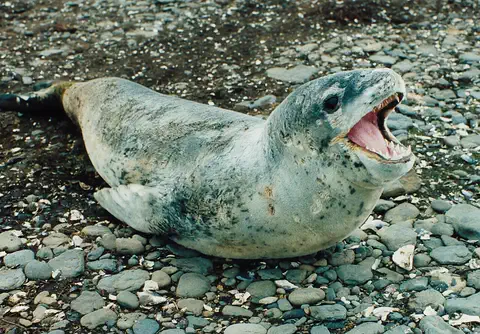
The leopard seal is a large, slender seal of the icy seas around Antarctica, named for the dark spots on its gray coat. It is a fast, powerful hunter with a big head and long teeth, and it eats everything from tiny krill to fish, penguins and young seals.
-
 Watch
Animal
African fish eagle
The African fish eagle is a big eagle of Africa's lakes, rivers and coasts, with a white head, chest and tail and a chestnut-brown body. It snatches fish from the surface of the water, and its loud, ringing call is one of the best-known sounds of Africa.
-
 Watch
Animal
African penguin
The African penguin is a penguin of warm, sunny coasts. It lives only in South Africa and Namibia, nests in burrows and under bushes, and hunts sardines and anchovies in the cold sea. Its numbers have fallen so far that it is now Critically Endangered, and people are working hard to protect it.
-
 Watch
Animal
American crow
The American crow is an all-black bird found across much of North America, from fields and beaches to city centers. It eats almost anything, lives in close family groups, gathers in huge winter roosts, and a University of Washington study found that wild crows can recognize and remember a human face.
For parents & teachers
What children will learn
- Describe how the Adélie penguin's body suits swimming, walking and sliding.
- Locate the Adélie penguin's range around Antarctica and describe its summer and winter homes.
- Describe the Adélie breeding cycle and compare it with the emperor penguin's.
- Explain how scientists count and monitor penguins.
Recommended ages: 3 to 17 · About 15 minutes
Talk about it
- Why might a pebble nest on a slope be better than a flat one when snow melts?
- Why do you think scientists know less about penguins in winter than in summer?
- How could fishing for krill affect penguins?
Try at home or in class
- Build two small pebble nests on a tray, one high and one flat, pour a little water on the tray and see which stays dry.
- Measure 70 centimeters up a wall and stand next to it to see how tall an Adélie penguin is.
Key vocabulary: colony, pack ice, krill, flipper, toboggan, incubate
Where these facts come from
- The IUCN Red List of Threatened Species , International Union for Conservation of Nature (IUCN terms of use (no redistribution of Red List data or range maps))
- GBIF Backbone Taxonomy and GBIF Occurrence Search , Global Biodiversity Information Facility (CC0 1.0 (backbone); occurrence counts are facts derived from records under CC0, CC BY and CC BY-NC)
- Wikidata , Wikimedia Foundation (CC0 1.0)
- Pygoscelis adeliae (Adelie Penguin), Red List global assessment 2020 , IUCN Red List of Threatened Species
- Adélie penguin , Australian Antarctic Division
- Dramatic decline in Adélie penguins near Mawson , Australian Antarctic Division
- Antarctic wildlife , British Antarctic Survey
- Pygoscelis antarcticus (Chinstrap Penguin), Red List global assessment 2020 , IUCN Red List of Threatened Species
- Wikimedia Commons , Wikimedia Foundation (Per file: Public domain, CC0, CC BY or CC BY-SA only (credited on each page))
Checked, not yet human-reviewed. Last updated October 24, 2026. Spotted a mistake? Tell us.