
 Country
North America
United States
The United States is a big country in North America. It has 50 states, deep canyons, a long river and bald eagles.
The United States is a large country in North America made of 50 states, from icy Alaska to the warm islands of Hawaii. It has the Grand Canyon, the Mississippi River and Yellowstone, and about 342 million people live there.
The United States is a federal republic of 50 states: 48 conterminous states across the middle latitudes of North America, Alaska in the far northwest and Hawaii in the mid-Pacific. It is the fourth-largest country by area, and the Census Bureau estimated its population at 341.8 million on July 1, 2025.
Photo: Daniel Schwen, CC BY-SA 4.0, via Wikimedia Commons
Discover the United States
The United States is a very big country.
It is in North America. It is made of 50 states. Some states are snowy and some are sunny. The capital city is Washington, D.C.
The United States is a country in North America made of 50 states. Forty-eight of them sit side by side across the middle of the continent. Alaska is far to the northwest, next to Canada, and Hawaii is a group of islands in the middle of the Pacific Ocean.
It is the fourth-largest country in the world by area, covering about 9.8 million square kilometers. Its land runs from Arctic cold to warm, wet places and dry deserts. About 342 million people lived there in 2025, and its capital is Washington, D.C.
The United States of America is a federal republic of 50 states. Britannica describes 48 conterminous states occupying the middle latitudes of North America, plus Alaska at the continent's northwestern extreme and the island state of Hawaii in the mid-Pacific. The conterminous states are bounded by Canada to the north, the Atlantic to the east, the Gulf of Mexico and Mexico to the south and the Pacific to the west.
At about 9.8 million square kilometers, it is the fourth-largest country in area, after Russia, Canada and China. Its environments range from Arctic to subtropical, rain forest to desert, and high peaks to flat prairie. The Census Bureau's Vintage 2025 estimate put the population at 341,784,857 on July 1, 2025. The capital, Washington, is the same area as the District of Columbia, created in 1790.
Cities and famous places
Washington, D.C. is the capital city.
A tall green statue stands in New York Harbor. It is called the Statue of Liberty. In San Francisco, a long red bridge crosses the water.
Washington, D.C. is the capital of the United States. It is not part of any state: it is a special area called the District of Columbia, created in 1790.
The Statue of Liberty stands at the entrance to New York Harbor. It was made in Paris by the sculptor Bartholdi, with a steel frame designed by Gustave Eiffel, and France gave it to the United States to mark 100 years of independence. It was unveiled in 1886. On the west coast, in San Francisco, the Golden Gate Bridge opened in 1937.
Washington, the national capital, is coextensive with the District of Columbia, the federal capital region created in 1790; it belongs to no state. Britannica's article on the country points readers to separate articles on Boston, Chicago, Los Angeles, New Orleans, New York City, Philadelphia and San Francisco, a sign of how many major urban centers the country has.
The Statue of Liberty, a World Heritage Site since 1984, was made in Paris by the French sculptor Frédéric-Auguste Bartholdi in collaboration with Gustave Eiffel, who designed its steel framework. It was a gift from France for the centenary of American independence and was inaugurated in 1886 at the entrance to New York Harbor, where UNESCO notes it has welcomed millions of immigrants. In San Francisco, the Golden Gate Bridge opened in May 1937.

Canyons, rivers and volcanoes
The Grand Canyon is a very deep valley.
A river cut it into the rock. In Yellowstone, hot water shoots up from the ground. Hawaii has volcanoes. The tallest mountain is in Alaska.
The Grand Canyon in Arizona was carved by the Colorado River. It is nearly 1,500 meters deep, and its stripes of rock record more than 2 billion years of Earth's history. Yellowstone, set up as a park in 1872, has more than 10,000 hot springs, geysers and other hot-water features, about half of all known in the world.
The Mississippi River flows about 3,800 kilometers (2,350 miles) from Lake Itasca in Minnesota to the Gulf of Mexico. In Hawaii, Mauna Loa and Kilauea are two of the most active volcanoes on Earth. The highest peak is Denali, also called Mount McKinley, at 6,190 meters in Alaska.
UNESCO describes the Grand Canyon, nearly 1,500 m deep and carved by the Colorado River, as having horizontal strata that retrace more than 2 billion years of geological history; it was inscribed in 1979. Yellowstone, established in 1872 and inscribed in 1978, covers nearly 9,000 km² and holds half of the world's known geothermal features (more than 10,000), including more than 300 geysers, about two-thirds of those on the planet.
The Mississippi flows 2,350 miles (about 3,780 km) from Lake Itasca to the Gulf, which the National Park Service now calls the Gulf of America. Its watershed, about 3.2 million km², drains all or part of 31 states and two Canadian provinces, about 40 percent of the continental United States. Hawaii Volcanoes National Park holds Mauna Loa (4,170 m) and Kilauea (1,250 m), two of the world's most active volcanoes. North America's highest peak, 6,190 m (20,310 ft), is called Mount McKinley by the National Park Service; its park is Denali National Park and Preserve.

Animals of the United States
The bald eagle is a big bird with a white head.
It is a symbol of the United States. Huge bison eat grass in Yellowstone. Alligators swim in warm swamps and rivers.
The bald eagle became the national symbol of the United States in 1782. By the middle of the 1900s it was in danger of dying out, harmed by habitat loss, shooting and a pesticide called DDT. Laws and people's care helped it recover, and in 2007 it was taken off the endangered species list.
Yellowstone is the only place in the United States where bison have lived since prehistoric times; a male can weigh up to 2,000 pounds (about 900 kilograms). American alligators live in slow rivers, swamps and marshes in the southeast, and an average adult male is about 3.4 meters long.
The United States adopted the bald eagle (Haliaeetus leucocephalus) as its national symbol in 1782. The US Fish and Wildlife Service calls it an Endangered Species Act success story: habitat loss, illegal shooting and DDT contamination of its food pushed it toward extinction across most of its range by the mid-1900s, and after habitat protection and the ban on DDT it was removed from the threatened and endangered list on June 28, 2007. Data from 2018–2019 put the lower 48 states' population at 316,700 birds.
The National Park Service says Yellowstone is the only place in the United States where bison (Bison bison) have lived continuously since prehistoric times; bulls weigh up to 2,000 lb. The American alligator lives across the southeastern states from North Carolina to central Texas, in fresh water; average adults are 2.6 m (females) and 3.4 m (males), and the Smithsonian names habitat destruction as its greatest current threat.

People and languages
About 342 million people live in the United States.
Most people speak English at home. Many people speak Spanish too. Native American nations have lived here for a very long time.
About 342 million people lived in the United States in 2025. Their families come from all over the world. Native Americans and Alaska Natives were the first peoples here, and today there are 575 tribes recognized by the national government. Many other families arrived as immigrants over hundreds of years.
In 2019, about 241 million people spoke only English at home and about 68 million spoke another language. Spanish was by far the most common of those other languages.
The Census Bureau estimated 341,784,857 residents on July 1, 2025. Britannica describes the population as highly diverse: alongside Native Americans and the descendants of Africans brought to the Americas as enslaved people, tens of millions of immigrants from around the world have shaped the country. The Bureau of Indian Affairs lists 575 federally recognized American Indian tribes and Alaska Native villages, and it serves about 1.9 million American Indians and Alaska Natives.
According to the Census Bureau's American Community Survey, 67.8 million people (almost 1 in 5) spoke a language other than English at home in 2019, nearly triple the 23.1 million of 1980, while 241 million spoke only English. Spanish accounted for 62 percent of the non-English languages spoken at home; the next four most common were Chinese, Vietnamese, Tagalog and Arabic. A presidential executive order of March 1, 2025, designated English as the official language of the United States.

A young country with a long past
Native American peoples lived here first, for thousands of years.
Later, people came from Europe and Africa. In 1776, the United States became its own country. In 1969, American astronauts walked on the Moon.
People have lived in places like the Grand Canyon for thousands of years. In 1607, English settlers began a colony at Jamestown, in Virginia, and as the colony grew, the Virginia Indians were pushed out of their homeland. In 1619 the arrival of Africans was recorded there, the start of slavery in English North America.
On July 4, 1776, the Continental Congress approved the Declaration of Independence, announcing that 13 British colonies were separating from Great Britain. In 1863, during a civil war, President Lincoln issued the Emancipation Proclamation, and in 1865 the 13th Amendment to the Constitution abolished slavery. In 1969, Apollo 11 astronauts landed on the Moon.
The National Park Service notes that people have lived in and explored the Grand Canyon for thousands of years, and that Native Americans lived along the Mississippi and used the river for food and travel. In 1607 the English settlement at Jamestown, Virginia, began a lasting English colony in North America; the National Park Service notes that the Virginia Indians were pushed from their homeland as it expanded, and that the 1619 arrival of Africans marks the origin of slavery in English North America.
The Continental Congress passed the Declaration of Independence on July 4, 1776, announcing the separation of 13 British colonies from Great Britain; Britannica calls the country the first European colony to separate successfully from its motherland. Britannica describes social debates that ultimately led to civil war. In 1863 President Lincoln issued the Emancipation Proclamation, and the 13th Amendment, passed by Congress on January 31, 1865, and ratified on December 6, 1865, abolished slavery in the United States. The country reached its current size only in the mid-20th century. Apollo 11, launched on July 16, 1969, with Neil Armstrong, Michael Collins and Buzz Aldrin, made the first crewed landing on the Moon on July 20.

The United States on the map
Find the United States on the globe.
It is in North America. Canada is to the north. Mexico is to the south. Big oceans lie on both sides.
The United States stretches across North America from the Atlantic Ocean in the east to the Pacific Ocean in the west. Canada lies to the north and Mexico to the south, and those are its only two land neighbors.
Two states are far from the rest. Alaska, the largest state, is in the far northwest of the continent, next to Canada. Hawaii is a chain of islands out in the middle of the Pacific. The smallest state, Rhode Island, would fit into Alaska more than 400 times.
The 48 conterminous states are bounded by Canada to the north, the Atlantic Ocean to the east, the Gulf of Mexico and Mexico to the south, and the Pacific Ocean to the west; Canada and Mexico are the only countries that share a land border with it. Alaska lies at the northwestern extreme of North America, bordering Canada, and Hawaii is an island state in the mid-Pacific.
Britannica gives Alaska an area of 1,723,337 km², about 400 times that of the smallest state, Rhode Island (4,001 km²). Britannica's total area figure (9,866,632 km²) includes coastal and territorial waters; excluding those, the land and inland waters cover 9,525,067 km². Such differences explain why sources give slightly different totals for the country's size.
- States
- 50, plus the District of Columbia
- Area rank
- fourth-largest country, after Russia, Canada and China
- Largest state
- Alaska, 1,723,337 km²
- Land neighbors
- Canada and Mexico
Amazing facts
-
Yellowstone has more than 10,000 hot springs and geysers.
Yellowstone holds about half of all the known hot springs, geysers and other hot-water features in the world.
UNESCO credits Yellowstone with more than 10,000 geothermal features, half the world's known total, and over 300 geysers, about two-thirds of those on Earth.
-
The Statue of Liberty was a present from France.
The Statue of Liberty was made in Paris and given by France to mark 100 years of American independence.
Bartholdi built the statue in Paris with Gustave Eiffel engineering its steel framework; France gave it for the centenary of independence, and it was inaugurated in 1886.
-
The Mississippi River gathers water from many states.
Rain that falls in 31 states, and in two Canadian provinces, can end up in the Mississippi River.
The Mississippi watershed covers about 3.2 million km², all or part of 31 states and two Canadian provinces, roughly 40 percent of the continental United States.
-
Bald eagles were in danger, but now there are many more.
Bald eagles nearly disappeared from much of the country, but they recovered and were taken off the endangered list in 2007.
After DDT was banned and habitat was protected, the bald eagle was delisted on June 28, 2007; 2018–2019 data put the lower 48 states' population at 316,700 birds.
-
Alaska is the biggest state.
Alaska is so big that the smallest state, Rhode Island, would fit into it about 400 times.
Britannica gives Alaska 1,723,337 km² and Rhode Island 4,001 km², a ratio of about 400 to 1.
Words to know
- federal republic
- a country made of states that share one national government, with leaders chosen by the people
- canyon
- a deep, narrow valley with steep sides, often cut by a river
- geyser
- a hot spring that shoots water and steam into the air from time to time
- watershed
- all the land that drains into one river and the streams that feed it
- Indigenous
- describes the first peoples known to have lived in a place
- immigrant
- a person who moves to a new country to live there
- amendment
- a change or addition to a law or a constitution
Discovery challenge
-
What is the capital city of the United States?
Which city is the capital of the United States?
Which city, coextensive with a federal district created in 1790, is the US capital?
- Washington, D.C.
- New York City
- Los Angeles
Show the answer
Washington, D.C.
Washington, D.C. is the capital.
Washington, D.C. is the capital. It is in the District of Columbia, which is not part of any state.
Washington is coextensive with the District of Columbia, the federal capital region created in 1790.
-
How many states does the United States have?
How many states make up the United States?
How many states make up the federal republic of the United States?
- 13
- 50
- 100
Show the answer
50
The United States has 50 states.
There are 50 states: 48 side by side, plus Alaska and Hawaii.
There are 50 states: 48 conterminous states, Alaska and Hawaii, plus the federal District of Columbia.
-
Which river made the Grand Canyon?
Which river carved the Grand Canyon?
Which river carved the nearly 1,500-meter-deep Grand Canyon in Arizona?
- The Nile
- The Amazon
- The Colorado River
Show the answer
The Colorado River
The Colorado River cut the Grand Canyon.
The Colorado River carved the Grand Canyon, nearly 1,500 meters deep.
The Colorado River carved it; its horizontal strata retrace more than 2 billion years of geological history.
-
Which bird is the symbol of the United States?
Which bird became the national symbol of the United States in 1782?
Which raptor, the US national symbol since 1782, was removed from the endangered list in 2007?
- Bald eagle
- American flamingo
- Barn owl
Show the answer
Bald eagle
The bald eagle, with its white head, is the symbol.
The bald eagle became the national symbol in 1782. It almost disappeared, then recovered.
Haliaeetus leucocephalus recovered after habitat protection and the DDT ban and was delisted on June 28, 2007.
-
Which state has the big volcanoes Mauna Loa and Kilauea?
In which state are the volcanoes Mauna Loa and Kilauea?
Which state holds Mauna Loa and Kilauea, two of the world's most active volcanoes?
- Alaska
- Hawaii
- Arizona
Show the answer
Hawaii
They are in Hawaii, on islands in the ocean.
Mauna Loa and Kilauea are in Hawaii, an island state in the Pacific Ocean.
Both are in Hawaii Volcanoes National Park, a World Heritage Site since 1987: Mauna Loa (4,170 m) and Kilauea (1,250 m).
Places to discover in United States
-
 Watch
City
Chicago
Chicago, in the state of Illinois, is the third-biggest city in the United States, with about 2.7 million people (2025). It grew fast beside Lake Michigan, rebuilt itself after the Great Fire of 1871 and became famous for its skyscrapers, railways, museums and music.
-
 Watch
City
Los Angeles
Los Angeles is the second-biggest city in the United States, spread across a wide plain between the mountains and the Pacific Ocean. Founded in 1781 as a small farming village, it grew into a world center of movies and music. About 3.9 million people lived there in 2020.
-
 Watch
City
New York City
New York City sits where the Hudson River meets a great harbor on the Atlantic coast. It has been the largest city in the United States since 1790. About 8.8 million people lived in its five boroughs in 2020, among skyscrapers, bridges and parks.
-
 Watch
City
San Francisco
San Francisco sits on the tip of a peninsula between the Pacific Ocean and San Francisco Bay in California. Spanish settlers arrived in 1776, the Gold Rush that began in 1848 turned it into a booming port, and today it is famous for the Golden Gate Bridge, its cable cars, its steep hills and its summer fog.
-
Watch
City
Washington, D.C.
Washington, D.C., is the capital of the United States, on the Potomac River. It was planned from scratch in the 1790s, with wide avenues, the U.S. Capitol, the White House and a long green park called the National Mall. About 690,000 people lived there in 2020.
-
 Watch
Landmark
Brooklyn Bridge
The Brooklyn Bridge crosses the East River between Brooklyn and Manhattan in New York City. Built from 1869 to 1883, it was the first bridge to use steel wire for its cables, and its main span was the longest in the world until 1890. Every day, cars, walkers and cyclists still cross it.
-
 Watch
Landmark
Empire State Building
The Empire State Building rises 1,454 feet (443 meters) over Fifth Avenue in New York City. Its steel frame went up at about four and a half floors a week, and the whole building was finished in one year and 45 days, opening on May 1, 1931.
-
 Watch
Landmark
Golden Gate Bridge
The Golden Gate Bridge crosses the Golden Gate, the strait where San Francisco Bay meets the Pacific Ocean. Built from 1933 to 1937, it hangs from two huge steel cables slung over towers 746 feet (227 meters) above the water, and it is painted a color called International Orange.
-
 Watch
Landmark
Metropolitan Museum of Art
The Metropolitan Museum of Art, or the Met, stands on Fifth Avenue at the edge of Central Park in New York City. Founded in 1870, it is the largest art museum in the city, with art from ancient Egypt to today. Its grand front, with three arches and pairs of columns, was finished in 1902.
-
 Watch
Landmark
Mount Rushmore
Mount Rushmore is a granite mountain in the Black Hills of South Dakota. From 1927 to 1941, nearly 400 workers carved the faces of Presidents Washington, Jefferson, Theodore Roosevelt and Lincoln into it, each about 60 feet (18 meters) tall. Most of the rock was removed with dynamite.
-
Watch
Landmark
Statue of Liberty
The Statue of Liberty stands on Liberty Island in New York Harbor. France gave her to the United States as a sign of friendship. The sculptor Auguste Bartholdi shaped her copper skin, Gustave Eiffel designed the iron frame inside, and she was dedicated in 1886.
-
 Watch
Landmark
White House
The White House in Washington, D.C. is the home and office of the President of the United States. Building began in 1792, and President John Adams moved in on November 1, 1800. Its sandstone walls are painted white, and today it has 132 rooms.
-
 Watch
Landmark
Willis Tower
Willis Tower, first called the Sears Tower, is a skyscraper in Chicago finished in 1973. It is 442 meters tall and was the tallest building in the world for about 25 years. Its clever 'bundled tube' design was made by engineer Fazlur Khan and the firm SOM.
-
Watch
Natural wonder
Grand Canyon
The Grand Canyon is a huge, steep-sided canyon in Arizona carved by the Colorado River. It is about 447 kilometers long and, on average, 1.6 kilometers deep, and its walls show layers of rock almost two billion years old.
-
 Watch
Natural wonder
Niagara Falls
Niagara Falls is a set of three waterfalls on the Niagara River, which flows from Lake Erie to Lake Ontario across the border between Canada and the United States. About 500 waterfalls in the world are taller, but Niagara is famous for its height together with the enormous amount of water that pours over it.
-
 Watch
Natural wonder
Yellowstone National Park
Yellowstone National Park sits on top of a giant volcano in the western United States. Heat from melted rock deep underground powers more than 10,000 hot springs, geysers, mudpots and steam vents, and the park is home to bison, wolves and two kinds of bears.
Animals of United States
-
Watch
3D
Animal
Bald eagle
The bald eagle is one of North America's biggest birds, with a white head and tail, a dark brown body and a huge yellow bill. It lives near lakes, rivers and coasts and eats mostly fish. Once rare because of hunting and pesticides, it has made an amazing comeback.
-
 Watch
3D
Animal
American bison
The American bison is the largest land animal in North America. Once tens of millions roamed the Great Plains, but by the 1890s fewer than a thousand were left. Careful protection, starting with a tiny herd in Yellowstone, brought bison back.
-
 Watch
Animal
Western diamondback rattlesnake
The western diamondback rattlesnake is a heavy-bodied snake of the deserts and dry grasslands of the southwestern United States and Mexico. It has diamond patterns, a black-and-white striped tail and a rattle that buzzes as a warning. It is venomous, so it is a snake to admire from far away, but it would much rather hide or slip away than meet a person.
-
 Watch
3D
Animal
Eastern gray squirrel
Eastern gray squirrels are bushy-tailed tree squirrels from the forests of eastern North America, and they are a common sight in parks and gardens. They bury nuts to eat later. People also took them to Britain and other countries; in Britain they cause problems for the native red squirrel.
-
 Watch
Animal
Yellow tang
The yellow tang is a lemon-yellow surgeonfish of Pacific coral reefs, most common around Hawaii. It grazes on algae all day, which helps keep reefs from being smothered by seaweed, and it has a sharp white spine on each side of its tail for defense. It is one of the most collected fish for home aquariums.
-
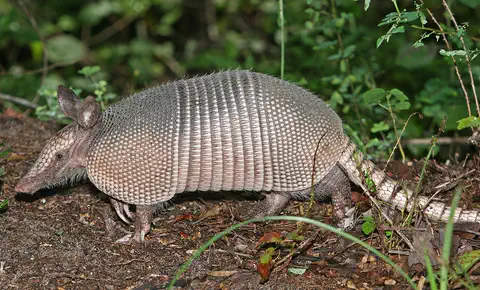 Watch
Animal
Nine-banded armadillo
The nine-banded armadillo is a small, armored digger that lives from Argentina all the way to the United States. It sniffs out beetles and other bugs in the soil, can hold its breath for six minutes, and almost always has four identical babies at once.
-
 Watch
3D
Animal
Red swamp crayfish
The red swamp crayfish is a dark red freshwater crustacean with long claws covered in bright red bumps. It comes from the swamps and streams of the southern United States and northern Mexico, where it digs burrows in the mud. People have carried it around the world for food, and in many new places it harms the plants and animals that already live there.
-
 Watch
3D
Animal
Eastern tiger swallowtail
The eastern tiger swallowtail is a large butterfly of eastern North America. Males are yellow with black tiger stripes, while many females are dark, which helps them look like a bad-tasting butterfly. Its caterpillars disguise themselves as bird droppings, then turn green with big fake eyes.
-
 Watch
3D
Animal
American bullfrog
The American bullfrog is the largest true frog in North America. It lives in warm, still ponds and lakes, sits and waits for food to come close, and the males' deep 'jug-o-rum' call carries more than a kilometer. Its tadpoles can take years to turn into frogs.
-
 Watch
Animal
Chinook salmon
The Chinook salmon, also called the king salmon, is the largest Pacific salmon. It hatches in a cold river, travels to the ocean to feed and grow for a few years, then swims back up its home river to lay eggs.
-
 Watch
3D
Animal
Great egret
The great egret is a tall, all-white heron that lives in wetlands on every continent except Antarctica. It wades slowly through shallow water, waits, then strikes like lightning to catch fish. Once nearly wiped out in the United States by hunters who wanted its lacy feathers, it made a remarkable comeback.
-
 Watch
Animal
Canada lynx
The Canada lynx is a wild cat of the snowy northern forests of Canada and Alaska. Its huge, furry paws work like snowshoes, and it depends on one animal above all, the snowshoe hare. When hares are plentiful, lynx do well; when hares become scarce, lynx have a hard time too.
Explore next
-
Watch
Natural wonder
Grand Canyon
The Grand Canyon is a huge, steep-sided canyon in Arizona carved by the Colorado River. It is about 447 kilometers long and, on average, 1.6 kilometers deep, and its walls show layers of rock almost two billion years old.
-
Watch
Natural wonder
Yellowstone National Park
Yellowstone National Park sits on top of a giant volcano in the western United States. Heat from melted rock deep underground powers more than 10,000 hot springs, geysers, mudpots and steam vents, and the park is home to bison, wolves and two kinds of bears.
-
Watch
Natural wonder
Mississippi River
The Mississippi River flows about 3,770 kilometers from Lake Itasca in Minnesota to the Gulf of Mexico, through the middle of the United States. Its basin drains about 40 percent of the continental United States. Long ago Native Americans paddled canoes on it; later came steamboats, and today huge barges carry grain and fuel. Millions of birds follow it when they migrate.
-
Watch
City
Washington, D.C.
Washington, D.C., is the capital of the United States, on the Potomac River. It was planned from scratch in the 1790s, with wide avenues, the U.S. Capitol, the White House and a long green park called the National Mall. About 690,000 people lived there in 2020.
-
Watch
Landmark
Statue of Liberty
The Statue of Liberty stands on Liberty Island in New York Harbor. France gave her to the United States as a sign of friendship. The sculptor Auguste Bartholdi shaped her copper skin, Gustave Eiffel designed the iron frame inside, and she was dedicated in 1886.
-
Watch
Landmark
Golden Gate Bridge
The Golden Gate Bridge crosses the Golden Gate, the strait where San Francisco Bay meets the Pacific Ocean. Built from 1933 to 1937, it hangs from two huge steel cables slung over towers 746 feet (227 meters) above the water, and it is painted a color called International Orange.
-
Watch
3D
Animal
Bald eagle
The bald eagle is one of North America's biggest birds, with a white head and tail, a dark brown body and a huge yellow bill. It lives near lakes, rivers and coasts and eats mostly fish. Once rare because of hunting and pesticides, it has made an amazing comeback.
-
Watch
3D
Animal
American bison
The American bison is the largest land animal in North America. Once tens of millions roamed the Great Plains, but by the 1890s fewer than a thousand were left. Careful protection, starting with a tiny herd in Yellowstone, brought bison back.
For parents & teachers
What children will learn
- Locate the United States, its neighbors and its two separated states, Alaska and Hawaii.
- Describe landscapes such as the Grand Canyon, Yellowstone and the Mississippi watershed, and how rivers shape land.
- Recognize that many peoples, languages and Native nations make up the country.
- Outline key dates from Jamestown (1607) and independence (1776) to the end of slavery (1865) and the Moon landing (1969).
Recommended ages: 3 to 17 · About 15 minutes
Talk about it
- Why might rain that falls far away in Montana end up in the Gulf near New Orleans?
- What languages do people speak in your family or neighborhood?
- Why do you think people decided to protect places like Yellowstone as parks?
Try at home or in class
- On a map, trace the Mississippi River from Minnesota to the Gulf and list the states it passes.
- Pour a little water on a tray of damp sand tilted at one end and watch it carve a small canyon.
Key vocabulary: federal republic, canyon, geyser, watershed, Indigenous, immigrant, amendment
Where these facts come from
- Wikidata , Wikimedia Foundation (CC0 1.0)
- Natural Earth vector data , Natural Earth (NACIS) (Public domain)
- UNESCO World Heritage List , UNESCO World Heritage Centre (Linked as a reference; site facts come from Wikidata)
- Annual Estimates of the Resident Population for the United States, Regions, States, District of Columbia, and Puerto Rico (Vintage 2025, NST-EST2025-ALLDATA) , U.S. Census Bureau
- National Population Totals and Components of Change: 2020-2025 , U.S. Census Bureau
- What Languages Do We Speak in the United States? , U.S. Census Bureau
- United States , Encyclopaedia Britannica
- Designating English as the Official Language of the United States (Executive Order, March 1, 2025) , The White House
- About Us (Indian Affairs) , U.S. Bureau of Indian Affairs
- Mississippi River Facts , National Park Service, Mississippi National River and Recreation Area
- Denali National Park and Preserve , National Park Service
- Yellowstone National Park , UNESCO World Heritage Centre
- Grand Canyon National Park , UNESCO World Heritage Centre
- History and Culture (Grand Canyon) , National Park Service
- Statue of Liberty , UNESCO World Heritage Centre
- Hawaii Volcanoes National Park , UNESCO World Heritage Centre
- Bald eagle (Haliaeetus leucocephalus) , U.S. Fish and Wildlife Service
- Bison Ecology , National Park Service, Yellowstone National Park
- American alligator , Smithsonian's National Zoo and Conservation Biology Institute
- Historic Jamestowne , National Park Service
- 13th Amendment to the U.S. Constitution: Abolition of Slavery (1865) , U.S. National Archives
- Apollo 11 , NASA
- PlayOwl region table, version 1 , PlayOwl (PlayOwl original data)
- flag-icons 7.5.0 , Panayiotis Lipiridis and contributors (MIT)
- Wikimedia Commons , Wikimedia Foundation (Per file (public domain, CC0, CC BY or CC BY-SA); see each media record)
Checked, not yet human-reviewed. Last updated October 24, 2026. Spotted a mistake? Tell us.
Picture credits
- Photo: Daniel Schwen, CC BY-SA 4.0, via Wikimedia Commons · source · license
- Photo: Christian David, CC BY-SA 4.0, via Wikimedia Commons · source · license
- Photo: W. Bulach, CC BY-SA 4.0, via Wikimedia Commons · source · license
- Photo: Paul Danese, CC BY-SA 4.0, via Wikimedia Commons · source · license
- Photo: Robert Linsdell from St. Andrews, Canada, CC BY 2.0, via Wikimedia Commons · source · license
- Photo: Carol M. Highsmith, public domain, via Wikimedia Commons · source
- Photo: James St. John from Newark, Ohio, CC BY 2.0, via Wikimedia Commons · source · license
- Photo: Jack Dykinga, public domain, via Wikimedia Commons · source
- Photo: Skeetdeloach at English Wikipedia, public domain, via Wikimedia Commons · source
- Photo: Daniel L. Lu (user:dllu), CC BY-SA 4.0, via Wikimedia Commons · source · license
- Photo: King of Hearts, CC BY-SA 4.0, via Wikimedia Commons · source · license