Animal
Common starling
The starling is a shiny bird covered in tiny white spots. Thousands of starlings can fly together and make swirling shapes in the sky.
The common starling, also called the European starling, is a glossy, spotted songbird from Europe, Asia and North Africa. It is a brilliant copycat that can imitate other birds and even car alarms, and in winter huge flocks swirl through the evening sky in shows called murmurations. People also carried starlings to North America, Australia and other places, where they now live in the wild.
Sturnus vulgaris is a highly adaptable songbird native to Eurasia and North Africa and introduced to North America, Australia, New Zealand, South Africa and elsewhere. Known for vocal mimicry, its 'wear molt' from spotted to glossy plumage and its winter murmurations, it is listed globally as Least Concern but is declining in the United Kingdom and North America.
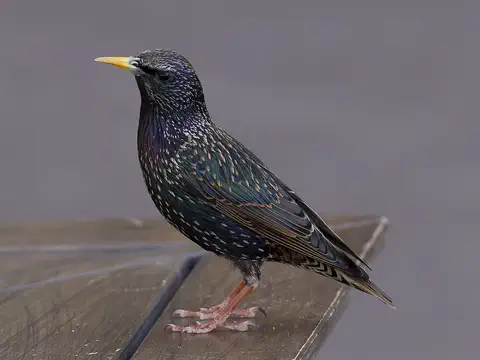
Photo: PierreSelim, CC BY-SA 3.0, via Wikimedia Commons
Meet the common starling
This is the starling.
From far away it looks black. Up close it shines purple and green, and it has lots of little white spots. It has a long, pointy beak.
The common starling is a chunky bird about 20 to 23 centimeters long, with a short tail and a long, pointed bill. From far away it looks black, but up close its feathers shine with purple and green, and they are speckled with white.
In flight its short, pointed wings make it look like a little four-pointed star, which is how the starling got its name. In North America it is called the European starling, because people brought it there from Europe.
Sturnus vulgaris, family Sturnidae, is a stocky, short-tailed songbird 20 to 23 centimeters long, weighing about 60 to 96 grams. Its short, pointed, triangular wings give it a star-like outline in flight, the origin of its English name.
Plumage looks black at a distance but is glossy with a purple and green iridescent sheen, flecked with white. The species is called the common starling in Britain and the European starling in North America, where it was introduced in the nineteenth century. It is one of the most familiar birds of towns and farmland across much of the world.
Quick facts
- Group
- Bird
- Length
- 0.2 to 0.23 m
- Wingspan
- 0.31 to 0.4 m
- Weight
- 0.06 to 0.1 kg
- Top speed
- up to 77 km/h
Where it lives
Starlings first lived in Europe and Asia.
People took them to other places too, like North America and Australia. They like towns, parks and fields.
Starlings come from Europe, western and central Asia and North Africa. People later carried them to other continents, and they now live wild in North America, Australia, New Zealand, South Africa, Argentina and some Caribbean islands.
Starlings like living near people. They feed on lawns, city parks and farm fields and nest in holes in buildings and trees. They need open, grassy ground for finding food, and they stay away from large, unbroken forests and deserts.
The IUCN's global assessment lists the species as resident or breeding across Europe, North Africa and Asia east to China, Mongolia and Japan, and some birds spend the winter farther south, in places such as Afghanistan, Cyprus and the Arabian Peninsula. In Britain, the RSPB notes, residents are joined in winter by birds from Scandinavia.
Introduced populations are listed for the United States, Canada, Mexico, Australia, New Zealand, Fiji, Argentina and several Caribbean islands, and Iziko Museums' Biodiversity Explorer adds South Africa, where starlings mainly live in the southern half of the country. Starlings need open, grassy ground for foraging, water and cavities for nesting, so towns and farmland suit them well.
Continents
Its habitat

Where can you find this animal?
- Brought here by people · Countries and seas named by a scientific source
- Brought here by people · Countries and seas named by a scientific source
- Lives here naturally · Countries and seas named by a scientific source
- Sightings recorded · Records of wild sightings (GBIF)
- Visits for part of the year · Countries and seas named by a scientific source
Brought here by people · Countries and seas named by a scientific source
Places where people released starlings and the IUCN lists wild introduced populations: North America from Canada to Mexico, Australia, New Zealand, Fiji, Argentina and several Caribbean islands.
Places: United States, Canada, Mexico, Australia, New Zealand, Fiji, Argentina, Cuba and 5 more places.
Source: iucn-red-list · checked October 2026
Brought here by people · Countries and seas named by a scientific source
Introduced to South Africa, where starlings live mainly in the southern half of the country, most commonly in towns and farmland.
Places: South Africa.
Source: https://www.biodiversityexplorer.info/birds/sturnidae/sturnus_vulgaris.htm · checked October 2026
Lives here naturally · Countries and seas named by a scientific source
Towns, farmland, grassland and open woodland across Europe, North Africa and Asia east to China, Mongolia and Japan, where the IUCN lists starlings as resident or breeding.
Places: Austria, Azerbaijan, Belarus, Belgium, Bulgaria, Croatia, Czechia, Estonia and 53 more places.
Source: iucn-red-list · checked October 2026
Sightings recorded · Records of wild sightings (GBIF)
Counts of GBIF records of wild observations (human and machine) and preserved specimens. Records include introduced populations, vagrants, escaped or released animals and misidentifications, so a country with records is not necessarily part of the native range.
Wild sightings have been recorded in United States, Canada, UK, Sweden, France, Australia, Netherlands, Germany and 109 more places.
Source: gbif · checked October 2026
Visits for part of the year · Countries and seas named by a scientific source
Countries where the IUCN lists starlings only outside the breeding season.
Places: Afghanistan, Cyprus, Jordan, Kuwait, Oman, Palestine, Qatar and Saudi Arabia.
Source: iucn-red-list · checked October 2026
Range maps show where scientists say an animal lives, often country by country. An animal may live in only part of a country shown, and sightings records can include animals that wandered far from home.
What it eats
Starlings eat bugs and worms from the grass.
They poke their beaks into the ground to find them. They also eat berries and seeds.
Starlings will eat nearly anything, but they love insects and other small creatures when they can find them: grasshoppers, beetles, caterpillars, earthworms, snails and spiders. They also eat berries, cherries, grains and seeds.
Watch a starling on a lawn. It hurries across the grass, pushing its closed bill into the ground. Then it uses strong jaw muscles to open its bill underground, making a little gap to look for hidden bugs.
Starlings are generalists that concentrate on insects and other invertebrates when available: grasshoppers, beetles, flies, caterpillars, snails, earthworms, millipedes and spiders. They also take fruit such as cherries and mulberries, grains, seeds, nectar, livestock feed and garbage.
Their signature foraging method is open-bill probing: a bird pushes its closed bill into the soil, then uses strong muscles to force it open, parting the soil to expose prey. Flocks often forage with other species such as grackles, blackbirds, house sparrows and American robins. Where they are introduced, the IUCN's invasive species database says starlings cost hundreds of millions of dollars in damage to farms each year.
Did you know?
Millions of starlings live in America.
North America's starlings took hold after birds were released in New York City's Central Park in 1877, 1890 and 1891.
A population founded by Central Park releases in 1877, 1890 and 1891 grew to about 93 million birds in the United States and Canada by a 2019 estimate.
An amazing body
In winter a starling is covered in white spots.
By summer the white tips wear away, and the starling turns shiny and dark. Its beak turns yellow in summer too.
Starlings change their look every year without growing new feathers in spring. In fall they grow fresh feathers with bright white tips, so they are covered in spots. Over the winter those tips slowly wear away, and by spring the bird is dark and glossy.
In summer the bill is yellow. Scientists who studied starlings' sense of taste found they can taste salt, sugars and bitter flavors, and they can tell table sugar apart from other sugars.
The change from spotted to glossy plumage is a 'wear molt'. New feathers grown in fall have bold white tips; by spring abrasion has worn the tips away, exposing the dark, iridescent feather beneath.
In summer adults have yellow bills. The starling's sense of taste is well studied: birds detect salt, sugars, citric acid and tannins, and they can distinguish sucrose from other sugars, which matters because starlings cannot digest sucrose. Cornell describes starlings as strong fliers that reach speeds of up to about 77 kilometers an hour (48 miles an hour).
Growing up
Starlings make their nest in a hole.
The eggs are pale blue or green. Mom and dad both keep the eggs warm. The babies leave the nest after about three weeks.
A male starling chooses a hole for a nest, in a building, an old woodpecker hole or a nest box, and starts filling it with grass, pine needles and feathers to attract a female. Starlings even add fresh green plants. The female finishes the nest the way she likes it.
She lays 3 to 6 pale bluish or greenish eggs, and both parents keep them warm for about 12 days. The chicks hatch helpless, with closed eyes, and leave the nest after 21 to 23 days.
Males select a cavity, usually in a building or other structure, an old woodpecker hole or a nest box, and begin building before pairing, packing it with grass, pine needles, feathers and even string and trash. Fresh green plants are added throughout laying and incubation, and females make the final arrangements.
Clutches are 3 to 6 bluish- or greenish-white eggs, incubated by both sexes for about 12 days. Hatchlings weigh about 6.4 grams, are sparsely downy and keep their eyes closed for 6 to 7 days; they leave the nest at 21 to 23 days. Pairs raise one or two broods a year. The oldest known wild starling in North America lived at least 15 years and 3 months.
Murmurations and copycat songs
On winter evenings, thousands of starlings fly together.
They swoop and swirl like one big cloud. Starlings are great copycats too. They can sound like other birds, or even a ringing phone!
On winter evenings, as the sun goes down, hundreds or even thousands of starlings gather and swoop across the sky in swirling flocks called murmurations. People once wondered whether the birds could read each other's minds! Scientists now know starlings react lightning-fast, copying the moves of the birds next to them.
Starlings are also amazing mimics. One bird can learn the calls of up to 20 other species, and starlings have copied car alarms, dog barks and phone ringtones.
Murmurations, the coordinated winter flocks seen as starlings gather at dusk, can involve thousands of birds. The RSPB explains the synchrony by very fast reaction times that let each bird match the flight path of its neighbors.
Starlings are gifted vocal mimics, using their syrinx, the bird voice box, to copy other birds (Cornell notes individuals learning the calls of up to 20 species) and sounds such as car alarms and phones. They are also assertive: flock members signal with wing-flicks and postures, and starlings drive other species, including eastern bluebirds, from nest cavities they want.
Did you know?
Starlings lose their spots without losing feathers.
Starlings go from spotted to shiny each year as the white tips of their feathers wear away, without growing new feathers.
The seasonal change from spotted to glossy is a wear molt: abrasion removes the white feather tips rather than a new molt.
Common, but falling
There are still lots of starlings.
But in some places there are far fewer than before. In the United Kingdom, there are less than half as many as about 30 years ago.
Starlings are still very common, and the IUCN lists them as Least Concern. But their numbers are falling. In the United Kingdom they declined by 57 percent between 1995 and 2023, and they are now on the UK's Red List of birds of high concern. In North America their numbers have also fallen by about half since 1966.
Where starlings were brought by people, they can be a problem: they eat crops and take nest holes from native birds such as eastern bluebirds.
The IUCN assessed the species as Least Concern in 2018, with a decreasing population of about 150 million mature individuals; it names livestock farming and ranching and hunting and trapping as threats. The RSPB reports a 57 percent UK decline between 1995 and 2023, and Cornell cites a cumulative 50 percent fall in North America between 1966 and 2023.
Where it has been introduced, Iziko's Biodiversity Explorer says it is considered a serious agricultural pest in some regions, and Cornell calls it a fierce competitor for nest holes. Its effect on native birds is debated: the IUCN's invasive species database says it contributes to their decline, while a 2003 study of 27 North American cavity-nesting species, cited by Cornell, found clear declines only in sapsuckers.
IUCN Red List
How is the common starling doing in the wild?
- Least Concern (this animal)
- Near Threatened
- Vulnerable
- Endangered
- Critically Endangered
- Extinct in the Wild
- Extinct
Least Concern
Not at risk of disappearing from the wild right now.
See the IUCN Red List assessment · The IUCN Red List of Threatened Species 2021.3
Amazing facts
-
The starling is named for its star shape when it flies.
In flight, a starling's short, pointed wings make it look like a small four-pointed star, which gave it its name.
The starling's short, triangular wings give a star-like silhouette in flight, the source of its common name.
-
Starlings can copy car alarms!
Starlings can copy other birds and sounds like car alarms, dog barks and ringing phones.
Individual starlings can learn the calls of up to 20 bird species, alongside mechanical sounds such as alarms and phones.
-
Starlings lose their spots without losing feathers.
Starlings go from spotted to shiny each year as the white tips of their feathers wear away, without growing new feathers.
The seasonal change from spotted to glossy is a wear molt: abrasion removes the white feather tips rather than a new molt.
-
Millions of starlings live in America.
North America's starlings took hold after birds were released in New York City's Central Park in 1877, 1890 and 1891.
A population founded by Central Park releases in 1877, 1890 and 1891 grew to about 93 million birds in the United States and Canada by a 2019 estimate.
Words to know
- murmuration
- a huge flock of starlings swirling together in the sky
- mimic
- an animal that copies the sounds or looks of something else
- introduced species
- an animal or plant that people brought to a new place
- iridescent
- shining with colors that change as you look from different angles
- molt
- to lose old feathers and grow new ones
- cavity
- a hole, such as a hole in a tree or a wall, used for a nest
Discovery challenge
-
What do we call a big swirling flock of starlings?
What is a huge, swirling flock of starlings called?
What is the name for the coordinated winter flocks of starlings at dusk?
- A murmuration
- A herd
- A school
Show the answer
A murmuration
It is called a murmuration. The birds swoop and swirl together.
A murmuration: thousands of starlings swirling together on winter evenings.
A murmuration; each bird reacts very quickly to match its neighbors' flight paths.
-
Where do starlings first come from?
Where did starlings live before people carried them around the world?
Which region is the starling's native range?
- Australia
- Europe, Asia and North Africa
- South America
Show the answer
Europe, Asia and North Africa
Starlings first came from Europe and Asia, and the north of Africa.
They are native to Europe, Asia and North Africa; people introduced them to North America, Australia and other places.
Native to Eurasia and North Africa; introduced populations live in North America, Oceania, South Africa and Argentina.
-
What makes a starling's white spots go away?
How do starlings lose their white spots by spring?
What causes the starling's change from spotted to glossy plumage?
- They paint over them
- Rain washes them off
- The white feather tips wear away
Show the answer
The white feather tips wear away
The white tips of the feathers slowly wear away.
The spots are white feather tips. Over the winter they wear off, and the starling becomes dark and shiny.
A wear molt: abrasion removes the white tips of fall-grown feathers, revealing the iridescent feather beneath.
-
Which sound can a starling copy?
Which of these sounds have starlings been heard copying?
Which sound is a documented example of starling mimicry?
- A car alarm
- An elephant's trumpet
- A lion's roar
Show the answer
A car alarm
Starlings can copy car alarms. Silly birds!
Starlings copy other birds and sounds like car alarms, dog barks and phones.
The RSPB lists car alarms, dog barks, phones and sirens among sounds starlings mimic.
Places where you might see it
-
 Watch
 Country
United Kingdom
The United Kingdom, or UK, lies on islands off the northwest coast of Europe. It is made up of four parts, England, Scotland, Wales and Northern Ireland, and about 69.5 million people live there. Its capital is London.
-
 Watch
 Country
United States
The United States is a large country in North America made of 50 states, from icy Alaska to the warm islands of Hawaii. It has the Grand Canyon, the Mississippi River and Yellowstone, and about 342 million people live there.
Explore next
-
Watch
Country
United Kingdom
The United Kingdom, or UK, lies on islands off the northwest coast of Europe. It is made up of four parts, England, Scotland, Wales and Northern Ireland, and about 69.5 million people live there. Its capital is London.
-
Watch
Country
United States
The United States is a large country in North America made of 50 states, from icy Alaska to the warm islands of Hawaii. It has the Grand Canyon, the Mississippi River and Yellowstone, and about 342 million people live there.
-
 Watch
3D
Animal
Eastern bluebird
The eastern bluebird is a small thrush of open fields and parks in eastern North America, south to Central America. Males are bright blue with a rusty orange chest. Bluebirds watch from wires and fence posts, flutter down to catch insects, and nest in tree holes and in nest boxes that people put up for them.
-
 Watch
Animal
House sparrow
The house sparrow is one of the most widespread songbirds in the world. It is native to Europe, Asia and North Africa, but people released it in many other places, and now it lives in towns and farms almost everywhere people do. Its numbers have fallen sharply in some places, including Britain and North America.
-
 Watch
Animal
Northern mockingbird
The northern mockingbird is a slim gray songbird famous for copying sounds. It sings long strings of phrases, many borrowed from other birds, and sometimes sings all night. It lives in towns, farms and brushy places across the United States, Mexico and the Caribbean.
-
 Watch
Animal
Common blackbird
The common blackbird is a thrush found in gardens, parks and woods across Europe, North Africa and parts of Asia. Males are glossy black with a bright yellow-orange bill and eye-ring, females are brown, and on summer evenings males sing a mellow, fluting song from high perches.
-
 Watch
Animal
Adélie penguin
The Adélie penguin is a medium-sized penguin, about 70 centimeters tall, with a black back, a white front and a bright white ring around each eye. It breeds in summer on rocky, ice-free ground all around Antarctica, building nests of pebbles, and spends the winter far out at sea among the pack ice.
-
 Watch
Animal
African fish eagle
The African fish eagle is a big eagle of Africa's lakes, rivers and coasts, with a white head, chest and tail and a chestnut-brown body. It snatches fish from the surface of the water, and its loud, ringing call is one of the best-known sounds of Africa.
For parents & teachers
What children will learn
- Describe the starling's plumage and explain its 'wear molt'.
- Explain what a murmuration is and how starlings stay together.
- Describe how people introduced starlings to other continents and some effects.
- Understand that a common bird can still be declining.
Recommended ages: 3 to 17 · About 15 minutes
Talk about it
- Why might moving an animal to a new continent cause problems for animals already living there?
- How do you think a starling knows where to turn in a murmuration?
- Starlings are common but declining. Why is it important to notice changes in common birds?
Try at home or in class
- Play 'murmuration': walk around a playground in a group, each person copying only the two people next to them, and see what shapes the group makes.
- Measure 21 centimeters (a starling's length) on a ruler and compare it with your hand and a pencil.
Key vocabulary: murmuration, mimic, introduced species, iridescent, molt, cavity
Where these facts come from
- The IUCN Red List of Threatened Species , International Union for Conservation of Nature (IUCN terms of use (no redistribution of Red List data or range maps))
- GBIF Backbone Taxonomy and GBIF Occurrence Search , Global Biodiversity Information Facility (CC0 1.0 (backbone); occurrence counts are facts derived from records under CC0, CC BY and CC BY-NC)
- Sturnus vulgaris (Common Starling), global Red List assessment 2018 , IUCN Red List of Threatened Species
- European Starling overview, identification and life history , Cornell Lab of Ornithology, All About Birds
- European Starling identification , Cornell Lab of Ornithology, All About Birds
- European Starling life history , Cornell Lab of Ornithology, All About Birds
- Starling , RSPB
- Sturnus vulgaris, Global Invasive Species Database , IUCN SSC Invasive Species Specialist Group
- Sturnus vulgaris (Common starling) , Biodiversity Explorer, Iziko Museums of South Africa
- Wikidata , Wikimedia Foundation (CC0 1.0)
- Wikimedia Commons , Wikimedia Foundation (Per file: Public domain, CC0, CC BY or CC BY-SA only (credited on each page))
Checked, not yet human-reviewed. Last updated October 28, 2026. Spotted a mistake? Tell us.