
Animal
Pygmy hippopotamus
The pygmy hippo is a small, shy hippo. It lives in forests in West Africa. It hides in streams by day and eats plants at night.
The pygmy hippopotamus is a small, shy relative of the common hippo. It lives alone in the swampy rainforests of West Africa, mostly in Liberia, rests in water by day and feeds on land at night. It is endangered, with fewer than 2,500 adults left.
Choeropsis liberiensis is a small, solitary, nocturnal hippopotamid of West African lowland forests. Less aquatic than the common hippo, it has longer legs, side-set eyes and less webbed toes. The IUCN lists it as Endangered, with 2,000 to 2,499 mature individuals and a decreasing trend.
Photo: Chuckupd, public domain, via Wikimedia Commons
Meet the pygmy hippo
The pygmy hippo looks like a small, round hippo.
Its skin is dark and shiny. It is shy and likes to be alone. It lives in the forest, near streams.
At first glance a pygmy hippo looks like a mini version of the common hippo, but it is a different species with its own way of life. A grown pygmy hippo weighs about 160 to 275 kilograms. A grown male common hippo weighs about 1,600 to 4,500 kilograms; San Diego Zoo Wildlife Alliance says a common hippo weighs about ten times as much as a pygmy hippo.
Pygmy hippos live in forests, not open rivers. They are shy and quiet, and they come out mostly at night, so they are very hard to see in the wild. Scientists still know little about how they live.
The pygmy hippopotamus (Choeropsis liberiensis; also placed in Hexaprotodon) is one of two living hippopotamids, with the common hippo, Hippopotamus amphibius. The common hippo lives in rivers and lakes across much of Africa; the pygmy hippo is confined to forests in four West African countries. Adults weigh 160 to 275 kilograms and stand 0.7 to 1.0 meters at the shoulder.
San Diego Zoo Wildlife Alliance notes that this shy, nocturnal forest animal was unknown to Western science until 1840, and that even now little is known of its behavior in the wild. Much of what is written about its breeding comes from animals in zoos. Its proportions and habits suit a life spent more on land, in dense forest, than the common hippo's.
Quick facts
- Group
- Mammal
- Length
- 1.5 to 1.75 m
- Height
- 0.7 to 1 m
- Weight
- 160 to 275 kg
- Lifespan in the wild
- up to 43 years
Where pygmy hippos live
Pygmy hippos live in West Africa.
They live in thick forests with swamps and streams. They walk along tunnel paths through the plants.
Pygmy hippos live in just four countries in West Africa: Liberia, Côte d'Ivoire, Sierra Leone and Guinea. Most of them live in Liberia.
They stay in low, thick forest, never far from water. Swamps, streams and rivers are their hiding places and keep their skin moist. On land they travel along worn, tunnel-like paths through the plants, and they avoid open ground. Some rest in burrows in riverbanks, with entrances that open under the water.
The IUCN's 2015 assessment lists the pygmy hippo as resident in Côte d'Ivoire, Guinea, Liberia and Sierra Leone, with most of the population in Liberia, and extinct in Nigeria. A subspecies, C. l. heslopi, was described in the 1940s from a skull from the Niger Delta; Animal Diversity Web considers its survival highly unlikely.
The species uses low-lying forest close to swamps, streams and rivers and avoids open areas. It moves on land along tunnel-like trails through dense vegetation and sometimes shelters in riverbank burrows whose entrances open below the waterline; it may enlarge burrows but probably does not dig them. The map shades whole countries; in each, the hippos live only in some forests and reserves.
Continent
Its habitat

Where can you find this animal?
- Used to live here · Countries and seas named by a scientific source
- Lives here naturally · Countries and seas named by a scientific source
- Sightings recorded · Records of wild sightings (GBIF)
Used to live here · Countries and seas named by a scientific source
Nigeria, where the IUCN lists the pygmy hippo as extinct.
Places: Nigeria.
Source: iucn-red-list · checked October 2026
Lives here naturally · Countries and seas named by a scientific source
Lowland forests near swamps and streams in Liberia, Côte d'Ivoire, Sierra Leone and Guinea; most pygmy hippos live in Liberia. They live in only some forests and reserves in each country shown.
Places: Côte d'Ivoire, Guinea, Liberia and Sierra Leone.
Source: iucn-red-list · checked October 2026
Sightings recorded · Records of wild sightings (GBIF)
Counts of GBIF records of wild observations (human and machine) and preserved specimens. Records include introduced populations, vagrants, escaped or released animals and misidentifications, so a country with records is not necessarily part of the native range.
Wild sightings have been recorded in Liberia, Côte d'Ivoire, Nigeria, France, Sierra Leone, United States, Germany, Denmark and 4 more places.
Source: gbif · checked October 2026
Range maps show where scientists say an animal lives, often country by country. An animal may live in only part of a country shown, and sightings records can include animals that wandered far from home.
A forest-floor plant eater
Pygmy hippos eat only plants.
They eat leaves, grass, ferns and fallen fruit. They can stand on their back legs to reach food up high.
Pygmy hippos are herbivores. At night they wander the forest floor and swamps, eating herbs, broad-leaved plants, grasses, water plants, ferns and fruit that has fallen to the ground. They spend about six hours a day feeding.
If food is out of reach, a pygmy hippo can stand up on its hind legs to get it. Its stomach has four chambers, but unlike a cow it does not chew its food a second time.
Animal Diversity Web lists a broad plant diet: herbs, broad-leaved plants, grasses, semi-aquatic plants, herbaceous shoots, forbs, sedges, ferns and fallen fruit. Feeding takes about six hours a day, mostly from late afternoon to around midnight, and the animals can rear onto their hind legs to reach higher food.
The pygmy hippo is described as a pseudo-ruminant: its stomach has four chambers, but it does not ferment food with microbes in the same way as true ruminants such as cattle, and it does not chew the cud. San Diego Zoo Wildlife Alliance stresses that much remains to be learned about its diet in the wild.
Did you know?
A famous pygmy hippo named Billy lived in America.
A pygmy hippo named Billy was given to U.S. President Calvin Coolidge, and he is an ancestor of almost all pygmy hippos in American zoos.
Billy, a pygmy hippo given to President Calvin Coolidge by Harvey Firestone, is an ancestor of almost all pygmy hippos in American zoos.
Built for forest life
A pygmy hippo's skin is thin and smooth.
Its skin makes a shiny liquid that protects it from the sun. Its nose and ears close up under water.
Compared with a common hippo, a pygmy hippo has a rounder, narrower head, a longer neck and longer legs. Its eyes are on the sides of its head, not on top, and its toes are more spread out, with less webbing. Scientists think these features help it get around on land.
Its dark skin is thin and smooth. It oozes a shiny liquid called blood sweat, which protects it from sunburn. Like its big cousin, it can close its nose and ears under water.
Relative to body size, the pygmy hippo has a smaller head, a longer neck and longer legs than the common hippo, and a back that slopes forward, a shape thought to help it push through dense vegetation. The orbits sit on the sides of the skull, and the digits are more spread and less webbed. Muscular valves close the ears and nostrils under water, as in the common hippo.
The skin is dark above and paler below. Glands in the dermis release a glossy secretion called blood sweat that protects the thin skin from the sun. The teeth also differ from the common hippo's, and the canines grow throughout life.
A calf hidden in the bushes
A baby pygmy hippo is called a calf.
It is born on land. Its mother hides it in the bushes while she eats. It grows very fast.
A mother pygmy hippo carries her calf for about six to seven months. Usually one calf is born, on land, weighing about 3.4 to 6.4 kilograms.
For the first few weeks the calf cannot walk well, so its mother tucks it away in the bushes while she feeds and comes back to nurse it. It grows fast: at five months it weighs about ten times as much as at birth. It starts eating plants at about three months.
What is known of reproduction comes mainly from zoos. Gestation lasts 184 to 210 days and usually produces one calf of 3.4 to 6.4 kilograms; births in deep water in captivity almost always end with the calf drowning, and San Diego Zoo Wildlife Alliance reports that calves are born on land.
The mother leaves the newborn hidden in one place while she forages, returning about three times a day to nurse, a behavior seen both in zoos and in the wild. Calves start eating plants at about three months, are weaned at six to eight months and mature at three to five years. The longest known lifespan, in captivity, is 43 years.

A shy, quiet loner
Pygmy hippos like to be alone.
They rest in water in the day. They come out at night to eat. If something scares them, they run and hide.
Unlike common hippos, which live in groups, pygmy hippos usually live alone. They are seen in pairs only when a male and female meet to mate or when a mother has a calf. They rest hidden in swamps and rivers during the heat of the day and come out to feed at night.
Pygmy hippos are shy. When startled, they run off into the plants rather than stand and fight. They are usually silent, but they can grunt, hiss, squeak and give a loud huff.
Pygmy hippos are solitary and largely nocturnal, active from late afternoon to around midnight. They seem not to be territorial: male home ranges of 165 to 185 hectares overlap several female ranges of 40 to 80 hectares. Individuals advertise their presence with dung, spread by vigorously wagging the tail, and when two meet they tend simply to ignore each other.
They rest by day in water or on banks and sleep on land, sometimes in burrows, changing sleeping places once or twice a week. When startled they flee into vegetation or water. Leopards are their main predator; pythons and crocodiles are possible ones. Calls include snorts, grunts, hisses and squeaks.
Did you know?
Pygmy hippos are so shy that scientists far away did not know about them for a long time.
Pygmy hippos are so shy that Western scientists did not know about them until 1840.
San Diego Zoo Wildlife Alliance dates the species' discovery by Western science to 1840.
Saving the forest hippo
There are not many pygmy hippos left.
Their forests are being cut down. People are working to protect them and the places where they live.
The pygmy hippo is endangered. The IUCN estimates that there are only 2,000 to 2,499 adults left in the wild, and the number is going down. Their forests are being cut down or burned, rivers are polluted, and in logged areas people hunt them for meat.
Pygmy hippos are protected by law in all four countries where they live, and some live in national forests and reserves. Experts say more conservation work is still needed to keep them safe.
The IUCN assessed the pygmy hippo as Endangered in 2015 (criterion C1), with 2,000 to 2,499 mature individuals and a decreasing trend. San Diego Zoo Wildlife Alliance names the main threats as forest loss from logging and burning, polluted rivers and hunting for meat in logged areas.
The species has full legal protection in all four range countries, and remaining populations outside Liberia are mostly in national forests and reserves, but SDZWA stresses that greater conservation action is needed. Animal Diversity Web notes that, apart from recent habitat loss, the species' range may never have been much larger than it is today.
IUCN Red List
How is the pygmy hippopotamus doing in the wild?
- Least Concern
- Near Threatened
- Vulnerable
- Endangered (this animal)
- Critically Endangered
- Extinct in the Wild
- Extinct
Endangered
At very high risk of disappearing from the wild.
See the IUCN Red List assessment · The IUCN Red List of Threatened Species 2022.2
Amazing facts
-
A pygmy hippo's skin makes a shiny liquid called blood sweat.
A pygmy hippo's skin oozes a shiny liquid called blood sweat that protects it from sunburn.
The glossy secretion called blood sweat comes from glands in the dermis and protects the thin skin from the sun.
-
A pygmy hippo can stand on its back legs to reach food.
When food is high up, a pygmy hippo can stand on its hind legs to reach it.
Pygmy hippos can rear onto their hind legs to reach vegetation above them.
-
Pygmy hippos are so shy that scientists far away did not know about them for a long time.
Pygmy hippos are so shy that Western scientists did not know about them until 1840.
San Diego Zoo Wildlife Alliance dates the species' discovery by Western science to 1840.
-
A famous pygmy hippo named Billy lived in America.
A pygmy hippo named Billy was given to U.S. President Calvin Coolidge, and he is an ancestor of almost all pygmy hippos in American zoos.
Billy, a pygmy hippo given to President Calvin Coolidge by Harvey Firestone, is an ancestor of almost all pygmy hippos in American zoos.
Words to know
- nocturnal
- active at night and resting during the day
- solitary
- living alone rather than in a group
- herbivore
- an animal that eats only plants
- blood sweat
- a shiny liquid from a hippo's skin that protects it from the sun
- endangered
- at risk of disappearing from the wild
Discovery challenge
-
When do pygmy hippos come out to eat?
At what time of day are pygmy hippos most active?
Which describes the pygmy hippo's activity pattern?
- At night
- Only at noon
- Never: they do not eat
Show the answer
At night
Pygmy hippos rest in the day and eat at night.
They are most active from late afternoon until around midnight and rest in water during the day.
Largely nocturnal, with activity from late afternoon to about midnight and about six hours of feeding.
-
Where are a pygmy hippo's eyes?
How are a pygmy hippo's eyes different from a common hippo's?
Where are the pygmy hippo's eyes, one of the traits suited to a less aquatic life than the common hippo's?
- On top of its head
- On the sides of its head
- On its back
Show the answer
On the sides of its head
Its eyes are on the sides of its head.
A pygmy hippo's eyes are on the sides of its head; a common hippo's are on top.
Side-set orbits, together with longer legs and less webbed toes, suit a more terrestrial life.
-
Where do pygmy hippos live?
In which part of the world do pygmy hippos live in the wild?
Which country holds most wild pygmy hippos?
- Liberia, in West African forests
- The Arctic
- South American grasslands
Show the answer
Liberia, in West African forests
They live in forests in West Africa. Most live in Liberia.
They live in the forests of four West African countries, and most live in Liberia.
Most of the population is in Liberia; smaller numbers live in Côte d'Ivoire, Sierra Leone and Guinea.
-
Does a pygmy hippo like to live alone or in a big group?
How do pygmy hippos usually live?
How do pygmy hippos usually live, unlike the gregarious common hippo?
- In big herds
- Alone
- In flocks with birds
Show the answer
Alone
Pygmy hippos like to be alone.
Pygmy hippos usually live alone and are seen in pairs only when mating or with a calf.
They are solitary, unlike the gregarious common hippo, and individuals that meet tend to ignore each other.
Places where you might see it
-
 Watch
 Country
Liberia
Liberia is a country on the Atlantic coast of West Africa, with long beaches, many rivers and lush rainforest. It was founded in the 1820s as a home for formerly enslaved people from the United States and became independent in 1847. About 5.8 million people lived there in 2026.
-
 Watch
 Country
Côte d'Ivoire
Côte d'Ivoire, also called Ivory Coast, is a country on the coast of West Africa. It has lagoons along the sea, rainforest in the south and savanna in the north. It became the world's leading grower of cocoa beans in the late 1980s, and about 32.7 million people lived there in 2025.
-
 Watch
 Country
Sierra Leone
Sierra Leone is a country on the Atlantic coast of West Africa. Its name comes from Portuguese words meaning Lion Mountains, after the hills around Freetown's huge natural harbor. Rainforests, rivers and mangrove swamps are home to chimpanzees and pygmy hippos, and the 2021 census counted about 7.5 million people.
Explore next
-
 Watch
Animal
Common hippopotamus
The common hippopotamus is one of the biggest animals on land, yet it spends most of the day resting in rivers and lakes to keep cool. At night it walks out to graze, and its special skin makes its own sunscreen.
-
Watch
Country
Liberia
Liberia is a country on the Atlantic coast of West Africa, with long beaches, many rivers and lush rainforest. It was founded in the 1820s as a home for formerly enslaved people from the United States and became independent in 1847. About 5.8 million people lived there in 2026.
-
 Watch
Animal
African forest elephant
The African forest elephant is a separate species from the bigger bush elephant. It lives in the rainforests of central and western Africa, eats lots of fruit and spreads the seeds of forest trees in its dung. It is Critically Endangered.
-
 Watch
3D
Animal
Leopard
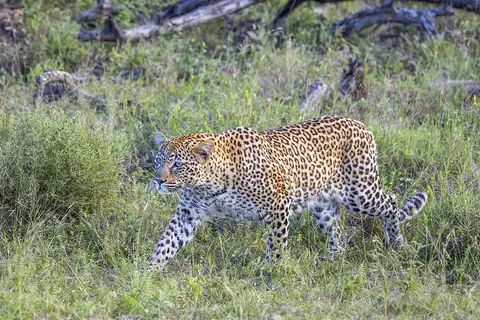
The leopard is a strong, spotted big cat and the best climber of them all. It can carry its food high up into a tree, away from lions and hyenas. Leopards live in more kinds of places than any other big cat, from deserts to rainforests, across Africa and Asia.
-
Watch
Country
Côte d'Ivoire
Côte d'Ivoire, also called Ivory Coast, is a country on the coast of West Africa. It has lagoons along the sea, rainforest in the south and savanna in the north. It became the world's leading grower of cocoa beans in the late 1980s, and about 32.7 million people lived there in 2025.
-
Watch
Country
Sierra Leone
Sierra Leone is a country on the Atlantic coast of West Africa. Its name comes from Portuguese words meaning Lion Mountains, after the hills around Freetown's huge natural harbor. Rainforests, rivers and mangrove swamps are home to chimpanzees and pygmy hippos, and the 2021 census counted about 7.5 million people.
-
 Watch
Animal
Aardvark
The aardvark is a shy night digger of African savannas. It sniffs out ant and termite nests, rips them open with its spade-like claws and laps up the insects with a sticky tongue about 30 centimeters long. Its name means 'earth pig' in Afrikaans.
-
 Watch
Animal
African buffalo
The African buffalo is a huge, cow-like grazer with heavy, curving horns. It lives in herds that can number in the thousands, and a herd will rush to protect a calf in danger. It lives across much of Africa south of the Sahara, from open savannas to rainforests.
For parents & teachers
What children will learn
- Describe how the pygmy hippo differs from the common hippo in size, body and way of life.
- Explain what nocturnal and solitary mean, using the pygmy hippo as an example.
- Describe the pygmy hippo's life cycle and how mothers hide their calves.
- Understand why the species is endangered and how it is protected.
Recommended ages: 3 to 17 · About 15 minutes
Talk about it
- Why might eyes on the sides of the head be more useful on land than eyes on top?
- Why is it hard for scientists to study an animal that is shy, solitary and active at night?
- How could protecting a forest help many animals at once, not only pygmy hippos?
Try at home or in class
- Mark 1 meter on a wall and stand beside it to see how tall a pygmy hippo is at the shoulder.
- Make a tunnel path through a pile of cushions and blankets and crawl through it, like a pygmy hippo moving through thick forest.
Key vocabulary: nocturnal, solitary, herbivore, blood sweat, endangered
Where these facts come from
- The IUCN Red List of Threatened Species , International Union for Conservation of Nature (IUCN terms of use (no redistribution of Red List data or range maps))
- GBIF Backbone Taxonomy and GBIF Occurrence Search , Global Biodiversity Information Facility (CC0 1.0 (backbone); occurrence counts are facts derived from records under CC0, CC BY and CC BY-NC)
- Hexaprotodon liberiensis (pygmy hippopotamus) , Animal Diversity Web, University of Michigan
- Pygmy hippopotamus , San Diego Zoo Wildlife Alliance
- Choeropsis liberiensis (Pygmy Hippopotamus), 2015 assessment , IUCN Red List
- Hippopotamus , San Diego Zoo Wildlife Alliance
- Wikidata , Wikimedia Foundation (CC0 1.0)
- Wikimedia Commons , Wikimedia Foundation (Per file: Public domain, CC0, CC BY or CC BY-SA only (credited on each page))
Checked, not yet human-reviewed. Last updated October 24, 2026. Spotted a mistake? Tell us.