
Animal
Shortfin mako shark
The shortfin mako is a fast shark of the open ocean. It is shiny blue on top and white underneath. It has a pointed nose and a tail shaped like a half moon.
The shortfin mako is a sleek, metallic-blue shark that roams warm and mild oceans all over the world. Scientists call it the fastest shark: it can sprint at up to about 70 kilometers an hour and even leap out of the water. It hunts fast fish such as tuna and swordfish, and it is now endangered.
Isurus oxyrinchus is a large, highly migratory pelagic shark of tropical and temperate oceans, built for speed with a conical body, pointed snout and crescent-shaped tail. Its slow life history, with females maturing at about 18 to 21 years and breeding every three years, has left it vulnerable to heavy fishing, and the IUCN assessed it as Endangered in 2018.
Photo: Mark Conlin, SWFSC Large Pelagics Program, public domain, via Wikimedia Commons
Meet the shortfin mako
The shortfin mako is a shark that swims very fast.
It is shiny blue on top and white underneath. It has a pointed nose, big black eyes and a tail shaped like a half moon.
The shortfin mako looks built for speed. Its body is smooth and rounded, narrowing at both ends, with a pointed snout, big black eyes and a tall, crescent-shaped tail. Its back is a deep, shiny blue and its belly is white.
The Florida Museum calls it the fastest shark in the world. It can burst forward at up to about 70 kilometers an hour, faster than cars are allowed to drive through most towns. Its name comes from mako, a Maori word for shark.
Isurus oxyrinchus is a cartilaginous fish (class Chondrichthyes) of the mackerel shark family, Lamnidae. Average adults measure about 2.0 to 2.15 meters (males) and 2.75 to 2.9 meters (females), with a maximum near 4 meters; the IUCN gives a maximum of about 4.45 meters. The Florida Museum describes it as the fastest shark, with burst speeds of up to 70 kilometers per hour (Diez and colleagues, 2015).
Its body is conic-cylindrical with a bluntly pointed snout, a lunate tail with a high aspect ratio, and a single keel on each side of the tail stalk. It is separated from the longfin mako (Isurus paucus) by smaller pectoral fins, smaller eyes and a white rather than dark area around the mouth.
Quick facts
- Group
- Fish
- Length
- 2 to 2.9 m
- Top speed
- up to 70 km/h
- Lifespan in the wild
- 29 to 32 years
A traveler of the open ocean
Shortfin makos live far out in the ocean.
They like water that is not too cold. They swim long distances across the sea.
Shortfin makos live in tropical and mild oceans all around the world. They are open-ocean sharks, but sometimes come near the coast where the deep water is close to shore.
They usually stay in water warmer than about 16 °C and swim from the surface down to about 500 meters deep. They are great travelers that can cross large stretches of ocean.
The species is widespread in temperate and tropical waters of all oceans (IUCN). The Florida Museum traces its range from California to Chile and from the Grand Banks to Argentina in the Americas, from Norway to South Africa including the Mediterranean, across the Indian Ocean to Australia, and from Japan to New Zealand and the Aleutians to the Society Islands.
It is a neritic and oceanic shark of the epipelagic and mesopelagic zones, usually in water above about 16 °C, from the surface to about 500 meters and recorded to 888 meters. NOAA Fisheries describes it as highly migratory, and genetic work has identified separate subpopulations in different ocean regions.
Did you know?
Young makos have a black spot on the tip of the nose.
Young shortfin makos have a black spot on the tip of the snout, and older makos get darker overall.
Juveniles show a black blotch on the snout tip; larger individuals are darker, with pigment spreading onto normally white areas.
Where can you find this animal?
- Lives here naturally · Countries and seas named by a scientific source
- Sightings recorded · Records of wild sightings (GBIF)
Lives here naturally · Countries and seas named by a scientific source
Temperate and tropical waters of all oceans, including the Mediterranean, usually where the water is warmer than about 16 °C. Shading is by whole ocean, so it includes cold polar waters where makos do not live.
Places: Atlantic Ocean, Indian Ocean and Pacific Ocean.
Source: iucn-red-list · checked October 2026
Sightings recorded · Records of wild sightings (GBIF)
Counts of GBIF records of wild observations (human and machine) and preserved specimens. Records include introduced populations, vagrants, escaped or released animals and misidentifications, so a country with records is not necessarily part of the native range.
Wild sightings have been recorded in Chile, New Zealand, Australia, Brazil, United States, UK, Mexico, Germany and 72 more places.
Source: gbif · checked October 2026
Range maps show where scientists say an animal lives, often country by country. An animal may live in only part of a country shown, and sightings records can include animals that wandered far from home.
A hunter of fast fish
Makos eat fast fish and squid.
They chase tuna and swordfish. They are fast enough to catch them.
Shortfin makos hunt other fast swimmers of the open ocean. They catch tuna, swordfish, other sharks and squid, and once in a while they eat a sea mammal or a sea turtle.
They are very active hunters and are often seen leaping out of the water while feeding.
The Florida Museum describes a diet of fast-moving pelagic fishes such as swordfish and tunas, other sharks, and squid, with marine mammals and sea turtles occasionally eaten. Makos are very active and are often seen breaching while feeding.
The same source notes that larger sharks may eat young makos, while adults are likely preyed on only by humans.
Did you know?
The name mako means shark.
The name mako comes from a Maori word meaning shark.
The common name is derived from the Maori word mako, meaning shark; Isurus means 'equal tail', for the lunate caudal fin.
Built for speed
The mako's body is shaped like a torpedo.
Its tail is tall and curved like a half moon. Its teeth are long and pointy. Its back fin sticks up like a triangle.
A mako's smooth, torpedo-like body slides through the water with little drag. Its tall, crescent-shaped tail makes almost all of its push, and there is a ridge on each side of the tail base, called a keel.
Its teeth are long, narrow and hooked, with smooth edges, and the lower ones show even when the mouth is closed. Bigger makos are darker, and young ones have a black spot on the tip of the snout.
The Florida Museum describes a markedly hydrodynamic, conic-cylindrical body, a prominent caudal keel and a lunate tail whose high aspect ratio gives maximum thrust for minimum drag and provides almost all propulsion. The mouth is a parabolic U shape; the teeth are large, narrow, hook-like and smooth-edged, without cusps or serrations, and the lower teeth are visible even when the jaw is closed.
Color is deep metallic blue above and white below, with a sharp boundary; larger sharks are darker, and juveniles have a black blotch on the snout tip. Its scales, called denticles, are small and overlapping with three to five ridges.
A long, slow start
Mother makos have live babies called pups.
The pups grow inside their mother for more than a year. They are born big and ready to swim.
Shortfin mako mothers do not lay eggs in the sea. The babies hatch from eggs inside their mother and keep growing there, feeding on extra eggs she makes, for 15 to 18 months. Then she gives birth to about 4 to 25 pups, each 60 to 70 centimeters long.
Makos grow up slowly. Males are ready to breed at about 7 to 9 years old, but females not until about 18 to 21, and a female has pups only about every three years.
Reproduction is aplacental viviparity with oophagy: embryos hatch in the uterus, use their yolk, then feed on unfertilized eggs. Gestation is estimated at 15 to 18 months within a three-year reproductive cycle; litters number 4 to 25 (mostly 10 to 18, possibly up to 30) and pups measure 60 to 70 centimeters at birth (IUCN, Florida Museum).
Males mature at 166 to 204 centimeters and females at 265 to 312 centimeters. Female age at maturity is 18 to 21 years and maximum age 28 to 32 years in several regions, giving a generation length of 24 to 25 years (IUCN).
Fast, active and far-roaming
Makos are always on the move.
They can jump right out of the water. They travel very far across the ocean.
Shortfin makos are very active sharks. They are famous for leaping high out of the water, often while they are hunting, and they travel long distances through the open ocean.
Because they swim so far, from one country's waters to another's, international groups help manage them. Makos are also well known to sport anglers, who count them among the great game fish of the world.
Makos are very active and are often seen breaching while feeding; the Florida Museum notes they can leap great distances out of the water. NOAA Fisheries describes the species as highly migratory, and it is managed internationally, including by the International Commission for the Conservation of Atlantic Tunas (ICCAT).
Regarding people, the Florida Museum, citing the International Shark Attack File (2018), records shortfin makos in 10 unprovoked attacks, and notes that hooked makos often damage boats and injure fishers. The species is also a prized sport fish.
Did you know?
The mako may be the fastest shark in the world.
The Florida Museum calls the shortfin mako the fastest shark in the world, with bursts of up to about 70 kilometers an hour.
Burst swimming speeds of up to 70 km/h are reported (Diez and colleagues, 2015, cited by the Florida Museum).
Too many caught
There are fewer mako sharks than there used to be.
Many are caught by fishing boats. New rules help protect them.
The shortfin mako is endangered. Its meat is valuable, its fins are sold, and many are caught on long fishing lines meant for tuna and swordfish. Because makos grow up slowly and have pups only every few years, they cannot quickly replace the sharks that are caught.
Countries are now working together on rules, such as limits on keeping makos and controls on the fin trade, to help them recover.
The IUCN assessed the shortfin mako as Endangered (A2bd) in 2018 (published 2019), estimating a median global decline of 46.6 percent with the highest probability of a 50 to 79 percent reduction over three generations (72 to 75 years). Declines were steep in the North and South Atlantic and less steep in the North Pacific and Indian Ocean; the South Pacific population appeared to be increasing.
It is caught as target and bycatch in longline, purse seine and gillnet fisheries and kept for its high-value meat and fins. Measures include CMS Appendix II (2008), a Mediterranean retention ban (GFCM, 2012), a 2017 ICCAT measure for the overfished North Atlantic stock, and listing on CITES Appendix II. In 2022 NOAA Fisheries found that listing under the US Endangered Species Act was not warranted.
IUCN Red List
How is the shortfin mako shark doing in the wild?
- Least Concern
- Near Threatened
- Vulnerable
- Endangered (this animal)
- Critically Endangered
- Extinct in the Wild
- Extinct
Endangered
At very high risk of disappearing from the wild.
See the IUCN Red List assessment · The IUCN Red List of Threatened Species 2022.2
Amazing facts
-
The mako may be the fastest shark in the world.
The Florida Museum calls the shortfin mako the fastest shark in the world, with bursts of up to about 70 kilometers an hour.
Burst swimming speeds of up to 70 km/h are reported (Diez and colleagues, 2015, cited by the Florida Museum).
-
Makos can jump right out of the water.
Shortfin makos are often seen leaping out of the water when they are feeding.
Breaching is common during feeding, and makos can leap great distances clear of the water.
-
The name mako means shark.
The name mako comes from a Maori word meaning shark.
The common name is derived from the Maori word mako, meaning shark; Isurus means 'equal tail', for the lunate caudal fin.
-
Young makos have a black spot on the tip of the nose.
Young shortfin makos have a black spot on the tip of the snout, and older makos get darker overall.
Juveniles show a black blotch on the snout tip; larger individuals are darker, with pigment spreading onto normally white areas.
Words to know
- pelagic
- living in the open ocean, away from the sea floor and the coast
- crescent
- a curved shape like a thin slice of the moon
- keel
- a ridge along the side of a shark's tail base
- migratory
- traveling long distances, often between different areas each year
- pup
- a baby shark
- bycatch
- animals caught by accident while fishing for something else
Discovery challenge
-
What is the mako famous for?
What makes the shortfin mako stand out among sharks?
Which trait does the Florida Museum highlight in the shortfin mako?
- Its speed
- Its long neck
- Its fluffy fur
Show the answer
Its speed
It is a very fast swimmer.
It is called the fastest shark, with bursts of up to about 70 km/h.
Burst speeds of up to 70 km/h, the fastest recorded for a shark.
-
What shape is the mako's tail?
What shape is the shortfin mako's tail?
Which caudal fin shape gives the mako most of its thrust?
- Round like a ball
- Curved like a half moon
- Flat like a paddle
Show the answer
Curved like a half moon
Its tail is curved like a half moon.
The tail is tall and crescent-shaped, like a half moon.
A lunate, high-aspect-ratio caudal fin that provides almost all propulsion.
-
What do makos eat?
Which of these is a typical mako meal?
Which prey is typical of the shortfin mako?
- Grass
- Tuna
- Seeds
Show the answer
Tuna
Makos eat fast fish like tuna.
They hunt fast fish such as tuna and swordfish, plus squid.
Fast-moving pelagic fishes such as tunas and swordfish, other sharks and squid.
-
Why are there fewer makos now?
Why is the shortfin mako endangered?
Which combination explains the shortfin mako's Endangered listing?
- Too much fishing, and slow growing up
- Too much snow
- Too many dolphins
Show the answer
Too much fishing, and slow growing up
Too many have been caught, and they grow up slowly.
Many are caught for meat and fins, and makos grow up slowly, so they cannot replace the lost sharks quickly.
Heavy target and bycatch fishing combined with late maturity and a three-year reproductive cycle.
Explore next
-
 Watch
3D
Animal
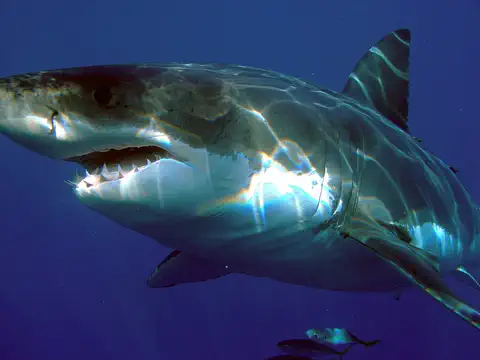
Great white shark
The great white shark is the largest of the mackerel sharks: a strong, torpedo-shaped fish with a gray back and a white belly. It hunts fish, seals and sea lions, and it is partly warm-blooded, which helps it stay active in cool water.
-
 Watch
3D
Animal
Basking shark
The basking shark is the second-biggest fish in the world, after the whale shark. It swims slowly near the surface with its enormous mouth open, sieving tiny floating animals called zooplankton out of the water. It is gentle and lives mainly in cool seas.
-
 Watch
3D
Animal
Scalloped hammerhead
The scalloped hammerhead is a large shark with a wide, flat head shaped like a hammer, with wavy notches along the front edge. It lives in warm coastal seas around the world, gathers in big schools, and hunts fish and squid. It is now critically endangered because so many are caught.
-
 Watch
3D
Animal
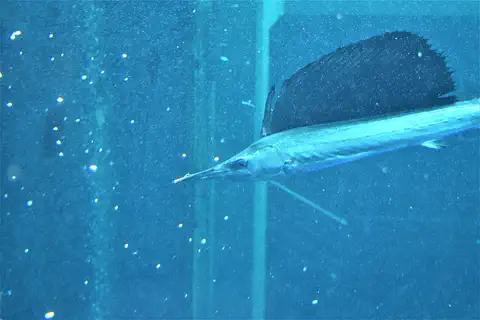
Indo-Pacific sailfish
The sailfish is a long, sleek ocean fish with a tall, sail-like fin on its back and a long, spear-shaped upper jaw called a bill. It hunts schools of small fish in warm seas, folding its sail away to speed up and raising it to make sharp turns.
-
 Watch
Animal
Atlantic bluefin tuna
The Atlantic bluefin tuna is the largest of all tunas: big ones can be about 4 meters long. Its torpedo-shaped body is built for long journeys, and it can keep its body warmer than the water around it. Bluefin tuna were badly overfished, but with fishing limits set by countries working together, the numbers caught are now controlled.
-
 Watch
3D
Animal
Megamouth shark
The megamouth shark is a huge, slow shark with a big, rounded head and an enormous mouth. It swims with its mouth open to gulp tiny shrimp called krill and other small animals. It lives far out in the open ocean and is so rarely seen that scientists did not know it existed until 1976.
-
 Watch
Animal
Alligator gar
The alligator gar is one of the largest freshwater fish in North America. It has a broad snout lined with teeth, armor-like scales, and a swim bladder that works like a lung, so it can gulp air in warm, still water. It lives in the big rivers, swamps and bayous of the southern United States, Mexico and Central America.
-
 Watch
Animal
Arapaima
The arapaima is one of the biggest freshwater fish in the world, longer than a grown-up is tall. It lives in the warm, slow rivers and flooded lakes of the Amazon, and it must swim up to the surface to gulp air every few minutes.
For parents & teachers
What children will learn
- Describe the body features that make the shortfin mako fast.
- Explain the mako's life cycle, including its long pregnancy and late maturity.
- Explain why a fast-growing threat (fishing) harms a slow-growing animal, and how international rules help.
Recommended ages: 3 to 17 · About 12 minutes
Talk about it
- Why might a shark that takes 20 years to grow up be harmed more by fishing than a fish that grows up in one year?
- Why do you think countries need to work together to protect a shark that crosses oceans?
- How is a mako's body shape like a fast boat or an airplane?
Try at home or in class
- Push a flat hand and then a pointed hand through water in a sink or bath and feel which one moves more easily.
- Cut a crescent and a round tail from paper and wave each through the air to compare how they feel.
Key vocabulary: pelagic, crescent, keel, migratory, pup, bycatch
Where these facts come from
- The IUCN Red List of Threatened Species , International Union for Conservation of Nature (IUCN terms of use (no redistribution of Red List data or range maps))
- GBIF Backbone Taxonomy and GBIF Occurrence Search , Global Biodiversity Information Facility (CC0 1.0 (backbone); occurrence counts are facts derived from records under CC0, CC BY and CC BY-NC)
- Isurus oxyrinchus (Shortfin Mako), 2019 global assessment , IUCN Red List of Threatened Species
- Shortfin mako shark , NOAA Fisheries
- Shortfin mako species profile , Florida Museum of Natural History
- Wikidata , Wikimedia Foundation (CC0 1.0)
- Wikimedia Commons , Wikimedia Foundation (Per file: Public domain, CC0, CC BY or CC BY-SA only (credited on each page))
Checked, not yet human-reviewed. Last updated October 28, 2026. Spotted a mistake? Tell us.