Animal
Indo-Pacific sailfish
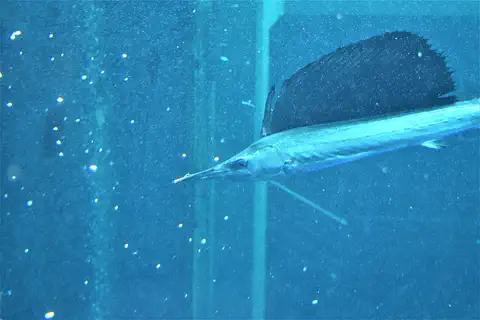
The sailfish has a huge fin on its back like a sail and a long, pointy nose. It is one of the fastest fish in the sea.
The sailfish is a long, sleek ocean fish with a tall, sail-like fin on its back and a long, spear-shaped upper jaw called a bill. It hunts schools of small fish in warm seas, folding its sail away to speed up and raising it to make sharp turns.
Istiophorus platypterus is a billfish (family Istiophoridae) of warm epipelagic waters, recognized by its huge first dorsal fin and a bill formed from the upper jaw. It is often named the fastest fish, though speeds in the wild are hard to measure. It changes color with excitement, hunts schooling fish, sometimes in groups, and is listed as Vulnerable by the IUCN.
Photo: 出羽雀台, CC BY-SA 4.0, via Wikimedia Commons
Meet the sailfish
The sailfish is a big ocean fish.
It has a tall fin on its back that looks like a sail. Its top jaw is long and pointy, like a sword. It can swim very fast.
The sailfish is a sleek, streamlined ocean fish. Its most famous feature is a huge fin on its back, taller than its body is deep, which runs along most of its length like the sail of a boat. Its upper jaw stretches into a long, round, pointed bill.
Sailfish belong to a group called billfish, together with marlins and swordfish. They can grow to over 3.4 meters long, including the bill, and weigh up to about 100 kilograms. Many sources name the sailfish as the fastest fish in the sea.
Istiophorus platypterus belongs to the family Istiophoridae and is one of its smaller members. It grows to over 3.4 meters total length and about 100 kilograms, and the largest fish are usually females. The first dorsal fin is far taller than the body is deep and runs most of the body's length; the upper jaw forms a bill, round in cross section, about twice as long as the lower jaw.
Its taxonomy is debated. The Australian Museum notes that most authorities now recognize a single worldwide species, while some scientists treat Atlantic sailfish as a separate species, Istiophorus albicans. This page follows the single-species view used by the IUCN, whose assessment covers the Atlantic, Indian and Pacific Oceans.
Quick facts
- Group
- Fish
- Length
- up to 3.4 m
- Weight
- up to 100 kg
- Top speed
- up to 110 km/h
Where it lives
Sailfish live in warm oceans around the world.
They swim near the top of the sea. Sometimes they come close to coasts and islands.
Sailfish live in warm and temperate parts of the Pacific, Indian and Atlantic Oceans. They usually swim in the upper layer of the open ocean, where the water is about 21 to 28 degrees Celsius.
Unlike some of their relatives, sailfish often come close to coasts, islands and reefs. They are especially common in places like the Gulf of Mexico, off Florida, around the Caribbean, off West Africa, and near Papua New Guinea, the Philippines and Hawaii.
The sailfish is epipelagic and oceanic but, as the Australian Museum puts it, shows a strong tendency to approach continental coasts, islands and reefs. The Florida Museum gives Atlantic limits of about 40°N to 40°S in the west and 50°N to 32°S in the east, with few Mediterranean records; in the Pacific it ranges from 45 to 50°N to 35°S in the west and 35°N to 35°S in the east, and in the Indian Ocean to about 35 to 45°S.
Atlantic sailfish mostly stay above the thermocline in water of 21 to 28 degrees Celsius, though they also make deeper dives; the IUCN gives a depth range of 0 to 500 meters. At the edges of the range they appear in warm seasons, a pattern the Florida Museum links to the movements of their prey. The IUCN classes the species as a full migrant.
Its habitat

Where can you find this animal?
- Lives here naturally · Countries and seas named by a scientific source
- Sightings recorded · Records of wild sightings (GBIF)
Lives here naturally · Countries and seas named by a scientific source
Warm and temperate open waters of the Atlantic, Indian and Pacific Oceans, often close to coasts, islands and reefs; rare in the Mediterranean. Shading is by whole ocean, so it is wider than where sailfish actually live.
Places: Atlantic Ocean, Indian Ocean and Pacific Ocean.
Source: iucn-red-list · checked October 2026
Sightings recorded · Records of wild sightings (GBIF)
Counts of GBIF records of wild observations (human and machine) and preserved specimens. Records include introduced populations, vagrants, escaped or released animals and misidentifications, so a country with records is not necessarily part of the native range.
Wild sightings have been recorded in Australia, UK, Mexico, United States, Germany, Japan, Italy, Norway and 72 more places.
Source: gbif · checked October 2026
Range maps show where scientists say an animal lives, often country by country. An animal may live in only part of a country shown, and sightings records can include animals that wandered far from home.
Hunting with a sail and a bill
Sailfish eat small fish and squid.
They chase schools of little fish. They swish their long bill to catch them.
Sailfish eat schooling fish such as sardines, anchovies and mackerel, along with squid and octopus. In the Atlantic they also catch tunas, jacks, halfbeaks and needlefish.
Fishermen have watched how they hunt. One or several sailfish chase a school of fish, then speed up with their sail folded down flat. When they catch up, they raise the sail, turn sharply to cut off part of the school, and hit the fish with their bill. Then they eat the stunned fish, usually head first.
Cephalopods and bony fishes dominate the diet. In the Atlantic, mackerels, tunas, jacks, halfbeaks and needlefish are taken most often, suggesting feeding at the surface, in midwater, along reef edges and near the bottom; in the Pacific, prey includes sardines, anchovies, jacks, dolphinfish, ribbonfish and triggerfish, plus squid.
The Australian Museum quotes an FAO description (Nakamura, 1985) of the hunt: sailfish pursue a school at half speed with fins half-folded into body grooves, close in at full speed with fins folded flat, then make sharp turns with fins fully raised to confront part of the school and strike prey with the bill, eating the stunned fish head first. A Queensland Museum ichthyologist also reports sailfish and marlin feeding on pufferfish.
Did you know?
A sailfish can fold its big sail down flat.
Sailfish fold their sail and their long belly fins into grooves on their body when they speed up, and raise them to turn sharply.
Fishermen's observations quoted in an FAO catalog describe sailfish folding their fins into grooves for full-speed pursuit and raising them for sharp turns into the school.
Built for speed
The sailfish has a long, thin body made for speed.
Its tall sail can fold down flat. Its long bill helps it catch fish. It can even change color!
A sailfish's body is long and sleek. Its long bill is the upper jaw, about twice as long as the lower jaw. Its huge sail can be raised tall or folded down into a groove along its back.
Underneath, two very long, thin fins hang down like streamers. They can also fold into grooves on its belly. Sailfish are dark blue on top and silvery underneath, with about 20 stripes made of light blue spots. Their colors can change when they get excited.
The upper jaw forms a long bill, circular in cross section and about twice the length of the lower jaw; the jaws carry file-like teeth. The sail-like first dorsal fin, longest at about its 20th ray, is speckled with small black dots. The pelvic fins are very long, nearly reaching the anal fin, and fold into a pair of grooves on the belly; the tail stalk has double keels, and the lateral line is clearly visible.
The body is dark blue above, brownish on the sides and silvery or white below, with about 20 bars of light blue spots on each side. The Florida Museum notes that body color varies with the fish's level of excitement. The Australian Museum, citing an encyclopedia of fishes, reports speeds over 110 kilometers per hour over short periods, and most sources call the sailfish the fastest fish. A 2016 study in Biology Open that estimated top speed from how quickly the swimming muscles contract questioned that figure: it put sailfish at about 8.3 meters per second (about 30 kilometers per hour), still the fastest of the four species tested, and suggested they cannot exceed 10 to 15 meters per second, where cavitation would damage the fins.
From tiny egg to giant
A sailfish mom lays millions of tiny eggs.
The babies are smaller than a grain of rice. They do not have a long bill at first. They grow very fast.
Sailfish spawn in warm seas, mostly in summer. A female swims slowly near the surface with her sail sticking out of the water, and one or more males swim with her. A large female can release about 4.5 million eggs.
A newly hatched sailfish is only about 3 millimeters long, and it does not have a long bill yet. Its jaws start to stretch out when it is just 6 millimeters long. By 20 centimeters it looks like a small adult, and by six months old it can be 1.4 meters long.
In the western North Atlantic spawning may begin in April but peaks in summer; females swim slowly in shallow water with the dorsal fin above the surface, accompanied by one or more males, and a large female may release about 4,500,000 eggs. In the Pacific, spawning occurs in tropical and subtropical waters with summer peaks, in pairs or with two or three males pursuing a female.
Larvae hatch at about 0.3 centimeters without the adult's long jaw and with spines on the head. The jaws begin to lengthen at about 0.6 centimeters, and by 20 centimeters all larval features are gone. Growth is very fast: at six months a juvenile may weigh 2.7 kilograms and measure 1.4 meters, after which growth slows. The IUCN gives a generation length of only 4.3 years.
Ocean travelers
Sailfish travel long ways across the ocean.
They follow the warm water and the fish they like to eat. Sometimes they hunt together.
Sailfish are travelers. At the edges of their range, they arrive in the warm seasons, possibly following the fish they eat.
They can hunt alone, or several sailfish may work the same school of fish together. Sailfish are hunted too: dolphinfish, other big fish and seabirds sometimes eat them.
The IUCN classes the sailfish as a full migrant, and the Florida Museum describes seasonal appearances at the northern and southern extremes of the range during warm months, possibly linked to prey movement; in the western Atlantic, wind conditions and water temperature also seem to influence where they are found.
The Nakamura account quoted by the Australian Museum describes one or several sailfish working a school of prey together. Predators include dolphinfish, other large predatory fishes and seabirds. The Florida Museum also lists 34 parasite species recorded from sailfish, from flukes and tapeworms to copepods and barnacles, and fish hitchhikers such as remoras and pilotfish.
Did you know?
A sailfish can change its colors when it gets excited.
A sailfish's body color changes depending on how excited it is.
The Florida Museum notes that sailfish body color varies with the fish's level of excitement.
Protecting sailfish
There are fewer sailfish than before.
Many get caught on fishing lines by mistake. Some countries have rules about catching them.
The sailfish is listed as Vulnerable, and its numbers are going down. In the Indian and Pacific Oceans many are caught by accident on long fishing lines set for tuna, and others are caught in nets.
Sailfish are also popular with people who fish for sport. In the United States, commercial boats are not allowed to keep or sell Atlantic sailfish, and sport fishers need a permit and must follow size limits.
The IUCN assessed the sailfish in May 2021 (published 2022) as Vulnerable under criterion A2bd, with a decreasing population; the threat is biological resource use (fishing). In the Indo-Pacific it is taken as bycatch on commercial tuna longlines and by driftnets, harpoons and trolling.
In the Atlantic its meat has little commercial value, but it is a prized recreational species. Under the U.S. Magnuson-Stevens Act, U.S.-flagged commercial vessels may not sell, keep or buy Atlantic billfish, recreational anglers in federal waters need a permit, and a minimum size of 160 centimeters lower-jaw fork length applies (Florida Museum).
IUCN Red List
How is the indo-pacific sailfish doing in the wild?
- Least Concern
- Near Threatened
- Vulnerable (this animal)
- Endangered
- Critically Endangered
- Extinct in the Wild
- Extinct
Vulnerable
At high risk of disappearing from the wild.
See the IUCN Red List assessment · The IUCN Red List of Threatened Species 2022.2
Amazing facts
-
A sailfish can change its colors when it gets excited.
A sailfish's body color changes depending on how excited it is.
The Florida Museum notes that sailfish body color varies with the fish's level of excitement.
-
Baby sailfish do not have a long nose at first.
Newly hatched sailfish are about 3 millimeters long and have no bill; their jaws only start to stretch out at about 6 millimeters.
Larvae hatch at about 0.3 centimeters with head spines and short jaws; the bill starts to develop at about 0.6 centimeters.
-
A sailfish can fold its big sail down flat.
Sailfish fold their sail and their long belly fins into grooves on their body when they speed up, and raise them to turn sharply.
Fishermen's observations quoted in an FAO catalog describe sailfish folding their fins into grooves for full-speed pursuit and raising them for sharp turns into the school.
-
A big sailfish mom can lay millions of eggs.
A large female sailfish may release about 4.5 million eggs while spawning.
A large female may release about 4,500,000 eggs in a spawning event.
Words to know
- bill
- the long, pointed upper jaw of a sailfish, marlin or swordfish
- dorsal fin
- a fin on a fish's back; the sailfish's is huge, like a sail
- school
- a large group of fish swimming together
- larva
- a very young fish that does not yet look like its parents
- bycatch
- animals caught by accident in fishing gear meant for other fish
- streamlined
- shaped to move easily through water or air
Discovery challenge
-
What does the sailfish have on its back?
What is the sailfish's 'sail'?
Which structure forms the sailfish's 'sail'?
- A huge fin
- A shell
- Wings
Show the answer
A huge fin
It has a huge fin that looks like a sail.
The sail is its very tall first dorsal fin, which it can raise or fold down.
The sail is the greatly enlarged first dorsal fin, which folds into a groove along the back.
-
What is the sailfish's long, pointy bill?
What is a sailfish's bill?
What is the sailfish's bill formed from?
- Its tail
- Its upper jaw
- A fin
Show the answer
Its upper jaw
The bill is its top jaw, stretched out long.
The bill is the upper jaw, about twice as long as the lower jaw.
It is the elongated upper jaw, round in cross section and about twice the length of the lower jaw.
-
What do sailfish eat?
What do sailfish mostly eat?
What are the sailfish's main prey?
- Grass
- Small fish and squid
- Seaweed
Show the answer
Small fish and squid
Sailfish eat small fish and squid.
They eat schooling fish like sardines and mackerel, plus squid and octopus.
Bony fishes such as sardines, anchovies and mackerels, and cephalopods.
-
What does a sailfish do with its sail when it wants to go fast?
What does a sailfish do with its sail when it speeds up?
How does a sailfish position its fins during a full-speed chase?
- Folds it down flat
- Waves it in the air
- Leaves it at home
Show the answer
Folds it down flat
It folds the sail down flat to go fast.
It folds the sail down into a groove to speed up, then raises it to turn sharply.
Fins are folded flat into body grooves for full-speed pursuit and fully raised for sharp turns into the school.
Places where you might see it
-
 Watch
 Country
Philippines
The Philippines is an island country in Southeast Asia, in the western Pacific Ocean. It has more than 7,000 islands, about 50 volcanoes and rich coral reefs, and about 112.7 million people were counted there in 2024.
-
 Watch
 Country
Mexico
Mexico is a large country in southern North America, between the Pacific Ocean and the Gulf of Mexico. It has smoking volcanoes, ancient cities built by the Maya and other peoples, and about 132 million people, many of them in and around Mexico City.
Explore next
-
 Watch
3D
Animal
Ocean sunfish
The ocean sunfish, or mola, is one of the heaviest bony fish in the world. Its body is tall, round and flat, with a long fin on top, another underneath, and a strange frilly edge instead of a tail. It dives deep to eat jellyfish and is often seen resting at the surface, perhaps to warm up.
-
 Watch
3D
Animal
Tiger shark
The tiger shark is one of the biggest sharks in the sea. Young tiger sharks have dark spots and stripes like a tiger, which fade as they grow. It eats an amazing range of food, and it travels long distances between warm and cooler seas.
-
 Watch
3D
Animal
Common bottlenose dolphin
The common bottlenose dolphin is a fast, clever ocean mammal named for its short, thick snout. It finds fish with echoes, talks with whistles and clicks, and lives in warm and mild seas all around the world.
-
 Watch
3D
Animal
Blue tang
The blue tang is a royal-blue reef fish with black markings and a bright yellow tail. It lives on coral reefs across the Indian and Pacific Oceans, starts life yellow, and carries sharp blades at the base of its tail.
-
Watch
Country
Philippines
The Philippines is an island country in Southeast Asia, in the western Pacific Ocean. It has more than 7,000 islands, about 50 volcanoes and rich coral reefs, and about 112.7 million people were counted there in 2024.
-
Watch
Country
Mexico
Mexico is a large country in southern North America, between the Pacific Ocean and the Gulf of Mexico. It has smoking volcanoes, ancient cities built by the Maya and other peoples, and about 132 million people, many of them in and around Mexico City.
-
 Watch
3D
Animal
Shortfin mako shark
The shortfin mako is a sleek, metallic-blue shark that roams warm and mild oceans all over the world. Scientists call it the fastest shark: it can sprint at up to about 70 kilometers an hour and even leap out of the water. It hunts fast fish such as tuna and swordfish, and it is now endangered.
-
 Watch
3D
Animal
Yellowfin tuna
The yellowfin tuna is a large, torpedo-shaped fish of warm oceans around the world. It has a dark blue back, a silver belly and long, bright yellow fins. Yellowfin travel huge distances, dive deep to hunt fish and squid, and are important to fisheries all around the world.
For parents & teachers
What children will learn
- Identify the sailfish's sail, bill and fins and explain how each helps it hunt.
- Describe how sailfish hunt schools of fish.
- Describe the sailfish's fast growth from a tiny larva.
- Explain why the sailfish is Vulnerable and how fishing rules protect it.
Recommended ages: 3 to 17 · About 15 minutes
Talk about it
- Why might folding fins away help a fish swim faster?
- Why is it so hard to measure how fast a wild fish swims?
- How do rules like size limits and catch-and-release help fish populations?
Try at home or in class
- Push a sheet of paper flat through the air, then push it edge-first, to feel how folding a 'sail' cuts down drag.
- Measure 3.4 meters along the floor with a tape measure to see how long a big sailfish is, bill and all.
Key vocabulary: bill, dorsal fin, school, larva, bycatch, streamlined
Where these facts come from
- The IUCN Red List of Threatened Species , International Union for Conservation of Nature (IUCN terms of use (no redistribution of Red List data or range maps))
- GBIF Backbone Taxonomy and GBIF Occurrence Search , Global Biodiversity Information Facility (CC0 1.0 (backbone); occurrence counts are facts derived from records under CC0, CC BY and CC BY-NC)
- Istiophorus platypterus (Sailfish), 2021 assessment , IUCN Red List of Threatened Species
- Sailfish (Istiophorus platypterus) species profile , Florida Museum of Natural History
- Sailfish, Istiophorus platypterus , Australian Museum
- What is the fastest fish? , Australian Museum
- Maximum swimming speeds of sailfish and three other large marine predatory fish species based on muscle contraction time and stride length: a myth revisited (Svendsen and colleagues, Biology Open, 2016) , Europe PMC
- Wikidata , Wikimedia Foundation (CC0 1.0)
- Wikimedia Commons , Wikimedia Foundation (Per file: Public domain, CC0, CC BY or CC BY-SA only (credited on each page))
Checked, not yet human-reviewed. Last updated October 27, 2026. Spotted a mistake? Tell us.