
Animal
Scalloped hammerhead
The scalloped hammerhead is a shark with a head shaped like a wide hammer. It lives in warm seas all around the world. Sometimes many swim together in big groups.
The scalloped hammerhead is a large shark with a wide, flat head shaped like a hammer, with wavy notches along the front edge. It lives in warm coastal seas around the world, gathers in big schools, and hunts fish and squid. It is now critically endangered because so many are caught.
Sphyrna lewini is a large coastal and semi-oceanic shark of warm-temperate and tropical seas worldwide, named for the scalloped front edge of its cephalofoil (hammer-shaped head). Known for forming schools, it has declined steeply in all oceans, mainly through fishing for its fins and meat, and has been assessed as Critically Endangered by the IUCN since 2018.
Photo: NOAA Photo Library, public domain, via Wikimedia Commons
Meet the scalloped hammerhead
The scalloped hammerhead is a shark with a very wide head.
Its head looks like a hammer. It has an eye at each end of the hammer. It is gray-brown on top and pale underneath.
The scalloped hammerhead is a big shark that can grow to about 3.4 meters long, about as long as two grown-ups lying head to toe. Its most famous feature is its head, which is wide and flat like a hammer, with an eye at each end.
The front edge of the hammer is curved and has a notch in the middle and small dips along it, like the edge of a scallop shell. That wavy edge is how it got its name. Its body is brownish gray to bronze on top and pale underneath.
Sphyrna lewini is a large cartilaginous fish (class Chondrichthyes) of the hammerhead family, Sphyrnidae; NOAA Fisheries gives lengths up to about 11 feet (3.4 meters) and weights up to about 335 pounds, and the IUCN gives a maximum size of 3.7 to 4.2 meters. Its laterally expanded head, or cephalofoil, is broadly arched with a central indentation and smaller notches along the front edge, which separates it from the great hammerhead's nearly straight-fronted head and the smooth hammerhead's un-notched one (Florida Museum).
The body is tapered at both ends, with a tall first dorsal fin and low second dorsal and pelvic fins. Adults are brownish gray to bronze or olive above and pale yellow or white below.
Quick facts
- Group
- Fish
- Length
- up to 3.4 m
- Weight
- up to 152 kg
- Lifespan in the wild
- up to 30 years
Warm seas around the world
Scalloped hammerheads live in warm seas all over the world.
Some swim near the coast. Others swim in deeper water far from land.
Scalloped hammerheads live in warm coastal seas around the world, in the Atlantic, Indian and Pacific Oceans. They swim over the shallow sea floor around continents and islands and in the deeper water nearby.
Adults spend most of their time offshore. Mothers come into shallow coastal waters to give birth, and the young sharks grow up there.
The species is circumglobal in coastal warm-temperate and tropical seas (IUCN). NOAA Fisheries describes a range from New Jersey to Brazil, including the Gulf of Mexico and the Caribbean; from the Mediterranean to Namibia; from South Africa and the Red Sea to Pakistan, India and Myanmar; from Japan and China to New Caledonia, Indonesia, the Philippines and Australia; and from southern California to Ecuador and possibly Peru, plus Hawaii and Tahiti.
It is a coastal and semi-oceanic pelagic shark found over continental and island shelves and nearby deep water, usually from the surface to 275 meters but recorded as deep as 1,043 meters. Adults spend most of their time offshore in midwater, and females move into coastal areas to give birth (IUCN).
Did you know?
Male hammerheads travel farther than females.
Genetic studies show male scalloped hammerheads travel across whole oceans, while females stay in their own region.
Genetic data show males moving between ocean basins while females move only regionally and do not cross between separate continental coastlines (IUCN).
Where can you find this animal?
- Lives here naturally · Countries and seas named by a scientific source
- Sightings recorded · Records of wild sightings (GBIF)
Lives here naturally · Countries and seas named by a scientific source
Coastal warm-temperate and tropical seas around the world, over continental and island shelves and nearby deep water, including the Mediterranean, the Red Sea, the Gulf of Mexico and the Caribbean. Shading is by whole ocean, so it is much wider than where these sharks actually live.
Places: Atlantic Ocean, Indian Ocean and Pacific Ocean.
Source: iucn-red-list · checked October 2026
Sightings recorded · Records of wild sightings (GBIF)
Counts of GBIF records of wild observations (human and machine) and preserved specimens. Records include introduced populations, vagrants, escaped or released animals and misidentifications, so a country with records is not necessarily part of the native range.
Wild sightings have been recorded in Australia, Mexico, United States, Fiji, Ecuador, Colombia, Indonesia, Cameroon and 79 more places.
Source: gbif · checked October 2026
Range maps show where scientists say an animal lives, often country by country. An animal may live in only part of a country shown, and sightings records can include animals that wandered far from home.
What it eats
Scalloped hammerheads eat fish and squid.
They also eat octopus, crabs and shrimp, and sometimes rays. They often hunt at night.
Scalloped hammerheads eat mostly bony fish, from small schooling fish like sardines to eels and reef fish. They also catch squid, octopus and crustaceans such as crabs and shrimp, and sometimes small sharks and rays.
Many spend the day near the coast and move offshore to hunt at night. The Florida Museum describes the wide head as helping the shark find prey that is well hidden.
The Florida Museum describes a diet mainly of teleost (bony) fishes and invertebrates, including sardines and other small schooling fish, conger eels, reef fishes, squid, octopus and crustaceans, along with smaller elasmobranchs such as blacktip reef sharks, angelsharks and stingrays; dozens of stingray spines are sometimes found in a hammerhead's mouth and gut.
The same source notes that scalloped hammerheads often spend the day closer inshore and move offshore to hunt at night, and that the broad cephalofoil is used to detect hidden prey.
Did you know?
A hammerhead has an eye at each end of its head.
A scalloped hammerhead's eyes sit at the two ends of its wide, flat head.
The eyes are set at the lateral tips of the cephalofoil, giving a very wide separation between them.
A hammer for a head
The hammer-shaped head is wide and flat.
Its eyes are at the two ends. A tall fin sticks up on its back. The top part of its tail is longer than the bottom part.
The flat, wide head is called a cephalofoil. It has an eye at each end and the mouth underneath, near the middle. The Florida Museum says the wide head helps it find prey, even when the prey is well hidden.
On its back is a tall, pointed first dorsal fin. Long side fins, called pectoral fins, stick out below. Young scalloped hammerheads have dark tips on some fins, and pups living in sunny shallow water have even been found to get darker, like a suntan.
The cephalofoil is broadly arched with a central notch and scalloped front margin; the mouth is broadly arched beneath it, and the eyes sit at the ends of the head. The tall first dorsal fin begins over or just behind the pectoral fins; the second dorsal and pelvic fins are low, and the pelvic fins have straight rear edges (Florida Museum).
The teeth are small, with smooth or slightly serrated cusps. Juveniles have dark tips on the pectoral fins, lower tail lobe and second dorsal fin, while adults have only dusky pectoral tips. Pups in shallow nurseries have been reported to darken in the sun, a 1996 finding by Lowe and Goodman-Lowe cited by the Florida Museum.
Born in a coastal nursery
Mother hammerheads give birth to live babies called pups.
The pups are born in shallow water near the coast. They stay there for a few years while they grow.
Scalloped hammerheads do not lay eggs. The babies, called pups, grow inside their mother for about 9 to 12 months, and she gives birth to between 12 and 41 pups at a time, each 31 to 57 centimeters long.
The pups are born in shallow coastal nurseries and spend their first couple of years there. It takes many years to grow up: females are not ready to have pups until they are about 13 years old.
Reproduction is viviparous, with litters of 12 to 41 pups measuring 31 to 57 centimeters at birth, born every year or every other year (IUCN); the Florida Museum gives a gestation of 9 to 12 months, with pups born in spring and summer. Juveniles spend about their first two years inshore, where predation, including by larger hammerheads, is high.
Males mature at 140 to 198 centimeters and females at 200 to 250 centimeters total length. Female age at maturity is 13.2 years and maximum age about 35 years, giving a generation length of 24.1 years (IUCN).
Schools of hammerheads
Scalloped hammerheads often swim together in big groups called schools.
Sometimes small fish clean their skin.
Scalloped hammerheads are famous for gathering in large schools, sometimes with many sharks swimming together. Adults often form groups of only males or only females.
They also visit cleaning stations, where small cleaner fish called wrasses pick tiny parasites off their skin and even from inside their mouths. The sharks travel too: large schools have been seen heading north for the summer on seasonal migrations.
Adults spend most of their time offshore and form schools segregated by sex, and large schools can be seen on seasonal migrations (Florida Museum). Genetic studies show that males move across ocean basins, while females move only regionally and do not cross between separate continental coastlines (IUCN).
Parasites such as leeches and copepods are removed at cleaning stations by cleaner wrasses. Regarding people, the Florida Museum, citing the International Shark Attack File, lists 17 unprovoked bites for all hammerhead species combined, and notes that scalloped hammerheads have sometimes made threat displays when divers came close, while at other times showing no aggressive behavior.
Did you know?
Baby hammerheads can get a suntan!
Scientists found that hammerhead pups living in sunny, shallow water turn darker, like a suntan.
Pups in shallow nurseries were reported to darken with sun exposure in a 1996 study by Lowe and Goodman-Lowe, cited by the Florida Museum.
A shark in trouble
There are far fewer scalloped hammerheads than before.
Too many have been caught by fishing boats. People are making new rules to protect them.
The scalloped hammerhead is critically endangered. Fishing boats catch many of them, sometimes on purpose and often by accident while fishing for other fish, and their fins are sold for shark fin soup. Because they swim in schools, many can be caught at once.
There is some hope: in the northwest Atlantic and the Gulf of Mexico, where catches have been controlled, their numbers have stopped falling and may be starting to recover. International trade in their fins is now controlled too.
The IUCN assessed the species as Critically Endangered (A2bd) in 2018 (published 2019), estimating median declines of 76.9 to 97.3 percent over three generations (72.3 years), with the most likely reduction above 80 percent. It is caught as a target and as bycatch in longline, purse seine and gillnet fisheries and kept for its meat and fins, which are among those preferred for shark fin soup.
Only in the Northwest Atlantic and Gulf of Mexico do populations show signs of stabilizing and possibly recovering under management. Protections include an ICCAT ban (2010) on keeping hammerheads in its tuna fisheries, listing on CITES Appendix II, and, in the United States, Endangered Species Act listing of two populations as endangered and two as threatened (NOAA Fisheries, 2014).
IUCN Red List
How is the scalloped hammerhead doing in the wild?
- Least Concern
- Near Threatened
- Vulnerable
- Endangered
- Critically Endangered (this animal)
- Extinct in the Wild
- Extinct
Critically Endangered
At extremely high risk of disappearing from the wild.
See the IUCN Red List assessment · The IUCN Red List of Threatened Species 2022.2
Amazing facts
-
A hammerhead has an eye at each end of its head.
A scalloped hammerhead's eyes sit at the two ends of its wide, flat head.
The eyes are set at the lateral tips of the cephalofoil, giving a very wide separation between them.
-
Baby hammerheads can get a suntan!
Scientists found that hammerhead pups living in sunny, shallow water turn darker, like a suntan.
Pups in shallow nurseries were reported to darken with sun exposure in a 1996 study by Lowe and Goodman-Lowe, cited by the Florida Museum.
-
Little fish clean hammerheads' skin.
Hammerheads visit cleaning stations where small wrasses pick parasites off their skin and out of their mouths.
Leeches and parasitic copepods are removed by cleaner wrasses at cleaning stations, including from inside the mouth (Florida Museum).
-
Male hammerheads travel farther than females.
Genetic studies show male scalloped hammerheads travel across whole oceans, while females stay in their own region.
Genetic data show males moving between ocean basins while females move only regionally and do not cross between separate continental coastlines (IUCN).
Words to know
- cephalofoil
- the wide, flat, hammer-shaped head of a hammerhead shark
- school
- a group of fish swimming together
- pup
- a baby shark
- nursery
- a sheltered place where young animals grow up
- bycatch
- animals caught by accident while fishing for something else
- critically endangered
- at very high risk of disappearing from the wild
Discovery challenge
-
What shape is this shark's head?
What gives the hammerhead its name?
Which feature gives the hammerhead family its name?
- A round ball
- A wide hammer
- A long sword
Show the answer
A wide hammer
Its head is wide and flat, like a hammer.
Its wide, flat head is shaped like a hammer, with an eye at each end.
The laterally expanded cephalofoil; in this species its front edge is scalloped with a central notch.
-
Where are baby hammerheads born?
Where do young scalloped hammerheads grow up?
Where do scalloped hammerhead pups spend their first years?
- In shallow water near the coast
- In a nest on land
- Under the ice
Show the answer
In shallow water near the coast
They are born in shallow water near the coast.
Mothers give birth in shallow coastal nurseries, where the pups stay for about two years.
In coastal nursery areas, inshore, for about their first two years.
-
Do scalloped hammerheads swim alone or in groups?
What are scalloped hammerheads famous for doing together?
Which social behavior is typical of adult scalloped hammerheads?
- Swimming in big schools
- Building nests
- Sleeping in trees
Show the answer
Swimming in big schools
They often swim together in big groups called schools.
They gather in large schools, often of only males or only females.
Forming schools segregated by sex, and moving in large schools during seasonal migrations.
-
Why are there fewer hammerheads now?
What is the main reason scalloped hammerheads are critically endangered?
According to the IUCN, what has driven the species' steep declines?
- Too much fishing
- Too much sunshine
- Too many cleaner fish
Show the answer
Too much fishing
Too many have been caught by fishing boats.
Many are caught by fishing boats, often by accident, and their fins are sold.
Target and bycatch capture in longline, purse seine and gillnet fisheries, with meat and fins retained.
Explore next
-
 Watch
Animal
Great hammerhead
The great hammerhead is the biggest of the hammerhead sharks. Its wide, flat head, called a cephalofoil, holds its eyes far apart and is packed with senses that help it find stingrays hiding in the sand of warm, shallow seas.
-
 Watch
3D
Animal
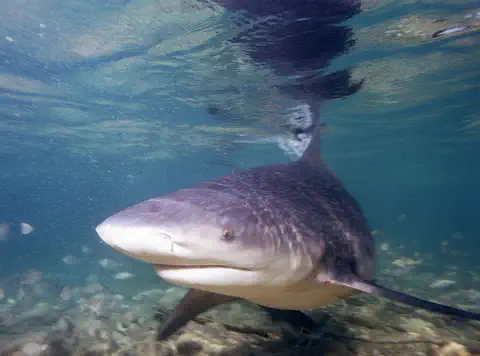
Bull shark
The bull shark is a large, stout shark of warm coasts around the world. It is one of very few sharks that can swim from the salty sea into fresh water, and it has been found thousands of kilometers up big rivers like the Amazon and the Mississippi.
-
 Watch
3D
Animal
Tiger shark
The tiger shark is one of the biggest sharks in the sea. Young tiger sharks have dark spots and stripes like a tiger, which fade as they grow. It eats an amazing range of food, and it travels long distances between warm and cooler seas.
-
 Watch
3D
Animal
Whale shark
The whale shark is the largest fish in the world. This gentle giant swims through warm seas with its huge mouth open, filtering tiny plankton and small fish from the water, and every whale shark has its own pattern of pale spots.
-
 Watch
Animal
Giant oceanic manta ray
The giant oceanic manta ray is the largest ray in the world, with wing-like fins that can stretch more than 6 meters from tip to tip. This gentle filter feeder funnels plankton into its wide mouth, and it has a single pup only every two to three years.
-
 Watch
3D
Animal
Shortfin mako shark
The shortfin mako is a sleek, metallic-blue shark that roams warm and mild oceans all over the world. Scientists call it the fastest shark: it can sprint at up to about 70 kilometers an hour and even leap out of the water. It hunts fast fish such as tuna and swordfish, and it is now endangered.
-
 Watch
3D
Animal
Spotted eagle ray
The spotted eagle ray is a ray that 'flies' through warm Atlantic waters by flapping its wide, wing-like fins. Its dark back is covered in white spots, its tail is long and whip-like, and its snout looks a bit like a duck's bill, which it uses to dig for clams and other shellfish.
-
 Watch
Animal
Alligator gar
The alligator gar is one of the largest freshwater fish in North America. It has a broad snout lined with teeth, armor-like scales, and a swim bladder that works like a lung, so it can gulp air in warm, still water. It lives in the big rivers, swamps and bayous of the southern United States, Mexico and Central America.
For parents & teachers
What children will learn
- Describe the scalloped hammerhead's head shape and other body features.
- Explain the life cycle, from live birth in coastal nurseries to slow maturity.
- Describe schooling and cleaning-station behavior.
- Explain why overfishing and slow reproduction put the species at risk, and what protections exist.
Recommended ages: 3 to 17 · About 12 minutes
Talk about it
- Why might an animal that has only a few dozen pups every year or two be hurt by fishing more than a fish that lays millions of eggs?
- How could a wide head with eyes far apart be helpful to a shark?
- Why do you think rules in one part of the ocean helped hammerheads recover there but not everywhere?
Try at home or in class
- Measure 3.4 meters along a hallway or sidewalk with a tape measure to see how long a large scalloped hammerhead is.
- Hold two small mirrors or paper tubes at arm's length on each side of your head to imagine seeing with eyes as far apart as a hammerhead's.
Key vocabulary: cephalofoil, school, pup, nursery, bycatch, critically endangered
Where these facts come from
- The IUCN Red List of Threatened Species , International Union for Conservation of Nature (IUCN terms of use (no redistribution of Red List data or range maps))
- GBIF Backbone Taxonomy and GBIF Occurrence Search , Global Biodiversity Information Facility (CC0 1.0 (backbone); occurrence counts are facts derived from records under CC0, CC BY and CC BY-NC)
- Sphyrna lewini (Scalloped Hammerhead), 2019 global assessment , IUCN Red List of Threatened Species
- Scalloped hammerhead shark , NOAA Fisheries
- Scalloped hammerhead species profile , Florida Museum of Natural History
- Wikidata , Wikimedia Foundation (CC0 1.0)
- Wikimedia Commons , Wikimedia Foundation (Per file: Public domain, CC0, CC BY or CC BY-SA only (credited on each page))
Checked, not yet human-reviewed. Last updated October 28, 2026. Spotted a mistake? Tell us.