
Animal
Southern elephant seal
The southern elephant seal is the biggest seal in the world. Grown-up males have a big floppy nose. They dive very deep to catch squid and fish.
The southern elephant seal is the world's largest seal. Adult males can weigh up to 3,000 kilograms and have a huge, trunk-like nose they use to roar. These amazing divers swim across the whole Southern Ocean and can hold their breath for up to two hours.
Mirounga leonina, the largest seal species, breeds on sub-Antarctic islands and forages across the Southern Ocean, diving beyond 1,500 meters. Once nearly wiped out by sealing, it is listed as Vulnerable (IUCN, 2026); bird flu caused severe losses at South Georgia from late 2023.
Photo: Butterfly austral - Serge Ouachée, CC BY-SA 3.0, via Wikimedia Commons
Meet the southern elephant seal
The elephant seal is the biggest seal of all.
Grown-up males have a big nose like a short trunk. That is how it got its name.
The southern elephant seal is the biggest seal in the world. It is named after the huge, floppy nose of adult males, called a proboscis, which looks a bit like an elephant's trunk. Males use it to make loud roaring sounds.
Males are giants: up to about 6 meters long and 3,000 kilograms. Females are much smaller, weighing about 300 to 900 kilograms just before they give birth.
Mirounga leonina is the largest living seal, with extreme sexual size difference. The Australian Antarctic Division gives adult males up to 3,000 kilograms and females 300 to 900 kilograms just before giving birth; Animal Diversity Web gives males up to about 6 meters long. The species is named for the inflatable proboscis of adult males, used to produce loud roars, especially in the breeding season.
The body is torpedo-shaped with wide hind flippers, and the short fur is brown or gray. Older males carry many scars on the neck from fights with rivals.
Quick facts
- Group
- Mammal
- Length
- up to 6 m
- Weight
- 300 to 3,000 kg
- Lifespan in the wild
- 14 to 20 years
Where it lives
Elephant seals live in the cold seas around Antarctica.
They swim far out to sea. They come onto beaches to have their pups.
Southern elephant seals live all around the cold Southern Ocean. They come ashore on beaches of sub-Antarctic islands, such as South Georgia, Kerguelen, Heard Island and Macquarie Island, and on Argentina's Península Valdés, to breed and to molt.
The rest of the year they are out at sea, swimming thousands of kilometers to feed near the Antarctic sea ice. Australian scientists have tracked seals from sub-Antarctic islands all the way to research stations in Antarctica.
The distribution is circumpolar (Australian Antarctic Division). Four populations are recognized: near Argentina (Península Valdés and nearby islands), the Atlantic sector (South Georgia, the South Orkney and South Shetland Islands, Bouvetøya and Gough Island), the Indian sector (Kerguelen, Crozet, Heard and the Prince Edward Islands) and the Pacific sector (Macquarie, Campbell and Antipodes Islands).
Seals haul out to breed from September to November and to molt from January to April. Between times they forage thousands of kilometers from their breeding islands: males mainly on the Antarctic continental shelf, females mostly in open water off the shelf, in the pack ice or near the Antarctic Polar Front.
Continent
Its habitat

Where can you find this animal?
- Lives here naturally · Countries and seas named by a scientific source
- Sightings recorded · Records of wild sightings (GBIF)
Lives here naturally · Countries and seas named by a scientific source
All around the Southern Ocean. Seals breed and molt on sub-Antarctic islands (such as South Georgia, Kerguelen, Heard and Macquarie) and at Península Valdés in Argentina, and feed thousands of kilometers away near the Antarctic sea ice. Only the far south of the Atlantic, Indian and Pacific Oceans is used.
Places: Southern Ocean, Atlantic Ocean, Indian Ocean and Pacific Ocean.
Source: Australian Antarctic Division · checked October 2026
Sightings recorded · Records of wild sightings (GBIF)
Counts of GBIF records of wild observations (human and machine) and preserved specimens. Records include introduced populations, vagrants, escaped or released animals and misidentifications, so a country with records is not necessarily part of the native range.
Wild sightings have been recorded in Antarctica, Fr. Southern Lands, South Africa, Australia, Argentina, New Zealand, Chile, Falkland Is. and 17 more places.
Source: gbif · checked October 2026
Range maps show where scientists say an animal lives, often country by country. An animal may live in only part of a country shown, and sightings records can include animals that wandered far from home.
Deep-sea hunters
Elephant seals eat squid and fish.
They dive very, very deep to find them.
Southern elephant seals hunt mostly squid and fish. After breeding or molting, they swim south toward Antarctica to feed at the edge of the sea ice.
They are incredible divers. Most dives last about 30 minutes and go 300 to 800 meters down, but they can dive deeper than 1,500 meters and stay under for up to two hours. Between dives they rest at the surface for only about two minutes!
The diet is mainly squid, such as glacial squid, and fish (Animal Diversity Web). After breeding or molting, seals migrate south to forage at the sea-ice edge (Australian Antarctic Division).
Most dives last about 30 minutes and reach 300 to 800 meters; dives beyond 1,500 meters and up to two hours are recorded, and the AAD also reports dives of up to 2 kilometers. At sea they dive almost continuously, spending only about two minutes at the surface between dives. During the breeding season they do not eat, living on their blubber.
Did you know?
Elephant seal muscles are very dark.
An elephant seal's muscles hold so much oxygen-carrying myoglobin that they look black.
High myoglobin concentrations color the muscles black.
A body built to dive
Elephant seals have lots of blood to hold air.
Their thick fat keeps them warm. It feeds them when they do not eat.
How can an elephant seal hold its breath for two hours? Its body is full of tricks. It has a huge amount of blood, extra blood stored in spaces in its belly, and lots of red blood cells to carry oxygen. Even its muscles store oxygen, which makes them very dark.
A thick layer of fat called blubber keeps it warm and gives it energy during the breeding season, when it does not eat at all.
The Australian Antarctic Division explains the adaptations behind these dives: a large blood volume, abdominal sinuses that store extra blood, many red blood cells per unit of blood (possibly with extra hemoglobin), and muscles rich in oxygen-binding myoglobin that colors them black. Together they let one breath last up to two hours.
The torpedo shape and wide hind flippers make for efficient swimming. A thick blubber layer insulates the seal and fuels it through the breeding season, when it fasts.
Growing up
Baby seals are called pups.
A pup drinks its mother's milk for about three weeks. It grows very fast!
In spring, from late September to early November, females come ashore and give birth to one pup. A pup weighs about 40 kilograms at birth.
The mother stays on the beach with her pup the whole time and feeds it milk. After about 24 days the pup weighs about 120 kilograms, three times its birth weight! Then the mother mates again and goes back to sea, and the pup must learn to look after itself.
Females give birth to a single pup on breeding beaches from late September to early November. Pups weigh about 40 kilograms at birth and are weaned after about 24 days, at an average of 120 kilograms; large weaners exceed 220 kilograms (Australian Antarctic Division). The mother stays ashore throughout, fasting.
Shortly before weaning she becomes fertile and mates with the dominant bull. Implantation is delayed about four months, so births fall at the same time each year (Animal Diversity Web). Females mature at 3 to 6 years; ADW gives lifespans of up to about 14 years for males and 20 for females.
Beachmasters and harems
In spring, many elephant seals crowd onto beaches.
The biggest males roar and push each other to be the boss.
In the breeding season, elephant seals gather in big, crowded colonies on beaches. The biggest males, called beachmasters, each guard a group of females called a harem.
Males roar with their huge noses and rear up to show how big they are. Rivals sometimes fight. Beachmasters are so busy guarding their harems that they do not leave the beach to eat; they live on their blubber.
Breeding colonies form on beaches in spring. Bulls hold harems of cows; competition is so intense that bulls do not leave to feed, relying on blubber reserves (Australian Antarctic Division). The dominant bull is the beachmaster; ADW notes that harems larger than about 50 females are controlled by more than one bull.
Males display by roaring through the proboscis and rearing up on their hind flippers; if neither backs down, they fight, and losers retreat. Outside the breeding and molting seasons, elephant seals are solitary ocean travelers.
Did you know?
An elephant seal can hold its breath for two hours.
A southern elephant seal can stay underwater for up to two hours on one breath.
Large blood volume, abdominal blood sinuses and myoglobin-rich muscles let one breath last up to two hours.
Listen to an elephant seal
Listen to the recording at the start of this page.
It is a male elephant seal making a loud noise!
At the start of this page you can play a real recording of a male southern elephant seal calling on Macquarie Island.
Male elephant seals use their huge noses to make loud roars, especially in the breeding season. Rival males roar and rear up on their back flippers to show how big they are, and the loser backs away.
The recording on this page is a male southern elephant seal vocalizing on Macquarie Island. The Australian Antarctic Division notes that adult males use the proboscis to make loud roaring sounds, especially during the mating season; such calls form part of the displays between rival bulls.
Did you know?
Elephant seals do not eat while they are on the beach having pups.
During the breeding season, elephant seals do not eat at all. They live on their thick blubber.
Both sexes fast through the breeding season, relying on blubber reserves.
Seals in trouble
Long ago, people hunted many elephant seals.
Now a bird illness is making many of them sick. Scientists are watching them closely.
In the 1800s and early 1900s, people killed huge numbers of elephant seals for the oil in their blubber, and some colonies almost disappeared. After that ended, many populations recovered.
Now there is a new danger: bird flu. After it reached South Georgia in late 2023, scientists counted 47 percent fewer breeding females in 2024 than in 2022 at the colonies they studied. The southern elephant seal is now listed as Vulnerable.
Sealers turned to elephant seals for oil in the 19th and early 20th centuries, nearly exterminating many populations (Australian Antarctic Division); in its older account the AAD described overall numbers as stable or increasing. The IUCN listed the species as Vulnerable in its 2026 assessment (Hofmeyr).
After highly pathogenic avian influenza H5N1 reached South Georgia, home to over half of the world's breeding-age southern elephant seals, a British Antarctic Survey team found an average 47 percent fall in breeding females between 2022 and 2024 at the three largest colonies, with some colonies down more than 60 percent, about 53,000 missing females across the island (Bangor University, reporting work in Communications Biology).
IUCN Red List
How is the southern elephant seal doing in the wild?
- Least Concern
- Near Threatened
- Vulnerable (this animal)
- Endangered
- Critically Endangered
- Extinct in the Wild
- Extinct
Vulnerable
At high risk of disappearing from the wild.
Amazing facts
-
An elephant seal can hold its breath for two hours.
A southern elephant seal can stay underwater for up to two hours on one breath.
Large blood volume, abdominal blood sinuses and myoglobin-rich muscles let one breath last up to two hours.
-
Elephant seal pups triple their weight in about three weeks.
A pup grows from about 40 kilograms to about 120 kilograms in just 24 days of drinking milk.
Pups grow from about 40 kilograms at birth to an average of 120 kilograms at weaning, about 24 days later.
-
Elephant seals do not eat while they are on the beach having pups.
During the breeding season, elephant seals do not eat at all. They live on their thick blubber.
Both sexes fast through the breeding season, relying on blubber reserves.
-
Elephant seal muscles are very dark.
An elephant seal's muscles hold so much oxygen-carrying myoglobin that they look black.
High myoglobin concentrations color the muscles black.
Words to know
- proboscis
- a long, flexible nose, like an adult male elephant seal's
- beachmaster
- the strongest male seal, who guards a group of females on a beach
- harem
- a group of females guarded by one male
- blubber
- a thick layer of fat under the skin of seals and whales
- molt
- to shed old fur and skin and grow new
Discovery challenge
-
How did the elephant seal get its name?
Why is it called an elephant seal?
Which feature gives the elephant seal its common name?
- Males have a big nose like a trunk
- It has big ears like an elephant
- It lives with elephants
Show the answer
Males have a big nose like a trunk
Grown-up males have a big floppy nose, a bit like a trunk.
Adult males have a huge nose, called a proboscis, that looks a bit like a trunk.
The adult male's inflatable proboscis, used to make loud roars.
-
How long can an elephant seal hold its breath?
For up to how long can a southern elephant seal stay underwater?
What is the longest dive duration reported for southern elephant seals by the Australian Antarctic Division?
- About 1 minute
- Up to 2 hours
- A whole week
Show the answer
Up to 2 hours
Up to two hours!
Up to two hours, though most dives last about 30 minutes.
Up to two hours; typical dives are about 30 minutes.
-
What do elephant seals eat?
What do southern elephant seals mainly eat?
What is the main prey of southern elephant seals?
- Squid and fish
- Grass and seaweed
- Penguins only
Show the answer
Squid and fish
They eat squid and fish.
Squid and fish, caught on deep dives.
Squid, such as glacial squid, and fish.
-
What is the big male seal on a beach called?
What is the dominant male who guards a harem called?
What is the term for the dominant bull that mates with the cows of a harem?
- A beachmaster
- A lifeguard
- A pup
Show the answer
A beachmaster
He is called the beachmaster.
The beachmaster guards a harem of females.
The beachmaster; large harems may be shared by several bulls.
Places where you might see it
Explore next
-
 Watch
Animal
Weddell seal
The Weddell seal lives farther south than any other mammal that lives in Antarctica all year. It spends the dark winter under the sea ice, diving deep for fish and keeping breathing holes open by scraping the ice with its teeth.
-
 Watch
Animal
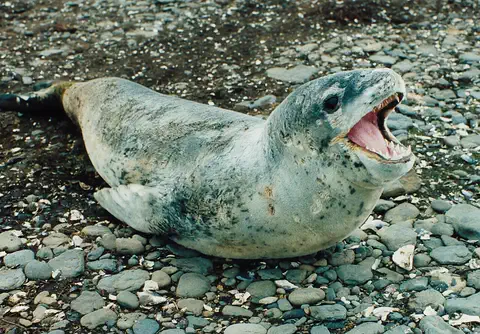
Leopard seal
The leopard seal is a large, slender seal of the icy seas around Antarctica, named for the dark spots on its gray coat. It is a fast, powerful hunter with a big head and long teeth, and it eats everything from tiny krill to fish, penguins and young seals.
-
 Watch
3D
Animal
King penguin
The king penguin is the second-largest penguin in the world. It lives in huge, noisy colonies on windy islands in the Southern Ocean and dives deep to catch lantern fish. Its babies grow a thick coat of brown fluff and take more than a year to raise.
-
 Watch
 Country
Argentina
Argentina covers most of the southern part of South America. The Andes mountains run down its western side, grassy plains called the Pampas spread across the middle, and windy Patagonia stretches to the far south. INDEC, the national statistics office, estimates that about 46.5 million people lived there in 2026, many of them in and around Buenos Aires.
-
 Watch
Animal
Aardvark
The aardvark is a shy night digger of African savannas. It sniffs out ant and termite nests, rips them open with its spade-like claws and laps up the insects with a sticky tongue about 30 centimeters long. Its name means 'earth pig' in Afrikaans.
-
 Watch
Animal
African buffalo
The African buffalo is a huge, cow-like grazer with heavy, curving horns. It lives in herds that can number in the thousands, and a herd will rush to protect a calf in danger. It lives across much of Africa south of the Sahara, from open savannas to rainforests.
-
 Watch
Animal
African forest elephant
The African forest elephant is a separate species from the bigger bush elephant. It lives in the rainforests of central and western Africa, eats lots of fruit and spreads the seeds of forest trees in its dung. It is Critically Endangered.
-
 Watch
3D
Animal
African wild dog
The African wild dog, or painted dog, has a patchy coat unlike any other dog's, big round ears and only four toes on its front feet. It lives in close packs that hunt together, share food and care for the pups. It is endangered: the IUCN estimated in 2025 that only about 1,676 adults are left in the wild.
For parents & teachers
What children will learn
- Describe how the southern elephant seal's body lets it dive so deep and so long.
- Explain the breeding season on the beach: beachmasters, harems and fast-growing pups.
- Locate the Southern Ocean and the sub-Antarctic islands where elephant seals breed.
- Discuss how hunting in the past and disease today affect seal populations.
Recommended ages: 3 to 17 · About 15 minutes
Talk about it
- Why might animals that crowd together on beaches be at risk when a disease arrives?
- How does living on stored fat help an animal that cannot leave its post?
- Why do you think males and females are so different in size?
Try at home or in class
- Mark 6 meters with string on the ground: that is how long a big male elephant seal can be.
- Fill a bowl with icy water and put a hand in it inside a bag of shortening (with a grown-up's help): feel how fat keeps you warm, like blubber.
Key vocabulary: proboscis, beachmaster, harem, blubber, molt
Where these facts come from
- GBIF Backbone Taxonomy and GBIF Occurrence Search , Global Biodiversity Information Facility (CC0 1.0 (backbone); occurrence counts are facts derived from records under CC0, CC BY and CC BY-NC)
- The IUCN Red List of Threatened Species , International Union for Conservation of Nature (IUCN terms of use (no redistribution of Red List data or range maps))
- Southern elephant seal , Australian Antarctic Division
- Mirounga leonina (southern elephant seal) , Animal Diversity Web, University of Michigan
- New research reveals severe impact of avian flu on southern elephant seals , Bangor University
- Mirounga leonina: IUCN Red List global assessment record (Hofmeyr 2026), IUCN checklist on GBIF , GBIF
- Wikidata , Wikimedia Foundation (CC0 1.0)
- Wikimedia Commons , Wikimedia Foundation (Per file: Public domain, CC0, CC BY or CC BY-SA only (credited on each page))
Checked, not yet human-reviewed. Last updated November 1, 2026. Spotted a mistake? Tell us.