
Animal
Weddell seal
The Weddell seal lives in icy Antarctica. It swims under the ice to catch fish. It chews holes in the ice so it can breathe.
The Weddell seal lives farther south than any other mammal that lives in Antarctica all year. It spends the dark winter under the sea ice, diving deep for fish and keeping breathing holes open by scraping the ice with its teeth.
Leptonychotes weddellii, a large phocid seal of the Antarctic fast ice, is the most southerly ranging mammal permanently inhabiting the continent. A deep, long diver, it maintains breathing holes through winter ice with its teeth. It is listed as Least Concern (IUCN, 2026).
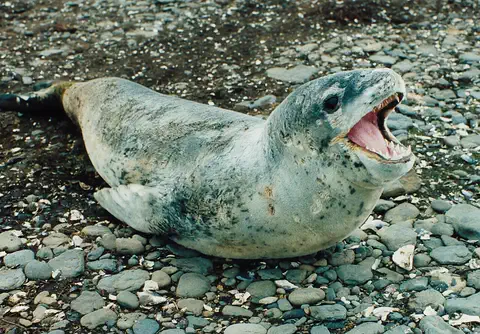
Photo: Butterfly austral, CC BY-SA 3.0, via Wikimedia Commons
Meet the Weddell seal
The Weddell seal is big and round.
Its fur has gray and black spots. It has a small head and a cute face with whiskers.
The Weddell seal is a big seal: adults are about 3 meters long and weigh around 400 to 500 kilograms. Its head looks small for its big body, and it has short whiskers.
Its coat is dappled gray and black on the back, with a mostly white belly. Weddell seals are very calm animals: the Australian Antarctic Division says people can often approach them without upsetting them much.
Leptonychotes weddellii is a true (earless) seal of the family Phocidae. The Australian Antarctic Division gives adults of both sexes as about 3 meters long and 400 to 500 kilograms; Animal Diversity Web reports males at 2.5 to 2.9 meters and females up to 3.5 meters. The head is small relative to the body, and the coat is usually dappled gray and black above and mostly white below.
Weddell seals are notably placid and sedentary, tolerating close approach with little apparent stress. Their lives revolve around the fast ice, sea ice fastened to the coast, and the holes and cracks that let them breathe.
Quick facts
- Group
- Mammal
- Length
- 3 m
- Weight
- 400 to 500 kg
Where it lives
Weddell seals live all around Antarctica.
They stay near the coast, on and under the ice.
Weddell seals live all the way around Antarctica. They stay near the coast, around the fast ice: sea ice that is frozen to the land. They swim only about 15 to 20 kilometers out to sea to feed.
They are the farthest-south mammal that lives in Antarctica all year round. A few have wandered as far as New Zealand and Australia, but that is very rare.
The species is circumpolar and coastal, staying around the fast ice and going only 15 to 20 kilometers into the Southern Ocean to feed (Australian Antarctic Division). Most remain within 50 to 100 kilometers of their breeding colonies, though juveniles occasionally travel several hundred kilometers; vagrants have very rarely reached New Zealand and Australia.
The AAD calls it the most southerly ranging mammal to permanently inhabit the continent; Animal Diversity Web cites colonies at about 78 degrees south. Living under the ice keeps them relatively safe from air-breathing predators such as orcas and leopard seals.
Continent
Its habitat

Where can you find this animal?
- Lives here naturally · Countries and seas named by a scientific source
- Sightings recorded · Records of wild sightings (GBIF)
Lives here naturally · Countries and seas named by a scientific source
All around the coast of Antarctica, on and under the fast ice, going only about 15 to 20 kilometers out to sea to feed. Very rare wanderers have reached New Zealand and Australia.
Places: Southern Ocean and Antarctica.
Source: Australian Antarctic Division · checked October 2026
Sightings recorded · Records of wild sightings (GBIF)
Counts of GBIF records of wild observations (human and machine) and preserved specimens. Records include introduced populations, vagrants, escaped or released animals and misidentifications, so a country with records is not necessarily part of the native range.
Wild sightings have been recorded in Antarctica, Fr. Southern Lands, Argentina, New Zealand, Chile, Australia, India, Falkland Is. and 6 more places.
Source: gbif · checked October 2026
Range maps show where scientists say an animal lives, often country by country. An animal may live in only part of a country shown, and sightings records can include animals that wandered far from home.
Hunting under the ice
Weddell seals eat fish, squid and shrimp.
They dive very deep under the ice to catch them.
Weddell seals are carnivores. They eat fish that swim in open water and fish that live on the seafloor, plus squid, octopus and prawns.
They are amazing divers. A Weddell seal can stay underwater for up to 45 minutes and dive as deep as 720 meters. One seal was seen catching a fish heavier than 40 kilograms, again and again!
The diet varies with time and place, but mid-water and bottom-dwelling fish, squid, octopus and prawns are common (Australian Antarctic Division). One seal was repeatedly seen catching a fish of more than 40 kilograms, and ADW cites Antarctic toothfish of up to 54 kilograms.
Dives last up to 45 minutes and reach as deep as 720 meters. The AAD suggests that long, shallow dives are probably explorations for new breathing holes and feeding areas. Finding the way back to a hole before running out of oxygen, even in the darkness of winter, demands very accurate navigation.
Did you know?
Weddell seals scrape ice with their teeth.
In winter, Weddell seals scrape the ice with their front teeth to keep breathing holes open.
Canine and incisor teeth rasp open new ice, wearing down over the years.
Teeth for ice
Weddell seals breathe air. Under the ice, they need holes to breathe.
They scrape the ice with their teeth to keep the holes open.
Like all seals, Weddell seals breathe air. In summer there are many cracks in the ice, but in winter they freeze over. So Weddell seals use their front teeth to scrape away the new ice and keep their breathing holes open.
All that scraping wears their teeth down. Over many years, a seal's teeth can get so worn that it can no longer keep its holes open or eat well. Its eyes work well in dim light, which helps it find breathing holes under the ice.
Weddell seals breathe through cracks and holes in the fast ice. In winter, when openings freeze, they rasp at new ice with their canine and incisor teeth to keep holes open (Australian Antarctic Division). This wears the teeth down, and eventually an animal may be unable to feed or maintain its holes.
Breath-hold dives last up to 45 minutes and reach 720 meters. The small head, large body and dappled coat are visible in the photo on this page.
Growing up
Baby seals are called pups.
They are born on the ice in spring. They can swim when they are only one week old!
Each spring, in October, female Weddell seals climb onto the ice to give birth to one pup. A newborn pup weighs 25 to 30 kilograms and has soft gray fur.
The mother feeds her pup for about six weeks. In that time it grows to 110 to 140 kilograms, around four times its birth weight! Pups start learning to swim and climb back onto the ice when they are only about one week old.
Females aged six years and over give birth in October to one pup a year, on stable fast ice in the same area each year (Australian Antarctic Division). Pups weigh 25 to 30 kilograms at birth and have a gray lanugo that becomes a dark coat after three to four weeks (Animal Diversity Web).
Mothers care for their pups for about six weeks, by which time they weigh 110 to 140 kilograms. Pups swim and haul out from about one week old. Social pressures mean males usually do not mate until six to eight years old (ADW).
Songs under the ice
Weddell seals sing under the water.
Male seals guard their own breathing holes from other males.
Weddell seals rest, molt (change their fur) and have their pups up on the ice, near their holes. They come back to the same place every year.
Under the water, both males and females call with many strange sounds. In the breeding season, males guard underwater territories around breathing holes, and their calls may help them keep other males away.
Weddell seals haul out onto stable fast ice to rest, molt and pup, returning to the same areas each year and staying close to their access holes (Australian Antarctic Division). In the breeding season, males defend underwater territories around breathing holes and the females using them.
Both sexes vocalize underwater, and males may call to maintain territories. Animal Diversity Web notes a varied repertoire, with overlapping calls longer than solitary ones; the AAD studies how the calls vary between places. The only recorded observation of mating (Cline et al., 1971) found it took place underwater.
Did you know?
A Weddell seal can hold its breath for a very long time.
A Weddell seal can stay underwater for up to 45 minutes.
Dives last up to 45 minutes and reach 720 meters.
Seals of the ice
There are many Weddell seals.
They live far from people. Scientists study them to learn about Antarctica.
The Weddell seal is listed as Least Concern. It lives far from most people, on and under the Antarctic ice, and it is protected.
Scientists study Weddell seals to learn how weather and climate affect life in Antarctica. Because these seals depend on sea ice that is frozen to the coast, changes in the ice could affect where they can live and raise their pups.
The IUCN listed Leptonychotes weddellii as Least Concern in its 2026 assessment (Hückstädt). Australia's long-term study in the Vestfold Hills near Davis station examines its prey, population structure, movements between colonies, underwater calls and the influence of climate and weather, from short-term local conditions to long-term fluctuations such as El Niño.
Because Weddell seals depend on stable fast ice for pupping and breathing holes, their dependence on ice makes them a useful species for watching how Antarctic conditions change.
IUCN Red List
How is the weddell seal doing in the wild?
- Least Concern (this animal)
- Near Threatened
- Vulnerable
- Endangered
- Critically Endangered
- Extinct in the Wild
- Extinct
Least Concern
Not at risk of disappearing from the wild right now.
Amazing facts
-
Weddell seals scrape ice with their teeth.
In winter, Weddell seals scrape the ice with their front teeth to keep breathing holes open.
Canine and incisor teeth rasp open new ice, wearing down over the years.
-
Weddell seal pups can swim at one week old.
Pups start learning to swim and climb onto the ice when they are about one week old.
Pups swim and haul out from about one week of age.
-
A Weddell seal can hold its breath for a very long time.
A Weddell seal can stay underwater for up to 45 minutes.
Dives last up to 45 minutes and reach 720 meters.
-
Weddell seals live farther south than any other mammal in Antarctica.
No other mammal living in Antarctica all year lives as far south as the Weddell seal.
It is the most southerly ranging mammal permanently inhabiting Antarctica (Australian Antarctic Division).
Words to know
- fast ice
- sea ice that is frozen to the coast and does not drift
- breathing hole
- a hole in the ice where a seal comes up for air
- pup
- a baby seal
- molt
- to shed old fur or skin and grow new
- circumpolar
- found all the way around one of the poles
Discovery challenge
-
How does a Weddell seal keep its breathing hole open?
How do Weddell seals keep breathing holes open in winter?
Which behavior lets Weddell seals maintain breathing holes in winter fast ice?
- It scrapes the ice with its teeth
- It melts the ice with warm breath
- It breaks the ice with its tail
Show the answer
It scrapes the ice with its teeth
It scrapes the ice with its teeth.
It scrapes away new ice with its front teeth, which slowly wears them down.
Rasping new ice with canine and incisor teeth, which causes heavy tooth wear.
-
Where do Weddell seals live?
Where do Weddell seals live?
How is the Weddell seal's range best described?
- All around Antarctica
- In the Arctic
- In tropical lagoons
Show the answer
All around Antarctica
They live all around Antarctica.
All around the coast of Antarctica, on and under the ice.
Circumpolar and coastal around Antarctica, around the fast ice.
-
How long can a Weddell seal stay underwater?
For up to how long can a Weddell seal stay underwater?
What is the Weddell seal's maximum recorded dive duration in the Australian Antarctic Division's account?
- About 1 minute
- Up to 45 minutes
- A whole day
Show the answer
Up to 45 minutes
It can stay under for a very long time: up to 45 minutes!
Up to 45 minutes, diving as deep as 720 meters.
Up to 45 minutes, with depths to 720 meters.
-
When are Weddell seal pups born?
In which month are Weddell seal pups born?
In which month do Weddell seals give birth?
- October
- July
- February
Show the answer
October
In October, which is spring in Antarctica.
In October, the Antarctic spring.
October, on stable fast ice.
Explore next
-
 Watch
Animal
Southern elephant seal
The southern elephant seal is the world's largest seal. Adult males can weigh up to 3,000 kilograms and have a huge, trunk-like nose they use to roar. These amazing divers swim across the whole Southern Ocean and can hold their breath for up to two hours.
-
 Watch
Animal
Leopard seal
The leopard seal is a large, slender seal of the icy seas around Antarctica, named for the dark spots on its gray coat. It is a fast, powerful hunter with a big head and long teeth, and it eats everything from tiny krill to fish, penguins and young seals.
-
 Watch
Animal
Emperor penguin
The emperor penguin is the largest penguin in the world. It lives around Antarctica, and it is the only animal that breeds during the dark, freezing Antarctic winter. Fathers keep the egg warm on their feet for about two months, huddled together against the storms.
-
 Watch
Animal
Hawaiian monk seal
The Hawaiian monk seal lives only in the Hawaiian Islands and nowhere else in the world. It sleeps on beaches, hunts fish and octopuses on the seafloor, and mostly lives alone. Only about 1,600 are left, but thanks to careful help, their numbers are slowly growing.
-
 Watch
Animal
Aardvark
The aardvark is a shy night digger of African savannas. It sniffs out ant and termite nests, rips them open with its spade-like claws and laps up the insects with a sticky tongue about 30 centimeters long. Its name means 'earth pig' in Afrikaans.
-
 Watch
Animal
African buffalo
The African buffalo is a huge, cow-like grazer with heavy, curving horns. It lives in herds that can number in the thousands, and a herd will rush to protect a calf in danger. It lives across much of Africa south of the Sahara, from open savannas to rainforests.
-
 Watch
Animal
African forest elephant
The African forest elephant is a separate species from the bigger bush elephant. It lives in the rainforests of central and western Africa, eats lots of fruit and spreads the seeds of forest trees in its dung. It is Critically Endangered.
-
 Watch
3D
Animal
African wild dog
The African wild dog, or painted dog, has a patchy coat unlike any other dog's, big round ears and only four toes on its front feet. It lives in close packs that hunt together, share food and care for the pups. It is endangered: the IUCN estimated in 2025 that only about 1,676 adults are left in the wild.
For parents & teachers
What children will learn
- Explain how Weddell seals survive under the Antarctic ice.
- Describe the Weddell seal's deep diving and how it keeps breathing holes open.
- Locate Antarctica and the Southern Ocean on a globe.
- Discuss why scientists study animals that depend on sea ice.
Recommended ages: 3 to 17 · About 15 minutes
Talk about it
- Why might a seal need very good navigation to live under the ice?
- What do you think happens to a seal whose teeth are worn out?
- Why is the Antarctic spring in October?
Try at home or in class
- Freeze a tray of water, then try scraping a small hole with a spoon: how long does it take?
- Time 45 minutes on a clock and think about a seal holding its breath that long.
Key vocabulary: fast ice, breathing hole, pup, molt, circumpolar
Where these facts come from
- GBIF Backbone Taxonomy and GBIF Occurrence Search , Global Biodiversity Information Facility (CC0 1.0 (backbone); occurrence counts are facts derived from records under CC0, CC BY and CC BY-NC)
- The IUCN Red List of Threatened Species , International Union for Conservation of Nature (IUCN terms of use (no redistribution of Red List data or range maps))
- Weddell seal , Australian Antarctic Division
- Leptonychotes weddellii (Weddell seal) , Animal Diversity Web, University of Michigan
- Leptonychotes weddellii: IUCN Red List global assessment record (Hückstädt 2026), IUCN checklist on GBIF , GBIF
- Wikidata , Wikimedia Foundation (CC0 1.0)
- Wikimedia Commons , Wikimedia Foundation (Per file: Public domain, CC0, CC BY or CC BY-SA only (credited on each page))
Checked, not yet human-reviewed. Last updated November 1, 2026. Spotted a mistake? Tell us.