
Animal
King penguin
The king penguin is a tall penguin with bright orange patches on its head. It lives on chilly islands and its fluffy brown chicks look like teddy bears.
The king penguin is the second-largest penguin in the world. It lives in huge, noisy colonies on windy islands in the Southern Ocean and dives deep to catch lantern fish. Its babies grow a thick coat of brown fluff and take more than a year to raise.
Aptenodytes patagonicus breeds in dense colonies on subantarctic islands, mostly between 45° and 55° South. Its breeding cycle of 13 to 16 months is the longest of any penguin, so pairs cannot breed successfully every year. Hunted for oil until the early twentieth century, it has since recovered to about 1.6 million breeding pairs, but research links warming seas to lower breeding success and survival.
Photo: Liam Quinn from Canada, CC BY-SA 2.0, via Wikimedia Commons
Meet the king penguin
The king penguin is a tall, smart-looking penguin.
It has a black head, a silver-gray back and a white tummy. Bright orange patches shine on the sides of its head and its chest.
The king penguin is the second-largest penguin, after its close cousin the emperor. It stands about 85 to 95 centimeters tall, about as high as a kitchen counter.
It is one of the most colorful penguins. Golden-orange, spoon-shaped patches sit on each side of the head, the upper chest glows orange, the back is silvery gray and the belly is satin white. Its long, thin bill has a bright orange stripe along the bottom.
The king penguin is the second-largest penguin, smaller only than the emperor penguin, the other member of the genus Aptenodytes. It stands about 85 to 95 centimeters tall, with males slightly larger than females. Early explorers took kings to be the largest penguin until George Robert Gray of the British Museum separated them from the emperor in 1844.
Compared with emperors, kings are slimmer, with proportionally larger flippers, a longer, decurved bill, orange ear patches that connect by a thin strip to the upper chest, and a thin black line separating neck from back. Two subspecies are recognized: A. p. patagonicus in the South Atlantic and A. p. halli in the Indian Ocean sector and at Macquarie Island.
Quick facts
- Group
- Bird
- Height
- 0.85 to 0.95 m
- Weight
- 8 to 15 kg
Where it lives
King penguins live on cold, windy islands far in the south.
They stand on beaches and grassy flat ground near the sea. They swim in the cold ocean to find food.
King penguins live on islands in the Southern Ocean, north of Antarctica, such as South Georgia, the Falkland Islands, the Crozet and Kerguelen Islands, and Macquarie Island.
Kings build colonies on flat beaches and valleys free of snow and ice, close to the sea. The biggest colonies, on South Georgia and the Crozet Islands, have several hundred thousand pairs. At sea they are mostly found in a band of ocean between about 40 and 55 degrees south of the equator.
The species breeds on subantarctic islands between about 45° and 55° South: South Georgia, the Falkland Islands, the Prince Edward and Marion Islands (South Africa), the French Crozet and Kerguelen Islands, Heard Island and Macquarie Island (Australia). The IUCN's 2020 global assessment also lists Argentina and Chile as non-breeding range, and the Australian Antarctic Division notes new colonies apparently establishing in Patagonia.
Colonies occupy level beaches, valleys and moraines free of snow and ice near the sea. Outside the breeding season kings are pelagic, ranging mainly between 40° and 55° South; immature birds wander far, and vagrants reach New Zealand, Australia and South America.
Its habitat

Where can you find this animal?
- Lives here naturally · Countries and seas named by a scientific source
- Sightings recorded · Records of wild sightings (GBIF)
- Visits for part of the year · Countries and seas named by a scientific source
Lives here naturally · Countries and seas named by a scientific source
Breeds on subantarctic islands: South Georgia, the Falkland Islands, the Prince Edward Islands (South Africa), the French Crozet and Kerguelen Islands, Heard Island and Macquarie Island (Australia). South Georgia and Heard Island have no separate map shape; for South Africa and Australia only their far-southern islands are meant.
Places: Falkland Is., Fr. Southern Lands, South Africa, Australia, Southern Ocean, Atlantic Ocean and Indian Ocean.
Source: iucn-red-list · checked October 2026
Sightings recorded · Records of wild sightings (GBIF)
Counts of GBIF records of wild observations (human and machine) and preserved specimens. Records include introduced populations, vagrants, escaped or released animals and misidentifications, so a country with records is not necessarily part of the native range.
Wild sightings have been recorded in Antarctica, Australia, South Africa, Fr. Southern Lands, Falkland Is., Argentina, Chile, New Zealand and 16 more places.
Source: gbif · checked October 2026
Visits for part of the year · Countries and seas named by a scientific source
Non-breeding visitors along southern South America; a few new colonies seem to be starting in Patagonia.
Places: Argentina and Chile.
Source: iucn-red-list · checked October 2026
Range maps show where scientists say an animal lives, often country by country. An animal may live in only part of a country shown, and sightings records can include animals that wandered far from home.
What it eats
King penguins eat small fish and squid.
They dive down into the dark sea to catch them. They can dive many times in one day.
King penguins are specialized hunters. Their main food is small fish called lantern fish, especially while they are raising chicks. In winter they eat more squid.
To catch them, kings may dive up to 100 times a day. Many dives are fairly shallow, but kings can dive deeper than 300 meters. The deepest dive recorded was 343 meters, and the longest lasted more than 9 minutes.
Kings are specialized predators of lantern fish (myctophids), especially in the breeding season, with squid becoming more important in winter; NZ Birds Online also lists krill. They pursue prey by diving, swimming at up to about 12 km/h and making up to 100 dives a day.
New Zealand Birds Online gives a maximum recorded depth of 343 meters and a longest dive of 9 minutes 20 seconds. During the breeding season they often feed in large groups near the colonies, while offshore they travel in small groups of about 5 to 20 and usually dive alone.
Did you know?
King penguins can slide on their tummies.
On snow or ice, king penguins can toboggan, sliding on their bellies and pushing with their feet and flippers.
On snow or ice kings toboggan, sliding on the belly while pushing forward with feet and flipper-like wings.
A body for swimming and cold
King penguins have flippers instead of wings for flying.
They swim fast with them. On land they walk on big webbed feet, or slide on their tummies.
A king penguin's wings are flippers, up to about 36 centimeters long, that it uses to swim. They are bigger, for its size, than an emperor penguin's flippers.
A layer of fat under the skin keeps it warm in icy water. On land it walks upright on big, black webbed feet. On snow or ice it can toboggan: it lies on its belly and pushes with its feet and flippers to slide along.
Flipper-like wings up to about 36 centimeters long, proportionally larger than an emperor's, are used for swimming and for pursuit diving to more than 300 meters. A subcutaneous fat layer insulates against cold water and fuels the annual molt, when birds cannot go to sea for more than three weeks.
On land kings walk upright on large, powerful webbed feet and can toboggan on snow or ice, sliding on the belly while pushing with feet and flippers. Like emperors, they do not build nests: the single egg, and later the small chick, rests on the parent's feet under a fold of abdominal skin.
The longest childhood
A king penguin lays one egg. It does not make a nest.
Mom and Dad take turns holding the egg on their feet. The chick grows a coat of thick brown fluff.
King penguins have the longest breeding cycle of any penguin, 13 to 16 months. The female lays a single egg, and the parents take turns keeping it on their feet for about 54 days.
The chick then grows a thick coat of brown fluff. It is so different from its parents that early explorers thought it was a different bird, the 'woolly penguin'. Chicks gather in groups called creches and wait through the winter, sometimes for months between meals.
The cycle, including the pre-molt period, lasts 13 to 16 months. The single greenish-white egg is laid between November and April and incubated for about 54 days, the male taking the first shift. Chicks are brooded for about 39 days, then gather in unguarded creches for nine months or more.
Through winter parents return only irregularly, and chicks may fast for months. Chicks from early eggs can build up enough reserves for winter, but late breeders are later still the next year and their chicks are usually too small to survive. NZ Birds Online describes the result as two young every three years; the Australian Antarctic Division says breeders are most successful every second year. Downy chicks were once described as a separate 'woolly penguin'.

City of penguins
King penguins live in big, noisy groups.
There can be thousands and thousands of them on one beach. Parents find their own chick by its special whistle.
King penguins are very social and live in huge colonies, packed close together on the beach. Fighting is rare, and breeding birds keep to different parts of the colony from birds that are not nesting.
With so many penguins, how does a parent find its own chick? By sound! Each chick has its own three-note whistle, and the parents know it among thousands of others. Adults court with loud, trumpet-like songs, head lifts and outstretched flippers.
Kings are highly gregarious, forming dense colonies in which breeding adults are segregated from non-breeding, molting or roosting birds, and fighting is rare. They feed in large groups near colonies in the breeding season but are often solitary when diving.
Vocal recognition is essential in such crowds: parents recognize chicks by an individually distinctive three-note whistle, and the adult display song is a musical, multi-note bugling. Courting males call repeatedly, raise the head and hold out the flippers; a responding female faces him and both shake their heads vigorously while calling.
Did you know?
King penguin chicks are brown and fluffy.
Fluffy brown king penguin chicks look so different from adults that early explorers named them 'woolly penguins'.
Downy chicks were once described as a separate species, the 'woolly penguin'.
From oil to recovery
Long ago, people hunted many king penguins.
The hunting stopped, and now there are many more of them. Scientists are watching how warmer oceans change their food.
In the 1800s and early 1900s, king penguins were killed in huge numbers for their oil, and many colonies were almost wiped out. Since the hunting stopped, most colonies have grown back, and today there are about 1.6 million breeding pairs. The species is listed as Least Concern.
The main worry now is climate change. Scientists who followed more than 450 king penguins for nine years found that in years when the sea was warmer, fewer chicks were raised and fewer adults survived.
During the nineteenth and early twentieth centuries, sealers turned to king penguins as a source of oil, nearly wiping out many populations; at Macquarie Island one colony was exterminated before 1920. Since sealing ended most populations have increased, and the Australian Antarctic Division puts the global population at about 1.6 million breeding pairs. The IUCN assessed the species as Least Concern in 2020.
The main current threat is change in ocean productivity near breeding islands. A nine-year study of more than 450 birds by a University of Strasbourg team linked warm events to lower breeding success and modeled a 9 percent drop in adult survival for 0.26 °C of warming. Invasive species on islands are also listed.
IUCN Red List
How is the king penguin doing in the wild?
- Least Concern (this animal)
- Near Threatened
- Vulnerable
- Endangered
- Critically Endangered
- Extinct in the Wild
- Extinct
Least Concern
Not at risk of disappearing from the wild right now.
See the IUCN Red List assessment · The IUCN Red List of Threatened Species 2021.3
Amazing facts
-
King penguin chicks are brown and fluffy.
Fluffy brown king penguin chicks look so different from adults that early explorers named them 'woolly penguins'.
Downy chicks were once described as a separate species, the 'woolly penguin'.
-
Parents know their chick by its whistle.
Each king penguin chick has its own three-note whistle, and its parents can find it among thousands of others.
Individually distinctive three-note whistles allow parents to locate their chick in crowded colonies.
-
King penguins can slide on their tummies.
On snow or ice, king penguins can toboggan, sliding on their bellies and pushing with their feet and flippers.
On snow or ice kings toboggan, sliding on the belly while pushing forward with feet and flipper-like wings.
-
Raising one king penguin chick takes more than a year.
King penguins have the longest breeding cycle of any penguin: 13 to 16 months.
Because the cycle lasts more than a year, king penguins alternate between two egg-laying periods and can raise about two young every three years (NZ Birds Online).
Words to know
- colony
- a large group of animals that live and breed together
- creche
- a group of young animals that stay together while their parents are away
- subantarctic
- the cold region of islands and ocean just north of Antarctica
- down
- soft, fluffy feathers that keep a young bird warm
- pelagic
- living out on the open ocean, far from the shore
- toboggan
- to slide along on your belly
Discovery challenge
-
What color are king penguin chicks?
What do young king penguin chicks look like?
What did the downy chicks that early explorers called 'woolly penguins' look like?
- Brown and fluffy
- Bright orange
- Black and shiny
Show the answer
Brown and fluffy
The chicks are brown and fluffy.
They are covered in thick brown down, very different from their parents.
Downy chicks look so unlike adults that they were taken for a separate species.
-
Where does a king penguin keep its egg?
Where do king penguins keep their egg warm?
How is a king penguin egg incubated?
- On its feet
- In a stick nest
- Buried in sand
Show the answer
On its feet
On its feet, under a warm flap of skin.
They make no nest; the egg sits on a parent's feet under a fold of skin.
On the feet under an abdominal skin fold, with parents alternating shifts for about 54 days.
-
Where do king penguins live?
Where do king penguins breed?
Which describes the king penguin's breeding range?
- On cold islands in the Southern Ocean
- In the Sahara Desert
- On top of mountains in Asia
Show the answer
On cold islands in the Southern Ocean
They live on cold islands near Antarctica.
On subantarctic islands such as South Georgia and the Falklands.
Subantarctic islands between about 45° and 55° South.
-
What do king penguins mostly eat?
What is a king penguin's main food?
Which prey group dominates the king penguin's diet?
- Lantern fish
- Leaves
- Bananas
Show the answer
Lantern fish
They eat little fish called lantern fish.
Lantern fish, small fish of the open ocean, plus more squid in winter.
Myctophids (lantern fish), with squid more important in winter.
Explore next
-
 Watch
Animal
Emperor penguin
The emperor penguin is the largest penguin in the world. It lives around Antarctica, and it is the only animal that breeds during the dark, freezing Antarctic winter. Fathers keep the egg warm on their feet for about two months, huddled together against the storms.
-
 Watch
Animal
Gentoo penguin
The gentoo penguin is the penguin with the red-orange bill, orange feet and a white band across the top of its head. It lives on the Antarctic Peninsula and on islands around Antarctica, builds nests of stones, and usually lays two eggs. National Geographic says no other diving bird swims faster.
-
 Watch
Animal
African penguin
The African penguin is a penguin of warm, sunny coasts. It lives only in South Africa and Namibia, nests in burrows and under bushes, and hunts sardines and anchovies in the cold sea. Its numbers have fallen so far that it is now Critically Endangered, and people are working hard to protect it.
-
 Watch
Animal
Leopard seal
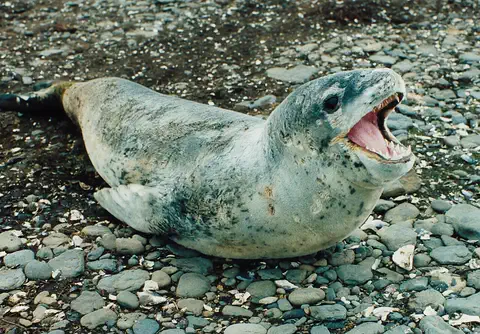
The leopard seal is a large, slender seal of the icy seas around Antarctica, named for the dark spots on its gray coat. It is a fast, powerful hunter with a big head and long teeth, and it eats everything from tiny krill to fish, penguins and young seals.
-
 Watch
3D
Animal
Orca
The orca, also called the killer whale, is the largest member of the dolphin family and the ocean's top predator. Orcas live in every ocean, in close family groups called pods, made up of orcas related through their mothers. Each group has its own favorite foods, hunting tricks and even its own calls, which young orcas learn from their families.
-
 Watch
Animal
Wandering albatross
The wandering albatross has the largest known wingspan of any living bird, up to about 3.4 meters from tip to tip. It soars over the stormy Southern Ocean using the wind, catching squid and fish at the surface, and comes ashore only to breed on remote islands. A pair raises one chick at most every two years.
-
 Watch
Animal
Adélie penguin
The Adélie penguin is a medium-sized penguin, about 70 centimeters tall, with a black back, a white front and a bright white ring around each eye. It breeds in summer on rocky, ice-free ground all around Antarctica, building nests of pebbles, and spends the winter far out at sea among the pack ice.
-
 Watch
Animal
African fish eagle
The African fish eagle is a big eagle of Africa's lakes, rivers and coasts, with a white head, chest and tail and a chestnut-brown body. It snatches fish from the surface of the water, and its loud, ringing call is one of the best-known sounds of Africa.
For parents & teachers
What children will learn
- Describe the king penguin's appearance and how its body suits life at sea.
- Explain why raising a king penguin chick takes more than a year.
- Describe how king penguins find each other in crowded colonies.
- Explain how hunting harmed king penguins in the past and how warming seas affect them now.
Recommended ages: 3 to 17 · About 15 minutes
Talk about it
- How might a parent penguin find its chick among thousands of others?
- Why might chicks that hatch late in the season have a harder time?
- Why can king penguins live on islands that are not covered in ice?
Try at home or in class
- Play a 'find my chick' game: one person whistles a special three-note tune while others whistle different ones, and a blindfolded 'parent' finds the right whistle.
- Measure 90 centimeters on a wall and stand next to it to see how tall a king penguin is.
Key vocabulary: colony, creche, subantarctic, down, pelagic, toboggan
Where these facts come from
- The IUCN Red List of Threatened Species , International Union for Conservation of Nature (IUCN terms of use (no redistribution of Red List data or range maps))
- GBIF Backbone Taxonomy and GBIF Occurrence Search , Global Biodiversity Information Facility (CC0 1.0 (backbone); occurrence counts are facts derived from records under CC0, CC BY and CC BY-NC)
- Wikidata , Wikimedia Foundation (CC0 1.0)
- Aptenodytes patagonicus (King Penguin), Red List global assessment 2020 , IUCN Red List of Threatened Species
- King penguin , Australian Antarctic Division
- King penguin | Tokoraki , New Zealand Birds Online
- Wikimedia Commons , Wikimedia Foundation (Per file: Public domain, CC0, CC BY or CC BY-SA only (credited on each page))
Checked, not yet human-reviewed. Last updated October 27, 2026. Spotted a mistake? Tell us.