
Animal
Swordfish
The swordfish has a long, flat nose shaped like a sword. It is a big, fast fish that lives in the open ocean. It swims deep down in the day and comes up at night.
The swordfish is a huge ocean hunter with a long, flat bill like a sword. It swings its bill to slash at fish and squid, then eats them. It dives deep into cold, dark water by day, and a special 'brain heater' near its eyes keeps its brain warm. Grown-up swordfish have no scales and no teeth.
Xiphias gladius is the only living member of the family Xiphiidae, a highly migratory billfish of tropical to cold seas worldwide. It spends the day deep, often below 400 meters, with tagged dives past 1,400 meters, warms its brain with a heater organ, and uses its flattened bill to slash prey. The IUCN lists it as Near Threatened (assessed 2021, published 2022); stock status differs by ocean.
Photo: NOAA Deep Sea Coral Research & Technology Program, Pelagic Research Services, public domain, via Wikimedia Commons
Meet the swordfish
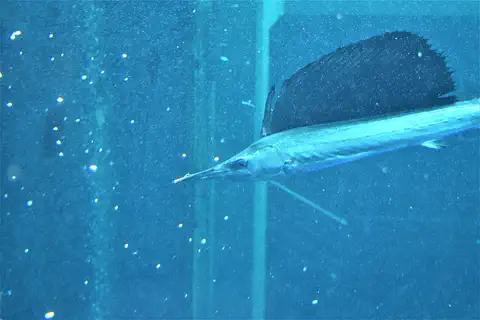
The swordfish has a very long, flat nose, like a sword.
It is dark on top and pale underneath. It has a tall fin on its back and a tail shaped like a moon.
The swordfish is named for its long, flat bill, which sticks out in front like a sword. It is a billfish, a relative of marlins and sailfish, but its bill is flatter and longer than theirs.
It is blackish-brown on top and lighter underneath, with a tall, stiff fin on its back and a crescent-shaped tail. Swordfish are big: the largest ever measured was about 4.5 meters long, about as long as a car.
Xiphias gladius is a ray-finned fish (class Actinopterygii) and the only member of the family Xiphiidae; the Florida Museum explains that its bill, flattened oval in cross-section and long compared with other billfishes (Istiophoridae), sets it apart. The name comes from Latin gladius, 'sword'.
The body is roughly cylindrical, with a high, rigid first dorsal fin, a small second dorsal set far back, two anal fins, no pelvic fins, a lunate tail and a strong keel on each side of the tail base. Adults lose their scales, teeth and lateral line. The Florida Museum gives a maximum of 455 centimeters and 650 kilograms; nearly all swordfish over 140 kilograms are females.
Quick facts
- Group
- Fish
- Length
- 1.2 to 4.55 m
- Weight
- up to 650 kg
- Top speed
- up to 80 km/h
Every ocean, top to deep
Swordfish live in oceans all over the world.
They like the open sea, far from land. They swim deep in the day and near the top at night.
Swordfish live in the Atlantic, Indian and Pacific Oceans, from warm tropical seas to cool waters, and in the Mediterranean Sea. They are open-ocean fish, though they sometimes come near coasts.
Each day they go on a big vertical trip. In daylight, tagged swordfish in the western Atlantic stayed deeper than 400 meters, and at night they rose to less than 100 meters below the surface. They also migrate, moving to cooler waters to feed in summer and back to warm waters to spawn.
The IUCN describes a worldwide range in tropical, temperate and sometimes cold waters of the Atlantic, Indian and Pacific Oceans, including the Mediterranean, the Sea of Marmara, the Black Sea and the Sea of Azov. The Florida Museum gives about 60°N to 45°S and notes they gather at frontal zones where currents meet.
Swordfish prefer 18 to 22 °C above the thermocline but dive deep: tagged fish reached 1,448 meters in the western Atlantic, 1,136 meters in the eastern South Pacific and about 1,200 meters in the central North Pacific, at 3.2 to 28.8 °C, with a depth record of 2,878 meters from prey remains (IUCN). They tend to stay nearer the surface at night, especially on darker nights.
Its habitat

Where can you find this animal?
- Lives here naturally · Countries and seas named by a scientific source
- Sightings recorded · Records of wild sightings (GBIF)
Lives here naturally · Countries and seas named by a scientific source
Open oceans worldwide, from tropical to cool waters (about 60° N to 45° S), plus the Mediterranean, the Sea of Marmara, the Black Sea and the Sea of Azov. Shading is by whole ocean.
Places: Atlantic Ocean, Indian Ocean and Pacific Ocean.
Source: iucn-red-list · checked October 2026
Sightings recorded · Records of wild sightings (GBIF)
Counts of GBIF records of wild observations (human and machine) and preserved specimens. Records include introduced populations, vagrants, escaped or released animals and misidentifications, so a country with records is not necessarily part of the native range.
Wild sightings have been recorded in Chile, United States, Australia, Cuba, Bahamas, Mexico, New Caledonia, Puerto Rico and 78 more places.
Source: gbif · checked October 2026
Range maps show where scientists say an animal lives, often country by country. An animal may live in only part of a country shown, and sightings records can include animals that wandered far from home.
Slash and gulp
Swordfish eat fish and squid.
They swing their long nose to hit a fish. Then they gulp it down.
Swordfish eat many kinds of fish and squid. NOAA describes how a swordfish catches prey: it slashes its bill back and forth, stunning or injuring fish and squid, and then eats them.
They hunt both near the surface and deep down. Big prey found in their stomachs often has slash marks, while small prey is swallowed whole.
Swordfish are opportunistic predators of pelagic fishes and cephalopods; at depth they also take demersal fishes (Florida Museum). Off the Bay of Biscay, fishes were found in 95 percent of 86 stomachs and cephalopods in 76 percent, with lanternfishes and squids prominent (IUCN).
The bill is used in feeding: squids and cuttlefishes from stomachs often show slashes, and a study found most large prey had been slashed while small items were eaten whole (Florida Museum). As top predators, large swordfish may accumulate mercury in their flesh (IUCN). Larvae eat zooplankton, and juveniles eat squid, fishes and crustaceans.
Did you know?
Swordfish have a heater by their eyes.
A special 'brain heater' near the eye keeps the swordfish's brain warm on deep, cold dives.
A heater organ linked to an eye muscle, with a countercurrent heat exchanger, warms the brain (Florida Museum).
A sword and a brain heater
A swordfish's sword is really its long top jaw.
Grown-ups have no teeth and no scales. A warm spot near its eyes keeps its brain warm in cold, deep water.
The sword is the swordfish's upper jaw, grown very long and flat. Grown-up swordfish have no teeth and no scales.
Swordfish dive into very cold, deep water. To stay sharp down there, they have a 'brain heater': a bundle of tissue next to one of the eye muscles that warms the brain. NOAA says this heat system lets them hunt in deep, cold water.
The bill is a prolonged upper jaw, flattened oval in cross-section. Young swordfish have scales, which are lost by about 1 meter body length, and adults lack teeth (Florida Museum).
The 'brain heater' is a large bundle of tissue associated with an eye muscle, supplied with blood through a vascular heat exchanger like the countercurrent exchangers of some tunas; the Florida Museum says it insulates and warms the brain and helps prevent rapid cooling during deep dives. It has the widest temperature tolerance of any billfish. NOAA describes these 'special eye muscles and a heat exchange system' as what lets swordfish hunt in deep, cold water.
From prickly larva to giant
Swordfish lay floating eggs in warm water.
Babies are tiny and look very different. Their sword grows as they get bigger.
Swordfish spawn in warm water near the surface. Solitary males and females appear to pair up, and a female can produce from 1 million to 29 million eggs. The tiny eggs float, and the babies hatch about two and a half days later, only 4 millimeters long.
Baby swordfish look very different from adults. They have prickly scales and a short snout. As they grow, the upper jaw grows faster than the lower one, making the long sword. Females can breed at about 4 to 5 years old.
Spawning occurs in the upper 75 meters, mainly in water of 24 °C or more: year-round in equatorial waters and the Caribbean, Gulf of Mexico and Florida, and in spring and summer at higher latitudes (IUCN; Florida Museum). In the western North Atlantic, NOAA notes spawning south of the Sargasso Sea and the upper Caribbean from December to March, and off the southeastern United States from April to August.
Females may carry 1 to 29 million eggs. Buoyant eggs of 1.6 to 1.8 millimeters develop for about 2.5 days, and larvae hatch at 4 millimeters with prickly scales and a short snout; the upper jaw then outgrows the lower, and the continuous dorsal fin later splits into a tall first and small second fin (Florida Museum). Females mature at about 4 to 5 years (NOAA). Lifespan estimates range from at least 9 years (Florida Museum) to about 15 (IUCN), and one otolith study suggested 32 years for females.
Ocean travelers
Swordfish usually swim alone.
They travel very far across the ocean, from warm water to cool water and back.
Swordfish usually live alone, pairing up only to spawn. They travel huge distances: NOAA says North Atlantic swordfish migrate thousands of miles each year, along the coasts of the United States and Canada and along Africa and Europe.
A swordfish off Massachusetts one week could be off Canada the next. Grown-up swordfish have few enemies, but sharks and big fish sometimes eat young ones, and killer whales may eat adults.
Swordfish are solitary outside spawning, when males and females appear to pair; in the Mediterranean, pairs show a 'circle-S' swimming pattern at surface temperatures of 24 °C or more (IUCN). North Atlantic fish migrate thousands of miles along the North American and European-African coasts (NOAA).
The Florida Museum lists killer whales as predators of adults, and sharks, marlins, sailfish, yellowfin tuna and dolphinfish as predators of young swordfish. It also records 49 species of parasites, and lamprey scratch marks that suggest swordfish rid themselves of lampreys.
Did you know?
Grown-up swordfish have no teeth.
Young swordfish have scales and teeth, but adults have neither.
Scales are lost by about 1 meter body length, and adults lack jaw teeth and a lateral line (Florida Museum).
Fished in every ocean
People catch swordfish for food.
In some oceans there are fewer swordfish than before. Countries set rules about how many can be caught.
Swordfish are an important food fish, and people catch them in every ocean. The IUCN lists the swordfish as Near Threatened, because worldwide their numbers fell by an estimated 22 percent or more between the mid-1990s and 2015.
The story is different in each ocean. In the North Atlantic, countries set yearly catch limits, catches have stayed below them for years, and the swordfish there are doing well. In the South Atlantic and the Mediterranean, there are still too few.
The IUCN assessed Xiphias gladius as Near Threatened (A2bd; assessed May 2021, published 2022; LC in 2011), estimating a global decline of at least 22 percent over three generations (about 1994 to 2015), with overfishing in the Mediterranean and South Atlantic stocks.
ICCAT's 2025 executive summaries (2022 Atlantic assessments, status for 2020) find the North Atlantic stock not overfished and not subject to overfishing, with a 2025 to 2027 catch limit of 14,769 tonnes; the South Atlantic stock overfished and subject to overfishing; and the Mediterranean stock (2020 assessment) overfished, though overfishing was not occurring in 2018. NOAA likewise reports North Atlantic swordfish not overfished and not subject to overfishing (2022 assessment).
IUCN Red List
How is the swordfish doing in the wild?
- Least Concern
- Near Threatened (this animal)
- Vulnerable
- Endangered
- Critically Endangered
- Extinct in the Wild
- Extinct
Near Threatened
Not at risk yet, but it could be soon.
See the IUCN Red List assessment · The IUCN Red List of Threatened Species 2022.2
Amazing facts
-
Baby swordfish have no sword yet.
A newly hatched swordfish is only 4 millimeters long, with a short snout. The sword grows later.
Larvae hatch at 4 millimeters with a short snout; the upper jaw later grows faster than the lower to form the bill (Florida Museum).
-
Swordfish have a heater by their eyes.
A special 'brain heater' near the eye keeps the swordfish's brain warm on deep, cold dives.
A heater organ linked to an eye muscle, with a countercurrent heat exchanger, warms the brain (Florida Museum).
-
Grown-up swordfish have no teeth.
Young swordfish have scales and teeth, but adults have neither.
Scales are lost by about 1 meter body length, and adults lack jaw teeth and a lateral line (Florida Museum).
-
The biggest swordfish are moms.
Female swordfish grow bigger than males: nearly all swordfish heavier than 140 kilograms are females.
Females grow faster after about age 2 and reach much larger sizes; nearly all fish over 140 kilograms are female (Florida Museum; IUCN).
Words to know
- bill
- a long, pointed jaw, like the swordfish's sword
- billfish
- a big ocean fish with a long bill, such as a swordfish, marlin or sailfish
- migrate
- to travel a long way, often at the same time each year
- larva
- a very young animal that looks different from the adult
- overfishing
- catching fish faster than they can be replaced by new young fish
- stock
- a group of fish of one species that breed in the same area and are managed together
Discovery challenge
-
What is a swordfish's sword?
What part of the swordfish forms its 'sword'?
What is the swordfish's bill, anatomically?
- A long top jaw
- A fin
- A tail
Show the answer
A long top jaw
The sword is a very long top jaw.
The bill is the upper jaw, grown long and flat.
A prolonged upper jaw, flattened oval in cross-section.
-
How does a swordfish catch fish?
How does a swordfish use its bill to catch prey?
How do swordfish use the bill in feeding?
- It slashes them with its bill
- It spears them on its tail
- It traps them in a net
Show the answer
It slashes them with its bill
It swings its long nose to hit fish, then eats them.
It slashes its bill back and forth to stun or injure fish and squid.
Slashing: large prey from stomachs often show slash wounds, while small prey are swallowed whole.
-
What keeps a swordfish's brain warm?
What helps a swordfish hunt in deep, cold water?
Which adaptation keeps the swordfish's brain warm on deep dives?
- A thick fur coat
- A brain heater near its eyes
- Swimming near a fire
Show the answer
A brain heater near its eyes
A warm spot near its eyes keeps its brain warm.
A brain heater next to an eye muscle keeps its brain warm.
A heater organ derived from eye-muscle tissue with a countercurrent heat exchanger.
-
Where do swordfish live?
Where in the world do swordfish live?
What is the geographic range of Xiphias gladius?
- In oceans all over the world
- Only in one small lake
- In rivers in the desert
Show the answer
In oceans all over the world
They live in oceans all over the world.
They live in the Atlantic, Indian and Pacific Oceans and the Mediterranean Sea.
Worldwide in tropical to cool seas, about 60° N to 45° S, including the Mediterranean and Black Sea.
Places where you might see it
-
 Watch
 Country
Chile
Chile stretches about 4,300 kilometers along the west coast of South America, between the Andes and the Pacific Ocean, but it averages only about 180 kilometers wide. Its north holds one of the driest deserts on Earth, and its south is cold, wet and full of fjords and ice.
-
 Watch
 Country
Spain
Spain covers most of the Iberian Peninsula in southwestern Europe. Its middle is a high, flat plateau, the Pyrenees mountains stand between it and France, and almost 50 million people live there, with Madrid as the capital.
Explore next
-
 Watch
3D
Animal
Indo-Pacific sailfish
The sailfish is a long, sleek ocean fish with a tall, sail-like fin on its back and a long, spear-shaped upper jaw called a bill. It hunts schools of small fish in warm seas, folding its sail away to speed up and raising it to make sharp turns.
-
 Watch
Animal
Atlantic bluefin tuna
The Atlantic bluefin tuna is the largest of all tunas: big ones can be about 4 meters long. Its torpedo-shaped body is built for long journeys, and it can keep its body warmer than the water around it. Bluefin tuna were badly overfished, but with fishing limits set by countries working together, the numbers caught are now controlled.
-
 Watch
3D
Animal
Yellowfin tuna
The yellowfin tuna is a large, torpedo-shaped fish of warm oceans around the world. It has a dark blue back, a silver belly and long, bright yellow fins. Yellowfin travel huge distances, dive deep to hunt fish and squid, and are important to fisheries all around the world.
-
Watch
Country
Chile
Chile stretches about 4,300 kilometers along the west coast of South America, between the Andes and the Pacific Ocean, but it averages only about 180 kilometers wide. Its north holds one of the driest deserts on Earth, and its south is cold, wet and full of fjords and ice.
-
Watch
Country
Spain
Spain covers most of the Iberian Peninsula in southwestern Europe. Its middle is a high, flat plateau, the Pyrenees mountains stand between it and France, and almost 50 million people live there, with Madrid as the capital.
-
 Watch
Animal
Giant oarfish
The giant oarfish is the longest bony fish in the world: it is usually about 3 meters long, and some have been reliably measured at 8 meters. Its silver, ribbon-shaped body has a red fin running all the way along its back. It lives in the open ocean, often hundreds of meters down, and drifts upright, head up, while it feeds on tiny krill.
-
 Watch
Animal
Alligator gar
The alligator gar is one of the largest freshwater fish in North America. It has a broad snout lined with teeth, armor-like scales, and a swim bladder that works like a lung, so it can gulp air in warm, still water. It lives in the big rivers, swamps and bayous of the southern United States, Mexico and Central America.
-
 Watch
Animal
Arapaima
The arapaima is one of the biggest freshwater fish in the world, longer than a grown-up is tall. It lives in the warm, slow rivers and flooded lakes of the Amazon, and it must swim up to the surface to gulp air every few minutes.
For parents & teachers
What children will learn
- Describe how the swordfish uses its bill and how its body changes from larva to adult.
- Explain how a 'brain heater' helps a fish hunt in cold, deep water.
- Understand that one species can be healthy in one ocean and overfished in another.
Recommended ages: 3 to 17 · About 12 minutes
Talk about it
- Why might keeping the eyes and brain warm help a predator hunt in cold, dark water?
- Why might a fish population recover in one ocean but not in another?
- How can people who buy fish help keep swordfish plentiful?
Try at home or in class
- Measure 4.5 meters across a room or yard with string: that is the longest swordfish ever measured.
- Hold a ruler flat and swish it through a tub of water edge-first, then flat-side-first, to feel why a flat bill can slash quickly.
Key vocabulary: bill, billfish, migrate, larva, overfishing, stock
Where these facts come from
- The IUCN Red List of Threatened Species , International Union for Conservation of Nature (IUCN terms of use (no redistribution of Red List data or range maps))
- GBIF Backbone Taxonomy and GBIF Occurrence Search , Global Biodiversity Information Facility (CC0 1.0 (backbone); occurrence counts are facts derived from records under CC0, CC BY and CC BY-NC)
- Xiphias gladius (Swordfish), 2022 global assessment , IUCN Red List of Threatened Species
- North Atlantic swordfish , NOAA Fisheries
- Swordfish (Xiphias gladius) , Florida Museum of Natural History
- Executive summary SWO-ATL: Atlantic swordfish (ICCAT Report 2024-2025) , International Commission for the Conservation of Atlantic Tunas (ICCAT)
- Executive summary SWO-MED: Mediterranean swordfish (ICCAT Report 2024-2025) , International Commission for the Conservation of Atlantic Tunas (ICCAT)
- Wikidata , Wikimedia Foundation (CC0 1.0)
- Wikimedia Commons , Wikimedia Foundation (Per file: Public domain, CC0, CC BY or CC BY-SA only (credited on each page))
Checked, not yet human-reviewed. Last updated October 28, 2026. Spotted a mistake? Tell us.
Picture credits
- Photo: NOAA Deep Sea Coral Research & Technology Program, Pelagic Research Services, public domain, via Wikimedia Commons · source