
Animal
Yellowfin tuna
The yellowfin tuna is a big fish shaped like a torpedo. It has bright yellow fins and swims in warm oceans all around the world.
The yellowfin tuna is a large, torpedo-shaped fish of warm oceans around the world. It has a dark blue back, a silver belly and long, bright yellow fins. Yellowfin travel huge distances, dive deep to hunt fish and squid, and are important to fisheries all around the world.
Thunnus albacares is a large, highly migratory member of the mackerel and tuna family Scombridae, found in tropical and subtropical seas worldwide. Fast-growing and highly productive, it supports major fisheries, with global catches above 1.4 million tonnes a year. The IUCN listed it as Least Concern in 2021, although the Indian Ocean stock was then overfished.
Photo: OAR/National Undersea Research Program (NURP), public domain, via Wikimedia Commons
Meet the yellowfin tuna
The yellowfin tuna is a big fish.
Its back is dark blue and its tummy is silver. Its fins are bright yellow. It swims in warm seas all over the world.
The yellowfin tuna is shaped like a torpedo: thick in the middle and pointed at both ends. Its back and upper sides are a shiny dark blue, and its belly fades from yellow to silver.
True to its name, its fins are bright yellow, and it has a yellow stripe along its side. A yellowfin can grow up to about 6 feet long and weigh about 400 pounds. It is also known as ahi.
Thunnus albacares belongs to the tunas and mackerels, family Scombridae; the IUCN places it in the class Actinopterygii and the order Perciformes, while NOAA Fisheries uses the newer order Scombriformes. Several geographic populations were once named as separate species, but the IUCN notes that body-shape and genetic data show a single worldwide, freely interbreeding species.
NOAA Fisheries describes a torpedo-shaped, metallic dark blue fish whose belly shades from yellow to silver, with bright yellow dorsal and anal fins and finlets. The long yellow dorsal fin and a yellow stripe along the side distinguish it from other tunas, and it is more slender than a bluefin. Fish can reach about 6 feet and 400 pounds; the largest documented, from the eastern Pacific, measured 206 centimeters to the fork of the tail and weighed 202 kilograms.
Quick facts
- Group
- Fish
- Length
- up to 1.8 m
- Weight
- up to 181 kg
- Lifespan in the wild
- 6 to 7 years
Where it lives
Yellowfin tuna live in warm oceans.
They swim near the top of the sea, far from land. Sometimes they dive down deep.
Yellowfin tuna live in the warm, tropical and subtropical parts of the Pacific, Atlantic and Indian Oceans. Most stay between about 20 degrees north and 20 degrees south of the equator, but in summer some swim much farther toward the poles.
They usually swim near the surface, in water from about 18 to 31 degrees Celsius. Yellowfin are great travelers: they are highly migratory and can swim across an entire ocean.
The IUCN describes a worldwide range in tropical and subtropical seas, mainly between 20°N and 20°S, with summer catches as far as 45 to 50 degrees in both hemispheres. In the eastern Pacific they commonly range from southern California to Peru, and they have been caught south of the Cape of Good Hope in the southern summer.
They are pelagic, living in open water at sea-surface temperatures of 18 to 31 °C. Their vertical movements are limited less by the thermocline than by how fast their bodies cool and by low oxygen below the mixed layer. Daytime bounce dives to 150 to 250 meters are common, dives averaging about 1,000 meters are not unusual, and the deepest recorded dive reached 1,602 meters.
Did you know?
Yellowfin tuna can dive very deep.
Yellowfin usually stay near the surface, but one was recorded diving to 1,602 meters, about a mile down.
Tagging studies summarized by the IUCN recorded deep dives averaging about 1,000 meters and lasting about 48 minutes, with a maximum depth of 1,602 meters.
Where can you find this animal?
- Lives here naturally · Countries and seas named by a scientific source
- Sightings recorded · Records of wild sightings (GBIF)
Lives here naturally · Countries and seas named by a scientific source
Tropical and subtropical waters of the Pacific, Atlantic and Indian Oceans, mostly between 20°N and 20°S, reaching 45 to 50 degrees north and south in summer. The map shades whole oceans, so it includes cold polar waters where yellowfin do not live.
Places: Pacific Ocean, Atlantic Ocean and Indian Ocean.
Source: iucn-red-list · checked October 2026
Sightings recorded · Records of wild sightings (GBIF)
Counts of GBIF records of wild observations (human and machine) and preserved specimens. Records include introduced populations, vagrants, escaped or released animals and misidentifications, so a country with records is not necessarily part of the native range.
Wild sightings have been recorded in United States, UK, Mexico, Germany, France, Cuba, Italy, Australia and 92 more places.
Source: gbif · checked October 2026
Range maps show where scientists say an animal lives, often country by country. An animal may live in only part of a country shown, and sightings records can include animals that wandered far from home.
What it eats
Yellowfin tuna hunt other sea animals.
They eat fish, squid and little shrimp-like animals. They use their eyes to find food.
Yellowfin tuna are hunters near the top of the ocean food chain. They eat many different animals, but most of their food is fish, squid and crustaceans, the group of animals that includes shrimp and crabs.
They hunt by sight. Big yellowfin can stay longer in cold, deep water, so they can search for food far below the surface. Tuna are food for others, too: sharks and large fish eat them, and seabirds and dolphins catch young tuna.
The IUCN describes yellowfin as opportunistic visual predators that take a wide diversity of prey; by volume, fishes, squids and crustaceans are the most important items. Larger yellowfin tolerate lower temperatures and oxygen levels than small ones, which lets them spend more time foraging below the mixed layer.
NOAA Fisheries places them near the top of the food chain. Adults are eaten by top predators such as sharks and large fish, while larval and juvenile tuna are taken by fish, seabirds, dolphins and other animals.
Did you know?
A yellowfin tuna's fins are bright yellow.
True to its name, a yellowfin tuna's long fins and the tiny finlets near its tail are bright yellow.
NOAA Fisheries notes that the dorsal and anal fins and the finlets are bright yellow, and a yellow stripe runs along each side.
A torpedo with yellow fins
A tuna has a smooth, pointed body.
It has long yellow fins and a row of tiny yellow fins near its tail. Its tail is shaped like a moon.
A yellowfin's body is smooth and pointed at both ends, like a torpedo. In the photo you can see that its tail is tall and curved, like a crescent moon.
On its back and belly it has long, sickle-shaped yellow fins. Behind them is a row of tiny yellow fins called finlets, running toward the tail.
NOAA Fisheries calls the body torpedo-shaped, with bright yellow second dorsal and anal fins and a series of yellow finlets on the back and belly ahead of the tail. Its slender profile also separates it from the bluefin tuna.
Body temperature limits how deep and how long a yellowfin can dive: the IUCN reports that cooling rates and tolerance of cold, low-oxygen water, rather than the thermocline itself, set its depth range, and that larger fish tolerate these conditions better.
Millions of eggs
A mother tuna lays millions of tiny eggs.
The baby tuna grow very fast. At two or three years old, they can have babies too.
Yellowfin tuna grow fast. Most can have young of their own by age 2 or 3. In the warm season a female spawns about once every 3 days, releasing 1 to 4 million eggs each time.
Where the water is warm all year, near the equator, yellowfin spawn in every month. Farther north and south, they spawn only in the warmest months. Yellowfin have a fairly short life, usually 6 to 7 years.
NOAA Fisheries reports that most yellowfin mature at age 2 or 3; the IUCN notes the smallest mature fish off the Philippines and Central America are 50 to 60 centimeters long at 12 to 15 months. In the Atlantic, spawning runs from May to August in the Gulf of Mexico and from October to March in the Gulf of Guinea, and females spawn about every 3 days, releasing 1 to 4 million eggs each time.
In the eastern Pacific, a study cited by the IUCN found spawning year-round between the equator and 20°N, seasonal farther north and south when surface water exceeded about 24 °C, and almost entirely at night. NOAA gives a life span of 6 to 7 years; one Atlantic estimate of 18 years is treated with some doubt by the IUCN.
Schools and travelers
Yellowfin tuna swim together in groups called schools.
They like to swim near floating logs and other big sea animals.
Yellowfin tuna swim in schools, usually with other fish about the same size. Young yellowfin often travel in mixed schools with other kinds of tuna, such as skipjack and young bigeye tuna.
Yellowfin like to gather around things floating in the sea, such as drifting logs, buoys and floating rafts that fishers put out, called fish aggregating devices. They also swim with dolphins and other large sea animals.
The IUCN describes surface schools formed mainly by size, either single-species or mixed, and often associated with floating objects. NOAA Fisheries lists drifting natural debris, fish aggregating devices (FADs), anchored buoys, dolphins and other large marine animals as things yellowfin gather around; in the eastern Pacific, the IUCN notes that fish larger than about 85 centimeters frequently travel with porpoises.
Fishers use these habits: the IUCN reports that purse seiners target yellowfin with dolphins, in free schools and around floating objects. In the eastern Pacific, purse seiners also work under the International Dolphin Conservation Program, which aims to reduce the bycatch of dolphins, and since 2000 the U.S. Dolphin-Safe Tuna Tracking and Verification Program has checked dolphin-safe claims on tuna products.
Did you know?
A mother tuna lays eggs again and again.
During the spawning season, a female yellowfin spawns about every 3 days, releasing 1 to 4 million eggs each time.
Females are batch spawners, spawning about every 3 days in season with 1 to 4 million eggs per batch (NOAA Fisheries).
Fishing for yellowfin
Many people eat yellowfin tuna.
There are rules about how many can be caught. Scientists count the tuna to make sure enough are left.
Yellowfin tuna are important to fishers all over the world. Because they swim across whole oceans, countries work together in international groups to set fishing rules.
Scientists check each population. NOAA Fisheries says the Atlantic yellowfin is not overfished (2024 check), and neither are the two Pacific populations. The IUCN lists the species as Least Concern, which means it is not at risk overall, but in 2021 it reported that the Indian Ocean population was being overfished.
The IUCN (assessed January 2021) lists yellowfin as Least Concern, down from Near Threatened in 2011, with an estimated global decline of 8 to 17 percent over three generations (10 to 14 years) and a decreasing trend. Global catches exceeded 1.4 million tonnes a year in the years before the assessment. The IUCN then reported the Indian Ocean stock overfished and subject to overfishing, and warned that Atlantic catches had exceeded recommended levels since 2015.
NOAA Fisheries states that, according to the 2024 assessment, Atlantic yellowfin is not overfished and not subject to overfishing; the eastern Pacific stock is in the same condition (2023 assessment), as is the western and central Pacific stock (2020 assessment). The stocks are managed internationally by ICCAT in the Atlantic and by the IATTC and WCPFC in the Pacific.
IUCN Red List
How is the yellowfin tuna doing in the wild?
- Least Concern (this animal)
- Near Threatened
- Vulnerable
- Endangered
- Critically Endangered
- Extinct in the Wild
- Extinct
Least Concern
Not at risk of disappearing from the wild right now.
See the IUCN Red List assessment · The IUCN Red List of Threatened Species 2022.2
Amazing facts
-
A yellowfin tuna's fins are bright yellow.
True to its name, a yellowfin tuna's long fins and the tiny finlets near its tail are bright yellow.
NOAA Fisheries notes that the dorsal and anal fins and the finlets are bright yellow, and a yellow stripe runs along each side.
-
Yellowfin tuna can dive very deep.
Yellowfin usually stay near the surface, but one was recorded diving to 1,602 meters, about a mile down.
Tagging studies summarized by the IUCN recorded deep dives averaging about 1,000 meters and lasting about 48 minutes, with a maximum depth of 1,602 meters.
-
A mother tuna lays eggs again and again.
During the spawning season, a female yellowfin spawns about every 3 days, releasing 1 to 4 million eggs each time.
Females are batch spawners, spawning about every 3 days in season with 1 to 4 million eggs per batch (NOAA Fisheries).
-
Yellowfin tuna like to swim near floating things.
Yellowfin tuna gather around floating logs, buoys and even dolphins and other large sea animals.
Yellowfin associate with drifting debris, fish aggregating devices, anchored buoys, dolphins and other large marine animals, a habit that fisheries use to find them.
Words to know
- finlet
- a small fin in a row between a fish's big fins and its tail
- school
- a group of fish swimming together
- migratory
- traveling long distances, often with the seasons
- spawn
- to release eggs and sperm into the water to make baby fish
- stock
- one population of fish that scientists study and manage as a group
- overfished
- so heavily caught that too few fish are left to keep the population healthy
Discovery challenge
-
What color are a yellowfin tuna's fins?
What color are a yellowfin tuna's fins and finlets?
Which color marks the second dorsal fin, anal fin and finlets of Thunnus albacares?
- Bright red
- Bright yellow
- Purple
Show the answer
Bright yellow
Its fins are bright yellow, just like its name says.
Its fins and the tiny finlets near its tail are bright yellow.
The second dorsal and anal fins and the finlets are bright yellow, with a yellow stripe along the flank.
-
What do yellowfin tuna eat?
What do yellowfin tuna mostly eat?
By volume, which prey groups are most important in the yellowfin's diet?
- Fish, squid and crustaceans
- Grass and leaves
- Sand and stones
Show the answer
Fish, squid and crustaceans
They eat fish, squid and little shrimp-like animals.
They are hunters that eat mostly fish, squid and crustaceans.
Opportunistic visual predators; fishes, squids and crustaceans dominate the diet by volume.
-
Where do yellowfin tuna live?
Where do yellowfin tuna live?
Which best describes the yellowfin tuna's range?
- Only in rivers and lakes
- In warm oceans around the world
- Only in the icy Arctic Ocean
Show the answer
In warm oceans around the world
They live in warm oceans all over the world.
They live in tropical and subtropical waters of the Pacific, Atlantic and Indian Oceans.
Circumtropical, mainly 20°N to 20°S, reaching 45 to 50 degrees in summer.
-
Does a mother tuna lay a few eggs or lots of eggs?
How many eggs can a female yellowfin release each time she spawns?
What is the typical batch fecundity of a yellowfin tuna, according to NOAA Fisheries?
- Just one egg
- About ten eggs
- Millions of eggs
Show the answer
Millions of eggs
She lays millions of tiny eggs!
She releases 1 to 4 million eggs each time, about every 3 days in the spawning season.
On average 1 to 4 million eggs per spawning, with spawning about every 3 days during the season.
Explore next
-
 Watch
3D
Animal
Atlantic mackerel
The Atlantic mackerel is a sleek, shiny fish of the North Atlantic Ocean, with a blue-green back covered in wavy black bars and a silvery white belly. Mackerel swim in large schools near the surface, eat tiny crustaceans and lay floating eggs. Many fish and sea mammals eat them, and so do people.
-
 Watch
3D
Animal
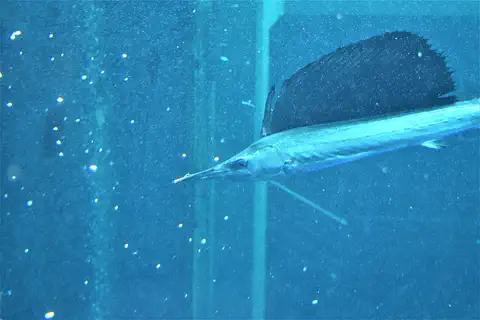
Indo-Pacific sailfish
The sailfish is a long, sleek ocean fish with a tall, sail-like fin on its back and a long, spear-shaped upper jaw called a bill. It hunts schools of small fish in warm seas, folding its sail away to speed up and raising it to make sharp turns.
-
 Watch
3D
Animal
Short-beaked common dolphin
The short-beaked common dolphin is one of the most numerous dolphins in the world. It lives in warm and cool seas around the globe, travels in groups of hundreds or even thousands, and is famous for leaping and riding the waves in front of boats.
-
 Watch
3D
Animal
Whale shark
The whale shark is the largest fish in the world. This gentle giant swims through warm seas with its huge mouth open, filtering tiny plankton and small fish from the water, and every whale shark has its own pattern of pale spots.
-
 Watch
3D
Animal
Atlantic herring
The Atlantic herring is a small, silvery fish of the cold North Atlantic. Herring swim in enormous schools, eat tiny floating plankton, and lay their sticky eggs on the sea floor. Whales, seabirds and many fish depend on them for food, and people have fished for them for hundreds of years.
-
 Watch
Animal
Atlantic bluefin tuna
The Atlantic bluefin tuna is the largest of all tunas: big ones can be about 4 meters long. Its torpedo-shaped body is built for long journeys, and it can keep its body warmer than the water around it. Bluefin tuna were badly overfished, but with fishing limits set by countries working together, the numbers caught are now controlled.
-
 Watch
Animal
Swordfish
The swordfish is a huge ocean hunter with a long, flat bill like a sword. It swings its bill to slash at fish and squid, then eats them. It dives deep into cold, dark water by day, and a special 'brain heater' near its eyes keeps its brain warm. Grown-up swordfish have no scales and no teeth.
-
 Watch
Animal
Alligator gar
The alligator gar is one of the largest freshwater fish in North America. It has a broad snout lined with teeth, armor-like scales, and a swim bladder that works like a lung, so it can gulp air in warm, still water. It lives in the big rivers, swamps and bayous of the southern United States, Mexico and Central America.
For parents & teachers
What children will learn
- Describe the yellowfin tuna's body shape, colors and fins, and how they suit life in the open ocean.
- Explain what yellowfin eat and what eats them.
- Describe how yellowfin reproduce and why they are called highly productive.
- Understand how fish stocks are assessed and managed by countries working together.
Recommended ages: 3 to 17 · About 15 minutes
Talk about it
- Why might a fish that swims across whole oceans need many countries to agree on fishing rules?
- Why do you think tuna like to gather around floating objects?
- What does it mean when scientists say a fish stock is not overfished?
Try at home or in class
- Mark 6 feet (about 1.8 meters) on the floor with tape and lie down beside it to compare yourself with a large yellowfin.
- Push a flat piece of cardboard and a pointed paper cone through a bathtub of water and feel which one moves more easily.
Key vocabulary: finlet, school, migratory, spawn, stock, overfished
Where these facts come from
- The IUCN Red List of Threatened Species , International Union for Conservation of Nature (IUCN terms of use (no redistribution of Red List data or range maps))
- GBIF Backbone Taxonomy and GBIF Occurrence Search , Global Biodiversity Information Facility (CC0 1.0 (backbone); occurrence counts are facts derived from records under CC0, CC BY and CC BY-NC)
- Thunnus albacares (Yellowfin Tuna), 2021 global assessment , IUCN Red List of Threatened Species
- Atlantic Yellowfin Tuna , NOAA Fisheries
- Pacific Yellowfin Tuna , NOAA Fisheries
- Wikidata , Wikimedia Foundation (CC0 1.0)
- Wikimedia Commons , Wikimedia Foundation (Per file: Public domain, CC0, CC BY or CC BY-SA only (credited on each page))
Checked, not yet human-reviewed. Last updated October 27, 2026. Spotted a mistake? Tell us.