
Animal
Yellow tang
The yellow tang is a bright yellow fish shaped like a flat oval. It lives on coral reefs in the Pacific Ocean and nibbles seaweed all day.
The yellow tang is a lemon-yellow surgeonfish of Pacific coral reefs, most common around Hawaii. It grazes on algae all day, which helps keep reefs from being smothered by seaweed, and it has a sharp white spine on each side of its tail for defense. It is one of the most collected fish for home aquariums.
Zebrasoma flavescens is a surgeonfish (Acanthuridae) of subtropical central and western Pacific reefs, abundant only in Hawaii. An algae-grazing herbivore with a defensive caudal spine and a pelagic larval stage, it has been Hawaii's most collected aquarium fish; the IUCN assessed it as Least Concern in 2010 while recommending continued monitoring of the harvest.
Photo: I, Luc Viatour, CC BY-SA 3.0, via Wikimedia Commons
Meet the yellow tang
The yellow tang is bright yellow all over.
It is flat, like a plate standing on its edge. It has a pointy snout and big fins on its back and belly.
The yellow tang is a bright yellow reef fish. Its body is shaped like an oval and very flat from side to side. It has a small mouth on a pointed snout, eyes set high on its head, and tall fins on its back and belly.
The only part that is not yellow is a white spine near its tail. In Hawaii it is called lauʻīpala, which means "yellowed ti leaf." Its scientific name, flavescens, also means yellow. The biggest grow to about 20 centimeters long.
Zebrasoma flavescens is a member of the surgeonfish family, Acanthuridae. The Waikiki Aquarium describes a roughly oval, strongly compressed body, a small mouth, eyes set high on the head, a somewhat longer, thinner snout than other surgeonfishes and a scalpel-like spine at the base of the tail; it is one of the smaller surgeonfishes, reaching about 20 centimeters (FishBase).
FishBase records 5 dorsal spines, 23 to 26 dorsal soft rays and 3 anal spines, and a very deep body. The Hawaiian name lauʻīpala means "yellowed ti leaf," and the species name flavescens comes from the Latin for yellow. Only the sheath of the tail spine is white.
Quick facts
- Group
- Fish
- Length
- up to 20 cm
- Lifespan in the wild
- up to 40 years
Where it lives
In the wild, yellow tangs live on coral reefs in the Pacific Ocean.
There are lots of them around Hawaii.
Wild yellow tangs live on coral reefs in the central and western Pacific Ocean, from the Hawaiian Islands west to the Marshall and Mariana Islands, the Philippines and southern Japan. They are very common in Hawaii but rare in the western part of their range.
They like warm but not the hottest seas: they live in subtropical waters and are missing from the warmest seas near the equator. They swim over coral-rich reefs and lagoons, from a couple of meters deep down to about 46 meters.
The IUCN (assessed 2010) gives a central and western Pacific range from the Hawaiian Islands and Johnston Island to the Marshall Islands, Wake, the Marianas, the Philippines and the Ogasawara and Ryukyu Islands of Japan, with a record from southern Taiwan. It is abundant only in Hawaii and rare elsewhere. The Waikiki Aquarium describes an anti-tropical distribution: subtropical waters, but not the warmest equatorial seas.
Adults inhabit coral-rich lagoon and seaward reefs from below the surge zone to about 46 meters (FishBase). The IUCN notes a complicated life history: fish settle in deeper, coral-rich areas and move into shallow water after they mature. Fish released from aquariums were seen in southern Florida between 1993 and 2002, but they did not establish a population.
Its habitat

Where can you find this animal?
- Lives here naturally · Countries and seas named by a scientific source
- Sightings recorded · Records of wild sightings (GBIF)
Lives here naturally · Countries and seas named by a scientific source
Coral reefs of the central and western Pacific: the Hawaiian Islands (where it is abundant) and Johnston Island west to the Marshall Islands, Wake, the Mariana Islands, the Philippines, and Japan's Ogasawara and Ryukyu Islands, with a record from southern Taiwan. The IUCN also lists Guam, Palau, the Northern Mariana Islands and Micronesia, too small to show. In the United States it lives only arou
Places: United States, Japan, Philippines and Taiwan.
Source: iucn-red-list · checked October 2026
Sightings recorded · Records of wild sightings (GBIF)
Counts of GBIF records of wild observations (human and machine) and preserved specimens. Records include introduced populations, vagrants, escaped or released animals and misidentifications, so a country with records is not necessarily part of the native range.
Wild sightings have been recorded in United States, Japan, Philippines, Indonesia, Fiji, Solomon Is., Vanuatu, Australia and 22 more places.
Source: gbif · checked October 2026
Range maps show where scientists say an animal lives, often country by country. An animal may live in only part of a country shown, and sightings records can include animals that wandered far from home.
A reef gardener
Yellow tangs eat algae, a kind of seaweed.
They nibble and nibble all day long. That helps keep the coral reef healthy.
Yellow tangs are herbivores: they mostly eat algae, the seaweed that grows on rocks and dead coral. Their small, down-turned mouths have comb-like teeth that are perfect for scraping and picking algae, and they spend most of the day feeding.
This job matters. Algae grow fast, and if nothing ate them they could smother the slower-growing corals. Grazers like the yellow tang keep the algae trimmed. They sometimes eat tiny drifting animals too.
The diet is mainly filamentous and uncalcified algae, with some macroalgae and occasional zooplankton (Animal Diversity Web; FishBase). The Waikiki Aquarium describes a small, slightly down-turned mouth with flexible, comb-like teeth suited to grazing; FishBase describes spatulate, close-set teeth with denticulate edges, increasing from 12 upper and 14 lower in juveniles to 18 and 22 in a 15-centimeter adult.
As grazers, yellow tangs and other algae feeders keep fast-growing seaweed from overgrowing slower-growing corals, a role both the Waikiki Aquarium and Animal Diversity Web emphasize.
Did you know?
Other fish may not see the yellow tang as bright yellow.
To people a yellow tang looks bright, but to other fish in deeper water it may blend in with the reef.
Marshall and colleagues (2003) found that at the depths yellow tangs live, the wavelength difference between their yellow and the reef background becomes negligible to fish vision.
A scalpel on its tail
Near its tail, the yellow tang has a white, sharp spine.
It uses it to keep other fish away. At night, its bright yellow turns darker.
Yellow tangs belong to the surgeonfish family, named for the sharp, scalpel-like spine on each side of the tail. The spine is a changed scale that folds into a slot and flicks out when the fish bends its tail. It is used to defend against predators and to chase away other fish competing for food or shelter.
Yellow tangs change at night. Their bright yellow turns a darker, grayish yellow, and a white stripe appears along each side. In deeper water, their yellow color blends in with the reef better than you might expect.
The caudal spines are modified scales that sit in slots and are exposed when the tail flexes; they are used against predators and competitors (Waikiki Aquarium). In threat displays, yellow tangs raise their fins to look bigger and expose the spines (Animal Diversity Web). Animal Diversity Web reports that young yellow tangs have venom glands that are lost as they grow; FishBase notes a venom gland could not be confirmed in this species despite distinct grooves on the spine.
At night the color shifts to a darker grayish yellow with a white band along the lateral line. Animal Diversity Web cites Marshall and colleagues (2003): at the depths where yellow tangs live, the difference in wavelength between their yellow and the average reef color becomes negligible to other fish, so the bright fish may be camouflaged.
Drifting babies
Yellow tangs lay lots of tiny eggs in the open water.
The babies are see-through and drift in the sea. Later they swim to a reef and grow up there.
Yellow tangs spawn by releasing eggs and sperm into the open water, either in groups or in pairs, often around the full moon. A female can release about 40,000 eggs, and females spawn about once a month. The parents do not look after the eggs.
The babies hatch as clear, see-through larvae that drift in the plankton for weeks. Ocean currents carry them toward reefs, where they settle into coral crevices and grow up. Young yellow tangs guard small patches of reef of their own.
Spawning is external, in groups or in pairs; in pair spawning, a territorial male courts a passing female with color changes and a shimmering display before both swim upward to release gametes (Animal Diversity Web; FishBase). Activity peaks around the full moon and from March to September, though fish spawn year-round; a female may release about 40,000 eggs and spawns about once a month. There is no parental care.
Clear pelagic larvae develop in the plankton, passing through an acronurus stage, and after about ten weeks are carried to reefs to settle in coral crevices. Juveniles defend small home ranges of a few meters; territoriality fades as adults roam more widely. FishBase gives a length at first maturity of about 6.3 centimeters.
Days grazing, nights hiding
Yellow tangs swim around the reef in the day, eating.
At night each one hides alone in a crack in the coral.
Yellow tangs are active in the daytime. They swim alone or in small, loose groups, sometimes mixed with other kinds of fish, moving from place to place to graze.
At night the groups split up, and each fish rests alone in a crack in the reef. When threatened, a yellow tang spreads its fins wide to look bigger and shows off its tail spines as a warning. Larger fish, crabs and octopuses hunt yellow tangs.
Yellow tangs are diurnal grazers, alone or in small, loose groups that sometimes include other species such as the sailfin tang (Animal Diversity Web). At night groups break up and individuals shelter in reef crevices (Waikiki Aquarium).
Defensive and aggressive displays include fully extended fins and exposed caudal spines. Predators include larger fishes and invertebrates such as crabs and octopuses. Juveniles are territorial, while adult home ranges are poorly known.
Did you know?
Yellow tangs help keep coral reefs healthy.
By eating algae, yellow tangs stop fast-growing seaweed from smothering slow-growing corals.
Herbivorous grazers such as Z. flavescens limit algal overgrowth of corals, an important ecosystem function.
Yellow tangs and aquariums
Many people like yellow tangs in their fish tanks.
In Hawaii, some parts of the reef are protected so that wild yellow tangs can grow up safely.
The IUCN lists the yellow tang as Least Concern, but it recommends keeping a close eye on the aquarium trade. The yellow tang has been the most collected aquarium fish in Hawaii. Around 2006, hundreds of thousands were caught there each year.
On the west coast of Hawaiʻi Island, areas called Fish Replenishment Areas are closed to aquarium collecting. In those protected areas, the number of adult yellow tangs went up, a 2010 report found.
The IUCN assessment (May 2010, published 2012, Needs Updating) lists the species as Least Concern but recommends continued monitoring of harvest and trade. It was the number one collected aquarium fish in Hawaii, about 80 percent of fish caught for the trade in West Hawaii in the late 2000s; reported catch rose about 30-fold between 1976 and 2007, from roughly 10,000 fish a year in the 1970s to several hundred thousand, and densities fell in areas open to collecting.
West Hawaii's Fish Replenishment Areas, closed to aquarium collecting, increased densities: three years after they were set up, yellow tang density was 78 percent higher than in open areas, and adult populations in them rose by 57 percent (figures reported in the 2010 assessment). These figures are from 2010 or earlier. Animal Diversity Web notes it is among the ten most popular marine aquarium fish.
IUCN Red List
How is the yellow tang doing in the wild?
- Least Concern (this animal)
- Near Threatened
- Vulnerable
- Endangered
- Critically Endangered
- Extinct in the Wild
- Extinct
Least Concern
Not at risk of disappearing from the wild right now.
See the IUCN Red List assessment · The IUCN Red List of Threatened Species 2022.2
Amazing facts
-
At night, the yellow tang turns darker.
At night, a yellow tang's bright yellow fades to a darker grayish yellow, and a white stripe appears along its side.
Nocturnal coloration is a darker grayish yellow with a white band along the lateral line, as the fish rests alone in a crevice.
-
Its Hawaiian name means yellowed leaf.
In Hawaiian, the yellow tang is called lauʻīpala, which means "yellowed ti leaf."
Both the Hawaiian name lauʻīpala ("yellowed ti leaf") and the species name flavescens refer to its color.
-
Yellow tangs help keep coral reefs healthy.
By eating algae, yellow tangs stop fast-growing seaweed from smothering slow-growing corals.
Herbivorous grazers such as Z. flavescens limit algal overgrowth of corals, an important ecosystem function.
-
Other fish may not see the yellow tang as bright yellow.
To people a yellow tang looks bright, but to other fish in deeper water it may blend in with the reef.
Marshall and colleagues (2003) found that at the depths yellow tangs live, the wavelength difference between their yellow and the reef background becomes negligible to fish vision.
Words to know
- algae
- simple plant-like living things, including seaweed
- herbivore
- an animal that eats plants or algae
- surgeonfish
- a family of fish with sharp, scalpel-like spines near the tail
- plankton
- tiny living things that drift in the water
- larva
- the young stage of an animal that looks different from the adult
- spawn
- to release eggs and sperm into the water
Discovery challenge
-
What does a yellow tang eat?
What does a yellow tang mostly eat?
What is the main food of the yellow tang?
- Algae (seaweed)
- Other big fish
- Insects on land
Show the answer
Algae (seaweed)
It nibbles seaweed called algae.
It grazes on algae growing on rocks and dead coral.
Mainly filamentous and uncalcified algae, with some macroalgae and zooplankton.
-
What is the white spot near its tail?
What is the white part near a yellow tang's tail?
What is the white structure at the base of the yellow tang's tail?
- A sharp spine
- An extra eye
- A gill
Show the answer
A sharp spine
It is a sharp spine that keeps other fish away.
It is a scalpel-like spine used for defense and to chase off competitors.
The white sheath of the caudal spine, a modified scale exposed when the tail flexes.
-
Where do the most wild yellow tangs live?
Where are wild yellow tangs most common?
Where does Z. flavescens reach high abundance?
- Hawaii
- Antarctica
- The Mediterranean Sea
Show the answer
Hawaii
There are lots of yellow tangs around Hawaii.
They are very common around Hawaii and rare in the western part of their range.
High abundance occurs only in Hawaii; elsewhere it is rare.
-
What happens to a yellow tang's color at night?
How does a yellow tang change at night?
How does the yellow tang's coloration change at night?
- It turns bright red
- It turns darker, with a white stripe
- It glows in the dark
Show the answer
It turns darker, with a white stripe
It turns darker at night.
Its yellow turns darker and grayer, and a white stripe appears along its side.
Darker grayish yellow with a white band along the lateral line.
Places where you might see it
-
 Watch
 Country
United States
The United States is a large country in North America made of 50 states, from icy Alaska to the warm islands of Hawaii. It has the Grand Canyon, the Mississippi River and Yellowstone, and about 342 million people live there.
-
 Watch
 Country
Japan
Japan is an island country in East Asia. Most of its land is steep mountains and forest, Mount Fuji is its tallest peak, and about 124 million people live there, many of them in big cities such as Tokyo.
Explore next
-
 Watch
3D
Animal
Blue tang
The blue tang is a royal-blue reef fish with black markings and a bright yellow tail. It lives on coral reefs across the Indian and Pacific Oceans, starts life yellow, and carries sharp blades at the base of its tail.
-
 Watch
Animal
Moorish idol
The Moorish idol is a tall, flat reef fish with bold black, white and yellow bars, an orange patch on its snout and a long white fin that trails behind it like a ribbon. It lives on reefs across the Indian and Pacific Oceans, from East Africa to the coasts of the Americas, and uses its tube-like snout to pick sponges and small animals from cracks.
-
Watch
Country
United States
The United States is a large country in North America made of 50 states, from icy Alaska to the warm islands of Hawaii. It has the Grand Canyon, the Mississippi River and Yellowstone, and about 342 million people live there.
-
Watch
Country
Japan
Japan is an island country in East Asia. Most of its land is steep mountains and forest, Mount Fuji is its tallest peak, and about 124 million people live there, many of them in big cities such as Tokyo.
-
 Watch
Animal
Orange clownfish
The orange clownfish is a small, bright orange reef fish with three white bands edged in black. It lives in the warm western Pacific, from northern Australia to New Guinea and the Solomon Islands, always beside a sea anemone. A coat of slimy mucus keeps the anemone's stings from hurting it, and the fish and anemone help each other.
-
 Watch
Animal
Green sea turtle
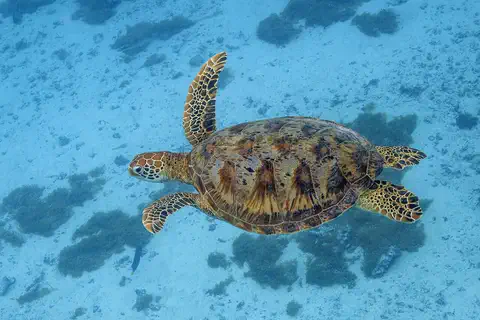
The green sea turtle is the largest sea turtle with a hard shell. It lives in warm seas around the world and, unlike other sea turtles, grown-ups eat mostly seagrass and algae. Females swim hundreds or even thousands of kilometers to lay their eggs on the beaches where they hatched long ago.
-
 Watch
Animal
Alligator gar
The alligator gar is one of the largest freshwater fish in North America. It has a broad snout lined with teeth, armor-like scales, and a swim bladder that works like a lung, so it can gulp air in warm, still water. It lives in the big rivers, swamps and bayous of the southern United States, Mexico and Central America.
-
 Watch
Animal
Arapaima
The arapaima is one of the biggest freshwater fish in the world, longer than a grown-up is tall. It lives in the warm, slow rivers and flooded lakes of the Amazon, and it must swim up to the surface to gulp air every few minutes.
For parents & teachers
What children will learn
- Explain how algae grazers like the yellow tang help coral reefs.
- Describe the surgeonfish tail spine and the tang's night coloring.
- Describe the life cycle from drifting larva to reef fish.
- Discuss how the aquarium trade and protected areas affect a wild fish population.
Recommended ages: 3 to 17 · About 15 minutes
Talk about it
- Why might a reef with no algae eaters become covered in seaweed?
- Should people collect wild fish for home aquariums? What rules might make it fairer to the fish?
- Why might a protected area help fish outside it too?
Try at home or in class
- Draw a yellow tang and label its snout, eye, fins and tail spine, then draw it again in its darker night colors.
- Make a simple bar chart: draw one block for Hawaii's reported yellow tang catch in 1976, then a bar 30 blocks tall for 2007, when the catch was about 30 times bigger.
Key vocabulary: algae, herbivore, surgeonfish, plankton, larva, spawn
Where these facts come from
- The IUCN Red List of Threatened Species , International Union for Conservation of Nature (IUCN terms of use (no redistribution of Red List data or range maps))
- GBIF Backbone Taxonomy and GBIF Occurrence Search , Global Biodiversity Information Facility (CC0 1.0 (backbone); occurrence counts are facts derived from records under CC0, CC BY and CC BY-NC)
- Wikimedia Commons , Wikimedia Foundation (Per file: Public domain, CC0, CC BY or CC BY-SA only (credited on each page))
- Zebrasoma flavescens (Yellow Tang), IUCN Red List assessment 2012 , IUCN
- Yellow Tang , Waikiki Aquarium, University of Hawaiʻi
- Zebrasoma flavescens, Yellow tang , FishBase
- Zebrasoma flavescens (Yellow Tang) , Animal Diversity Web, University of Michigan Museum of Zoology
- Wikidata , Wikimedia Foundation (CC0 1.0)
Checked, not yet human-reviewed. Last updated October 27, 2026. Spotted a mistake? Tell us.