
Animal
Orange clownfish
The orange clownfish is a small orange fish with white stripes. It lives safely among the stinging arms of a sea anemone.
The orange clownfish is a small, bright orange reef fish with three white bands edged in black. It lives in the warm western Pacific, from northern Australia to New Guinea and the Solomon Islands, always beside a sea anemone. A coat of slimy mucus keeps the anemone's stings from hurting it, and the fish and anemone help each other.
Amphiprion percula is an anemonefish (Pomacentridae) of shallow western Pacific reefs, from Queensland through Melanesia. Each group lives in one host anemone in a strict size hierarchy, all fish start as males, and the dominant one becomes female (protandrous hermaphroditism). It is listed as Least Concern (IUCN assessment of 2010) and is collected for, and bred in, the aquarium trade.
Photo: Kai Squires, CC BY 4.0, via Wikimedia Commons
Meet the orange clownfish
The orange clownfish is small and bright orange.
It has three white stripes with black edges. It lives with a sea anemone, an animal with lots of wiggly, stinging arms.
The orange clownfish is a small reef fish, no longer than about 11 centimeters, a little longer than a crayon. Its body is bright orange with three white bars: one just behind the eye, one across the middle and one near the tail. Each fin is outlined in black.
It is also called the clown anemonefish, because it always lives in a sea anemone. It looks so much like its close relative, the ocellaris clownfish, that people often mix them up.
Amphiprion percula belongs to the damselfish family, Pomacentridae. Animal Diversity Web describes a bright orange body with three white bars (the middle one with a forward bulge) and black edging of varying thickness on each fin; maximum length is about 11 centimeters (FishBase). Males and females share the same colors, but females are larger.
The species is often confused with the ocellaris clownfish, Amphiprion ocellaris. Animal Diversity Web notes that A. percula usually has 10 dorsal-fin spines and A. ocellaris 11, and that A. ocellaris never has thick black fin margins; FishBase gives 9 to 10 dorsal spines for A. percula. The IUCN adds that A. percula appears to live in shallower water than A. ocellaris.
Quick facts
- Group
- Fish
- Length
- up to 11 cm
- Lifespan in the wild
- 6 to 10 years
Where it lives
Orange clownfish live in warm, shallow seas near Australia and New Guinea.
They live on coral reefs, right inside a sea anemone.
In the wild, orange clownfish live in the warm western Pacific Ocean: off Queensland in northeastern Australia, including the northern Great Barrier Reef, and around northern New Guinea, New Britain, the Solomon Islands and Vanuatu.
They live in lagoons and on reefs facing the open sea, in shallow water usually less than 12 to 15 meters deep. Where a clownfish can live depends on where its host anemones grow, because it never strays far from one.
The IUCN (assessed 2010) places the species in the western Pacific off Queensland and Melanesia, including the northern Great Barrier Reef, northern New Guinea, New Britain, the Solomon Islands and Vanuatu; FishBase gives about 6° to 26° S and 141° to 155° E, and notes it is not known from New Caledonia or Fiji. It inhabits lagoons and seaward reefs at 1 to 15 meters (FishBase), and Animal Diversity Web reports water of about 25 to 28 °C.
Because each fish depends on a host anemone, anemone distribution sets its habitat. Where several anemonefish species overlap, they divide up anemone species and microhabitats; Animal Diversity Web gives the example of A. percula occupying the magnificent sea anemone nearshore while A. perideraion uses the same anemone offshore.
Its habitat

Where can you find this animal?
- Lives here naturally · Countries and seas named by a scientific source
- Sightings recorded · Records of wild sightings (GBIF)
Lives here naturally · Countries and seas named by a scientific source
Shallow lagoons and seaward reefs of the western Pacific off Queensland (including the northern Great Barrier Reef) and in Melanesia: northern New Guinea, New Britain, the Solomon Islands and Vanuatu. In Indonesia it lives only at the eastern edge (FishBase gives 141° to 155° E). It lives only on reefs with its host anemones, so just small coastal parts of each country are home to it.
Places: Australia, Papua New Guinea, Solomon Is., Vanuatu and Indonesia.
Source: iucn-red-list · checked October 2026
Sightings recorded · Records of wild sightings (GBIF)
Counts of GBIF records of wild observations (human and machine) and preserved specimens. Records include introduced populations, vagrants, escaped or released animals and misidentifications, so a country with records is not necessarily part of the native range.
Wild sightings have been recorded in Australia, Papua New Guinea, Solomon Is., Philippines, Indonesia, Malaysia, Egypt, Thailand and 15 more places.
Source: gbif · checked October 2026
Range maps show where scientists say an animal lives, often country by country. An animal may live in only part of a country shown, and sightings records can include animals that wandered far from home.
What it eats
Clownfish eat tiny animals that drift in the water.
Sometimes a clownfish carries a big piece of food back to its anemone.
Orange clownfish mostly eat zooplankton: tiny animals that drift in the water, such as copepods and the young of sea squirts. They may also nibble algae or leftovers from their anemone's meals.
Sometimes a clownfish carries a large piece of food back to its anemone. Scientists think it may be storing the food, but the anemone usually eats it!
Animal Diversity Web describes the diet as mainly zooplankton, such as copepods and larval tunicates, possibly with algae and scraps from the host anemone. Clownfish often carry large food items to the anemone, presumably to cache them, though the anemone usually consumes them.
Feeding is shaped by social rank: smaller group members are chased by larger ones, have a more restricted feeding area and grow more slowly, and their growth speeds up only when a larger fish disappears.
Did you know?
Moonlight helps clownfish get ready to lay eggs.
Clownfish courtship follows the moon: the start of courtship is closely linked to the lunar cycle.
Initiation of courtship is highly correlated with the lunar cycle, and spawning takes place in the morning, lasting from about 30 minutes to more than two hours.
Living with stingers
A sea anemone's arms can sting other fish.
But the clownfish has a slimy coat that keeps it safe. It can hide right inside the anemone!
Sea anemones catch fish with stinging cells in their tentacles. The orange clownfish is one of a small group of fishes that are not stung. A thick coat of mucus, a kind of slime, keeps the anemone from reacting to it.
A young clownfish has to get used to its anemone. At first it does a careful dance, touching the tentacles with its fins and then its whole body, and it may get stung a few times. This can take a few minutes or a few hours. After that, it can swim among the tentacles safely.
Anemonefishes avoid the nematocysts (stinging cells) of their hosts thanks to a thick mucus layer believed to hide them from detection (Animal Diversity Web). How the coat forms is debated: it may be acquired from contact with the tentacles or produced by the fish itself, and both are thought to matter.
Acclimation involves a cautious dance, touching tentacles first with the ventral fins and then the whole body, sometimes with stings, over minutes to hours. Protection can fade after long separation and returns with renewed contact. In the wild, A. percula is found with anemones including the magnificent sea anemone (Heteractis magnifica) and the giant carpet anemone (Stichodactyla gigantea); FishBase also lists Heteractis crispa and Animal Diversity Web Stichodactyla mertensii.
From egg to anemone
Clownfish lay eggs on a rock under their anemone.
The dad clownfish guards the eggs and fans them. Tiny babies hatch and drift away, then find an anemone of their own.
A clownfish pair lays eggs on a cleaned patch of rock under the anemone's tentacles: from 100 to more than 1,000 eggs, each 3 to 4 millimeters long. The male guards them, fans them with his fins and removes bad eggs.
The eggs hatch after 6 or 7 days. The tiny larvae drift in the open water for about a week, then settle on the reef 8 to 12 days after hatching and search for an anemone, finding it by smell rather than sight.
Spawning occurs in the morning, often linked to the lunar cycle, on rock cleared by the male under the leeward edge of the host's tentacles. Clutches range from 100 to more than 1,000 eggs, 3 to 4 millimeters long, attached by adhesive strands; the male mouths, fans and guards them for 6 to 7 days (Animal Diversity Web; FishBase notes males guard and aerate the eggs).
Larvae of 3 to 4 millimeters drift among the plankton for about a week and settle 8 to 12 days after hatching. White bars begin to form around day 11, possibly when they first meet a host. Laying eggs beside the anemone may imprint the young on its chemical scent, which juveniles later follow on currents rather than by sight. All anemonefishes start life as males.
A family with a boss
Each anemone has its own clownfish family.
The biggest fish is the mother. The next biggest is the father. If the mother dies, the father turns into a mother!
Each anemone is home to a clownfish group: a breeding pair and up to four smaller fish that do not breed. The biggest fish is the female, the second biggest is the breeding male, and the others get smaller and smaller down the line.
If the female dies, the male changes into a female, and the biggest of the others becomes the new breeding male. The fish and anemone help each other too: the clownfish chases away fish that try to eat the anemone and may help keep it clean.
Groups consist of a breeding pair and zero to four non-breeders in a size-based hierarchy: the female largest, then the male, then progressively smaller non-breeders (IUCN; FishBase, citing Buston 2003). If the female dies, the male changes sex to become the breeding female and the largest non-breeder becomes the breeding male. Keeping size gaps may avoid conflict, because subordinates never become a threat to their dominants.
The partnership is mutual. Animal Diversity Web reports that the fish may feed, oxygenate and clean its host and may drive off anemone-eaters such as butterflyfishes, while the anemone shelters the fish; adults have few predators, though eggs are taken by wrasses and damselfishes by day and brittle stars by night.
Did you know?
Clownfish chase away fish that try to eat their anemone.
A clownfish guards its anemone, chasing away fish such as butterflyfishes that might nibble it.
By defending its territory, A. percula may drive away coelenterate feeders such as butterflyfishes, benefiting its host.
Clownfish and people
Orange clownfish are common on their reefs.
Many people keep clownfish in fish tanks. Clownfish can also be raised in tanks.
In 2010 the IUCN listed the orange clownfish as Least Concern: it was common and, in places, plentiful. It is collected from the wild for home aquariums, and it can also be bred and raised in captivity.
Threats include collecting for the aquarium trade, fishing with explosives on some reefs, and bleaching of the anemones it depends on. Many reefs where it lives are protected, and in Australia collecting it is strictly controlled.
The IUCN assessed Amphiprion percula as Least Concern in November 2010 (published 2017; marked Needs Updating), noting that it is common and locally abundant, with a significant population increase reported from northern Papua New Guinea over the previous 13 years. Threats are aquarium-trade collection, dynamite fishing in parts of its range and periodic bleaching of host anemones.
It occurs in marine protected areas throughout its range, and collection is strictly regulated in Australia. The species has been reared in captivity, and Animal Diversity Web describes aquaculture research on diets for larvae and juveniles as a way to supply the aquarium trade.
IUCN Red List
How is the orange clownfish doing in the wild?
- Least Concern (this animal)
- Near Threatened
- Vulnerable
- Endangered
- Critically Endangered
- Extinct in the Wild
- Extinct
Least Concern
Not at risk of disappearing from the wild right now.
See the IUCN Red List assessment · The IUCN Red List of Threatened Species 2022.2
Amazing facts
-
All clownfish start out as boys.
Every anemonefish begins life as a male. The biggest in a group becomes the female.
Anemonefishes are protandrous hermaphrodites: all start as males, and the dominant individual changes sex to become the female.
-
Clownfish find their way home by smell.
Young clownfish find the right kind of anemone by following its smell on the current.
Eggs laid against the host may imprint on its chemical signature, and settling juveniles follow chemical cues on currents to suitable anemones.
-
Clownfish chase away fish that try to eat their anemone.
A clownfish guards its anemone, chasing away fish such as butterflyfishes that might nibble it.
By defending its territory, A. percula may drive away coelenterate feeders such as butterflyfishes, benefiting its host.
-
Moonlight helps clownfish get ready to lay eggs.
Clownfish courtship follows the moon: the start of courtship is closely linked to the lunar cycle.
Initiation of courtship is highly correlated with the lunar cycle, and spawning takes place in the morning, lasting from about 30 minutes to more than two hours.
Words to know
- sea anemone
- a soft sea animal with stinging tentacles that stays attached to one spot
- tentacle
- a long, bendy arm used for feeling or catching food
- mucus
- a slimy coating
- symbiosis
- a close partnership between two different kinds of living things
- zooplankton
- tiny animals that drift in the water
- larva
- the young stage of an animal that looks different from the adult
Discovery challenge
-
Where does an orange clownfish live?
Where does an orange clownfish make its home?
Which host does Amphiprion percula depend on?
- In a sea anemone
- In a burrow on land
- Inside a seashell
Show the answer
In a sea anemone
It lives among the soft arms of a sea anemone.
It always lives with a sea anemone on a shallow reef.
Host sea anemones such as Heteractis magnifica and Stichodactyla gigantea.
-
Why doesn't the anemone sting the clownfish?
What keeps an anemone's stings from hurting a clownfish?
What is believed to protect anemonefish from their host's nematocysts?
- Hard armor plates
- A slimy mucus coat
- Swimming too fast to be stung
Show the answer
A slimy mucus coat
A slimy coat keeps it safe.
A thick coat of mucus stops the anemone from stinging it, after the fish gets used to its host.
A thick mucus layer, acquired or produced during acclimation, is believed to hide the fish from the nematocysts.
-
Who is the biggest fish in a clownfish family?
Which fish is the biggest in a clownfish group?
Which individual is largest in an A. percula group?
- A young fish
- The male
- The female
Show the answer
The female
The mother clownfish is the biggest.
The breeding female is the biggest, then the breeding male, then the smaller non-breeders.
The breeding female; the male is second largest, and non-breeders are progressively smaller.
-
Who looks after the clownfish eggs?
Which parent guards orange clownfish eggs?
Which parent provides egg care in A. percula?
- The father
- The anemone
- Nobody
Show the answer
The father
The dad guards the eggs and keeps them clean.
The male guards the eggs, fans them and removes bad ones until they hatch.
The male guards, mouths and aerates the eggs for 6 to 7 days.
Places where you might see it
Explore next
-
 Watch
Animal
Ocellaris clownfish
The ocellaris clownfish is a small orange-and-white reef fish from the Indian and Pacific Oceans. It shelters among the stinging tentacles of a sea anemone, protected by a slimy coat, and every clownfish starts life as a male.
-
 Watch
Animal
Magnificent sea anemone
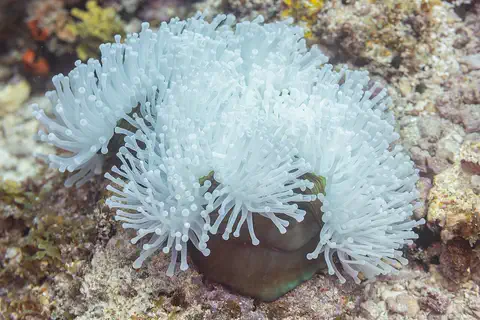
The magnificent sea anemone is a large sea anemone of warm Indian and Pacific Ocean reefs. Its body is a soft column topped with hundreds of finger-shaped tentacles, and it often perches on top of rocks in plain view. Many kinds of clownfish live safely among its stinging tentacles.
-
 Watch
 Country
Australia
Australia is a country and the smallest continent, surrounded by ocean in the Southern Hemisphere. Much of its middle is dry and flat, most people live near the coast, and its animals include kangaroos, koalas and the platypus, a mammal that lays eggs.
-
 Watch
3D
Animal
Blue tang
The blue tang is a royal-blue reef fish with black markings and a bright yellow tail. It lives on coral reefs across the Indian and Pacific Oceans, starts life yellow, and carries sharp blades at the base of its tail.
-
 Watch
Animal
Moorish idol
The Moorish idol is a tall, flat reef fish with bold black, white and yellow bars, an orange patch on its snout and a long white fin that trails behind it like a ribbon. It lives on reefs across the Indian and Pacific Oceans, from East Africa to the coasts of the Americas, and uses its tube-like snout to pick sponges and small animals from cracks.
-
 Watch
Animal
Yellow tang
The yellow tang is a lemon-yellow surgeonfish of Pacific coral reefs, most common around Hawaii. It grazes on algae all day, which helps keep reefs from being smothered by seaweed, and it has a sharp white spine on each side of its tail for defense. It is one of the most collected fish for home aquariums.
-
 Watch
Animal
Mandarinfish
The mandarinfish is a small, shy fish from the coral reefs of the western Pacific Ocean. It has no scales; instead its skin is covered with slimy mucus and painted with swirling blue, orange and green lines. It hops along the reef bottom on fan-shaped fins, picking up tiny animals, and at dusk males and females rise together to release their eggs.
-
 Watch
Animal
Alligator gar
The alligator gar is one of the largest freshwater fish in North America. It has a broad snout lined with teeth, armor-like scales, and a swim bladder that works like a lung, so it can gulp air in warm, still water. It lives in the big rivers, swamps and bayous of the southern United States, Mexico and Central America.
For parents & teachers
What children will learn
- Explain how the orange clownfish and its sea anemone help each other.
- Describe how a mucus coat protects the clownfish from stings.
- Describe the size-based family hierarchy and sex change.
- Locate the species' wild range and discuss the aquarium trade.
Recommended ages: 3 to 17 · About 15 minutes
Talk about it
- How does the clownfish help the anemone, and how does the anemone help the clownfish?
- Why might it be better to buy a clownfish raised in a tank than one taken from the sea?
- Why might keeping size differences in a group help the fish avoid fights?
Try at home or in class
- Draw a clownfish and an anemone, then draw arrows showing what each gives the other.
- Measure 11 centimeters on a ruler to see how big the largest orange clownfish grow.
Key vocabulary: sea anemone, tentacle, mucus, symbiosis, zooplankton, larva
Where these facts come from
- The IUCN Red List of Threatened Species , International Union for Conservation of Nature (IUCN terms of use (no redistribution of Red List data or range maps))
- GBIF Backbone Taxonomy and GBIF Occurrence Search , Global Biodiversity Information Facility (CC0 1.0 (backbone); occurrence counts are facts derived from records under CC0, CC BY and CC BY-NC)
- Wikimedia Commons , Wikimedia Foundation (Per file: Public domain, CC0, CC BY or CC BY-SA only (credited on each page))
- Amphiprion percula (Orange Clownfish), IUCN Red List assessment 2017 , IUCN
- Amphiprion percula, Orange clownfish , FishBase
- Amphiprion percula (Clown Anemonefish) , Animal Diversity Web, University of Michigan Museum of Zoology
- Wikidata , Wikimedia Foundation (CC0 1.0)
Checked, not yet human-reviewed. Last updated October 27, 2026. Spotted a mistake? Tell us.