
Animal
Blue tang
The blue tang is a bright blue fish with a yellow tail. It lives on coral reefs in warm seas.
The blue tang is a royal-blue reef fish with black markings and a bright yellow tail. It lives on coral reefs across the Indian and Pacific Oceans, starts life yellow, and carries sharp blades at the base of its tail.
Paracanthurus hepatus, the palette surgeonfish, is the only species in its genus: a reef fish of the Indo-Pacific with a sharp blade on each side of its tail and venomous fin spines. Widespread but relatively uncommon, it is popular in the aquarium trade, and was first raised in captivity in 2016.
Photo: Tewy, CC BY 2.5, via Wikimedia Commons
Meet the blue tang
The blue tang is a bright blue fish.
It has black stripes and a yellow tail. It lives on coral reefs, where it is easy to spot.
The blue tang is easy to spot on a reef. Its body is royal blue with a black pattern, a little like an artist's paint palette, and its tail is bright yellow with black edges.
Blue tangs belong to a family called surgeonfish, named for the sharp blades near their tails. The species has lots of names, including palette surgeonfish, regal blue tang and hippo tang, and many people call it "Dory."
Paracanthurus hepatus is a surgeonfish (family Acanthuridae) and, according to the Australian Museum, the only species in the genus Paracanthurus. Adults are blue with black markings; the caudal fin is yellow, edged above and below with black. Common names are many, including palette surgeonfish, regal blue tang, hippo tang and flagtail surgeonfish.
Those names cause confusion, because other surgeonfish, such as Acanthurus coeruleus of the Atlantic, are also called blue tangs. National Geographic points out that this is exactly why scientists rely on scientific names: there are many "blue tangs" but only one Paracanthurus hepatus.
Quick facts
- Group
- Fish
- Length
- 25 to 31 cm
- Weight
- up to 0.45 kg
- Lifespan in the wild
- up to 20 years
Where it lives
Blue tangs live in warm seas.
They swim near coral reefs from Africa to the middle of the Pacific Ocean. Clear water with strong currents suits them.
Blue tangs live on coral reefs across the Indian and Pacific Oceans, from the coast of East Africa all the way to islands such as Samoa and Kiribati. In Australia they live along nearly the whole Great Barrier Reef.
They like clear water on the outer edges of reefs, where currents sweep past. They are usually found between 2 and 40 meters deep, swimming in loose groups a meter or two above the bottom.
FishBase gives the range as the Indo-Pacific, from East Africa and the Mascarene Islands east to Kiribati, north to southern Japan and south to the southern Great Barrier Reef, New Caledonia and Samoa. The IUCN's global assessment lists more than 50 countries and territories, many of them small islands.
The species occurs from about 2 to 40 meters deep, usually 10 to 40, on clear, current-swept terraces of seaward reefs, in loose aggregations 1 or 2 meters above the bottom. Despite its huge range, FishBase describes it as relatively uncommon and highly localized.

Where can you find this animal?
- Lives here naturally · Countries and seas named by a scientific source
- Sightings recorded · Records of wild sightings (GBIF)
Lives here naturally · Countries and seas named by a scientific source
Coral reefs of the tropical Indian and Pacific Oceans, from East Africa to Kiribati and Samoa, north to southern Japan and south to the southern Great Barrier Reef. Blue tangs live only on reefs: in India they live around the Andaman and Nicobar Islands, and in the United States only around Hawaiʻi. Many small island nations in the range are too small to show on this map.
Places: Australia, Fiji, India, Indonesia, Japan, Kenya, Madagascar, Malaysia and 11 more places.
Source: iucn-red-list · checked October 2026
Sightings recorded · Records of wild sightings (GBIF)
Counts of GBIF records of wild observations (human and machine) and preserved specimens. Records include introduced populations, vagrants, escaped or released animals and misidentifications, so a country with records is not necessarily part of the native range.
Wild sightings have been recorded in Australia, Indonesia, Japan, Philippines, New Caledonia, Mozambique, Fiji, United States and 41 more places.
Source: gbif · checked October 2026
Range maps show where scientists say an animal lives, often country by country. An animal may live in only part of a country shown, and sightings records can include animals that wandered far from home.
What it eats
Blue tangs eat tiny floating animals.
They also nibble algae off rocks and coral. They have small, sharp teeth for nibbling.
Blue tangs eat zooplankton, the tiny animals that drift in the water, and algae, simple plant-like living things that grow on rocks and coral. They use small, sharp teeth to nip algae off the reef.
Scientists describe their diet in different ways. Some sources say they mostly eat zooplankton and only sometimes algae; others say algae is their main food. Both are part of the menu.
Sources disagree on the balance of the diet. FishBase and the Australian Museum describe a zooplankton feeder that occasionally eats algae. National Geographic and Oceana describe adults as mainly algae grazers that also take plankton, scraping algae from rock and coral with small teeth.
Algae grazers matter on reefs: National Geographic's education team notes that fish which keep algae in check help stop it from overgrowing corals. In turn, blue tangs are eaten by larger fish such as tuna and groupers. National Geographic also notes that people who eat blue tangs can develop ciguatera, a foodborne illness, because toxins from tiny organisms called dinoflagellates that the fish take in build up in their bodies.
Did you know?
The blue tang is the only fish in its genus, a small group of close relatives.
The blue tang is the only species in its genus, Paracanthurus.
According to the Australian Museum, P. hepatus is the only species in the genus Paracanthurus.
Blades and bright colors
A blue tang has a sharp spine near its tail.
It uses it to protect itself. Young blue tangs are yellow. They turn blue as they grow up.
Look closely where the tail joins the body. On each side, a blue tang has a sharp blade, a bit like a surgeon's scalpel. When it is in danger, it raises these spines and swishes its tail from side to side to warn off attackers.
Its colors change, too. Young blue tangs are bright yellow, with blue near the eyes and fin tips. Adults become blue and can turn darker blue or violet when they are stressed.
The caudal peduncle carries a blade on each side, and the fin spines are venomous; FishBase also records a glandular groove with a venom gland. Threatened tangs extend the caudal spines and thrash the tail, a defense that gives surgeonfish their name.
Color changes with age and condition. Juveniles are almost completely bright yellow, with blue near the eyes and on the fin tips; adults are blue with black markings and a yellow tail. Adults can flush deeper blue and violet as a sign of stress. FishBase lists 9 dorsal spines, 3 anal spines and a maximum total length of 31 centimeters.
Growing up
A baby blue tang is tiny when it hatches.
It is see-through and has no eyes yet. Its eyes and mouth grow in a few days. Then it grows into a yellow young fish.
A newly hatched blue tang is just over 1 millimeter long, clear, and has no eyes or mouth. For its first three days it lives on the yolk it hatched with, while its eyes and mouth form.
The young fish turn bright yellow and stay in groups near branching coral. When frightened, they squeeze tightly between the branches to hide. As they grow up, they turn blue. In aquariums, blue tangs can live up to 20 years.
Researchers at the University of Florida, who in 2016 became the first to raise the species in captivity, describe hatchlings just over 1 millimeter long, transparent and without eyes or a mouth. For about three days the larvae live on their yolk while the eyes and mouth develop; at this stage water quality and the parents' diet decide survival. In that project the first juvenile with adult blue and black coloring was photographed on day 52.
In the wild, juveniles and subadults gather near isolated coral heads of Pocillopora eydouxi and hide tightly among the branches when alarmed. National Geographic gives a lifespan in human care of up to 20 years; wild lifespans are not well established.
Safety in numbers
Blue tangs often swim in groups.
A group is called a school. When danger comes near, young ones dart into the coral to hide.
Blue tangs often swim in groups, and a group of fish is called a school. Being in a school makes it harder and riskier for a predator to catch any one fish, especially fish with sharp tail spines.
Adults hover in loose groups a meter or two above the reef. Young blue tangs stay closer to branching corals, ready to dive in among the branches.
Adults gather in loose aggregations a meter or two above the bottom, while juveniles cluster around particular branching corals. Oceana notes that schooling adds to the fish's defenses: a group of fish carrying sharp, venomous caudal spines is a difficult and possibly dangerous target for predators such as tuna and tiger groupers.
National Geographic's education team adds that some similarly colored parrotfish, which lack caudal spines, join groups of blue tangs, apparently for protection. Hiding, schooling and spines together make up a layered defense. The habit has a cost: National Geographic reports that juveniles flock to stony corals, where collectors can catch many at once.
Did you know?
Scientists first raised baby blue tangs in 2016.
In 2016, scientists at the University of Florida raised blue tangs in captivity for the first time. The first young fish showed its blue colors on day 52.
The University of Florida Tropical Aquaculture Laboratory reported the first captive rearing of the species in 2016; the team's best earlier attempt had kept a single larva alive for 21 days.
Blue tangs and people
There are still many blue tangs in the sea.
Some are caught to live in fish tanks. Keeping coral reefs healthy helps blue tangs stay safe.
The blue tang is listed as Least Concern, so it is not in danger of disappearing soon. But it is a very popular aquarium fish, and until 2016 nobody knew how to raise it in captivity, so every blue tang in a tank had been caught on a reef.
National Geographic reports that experts estimate as many as a quarter-million could be taken from reefs each year. Damage to coral reefs is another worry. Scientists in Florida have now raised blue tangs from eggs.
The IUCN assessed the species as Least Concern in 2010, with an unknown population trend, and marks that assessment as needing an update. It records fishing and harvesting and coastal development, including tourism, as threats. Oceana adds destructive fishing such as bottom trawling in parts of the range, and the loss and degradation of reefs.
The aquarium trade is a particular worry. National Geographic reports that many wild reef fish, including blue tangs, are caught with cyanide, which can kill them and harm other animals nearby, and that juveniles are often targeted. Captive rearing, first achieved in 2016, may one day reduce the pressure, but scaling it up will take time.
IUCN Red List
How is the blue tang doing in the wild?
- Least Concern (this animal)
- Near Threatened
- Vulnerable
- Endangered
- Critically Endangered
- Extinct in the Wild
- Extinct
Least Concern
Not at risk of disappearing from the wild right now.
See the IUCN Red List assessment · The IUCN Red List of Threatened Species 2022.2
Amazing facts
-
Baby blue tangs are yellow, not blue.
Young blue tangs are almost completely bright yellow, with blue only near their eyes and on the tips of their fins.
Juvenile Paracanthurus hepatus are almost entirely yellow; the blue-and-black adult pattern develops as they grow.
-
Blue tangs can turn darker blue when they are upset.
When a blue tang is stressed, its blue color can deepen to violet.
Adults can flush deeper blues and violets as a sign of stress, so their color is not fixed.
-
Scientists first raised baby blue tangs in 2016.
In 2016, scientists at the University of Florida raised blue tangs in captivity for the first time. The first young fish showed its blue colors on day 52.
The University of Florida Tropical Aquaculture Laboratory reported the first captive rearing of the species in 2016; the team's best earlier attempt had kept a single larva alive for 21 days.
-
The blue tang is the only fish in its genus, a small group of close relatives.
The blue tang is the only species in its genus, Paracanthurus.
According to the Australian Museum, P. hepatus is the only species in the genus Paracanthurus.
Words to know
- surgeonfish
- a fish with sharp, blade-like spines near its tail
- zooplankton
- tiny animals that drift in the water
- algae
- simple plant-like living things that grow in water and on rocks
- school
- a group of fish swimming together
- venom
- a harmful substance an animal uses to protect itself or catch food
- juvenile
- a young animal that is not yet grown up
Discovery challenge
-
What color is a baby blue tang?
What color is a young blue tang?
What color are juvenile Paracanthurus hepatus?
- Bright yellow
- Bright blue
- Green with spots
Show the answer
Bright yellow
Baby blue tangs are yellow. They turn blue as they grow up.
Young blue tangs are bright yellow, with a little blue near the eyes and fin tips.
Juveniles are almost entirely yellow; the blue adult pattern with its black marking develops with growth.
-
Where are a blue tang's sharp spines?
Where does a blue tang keep its sharp blades?
Where are a surgeonfish's defensive blades located?
- On top of its head
- Near the base of its tail
- Inside its mouth
Show the answer
Near the base of its tail
The sharp spines are near its tail. It uses them to stay safe.
There is a sharp blade on each side, where the tail joins the body. The fish raises them when it is in danger.
A blade sits on each side of the caudal peduncle and is extended in defense; the fin spines are also venomous.
-
Where do wild blue tangs live?
Where do blue tangs live in the wild?
Which describes the blue tang's native range?
- Rivers in Europe
- Under the Arctic ice
- Coral reefs of the Indian and Pacific Oceans
Show the answer
Coral reefs of the Indian and Pacific Oceans
Blue tangs live on coral reefs in warm seas.
They live on coral reefs across the Indian and Pacific Oceans, from East Africa to the islands of the Pacific.
Indo-Pacific reefs from East Africa and the Mascarenes to Kiribati and Samoa, north to southern Japan.
-
Where do young blue tangs hide when they are scared?
Where do young blue tangs hide when something frightens them?
When alarmed, where do juvenile and subadult blue tangs shelter?
- Inside a sea anemone
- Among branching coral
- Buried in the sand
Show the answer
Among branching coral
They squeeze in between the branches of coral.
Young blue tangs gather near branching corals and hide tightly among the branches when alarmed.
Juveniles and subadults gather near isolated heads of Pocillopora eydouxi and hide among its branches when alarmed.
Places where you might see it
-
 Watch
 Country
Australia
Australia is a country and the smallest continent, surrounded by ocean in the Southern Hemisphere. Much of its middle is dry and flat, most people live near the coast, and its animals include kangaroos, koalas and the platypus, a mammal that lays eggs.
-
 Watch
 Country
Indonesia
Indonesia is a country of about 17,500 islands in Southeast Asia, spread across the Equator between the Indian and Pacific oceans. It has more than 100 active volcanoes, rainforests full of wildlife, and about 286 million people (2025).
-
 Watch
 Country
Philippines
The Philippines is an island country in Southeast Asia, in the western Pacific Ocean. It has more than 7,000 islands, about 50 volcanoes and rich coral reefs, and about 112.7 million people were counted there in 2024.
Explore next
-
 Watch
Animal
Yellow tang
The yellow tang is a lemon-yellow surgeonfish of Pacific coral reefs, most common around Hawaii. It grazes on algae all day, which helps keep reefs from being smothered by seaweed, and it has a sharp white spine on each side of its tail for defense. It is one of the most collected fish for home aquariums.
-
Watch
Country
Australia
Australia is a country and the smallest continent, surrounded by ocean in the Southern Hemisphere. Much of its middle is dry and flat, most people live near the coast, and its animals include kangaroos, koalas and the platypus, a mammal that lays eggs.
-
Watch
Country
Indonesia
Indonesia is a country of about 17,500 islands in Southeast Asia, spread across the Equator between the Indian and Pacific oceans. It has more than 100 active volcanoes, rainforests full of wildlife, and about 286 million people (2025).
-
Watch
Country
Philippines
The Philippines is an island country in Southeast Asia, in the western Pacific Ocean. It has more than 7,000 islands, about 50 volcanoes and rich coral reefs, and about 112.7 million people were counted there in 2024.
-
 Watch
Animal
Ocellaris clownfish
The ocellaris clownfish is a small orange-and-white reef fish from the Indian and Pacific Oceans. It shelters among the stinging tentacles of a sea anemone, protected by a slimy coat, and every clownfish starts life as a male.
-
 Watch
Animal
Moorish idol
The Moorish idol is a tall, flat reef fish with bold black, white and yellow bars, an orange patch on its snout and a long white fin that trails behind it like a ribbon. It lives on reefs across the Indian and Pacific Oceans, from East Africa to the coasts of the Americas, and uses its tube-like snout to pick sponges and small animals from cracks.
-
 Watch
3D
Animal
Indo-Pacific sailfish
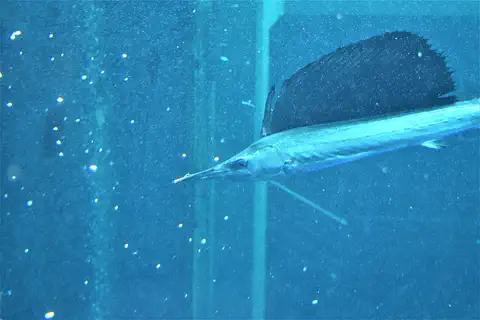
The sailfish is a long, sleek ocean fish with a tall, sail-like fin on its back and a long, spear-shaped upper jaw called a bill. It hunts schools of small fish in warm seas, folding its sail away to speed up and raising it to make sharp turns.
-
 Watch
Animal
Orange clownfish
The orange clownfish is a small, bright orange reef fish with three white bands edged in black. It lives in the warm western Pacific, from northern Australia to New Guinea and the Solomon Islands, always beside a sea anemone. A coat of slimy mucus keeps the anemone's stings from hurting it, and the fish and anemone help each other.
For parents & teachers
What children will learn
- Describe the blue tang's appearance and how its color changes from young to adult.
- Explain how blue tangs defend themselves: hiding, schooling and tail blades.
- Understand that scientists sometimes disagree, using the blue tang's diet as an example.
- Discuss how the aquarium trade affects wild reef fish and how captive rearing could help.
Recommended ages: 3 to 17 · About 15 minutes
Talk about it
- Why might swimming in a group help a fish stay safe?
- Why do scientists use scientific names when one fish has so many common names?
- What questions would you ask before buying a fish for an aquarium?
Try at home or in class
- Measure 30 centimeters with a ruler and draw a life-size blue tang, with its black palette shape and yellow tail.
- Mix yellow and blue paint and see which colors you can make: then talk about how young blue tangs change color as they grow.
Key vocabulary: surgeonfish, zooplankton, algae, school, venom, juvenile
Where these facts come from
- The IUCN Red List of Threatened Species , International Union for Conservation of Nature (IUCN terms of use (no redistribution of Red List data or range maps))
- GBIF Backbone Taxonomy and GBIF Occurrence Search , Global Biodiversity Information Facility (CC0 1.0 (backbone); occurrence counts are facts derived from records under CC0, CC BY and CC BY-NC)
- Paracanthurus hepatus (Palette Surgeonfish), 2010 global assessment , IUCN Red List of Threatened Species
- Paracanthurus hepatus, Palette surgeonfish , FishBase
- Blue Tang, Paracanthurus hepatus , Australian Museum
- Blue tang , National Geographic
- Blue Tang , Oceana
- Finding Dory: UF/IFAS researchers find first-ever method to farm Pacific Blue Tang , University of Florida IFAS
- Finding Out about Dory: 5½ Facts on the Blue Tang , National Geographic Education Blog
- Wikidata , Wikimedia Foundation (CC0 1.0)
- Wikimedia Commons , Wikimedia Foundation (Per file: Public domain, CC0, CC BY or CC BY-SA only (credited on each page))
Checked, not yet human-reviewed. Last updated October 28, 2026. Spotted a mistake? Tell us.