
Animal
Whale shark
The whale shark is the biggest fish in the sea. It is covered in pale spots, and it eats tiny food that floats in the water.
The whale shark is the largest fish in the world. This gentle giant swims through warm seas with its huge mouth open, filtering tiny plankton and small fish from the water, and every whale shark has its own pattern of pale spots.
Rhincodon typus, the whale shark, is the largest living fish: a filter-feeding shark of tropical and warm temperate seas. Its biology, from how it breeds to how long it lives, is still poorly known, and the IUCN's 2025 global assessment lists it as Endangered with a decreasing population.
Photo: Barlky, CC BY-SA 4.0, via Wikimedia Commons
Meet the whale shark
The whale shark is the biggest fish in the whole sea.
It is not a whale. It is a shark! It has a wide, flat head and a huge mouth. Pale spots cover its dark back.
The whale shark is the largest fish in the world. Despite its name it is not a whale, which is a mammal, but a shark, which is a fish. Most adults are about 5.5 to 10 meters long.
This giant is gentle. Instead of hunting big animals, it swims with its mouth open and filters tiny food from the water. Its dark back is covered in pale spots and stripes, and no two whale sharks have exactly the same pattern.
Rhincodon typus is the largest living fish. It is placed in its own family, Rhincodontidae, within the order Orectolobiformes, alongside the nurse sharks and wobbegongs, most of which live on the seafloor; the whale shark is the exception, a pelagic (open-sea) species.
Common adult length is about 5.5 to 10 meters. The largest measured individual was 18.8 meters, and the Florida Museum gives a maximum size thought to be about 20 meters. Because of its size and its skeleton of cartilage, Georgia Aquarium notes, it is very hard to weigh accurately and does not fossilize well. The Florida Museum considers it generally harmless to people.
Quick facts
- Group
- Fish
- Length
- 5.5 to 10 m
- Lifespan in the wild
- up to 60 years
Where it lives
Whale sharks live in warm seas around the world.
They swim far out in the open ocean. Sometimes they come close to the shore, to coral reefs and calm lagoons, to find food.
Whale sharks live in tropical and warm temperate seas around the world, in the Atlantic, Indian and Pacific Oceans, but not in the Mediterranean Sea. They like surface water of about 21 to 30 °C.
They often swim far offshore, but they also come close to the coast, into lagoons and around coral atolls, when food is plentiful. At places such as Ningaloo Reef in Western Australia, many whale sharks gather at the same time every year.
The whale shark occurs in all tropical and warm temperate seas except the Mediterranean, preferring surface temperatures around 21 to 30 °C in waters rich in plankton. It is pelagic and has been tracked to 1,928 meters deep, yet it regularly comes inshore, entering lagoons and coral atolls, and frequents upwelling areas near continental drop-offs.
Coastal feeding sites are dominated by juvenile males, and the largest gatherings hold hundreds to thousands of sharks. Individuals show site fidelity, returning to the same feeding sites, but are also highly migratory, moving about 24 to 28 kilometers a day. Every March and April whale sharks aggregate on the shelf off Western Australia, especially at Ningaloo Reef, where the zooplankton is rich. Genetic studies identify two subpopulations, one in the Atlantic and one in the Indo-Pacific.
Its habitats


Where can you find this animal?
- Lives here naturally · Countries and seas named by a scientific source
- Sightings recorded · Records of wild sightings (GBIF)
Lives here naturally · Countries and seas named by a scientific source
Tropical and warm temperate seas of the Atlantic, Indian and Pacific Oceans, but not the Mediterranean; mostly offshore, sometimes coming close to coasts, lagoons and coral atolls. Shading is by whole ocean, so it is wider than where whale sharks actually live.
Places: Atlantic Ocean, Indian Ocean and Pacific Ocean.
Source: https://www.floridamuseum.ufl.edu/discover-fish/species-profiles/whale-shark/ · checked October 2026
Sightings recorded · Records of wild sightings (GBIF)
Counts of GBIF records of wild observations (human and machine) and preserved specimens. Records include introduced populations, vagrants, escaped or released animals and misidentifications, so a country with records is not necessarily part of the native range.
Wild sightings have been recorded in Australia, Ecuador, Mexico, Indonesia, Peru, Philippines, Costa Rica, United States and 59 more places.
Source: gbif · checked October 2026
Range maps show where scientists say an animal lives, often country by country. An animal may live in only part of a country shown, and sightings records can include animals that wandered far from home.
What it eats
The whale shark eats very tiny food.
It opens its huge mouth and gulps seawater. It keeps the tiny shrimp, fish eggs and little fish, and lets the water flow out.
Whale sharks are filter feeders. They eat zooplankton, tiny floating animals such as small shrimp, krill and fish eggs, plus jellies, coral spawn and small fish like sardines and anchovies.
A whale shark sucks in a big mouthful of water, then closes its mouth so the water flows out through its gills. Filter pads inside its mouth keep the food in. Its throat is very narrow, so it can swallow only small prey.
The whale shark is a suction filter feeder. Rather than relying on slow forward swimming, it opens its mouth, distends its jaws and sucks in plankton-rich water at high speed, which lets it capture active prey such as small schooling fish as well as dense swarms of zooplankton. It also ram-feeds, swimming with its mouth open, and may feed in a vertical position with its head at the surface.
Twenty filtering pads, modified gill rakers, retain anything larger than about 2 to 3 millimeters. Georgia Aquarium describes this as cross-flow filtration: water leaves through the gills while food particles carry on to the back of the throat and collect into a ball that triggers swallowing. Researchers estimate an average intake of about 20.7 kilograms of plankton a day, and whale sharks have been seen 'coughing' to clear their filters.

A gentle giant's body
The whale shark has a wide, flat head.
Its mouth is at the very front, and it can be about as wide as you are tall. Its skin is thick and tough, like rubber. Every whale shark has its own spots.
A whale shark's mouth sits right at the front of its broad, flat head and can be up to about 1.2 meters (4 feet) wide. Inside are about 300 rows of tiny teeth that it does not seem to use for eating.
Its skin can be 10 centimeters thick, with the feel of strong rubber, and is covered in tooth-like scales. The pattern of pale spots on its back is unique to each shark, like a fingerprint.
The head is broad and flattened, with the mouth at the tip of the snout (terminal) rather than underneath it, up to about 1.2 meters wide. Its tiny, backward-pointing teeth, some 300 rows in each jaw, are thought to play no part in feeding. Behind the eye is a vestigial spiracle, which Georgia Aquarium describes as a remnant of the species' shared ancestry with bottom-dwelling carpet sharks. The small eyes sit on the sides of the head, and the Florida Museum suggests that the well-developed nostrils, more than vision, guide the shark toward dense plankton.
Adult skin can be 10 centimeters thick and is armored with denticles, each with a strong central keel. Three prominent ridges run along each side. The checkerboard of creamy spots between pale stripes is unique to each individual; its function is unknown.
Growing up
Baby whale sharks hatch from eggs inside their mother.
Then they are born and swim away. A newborn whale shark is about as long as a grown-up's arm. It grows into a giant!
Whale sharks are ovoviviparous: the babies grow in egg cases that hatch inside the mother, and then she gives birth to live young. Newborn pups are about 55 to 64 centimeters long.
Scientists know very little about how whale sharks mate; it has been seen only twice in the wild. Both males and females are thought to be grown up by the time they reach about 9 meters long. Nobody knows for sure how long they live.
For a long time scientists debated how whale sharks reproduce. The question was settled in 1995, when an 11-meter female caught off eastern Taiwan was found carrying 300 young, 42 to 63 centimeters long, in her two uteri: the species is ovoviviparous, with egg cases that hatch inside the mother before live birth. That is still the only litter ever documented. Pups are believed to measure 55 to 64 centimeters at birth.
Mating has been observed only twice in the wild. Studies suggest both sexes are mature by about 9 meters, and age estimates reach 60 years, though true lifespan is unknown. Southeast of Taiwan appears to be an important birthing area in summer.
Journeys and gatherings
Whale sharks swim slowly through the sea.
They often visit the same places to eat. Sometimes many whale sharks meet in one place when there is lots of food.
Whale sharks are travelers. Some make long journeys across oceans, while others stay in one region, and many come back again and again to the same feeding places.
When plankton is plentiful, large groups gather to feed. They dive up and down through the water, and groups have been seen feeding at dusk and after dark. Near snorkelers, tracked whale sharks either ignored them or slowly dived away.
Movements range from local to large-scale transoceanic migrations, apparently timed to pulses of plankton production and possibly to breeding. Seasonal migrations have been proposed for several areas, but the Florida Museum notes that more information is needed to confirm them.
At aggregation sites sharks segregate by size and sex. Tracked whale sharks at Ningaloo Reef swam in large circles near passes in the reef when water flowed out of the lagoon, possibly carrying prey, and made repeated dives associated with feeding; studies there found that regular diving is normal behavior rather than a reaction to swimmers. When not feeding, whale sharks off La Paz, Mexico, swam with their mouths slightly open and water flowing steadily through their gills.
Did you know?
Whale sharks can dive very, very deep.
Whale sharks usually feed near the surface, but one has been tracked diving to 1,928 meters deep.
Although it feeds at the surface, the whale shark has been recorded diving to 1,928 meters (Tyminski and colleagues, 2015).
Helping whale sharks
There are fewer whale sharks than there used to be.
Some get caught by fishing boats or bumped by ships. Many places now protect them, and visitors are asked to watch them gently.
The whale shark is endangered. It is threatened by fishing, being caught by accident in nets meant for other fish, being hit by boats while it feeds near the surface, and tourism that is badly run.
Many places now help. The Maldives and the Philippines have banned fishing for whale sharks, and in Western Australia tours are licensed and controlled. Divers and snorkelers are asked never to ride, chase or bother these gentle giants.
The IUCN's 2025 global assessment lists Rhincodon typus as Endangered (criteria A2bd) with a decreasing population, naming threats from fishing, shipping lanes, oil and gas drilling, recreational activities and climate-driven habitat shifts. Its 2021 Green Status assessment rates the species Largely Depleted, with a recovery score of 29 percent. The Florida Museum adds bycatch, vessel strikes and poorly conducted tourism, and describes fisheries for its meat, fins and liver oil.
The Maldives and the Philippines ban all fishing for whale sharks, and India protects them. In Western Australia the species is protected and tourism is managed through a limited number of licensed operators. Where whale sharks gather predictably, tourism built around them has been reported to bring in millions of dollars a year per country.
IUCN Red List
How is the whale shark doing in the wild?
- Least Concern
- Near Threatened
- Vulnerable
- Endangered (this animal)
- Critically Endangered
- Extinct in the Wild
- Extinct
Endangered
At very high risk of disappearing from the wild.
See the IUCN Red List assessment · The IUCN Red List of Threatened Species 2022.2
Amazing facts
-
No two whale sharks have the same spots.
A whale shark's spot pattern is like a human fingerprint: no two are exactly alike.
Each whale shark carries a unique arrangement of pale spots, which makes every individual recognizable, although what the pattern is for remains unknown.
-
The biggest fish has a throat about as small as a coin.
Even though its mouth can be 1.2 meters wide, a whale shark's throat is so narrow it is often compared to the size of a quarter, so it can swallow only small food.
The very narrow throat, often compared to a quarter, restricts the whale shark to small prey despite a mouth up to about 1.2 meters wide.
-
Whale sharks have hundreds of rows of tiny teeth.
A whale shark has about 300 rows of tiny teeth in each jaw, but scientists think it does not use them for eating.
About 300 rows of tiny, backward-pointing teeth line each jaw; they are thought to have no function in feeding, which depends on filter pads instead.
-
Whale sharks can dive very, very deep.
Whale sharks usually feed near the surface, but one has been tracked diving to 1,928 meters deep.
Although it feeds at the surface, the whale shark has been recorded diving to 1,928 meters (Tyminski and colleagues, 2015).
Words to know
- plankton
- tiny living things that drift in the water
- filter feeder
- an animal that strains small food out of the water
- pelagic
- living in the open sea, away from the seafloor
- ovoviviparous
- having eggs that hatch inside the mother before the young are born
- aggregation
- a gathering of many animals in one place
- endangered
- at risk of disappearing from the wild
Discovery challenge
-
What kind of animal is a whale shark?
Despite its name, what kind of animal is a whale shark?
To which group does Rhincodon typus belong?
- A shark, which is a fish
- A whale, which is a mammal
- A turtle, which is a reptile
Show the answer
A shark, which is a fish
A whale shark is a shark, and sharks are fish.
It is a shark, a fish, and the largest fish in the world.
It is a shark (order Orectolobiformes, family Rhincodontidae) and the largest living fish.
-
What does a whale shark eat?
What is a whale shark's main food?
Which food does the whale shark's filter system mainly collect?
- Seals and sea lions
- Grass and seaweed from the beach
- Plankton and small fish
Show the answer
Plankton and small fish
Whale sharks eat tiny plankton and little fish.
Whale sharks filter plankton, such as tiny shrimp and fish eggs, and small fish from the water.
Zooplankton, including sergestid shrimps, krill and fish eggs, plus small schooling fish; filter pads retain prey larger than about 2 to 3 mm.
-
What makes each whale shark different?
Which feature is different on every whale shark, like a fingerprint?
Which feature is unique to each individual whale shark?
- The number of its fins
- Its pattern of spots
- The color of its belly
Show the answer
Its pattern of spots
Every whale shark has its own spots.
The pale spots on a whale shark's back make a pattern that no other whale shark has.
The arrangement of pale spots is unique to each individual; the function of the pattern is not known.
-
Why are there fewer whale sharks than before?
Which of these harms whale sharks?
Which threats does the Florida Museum list for whale sharks?
- Fishing and boat strikes
- Eating too much plankton
- Water that is too warm for them
Show the answer
Fishing and boat strikes
Some whale sharks are caught by fishing boats or hit by ships.
Fishing, being caught by accident, boat strikes and badly run tourism all harm whale sharks.
Bycatch, fisheries, vessel strikes and poorly conducted tourism; the IUCN also names shipping lanes, oil and gas drilling and habitat shifts.
Places where you might see it
-
 Watch
 Country
Australia
Australia is a country and the smallest continent, surrounded by ocean in the Southern Hemisphere. Much of its middle is dry and flat, most people live near the coast, and its animals include kangaroos, koalas and the platypus, a mammal that lays eggs.
-
 Watch
 Country
Philippines
The Philippines is an island country in Southeast Asia, in the western Pacific Ocean. It has more than 7,000 islands, about 50 volcanoes and rich coral reefs, and about 112.7 million people were counted there in 2024.
Explore next
-
 Watch
3D
Animal
Basking shark
The basking shark is the second-biggest fish in the world, after the whale shark. It swims slowly near the surface with its enormous mouth open, sieving tiny floating animals called zooplankton out of the water. It is gentle and lives mainly in cool seas.
-
 Watch
Animal
Giant oceanic manta ray
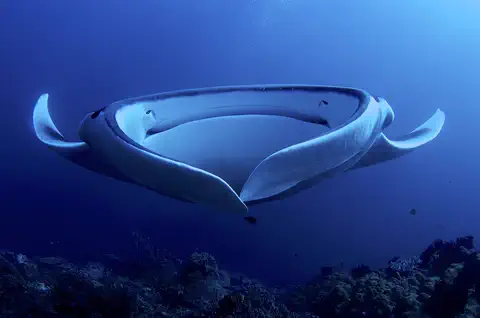
The giant oceanic manta ray is the largest ray in the world, with wing-like fins that can stretch more than 6 meters from tip to tip. This gentle filter feeder funnels plankton into its wide mouth, and it has a single pup only every two to three years.
-
 Watch
3D
Animal
Great white shark
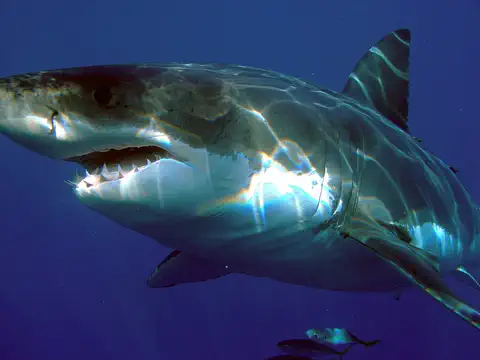
The great white shark is the largest of the mackerel sharks: a strong, torpedo-shaped fish with a gray back and a white belly. It hunts fish, seals and sea lions, and it is partly warm-blooded, which helps it stay active in cool water.
-
 Watch
3D
Animal
Antarctic krill
Antarctic krill are small, shrimp-like crustaceans about 6 centimeters long that live in the icy Southern Ocean around Antarctica. They gather in enormous swarms, and almost all the bigger animals of the Antarctic, from penguins to blue whales, depend on them for food.
-
Watch
Country
Australia
Australia is a country and the smallest continent, surrounded by ocean in the Southern Hemisphere. Much of its middle is dry and flat, most people live near the coast, and its animals include kangaroos, koalas and the platypus, a mammal that lays eggs.
-
Watch
Country
Philippines
The Philippines is an island country in Southeast Asia, in the western Pacific Ocean. It has more than 7,000 islands, about 50 volcanoes and rich coral reefs, and about 112.7 million people were counted there in 2024.
-
 Watch
3D
Animal
Yellowfin tuna
The yellowfin tuna is a large, torpedo-shaped fish of warm oceans around the world. It has a dark blue back, a silver belly and long, bright yellow fins. Yellowfin travel huge distances, dive deep to hunt fish and squid, and are important to fisheries all around the world.
-
 Watch
3D
Animal
West Indian Ocean coelacanth
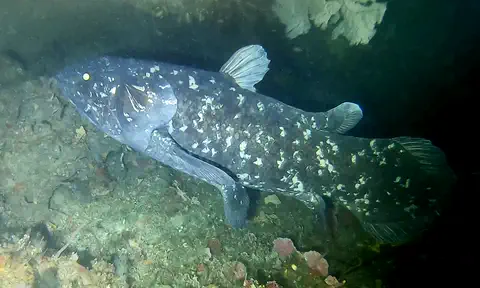
The West Indian Ocean coelacanth is a large, blue, spotted fish that lives in deep, rocky waters off eastern Africa. Its group was known only from fossils and thought to have died out about 66 million years ago, until a living one was found in South Africa in 1938.
For parents & teachers
What children will learn
- Explain that the whale shark is a shark and the largest fish, not a whale.
- Describe how a filter feeder eats, and why a giant can live on tiny plankton.
- Recognize that each whale shark has a unique spot pattern.
- Understand why the species is endangered and how careful tourism and fishing bans help.
Recommended ages: 3 to 17 · About 15 minutes
Talk about it
- Why might the biggest fish in the sea eat some of the smallest food?
- How could tourism help whale sharks, and how could it harm them?
- What questions about whale sharks are scientists still trying to answer?
Try at home or in class
- Measure 10 meters along a hallway or sidewalk to see how long a big adult whale shark is.
- Stir a pinch of ground pepper into a bowl of water, then pour it through a coffee filter or a clean cloth to see how a filter keeps the bits and lets the water through.
Key vocabulary: plankton, filter feeder, pelagic, ovoviviparous, aggregation, endangered
Where these facts come from
- The IUCN Red List of Threatened Species , International Union for Conservation of Nature (IUCN terms of use (no redistribution of Red List data or range maps))
- GBIF Backbone Taxonomy and GBIF Occurrence Search , Global Biodiversity Information Facility (CC0 1.0 (backbone); occurrence counts are facts derived from records under CC0, CC BY and CC BY-NC)
- Rhincodon typus (Whale Shark), 2025 global assessment , IUCN Red List of Threatened Species
- Whale Shark (Rhincodon typus) species profile , Florida Museum of Natural History
- Whale Shark , Georgia Aquarium
- Wikidata , Wikimedia Foundation (CC0 1.0)
- Wikimedia Commons , Wikimedia Foundation (Per file: Public domain, CC0, CC BY or CC BY-SA only (credited on each page))
Checked, not yet human-reviewed. Last updated October 28, 2026. Spotted a mistake? Tell us.