Animal
Seven-spot ladybird
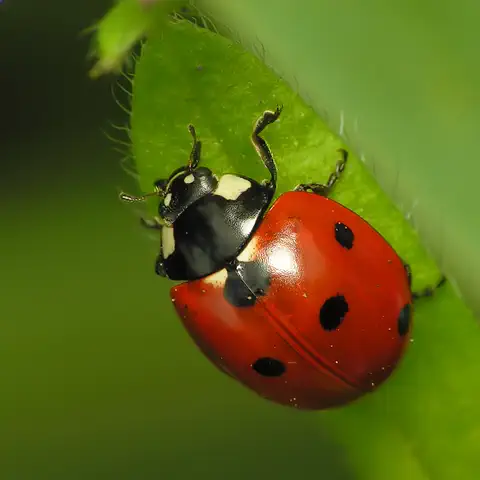
The seven-spot ladybird is a small red beetle with seven black spots. It eats tiny aphids that harm garden plants.
The seven-spot ladybird, or ladybug, is a domed red beetle with seven black spots. Both the young and the adults hunt aphids, small insects that suck plant juices, so gardeners and farmers are glad to see them. Its bright colors warn predators that it tastes horrible.
Coccinella septempunctata is a coccinellid beetle native to Europe and Asia and established in North America since the early 1970s after attempts to use it for biological control of aphids. A voracious aphid predator with aposematic coloration and toxic alkaloid defenses, it can develop from egg to adult in two to three weeks, and has displaced some native lady beetles.
Photo: Reytan (uploader), CC BY-SA 3.0, via Wikimedia Commons
Meet the seven-spot ladybird
The seven-spot ladybird is a little round beetle.
It is shiny red with seven black spots. It has a black head with white marks. In America, people call it a ladybug.
The seven-spot ladybird is a beetle, and in North America it is often called a ladybug. It is oval and domed, about 6.5 to 7.8 millimeters long, with shiny red-orange wing cases and, usually, seven black spots.
Ladybirds are helpers in gardens and on farms. They eat aphids, tiny insects that suck the juice out of plants. In the United Kingdom, the seven-spot is the most common ladybird of all.
Coccinella septempunctata is a lady beetle in the family Coccinellidae. Its spot count usually is seven, three on each elytron and one shared spot straddling the join by the scutellum, but Animal Diversity Web notes it can range from 0 to 9. Two pale patches flank the scutellum, and two pale spots mark the front of the pronotum.
The species is a polyphagous predator that mainly eats aphids, which makes it valuable in agriculture. Repeated releases to control aphids in North America from 1951 to 1971 apparently failed; a population found in New Jersey in 1973 is thought to have come from an accidental release.
Quick facts
- Group
- Invertebrate
- Length
- 6.5 to 7.8 mm
- Lifespan in the wild
- 1 to 2 years
Where it lives
Seven-spot ladybirds first lived in Europe and Asia.
Now they live in North America too. They live in gardens, parks, fields and farms, wherever there are aphids to eat.
The seven-spot ladybird comes from Europe and Asia. People brought it to North America to eat crop pests, and since the 1970s it has spread through the United States and Canada. It is now one of the most common ladybirds there.
You can find it wherever there are plenty of aphids: on plants, shrubs and trees in fields, meadows, marshes, farms, gardens and parks, from sea level up to about 1,500 meters.
Animal Diversity Web gives the native range as Europe and Asia, with the species now found through the Middle East, India and North America. In North America it became established after 1973 and is now one of the most common and widespread coccinellids (ADW); Cornell's biological control guide adds that it is spreading to new areas each season.
It occurs wherever aphids are abundant: herbaceous plants, shrubs and trees in fields, grasslands, marshes, crops, gardens and parks, from sea level to about 1,500 meters. Preferred overwintering sites are open, south-facing areas with boulders, tussocks or dense grass hedgerows that catch the most sunlight.
Continents
Its habitat

Where can you find this animal?
- Brought here by people · Countries and seas named by a scientific source
- Lives here naturally · Countries and seas named by a scientific source
- Sightings recorded · Records of wild sightings (GBIF)
Brought here by people · Countries and seas named by a scientific source
Brought to North America to control aphids. It became established in New Jersey in the early 1970s and has spread across the United States and Canada.
Places: United States and Canada.
Source: https://biocontrol.entomology.cornell.edu/predators/Coccinella.php · checked October 2026
Lives here naturally · Countries and seas named by a scientific source
Native to Europe and Asia, in fields, meadows, gardens and parks wherever aphids are common. The map shades whole continents; the source does not list individual countries.
Places: Europe and Asia.
Source: https://animaldiversity.org/accounts/Coccinella_septempunctata/ · checked October 2026
Sightings recorded · Records of wild sightings (GBIF)
Counts of GBIF records of wild observations (human and machine) and preserved specimens. Records include introduced populations, vagrants, escaped or released animals and misidentifications, so a country with records is not necessarily part of the native range.
Wild sightings have been recorded in UK, Netherlands, Germany, United States, France, Canada, Belgium, Sweden and 90 more places.
Source: gbif · checked October 2026
Range maps show where scientists say an animal lives, often country by country. An animal may live in only part of a country shown, and sightings records can include animals that wandered far from home.
Aphid hunters
Ladybirds love to eat aphids.
Aphids are tiny bugs that suck juice from plants. Ladybird babies eat aphids too. When there are no aphids, grown-ups eat pollen.
Seven-spot ladybirds mainly eat aphids, tiny soft insects that suck sap from plants. By eating huge numbers of them, ladybirds help protect crops such as potatoes, beans, sweet corn and wheat.
Ladybirds find food partly by smell. They are attracted to the warning scent aphids give off when a predator is near, and to smells plants release when aphids feed on them. When aphids are scarce, adults eat pollen. Larvae hunt aphids too, and can travel up to 12 meters to find them.
The species is polyphagous but feeds mainly on aphids; Cornell lists prey including pea, cowpea, green peach, potato, corn leaf and melon aphids and greenbug, in crops such as potatoes, legumes, sweet corn, alfalfa, wheat, sorghum and pecans. When prey is scarce adults eat pollen, and both adults and larvae may eat eggs and larvae of their own or other species.
Foraging uses chemical cues: the alarm pheromone aphids release from their cornicles attracts the beetles, as do volatiles from plants damaged by aphids (ADW). Young larvae suck aphid fluids and later eat whole aphids; large larvae may travel up to 12 meters searching for prey (Cornell).

Wing cases and warning colors
The red part is two hard wing cases.
Thin flying wings hide underneath. The bright red tells birds, "I taste bad!" A ladybird can make a smelly yellow liquid to stay safe.
A ladybird's red, spotted back is really two hard wing cases called elytra. They protect the thin flying wings underneath.
Those bright colors are a warning. They tell predators that ladybirds taste horrible. If a ladybird is grabbed, it can also squeeze a smelly yellow liquid from its leg joints. Grown-ups who pick up ladybirds sometimes find little yellow stains on their hands.
The elytra are hardened forewings that, as the UK Ladybird Survey explains, protect the hind wings and soft body when the beetle is not flying. Their red and black pigments derive from melanins and the lighter areas from carotenes. A newly emerged adult has soft, unpigmented elytra, and the coloration develops over time (ADW).
Aposematic coloration deters most predators, backed by chemistry: Animal Diversity Web reports toxic N-oxides and alkaloids released from a gland between the femur and tibia, which can account for up to 20 percent of body weight. The Wildlife Trusts describe this reflex bleeding as a pungent yellow fluid from the joints. Even so, ADW lists birds and small mammals among known predators, and spiders take the larvae; the Wildlife Trusts note that some birds still try.
Egg, larva, pupa, beetle
A ladybird starts as a tiny egg.
The baby looks like a little dark alligator with legs. It eats lots of aphids. Then it rests as a pupa. Out comes a ladybird!
Ladybirds go through complete metamorphosis. A female lays small, spindle-shaped eggs about 1 millimeter long in little groups near aphids. The larvae that hatch look nothing like ladybirds: they are dark and alligator-shaped, with three pairs of legs.
A larva eats its own eggshell first, then aphids. It grows for 10 to 30 days, molting three times, then fixes the tip of its body to a surface and becomes a pupa for 3 to 12 days. A new adult comes out pale and soft, and its red color and spots appear over time.
Females lay about 250 to 500 eggs in a lifetime according to Animal Diversity Web (Cornell gives 200 to over 1,000 over one to three months), in small clusters near prey; females avoid sites already holding eggs of their species, laying at most about 15 per site. Eggs are spindle-shaped and about 1 millimeter long.
There are four larval instars lasting 10 to 30 days in total, depending on aphid supply and temperature. The fourth instar stops feeding for about 24 hours and attaches by its abdomen tip before pupating; the pupa lasts 3 to 12 days. Development from egg to adult can take only two to three weeks, with one to two generations a year in the northeastern United States.
Daytime flyers, winter huddles
Ladybirds fly about in the daytime.
In winter, they huddle together in a sheltered spot and sleep until spring. They use smells to find each other.
Seven-spot ladybirds are active during the day and can fly. Before winter they look for a sheltered place to spend the winter, such as hollow plant stems, thick grass or gaps between rocks, often gathering in groups.
Most winter groups have around 10 to 15 beetles, but groups of more than 200 have been found. A special smell helps ladybirds find each other, so that in spring there are partners nearby to mate with. Then the females begin laying eggs near aphids.
Adults are diurnal and fly. Overwintering in diapause, they form aggregations of about 10 to 15 individuals, occasionally over 200, in dense low foliage or between boulders; the Wildlife Trusts mention hollow plant stems. ADW reports that 2-isopropyl-3-methoxy-pyrazine attracts beetles to these aggregations, which also ensures mates are nearby when diapause ends.
Courtship follows five steps: approach, watching, examination of the female's antennae and mouthparts, mounting and copulation attempt. Both sexes mate many times, and some females overwinter with stored sperm. Breeding peaks in spring and early summer.
Did you know?
Not every seven-spot ladybird has seven spots.
Most seven-spot ladybirds have seven spots, but some have anywhere from none to nine.
Spot number ranges from 0 to 9, though seven is typical (ADW).
A garden helper
Seven-spot ladybirds are not in danger.
They are common in many places. You can welcome them to a garden with a bug box.
The seven-spot ladybird has not been assessed by the IUCN, but it is very common in Europe and has spread widely in North America. Gardeners can welcome ladybirds by putting up a bug box.
There is another side to its story. In North America, the seven-spot is not native, and scientists at Cornell report that it may outcompete some native lady beetles and push them out of some areas.
The species has not been evaluated by the IUCN (Not Evaluated in GBIF's copy of the Red List). It is the most common ladybird in the UK according to the Wildlife Trusts, and one of the most common and widespread coccinellids in North America.
Introduced to North America for biological control, it may be a more effective predator than some native lady beetles and has displaced them in some areas (Cornell). Cornell's guide recommends integrated pest management to conserve it in crops and notes it is likely to tolerate some pesticides at recommended rates, with overwintering adults less susceptible than active adults and larvae.
Did you know?
Ladybird groups snuggle together in winter.
In winter, seven-spot ladybirds huddle in groups, usually 10 to 15, but sometimes more than 200.
Overwintering aggregations are attracted by the pyrazine 2-isopropyl-3-methoxy-pyrazine (ADW).
Amazing facts
-
A baby ladybird looks like a tiny alligator.
Ladybird larvae look nothing like their parents: they are dark and alligator-shaped, with six legs.
Larvae are dark, segmented and 'alligator-like' (Cornell), with four instars before pupation.
-
A new ladybird is pale. It turns red later.
A ladybird that has just come out of its pupa is pale and soft. Its red color and spots develop over time.
Newly eclosed adults have soft, unpigmented elytra; melanins and carotenes produce the final pattern (ADW).
-
Ladybird groups snuggle together in winter.
In winter, seven-spot ladybirds huddle in groups, usually 10 to 15, but sometimes more than 200.
Overwintering aggregations are attracted by the pyrazine 2-isopropyl-3-methoxy-pyrazine (ADW).
-
Not every seven-spot ladybird has seven spots.
Most seven-spot ladybirds have seven spots, but some have anywhere from none to nine.
Spot number ranges from 0 to 9, though seven is typical (ADW).
Words to know
- aphid
- a tiny insect that sucks sap from plants
- elytra
- the hard wing cases of a beetle
- larva
- the young, wormlike stage of an insect
- pupa
- the resting stage when an insect changes into its adult form
- warning coloration
- bright colors that tell predators an animal tastes bad
- biological control
- using one living thing to control a pest
Discovery challenge
-
What do ladybirds love to eat?
Which insects do seven-spot ladybirds mainly eat?
What is the main prey of Coccinella septempunctata?
- Aphids
- Butterflies
- Bees
Show the answer
Aphids
Ladybirds love to eat aphids.
They mainly eat aphids, tiny insects that suck plant sap.
Aphids are the main prey; pollen is eaten when aphids are scarce.
-
What is the red part of a ladybird?
What is a ladybird's red, spotted back made of?
What are a beetle's elytra?
- Hard wing cases
- Its stomach
- A shell like a snail's
Show the answer
Hard wing cases
The red part is two hard wing cases.
It is two hard wing cases, the elytra, covering the flying wings.
Elytra are hardened forewings that protect the hind wings when not flying.
-
Why is a ladybird bright red?
What do a ladybird's bright colors tell predators?
What is the function of the ladybird's red and black coloration?
- It tastes bad
- It is very fast
- It is a flower
Show the answer
It tastes bad
Red tells birds that ladybirds taste bad.
The colors warn that ladybirds taste horrible; they can also release a smelly yellow liquid.
Aposematic coloration advertising toxic alkaloids released by reflex bleeding.
-
What does a baby ladybird look like?
What does a ladybird larva look like?
Which describes the larval stage of the seven-spot ladybird?
- A tiny red ladybird
- A dark, alligator-shaped bug
- A fluffy caterpillar
Show the answer
A dark, alligator-shaped bug
It is dark and looks like a little alligator.
The larva is dark and alligator-shaped with six legs, and it eats aphids.
Dark, segmented, alligator-like larvae pass through four instars over 10 to 30 days.
Places where you might see it
Experiments to try
Explore next
-
 Watch
 Country
United Kingdom
The United Kingdom, or UK, lies on islands off the northwest coast of Europe. It is made up of four parts, England, Scotland, Wales and Northern Ireland, and about 69.5 million people live there. Its capital is London.
-
 Watch
3D
Animal
Western honey bee
The western honey bee lives in big families called colonies, with one queen and many workers. Workers collect nectar and pollen from flowers, turn nectar into honey, and tell each other where food is by dancing. As they travel, they pollinate many plants, including crops people eat.
-
 Watch
Animal
Common eastern firefly
The common eastern firefly, or big dipper firefly, is a beetle that makes its own light. On summer evenings, males fly over lawns and fields, drawing a J-shaped flash in the air, and females on the ground flash back. Most of its life is spent as a glowing larva in damp soil, hunting snails and worms.
-
 Watch
3D
Animal
European mantis
The European mantis is the best-known praying mantis. It sits very still with its spiky front legs folded, then snatches insects that come close. It is native to Europe, Africa and much of Asia, and people brought it to North America more than 100 years ago.
-
 Watch
3D
Animal
Bull-headed dung beetle
The bull-headed dung beetle is a shiny black beetle about 1 centimeter long. Large males have two long, curved horns on their heads, like a bull. These beetles dig tunnels under cow dung and pack dung into balls for their young, which cleans up pastures and helps the soil. They came from Europe and now also live in North America and Australia.
-
 Watch
3D
Animal
Common wasp
The common wasp is a black and yellow striped insect that lives in a big family called a colony. Thousands of wasps share a round nest made of paper that they make by chewing wood. They catch insects such as caterpillars and flies to feed their young, which makes them useful garden helpers.
-
 Watch
3D
Animal
European stag beetle
The European stag beetle is one of Europe's biggest beetles. Males have giant jaws shaped like a stag's antlers, which they use to wrestle other males. Stag beetles spend most of their lives underground as larvae, eating rotting wood for about four years, and live only a few weeks as adults.
- Watch Try it What If? Lab What if insects vanished? Insects eat plants, and birds, mice and bears eat insects. In our forest food web, take the insects out and see who could go hungry and who could change. Then find out why scientists are counting insects carefully, and how people help them.
For parents & teachers
What children will learn
- Name the four stages of the ladybird's life cycle.
- Explain why ladybirds are helpful to farmers and gardeners.
- Describe how warning colors and chemicals protect ladybirds.
- Understand that an introduced species can affect native animals.
Recommended ages: 3 to 17 · About 12 minutes
Talk about it
- Why might farmers have brought ladybirds from Europe to North America?
- How could a helpful insect also cause problems in a new place?
- Why do you think young ladybirds look so different from adults?
Try at home or in class
- Search garden plants for aphids and ladybird larvae with a magnifying glass, and draw what you find without picking them up.
- Make a simple bug box from hollow plant stems tied in a bundle to give ladybirds a winter shelter.
Key vocabulary: aphid, elytra, larva, pupa, warning coloration, biological control
Where these facts come from
- GBIF Backbone Taxonomy and GBIF Occurrence Search , Global Biodiversity Information Facility (CC0 1.0 (backbone); occurrence counts are facts derived from records under CC0, CC BY and CC BY-NC)
- Coccinella septempunctata (seven-spotted lady beetle) , Animal Diversity Web, University of Michigan Museum of Zoology
- Coccinella septempunctata (Coleoptera: Coccinellidae) , Biological Control: A Guide to Natural Enemies in North America, Cornell University
- 7-spot ladybird , The Wildlife Trusts
- Elytra , UK Ladybird Survey, UK Beetle Recording
- Wikidata , Wikimedia Foundation (CC0 1.0)
- Wikimedia Commons , Wikimedia Foundation (Per file: Public domain, CC0, CC BY or CC BY-SA only (credited on each page))
Checked, not yet human-reviewed. Last updated October 28, 2026. Spotted a mistake? Tell us.