
What If? Lab
What if whales returned to every ocean?
Long ago, the oceans had many more whales. What if they all came back? Whales help feed tiny sea plants. Let's find out how!
Hunting in the last century took away most of the world's great whales, and since a 1985 ban on commercial whaling many are growing in number again. Whale poop feeds the tiny drifting plants at the base of the ocean food web, and whale bodies carry carbon to the deep sea. Imagine whales back in every ocean and follow what they might do.
Commercial whaling depleted great whale populations by more than 80 percent globally (NOAA). Research since 2010 has described whales as nutrient cyclers: they feed at depth and release iron- and nitrogen-rich fecal plumes at the surface, fertilizing phytoplankton. This thought experiment examines the whale pump, carbon transport to the deep sea and the sound of a fuller ocean, separating measurements from modeled ideas.
The big question
Whales are the biggest animals in the sea.
Once there were many more of them. What if whales came back to every ocean?
Blue whales, humpbacks, sperm whales and fin whales once swam in far greater numbers than today. In the 1900s, hunting removed most of them.
Now many whale populations are growing again. So here is a thought experiment: what if whales returned to every ocean, as many as there used to be? What would change for the tiny plankton, the fish, the seabirds and even the air? You can follow three paths: whale poop, carbon sinking to the deep, and a sea full of whale sounds.
Industrial whaling in the 20th century removed millions of large whales. Populations protected since then are recovering unevenly; some remain endangered.
This thought experiment asks what a return to pre-whaling numbers might mean for ocean ecosystems. It draws on field measurements of fecal plumes, tag-based estimates of how much whales eat, and research on carbon storage. Many of the system-wide effects are calculated from models and remain ideas rather than observations.
Explore the idea
Make a prediction
When people hunted most whales, did the krill they eat grow in number, or fall?
After whaling removed most whales from Antarctic waters, what happened to the krill they used to eat?
Following 20th-century whaling in the Southern Ocean, how did krill stocks in heavily hunted areas respond?
- Krill numbers fell
- Krill numbers boomed
- Nothing changed
-
Established fact
Whales help feed the tiny plants at the bottom of the ocean food web.
Whales bring nutrients up from the deep and release them near the surface, where they feed phytoplankton.
Whales act as nutrient pumps, releasing nitrogen- and iron-rich fecal plumes in the euphotic zone (Roman and McCarthy, 2010; NOAA).
-
An idea scientists discuss
Whales back in every ocean is pretend, for now.
How much a full recovery of whales would change the ocean is an idea built from measurements and calculations.
Ecosystem-scale outcomes of full recovery come from models with large uncertainties; NOAA notes whales' carbon role is hard to quantify.
-
Established fact
Hunting took away most whales. Now many are coming back.
Commercial whaling cut whale populations by more than 80 percent around the world. Since a final ban took effect in 1985, humpbacks have been increasing across much of their range.
Whaling depleted whales by more than 80 percent globally; humpbacks, most populations reduced by over 95 percent before the 1985 moratorium, are now increasing through much of their range (NOAA Fisheries).
-
Established fact
Whales bring food for tiny sea plants up to the sunny water.
A 2010 study found that whales and seals bring more nitrogen to the sunlit surface of the Gulf of Maine each year than all the region's rivers combined.
Whales and seals may replenish about 23,000 metric tons of nitrogen a year to the Gulf of Maine's euphotic zone, more than all river input combined (Roman and McCarthy, PLoS ONE, 2010).
-
Established fact
Whales eat much more than people thought.
A 2021 study of 321 whales found that baleen whales eat about three times as much as earlier estimates. A blue whale can gulp about 16 metric tons of krill in a day.
Savoca et al. (Nature, 2021) tagged 321 whales of seven species: baleen whales eat about three times prior estimates; a blue whale can consume about 16 metric tons of krill in a day.
-
An idea scientists discuss
More whales might mean more krill, not less!
Krill in heavily hunted Antarctic waters fell by more than 80 percent after whaling, instead of booming. Scientists think more whales might mean more krill again, because whale poop feeds the plankton krill eat.
Savoca's team calculated that restoring whales and krill to early-1900s levels might raise Southern Ocean productivity by about 11 percent; this is a modeled scenario, not an observed result.
-
Established fact
A whale's body can keep carbon at the bottom of the sea for a very long time.
After whales die, their bodies often sink to the seafloor, trapping their carbon there for hundreds to thousands of years.
Whale falls can sequester carbon for hundreds to thousands of years, cycling it through deep-sea ecosystems and sediment (NOAA Fisheries).
-
Established fact
One whale feeds deep-sea animals a lot of food.
One whale fall can bring as much food to the deep seafloor as several thousand years' worth of marine snow.
A single whale fall can deliver as much organic material as several thousand years of marine snow (MBARI).
-
An idea scientists discuss
More whales might help keep more carbon in the sea.
Scientists think more whales might help the ocean store more carbon, but NOAA says it is hard to put an exact number on how much.
Restored whales and krill might store about 215 million metric tons of carbon a year in the Southern Ocean (Savoca et al., calculated); NOAA cautions that whales' share of blue carbon is hard to quantify.
-
Established fact
Whales use sounds to talk and to find food.
Whales, dolphins and porpoises send and receive complex sounds to communicate, find their way and find food, and sound travels much farther than light underwater.
Cetaceans use complex sounds to communicate, navigate and find food; human activities such as shipping have added increasing noise to the ocean since the industrial age (NOAA Fisheries).
-
An idea scientists discuss
A quieter sea might help returning whales hear each other.
If whales returned everywhere, keeping the ocean quieter might help them hear each other's calls; scientists are studying how noise affects them.
A recovered whale population might depend partly on managing human noise; NOAA lists underwater noise among current threats to humpbacks, but its population-level effect is still being studied.
Whales today
People hunted lots of whales long ago. Then most whale hunting stopped.
Now some whales, like humpbacks, are growing in number again.
NOAA Fisheries says commercial whaling cut whale populations by more than 80 percent around the world. Humpback whales were hit especially hard: before a final ban on commercial whaling in 1985, most humpback populations had dropped by more than 95 percent.
Since then, humpbacks have been increasing across much of their range. Blue whales off the U.S. West Coast and gray whales in the eastern North Pacific have also responded to protection. But whales still face dangers from fishing gear, ship strikes and underwater noise.
NOAA Fisheries: commercial whaling depleted whale populations by more than 80 percent globally. Before the International Whaling Commission's final moratorium on commercial harvest, in effect since 1985, humpback populations had mostly fallen by more than 95 percent.
Humpbacks are now increasing throughout much of their range; of 14 distinct population segments, four remain endangered and one threatened (2016 listing). Threats include entanglement in fishing gear, vessel strikes, vessel-based harassment and underwater noise. Blue whales off the U.S. West Coast and Eastern North Pacific gray whales show positive responses to conservation.
Imagine the whales back
Let's pretend the oceans are full of whales again.
Whales eat lots of tiny animals. Then their poop feeds tiny sea plants. More whales might mean more food for everyone!
Imagine whales back in their old numbers, spouting across every ocean. Whales eat enormous amounts: a 2021 study found baleen whales eat about three times as much as scientists had thought, and a blue whale can gulp about 16 metric tons of krill in a day.
All that eating means lots of poop, full of iron and other nutrients. That poop feeds phytoplankton, the tiny drifting plants that feed krill and much of sea life. So scientists think more whales might mean more plankton, more krill, and more carbon taken out of the air. These are ideas being studied.
Savoca and colleagues (Nature, 2021) tagged 321 whales of seven species, used drones to photograph 105, and measured prey with sonar. They found baleen whales eat about three times earlier estimates; a blue whale can take about 16 metric tons of krill in a day.
The team estimated that before whaling, Southern Ocean baleen whales ate about 430 million metric tons of krill a year, while less than half that much krill lives there today. They calculated that restoring whales and krill to early-1900s levels might raise Southern Ocean productivity by 11 percent. These are model estimates, not observed outcomes.
Why whale poop matters
Whales eat deep down. Then they come up to breathe and poop near the top.
The poop feeds tiny sea plants that need sunlight. Scientists call this the whale pump.
Phytoplankton need sunlight and nutrients, such as nitrogen and iron, to grow. Sunlight is only near the surface, but many nutrients sink into the deep.
Whales help bring them back. Many whales feed deep down, then rise to the surface to breathe, where they release floating plumes of poop and pee. Scientists call this the whale pump. A 2010 study found that whales and seals in the Gulf of Maine bring more nitrogen to the sunlit surface each year than all the region's rivers combined.
Roman and McCarthy (PLoS ONE, 2010) sampled humpback fecal plumes on Stellwagen Bank and found nitrogen concentrations far above surrounding water. They estimated that whales and seals replenish about 23,000 metric tons of nitrogen a year to the Gulf of Maine's euphotic zone, more than all rivers combined, and that before commercial whaling this recycling was likely more than three times atmospheric nitrogen input.
NOAA describes the vertical whale pump and a horizontal whale conveyor belt: nutrients consumed on feeding grounds are released along migration routes up to 12,000 miles long.
Whales and carbon
When a whale dies, it sinks to the deep sea floor.
Many deep-sea animals feed on it for years. Its body keeps carbon down deep for a very long time.
NOAA Fisheries explains that whales store carbon in their huge bodies. When a whale dies, its body often sinks to the seafloor, an event called a whale fall. The carbon can stay down there for hundreds to thousands of years, while deep-sea animals feed on the body. The Monterey Bay Aquarium Research Institute says one whale fall can bring as much food to the seafloor as several thousand years of falling bits called marine snow.
NOAA also says it's hard to put an exact number on how much carbon whales store.
NOAA Fisheries lists three routes: biomass storage in long-lived bodies, whale falls that sequester carbon for hundreds to thousands of years, and nutrient supply that stimulates carbon-capturing phytoplankton blooms. It also says it is difficult to put an exact number on whales' share of blue carbon storage.
MBARI notes a single whale fall can deliver as much organic material as several thousand years of marine snow. Savoca's team calculated that restored Southern Ocean whales and krill might store about 215 million metric tons of carbon a year; like other system-wide estimates, this comes from calculation, not measurement.
Amazing facts
-
A blue whale can eat a huge amount of krill in one day.
A blue whale can gulp down about 16 metric tons of krill in a single day.
Tag data show a blue whale can consume about 16 metric tons of krill, roughly 10 to 20 million calories, in a day (Savoca et al., 2021).
-
Some whales swim very, very far every year.
Some baleen whales migrate up to 12,000 miles, spreading nutrients along the way.
NOAA notes baleen whale migrations of up to 12,000 miles, carrying nutrients from feeding grounds to breeding grounds.
-
Tiny sea plants make lots of the oxygen we breathe.
Phytoplankton, the tiny plants whale poop helps feed, produce about half the oxygen we breathe.
NOAA: marine phytoplankton produce about half of Earth's oxygen and capture the equivalent of four Amazon rainforests' worth of carbon dioxide a year.
-
Scientists stuck sensors on whales with suction cups.
To learn how much whales eat, scientists attached suction-cup sensors to 321 whales of seven species.
Savoca's team combined suction-cup tags on 321 whales, drone photos of 105 whales and sonar prey surveys (Science News Explores).
Words to know
- phytoplankton
- tiny drifting plant-like living things that make food from sunlight
- krill
- small shrimp-like animals that many whales eat
- whale pump
- the way whales bring nutrients from the deep to the surface by feeding deep and pooping near the top
- whale fall
- a dead whale's body that has sunk to the seafloor
- nutrient
- a substance living things need to grow, such as nitrogen or iron
- baleen whale
- a whale that filters food from water with plates of baleen instead of teeth
Discovery challenge
-
What does whale poop feed?
What does whale poop help to grow near the ocean surface?
Whale fecal plumes chiefly fertilize…
- Phytoplankton
- Coral rocks
- Sea ice
Show the answer
Phytoplankton
Tiny sea plants called phytoplankton.
Phytoplankton, the tiny plants at the base of the ocean food web.
…phytoplankton, by returning nitrogen and iron to the euphotic zone.
-
What is it called when a dead whale sinks to the sea floor?
What do scientists call a dead whale's body on the deep seafloor?
The carcass of a whale on the deep seafloor is called a…
- A whale fall
- A whale pump
- A whale song
Show the answer
A whale fall
A whale fall.
A whale fall, which feeds deep-sea life and stores carbon.
…whale fall, which can sequester carbon for hundreds to thousands of years.
-
When most whales were hunted, what happened to krill?
After whaling, what happened to krill in heavily hunted Antarctic waters?
Krill in heavily hunted Southern Ocean areas after whaling…
- They fell by more than 80 percent
- They doubled
- They stayed the same
Show the answer
They fell by more than 80 percent
They went down, a big surprise!
They dropped by more than 80 percent, probably partly because whale poop was missing.
…declined by more than 80 percent, consistent with a broken iron cycle.
Experiments to try
- Watch What If? Lab What if the sea were as clear as glass? Sunlight fades as it goes deeper into the sea, and below about 200 meters there is hardly any. Tiny drifting plants and bits of mud also change how green, blue or murky the water looks. Imagine the sea perfectly clear, then follow how deep light would go, what it would mean for seaweed forests, and what gives the sea its colors.
- Watch What If? Lab What if you could dive to the deepest trench? The Challenger Deep, at the bottom of the Mariana Trench, is about 11 kilometers down: deeper than Mount Everest is tall. Imagine diving there. Discover how strong the water's squeeze becomes, what lives in the dark, and the explorers who have already made the trip.
- Watch What If? Lab What if sharks disappeared? Sharks catch and eat other sea animals, and just having them around changes where those animals go. Follow what scientists have found in Australia's Shark Bay seagrass meadows and on coral reefs, where the evidence is still debated, and how some shark populations are recovering.
Explore next
-
 Watch
Animal
Blue whale
The blue whale is the largest animal ever to live on Earth, bigger than any dinosaur. It is a baleen whale: instead of teeth it has bristly plates that strain huge mouthfuls of seawater to catch krill. Blue whales live in every ocean except the Arctic, and their deep calls are among the loudest sounds made by any animal.
-
 Watch
3D
Animal
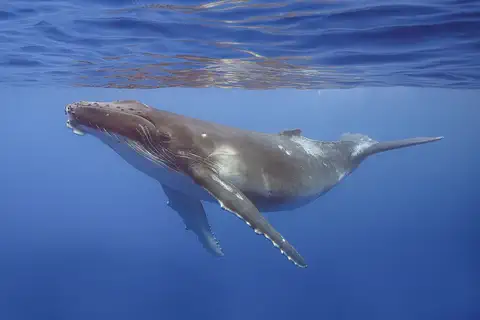
Humpback whale
The humpback whale is a baleen whale famous for leaping out of the water, slapping its giant flippers and singing long, complex songs. It lives in every ocean and makes one of the longest journeys of any mammal, between cold feeding waters and warm waters where calves are born. Once hunted almost to extinction, it is now recovering.
-
 Watch
Animal
Sperm whale
The sperm whale is the biggest whale with teeth. Its huge, boxy head is about a third of its body, it dives deep into the dark ocean to hunt squid, and it makes the loudest sounds of any animal.
- Watch What If? Lab What if the sea were as clear as glass? Sunlight fades as it goes deeper into the sea, and below about 200 meters there is hardly any. Tiny drifting plants and bits of mud also change how green, blue or murky the water looks. Imagine the sea perfectly clear, then follow how deep light would go, what it would mean for seaweed forests, and what gives the sea its colors.
- Watch What If? Lab What if you could dive to the deepest trench? The Challenger Deep, at the bottom of the Mariana Trench, is about 11 kilometers down: deeper than Mount Everest is tall. Imagine diving there. Discover how strong the water's squeeze becomes, what lives in the dark, and the explorers who have already made the trip.
- Watch What If? Lab What if sharks disappeared? Sharks catch and eat other sea animals, and just having them around changes where those animals go. Follow what scientists have found in Australia's Shark Bay seagrass meadows and on coral reefs, where the evidence is still debated, and how some shark populations are recovering.
- Watch Try it What If? Lab What if a coast were made of hard rock? Waves wear coasts away, but not every coast wears at the same speed. In our model, a bare sandy island facing ordinary waves keeps about 72 percent of its land after 50 model years. Make the same island of hard rock and it keeps about 99 percent. That is why hard rock is often left sticking out to sea as headlands.
- Watch Try it What If? Lab What if all the sea ice melted? Sea ice floats, so it is already pushing aside about as much water as it will make when it melts, like an ice cube in a glass. In our model, melting all the Arctic's springtime sea ice raises the sea by only about 2 millimeters. The same ice melting on land would raise it about 7 centimeters.
For parents & teachers
What children will learn
- Whales were heavily hunted, and many populations are recovering since the 1985 moratorium.
- Whales recycle nutrients that feed phytoplankton, the base of ocean food webs.
- Whale falls carry carbon and food to the deep sea.
- Measurements and modeled estimates are different kinds of evidence.
Recommended ages: 11 to 17 · About 15 minutes
Talk about it
- Why might removing a predator make its prey scarcer instead of more common?
- Which claims in this lab were measured, and which were calculated?
- What could people do to help returning whales?
Try at home or in class
- Draw an ocean food web with whales, krill, phytoplankton and the Sun. Add arrows for who eats whom, then a new arrow for whale poop feeding phytoplankton.
- Put a few drops of food coloring at the bottom of a clear glass of water and gently stir upward with a straw: see how mixing brings deep water to the top.
Key vocabulary: phytoplankton, krill, whale pump, whale fall, nutrient, baleen whale
Where these facts come from
- Humpback Whale , NOAA Fisheries
- Whales and Carbon Sequestration: Can Whales Store Carbon? (February 13, 2024) , NOAA Fisheries
- Ocean Noise , NOAA Fisheries
- The Whale Pump: Marine Mammals Enhance Primary Productivity in a Coastal Basin (Roman and McCarthy, 2010) , PLoS ONE
- Baleen whales eat (and poop) a lot more than we thought (December 1, 2021) , Science News Explores
- Whale falls: islands of abundance and diversity in the deep sea , Monterey Bay Aquarium Research Institute (MBARI)
Checked, not yet human-reviewed. Last updated October 26, 2026. Spotted a mistake? Tell us.
Picture credits
- Photo: Charles J. Sharp, CC BY-SA 4.0, via Wikimedia Commons · source · license
- Photo: Rhododendrites, CC BY-SA 4.0, via Wikimedia Commons · source · license
- Photo: Krill666.jpg: Uwe Kils I am willing to give the image in 1700 resolution to Wikipedia Uwe Kils, CC BY-SA 3.0, via Wikimedia Commons · source · license
- Photo: Bernard Spragg. NZ from Christchurch, New Zealand, CC0 1.0, via Wikimedia Commons · source · license
- Photo: National Marine Sanctuaries, public domain, via Wikimedia Commons · source