
Animal
Blue whale
The blue whale is the biggest animal that has ever lived. It lives in the ocean and eats tiny shrimp-like animals called krill.
The blue whale is the largest animal ever to live on Earth, bigger than any dinosaur. It is a baleen whale: instead of teeth it has bristly plates that strain huge mouthfuls of seawater to catch krill. Blue whales live in every ocean except the Arctic, and their deep calls are among the loudest sounds made by any animal.
Balaenoptera musculus, the largest animal known to have existed, is a rorqual that lunges into krill swarms and filters them through baleen. Antarctic blue whales reach about 33 meters and more than 150 tonnes. Industrial whaling in the early 1900s reduced them to a small fraction of their former numbers; they remain Endangered, though populations are increasing.
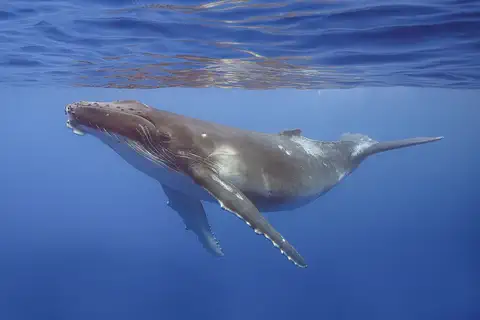
Photo: NOAA Photo Library, public domain, via Wikimedia Commons
Meet the blue whale
The blue whale is the biggest animal ever.
It is bigger than the biggest dinosaur. It is a mammal, so it breathes air. A baby blue whale drinks its mother's milk.
The blue whale is the largest animal that has ever lived, bigger than any dinosaur. In the Antarctic a blue whale can be up to about 33 meters long, nearly as long as three school buses in a row, and weigh more than 150,000 kilograms.
Even though it lives in the sea, a blue whale is a mammal, not a fish. It breathes air through blowholes on top of its head, and mothers feed their calves milk. Its name comes from its color: its mottled blue-gray skin looks light blue under the water.
Balaenoptera musculus is the largest of the rorquals and the largest animal ever known. Size varies by population: in the North Atlantic and North Pacific blue whales reach about 27 meters and more than 45 tonnes, while Antarctic blue whales reach about 33.5 meters and more than 150 tonnes. As in many baleen whales, females are generally larger than males.
Five subspecies are currently recognized, including the Antarctic blue whale and the pygmy blue whale (B. m. brevicauda). The body is long and slender, and the mottled blue-gray pigmentation varies enough between individuals that researchers use it to identify them in photographs.
Quick facts
- Group
- Mammal
- Length
- up to 33.5 m
- Weight
- up to 150,000 kg
- Top speed
- up to 32 km/h
- Lifespan in the wild
- 80 to 90 years
Where it lives
Blue whales live in the big, open ocean.
They swim in every ocean except the icy Arctic. In summer they go to cold water to eat. In winter they swim to warmer water.
Blue whales are found in all the world's oceans except the Arctic Ocean. They go wherever their food, krill, gathers in huge swarms.
Many blue whales migrate. They spend summer feeding in cold waters near the poles, then swim toward warmer waters near the equator in winter, where calves are born. Off Mexico, in the Gulf of California, mothers with young calves are seen every winter. Some blue whales, like a group in the northern Indian Ocean, seem to stay in one area all year.
NOAA Fisheries describes blue whales as occurring in all oceans except the Arctic, with distribution driven largely by where krill concentrate. In the North Atlantic the range extends from the subtropics to the Greenland Sea; eastern North Pacific blue whales feed off the U.S. West Coast in summer and winter off Mexico and Central America, with the Gulf of California an important calving area from December to March.
A resident population lives in the northern Indian Ocean, from the Gulf of Aden to the Bay of Bengal. Antarctic blue whales feed south of the Antarctic Convergence near the ice edge in summer and move to lower latitudes in winter, though not every whale migrates every year. Migration routes are not well known, so this page maps only the oceans where blue whales live.
Its habitat

Where can you find this animal?
- Lives here naturally · Countries and seas named by a scientific source
- Sightings recorded · Records of wild sightings (GBIF)
Lives here naturally · Countries and seas named by a scientific source
All the world's oceans except the Arctic, wherever krill gather. Many blue whales feed in cold polar waters in summer and move toward warmer waters in winter, but their routes are not well known.
Places: Pacific Ocean, Atlantic Ocean, Indian Ocean and Southern Ocean.
Source: https://www.fisheries.noaa.gov/species/blue-whale · checked October 2026
Sightings recorded · Records of wild sightings (GBIF)
Counts of GBIF records of wild observations (human and machine) and preserved specimens. Records include introduced populations, vagrants, escaped or released animals and misidentifications, so a country with records is not necessarily part of the native range.
Wild sightings have been recorded in United States, Antarctica, Portugal, Mexico, Australia, Canada, Chile, Iceland and 53 more places.
Source: gbif · checked October 2026
Range maps show where scientists say an animal lives, often country by country. An animal may live in only part of a country shown, and sightings records can include animals that wandered far from home.
A giant that eats tiny food
Blue whales eat krill.
Krill are tiny animals that look like shrimp. A blue whale takes a huge gulp of water full of krill. Then it pushes the water out and swallows the krill.
The biggest animal on Earth eats some of the smallest: krill, tiny shrimp-like animals that gather in enormous swarms. A blue whale has no teeth. Instead, plates of baleen hang from the roof of its mouth like a giant comb.
To feed, it swims at a swarm with its mouth wide open. Folds of skin on its throat stretch like a balloon to hold the water. Then it closes its mouth, pushes the water out with its tongue, and the baleen traps the krill inside. The biggest blue whales may eat up to about 6 tons of krill in a day.
Blue whales are filter feeders that specialize almost entirely on krill, with occasional fish and copepods. Feeding is by lunge: the whale accelerates into a krill patch with its mouth open, expanding its ventral throat pleats to engulf a huge volume of water, then closes its mouth, uses its tongue to expel the water and retains the krill on the baleen plates.
NOAA Fisheries reports that some of the largest individuals may eat up to about 6 tons of krill a day. Because krill are patchy, blue whale distribution and movements track where krill concentrate, which ties the species closely to ocean conditions in its feeding grounds.
Did you know?
Every blue whale has its own pattern of spots.
The blotchy pattern on each blue whale's skin is different, so scientists can recognize individual whales from photos.
Individually variable mottling allows photo-identification of blue whales across years.
An enormous body
Blue whales breathe through holes on top of their heads.
When they breathe out, a tall spout of mist shoots up. Their skin is blue-gray with pale spots.
A blue whale breathes through two blowholes on top of its head. When it comes up and breathes out, it blows a tall column of misty air called a spout. Its long, slim body is mottled blue-gray, and every whale's pattern is a little different, like a fingerprint.
Blue whales usually cruise at about 8 kilometers per hour, about as fast as you jog, but they can speed up to more than 32 kilometers per hour for short bursts. Their throat has long folds, called throat pleats, that stretch open when the whale takes a giant gulp.
Like other baleen whales, blue whales have paired blowholes; the exhaled spout is tall and conspicuous. The long, slender, streamlined body allows cruising at about 8 kilometers per hour with bursts above 32. Ventral throat pleats running from the chin let the mouth cavity expand enormously during lunges.
Mottling is individually variable and supports photo-identification. Blue whales have excellent hearing, and scientists think their low-frequency calls may help them communicate and perhaps navigate. Their age can be estimated by counting layers in the wax-like earplugs of dead whales, much as tree rings are counted.
Growing up
A blue whale mother has one baby at a time.
The baby is called a calf. It drinks its mother's milk and grows very fast. Blue whales can live a very long time.
Scientists still have a lot to learn about blue whale families. A mother carries her calf for about 10 to 12 months, and most calves are born in winter in warmer waters. The calf drinks milk and probably stops at about 6 to 7 months old, while traveling to the summer feeding grounds.
Blue whales are grown up somewhere between 5 and 15 years old, and a mother usually has a calf every two or three years. They live a long time: their average lifespan is thought to be about 80 to 90 years.
Knowledge of blue whale life history is limited. The best available science suggests a gestation of about 10 to 12 months, with most mating and births in winter. Weaning probably occurs at about 6 to 7 months, on or en route to the summer feeding grounds. Sexual maturity is thought to come at 5 to 15 years, and the average calving interval is estimated at 2 to 3 years.
Average lifespan is estimated at about 80 to 90 years, based on counts of growth layers in earplugs. Slow maturation and long calving intervals mean populations recover slowly from losses.
The loudest animal
Blue whales sing very deep, very loud songs.
Other whales can hear them far away in the ocean. Blue whales often swim alone or with one friend.
Blue whales are among the loudest animals on the planet. They make deep pulses, groans and moans. In the right conditions, scientists think other whales may hear these calls up to about 1,600 kilometers away.
Blue whales are usually seen alone or in pairs, although sometimes they swim in small groups. Scientists think they use their calls to stay in touch, and maybe to help find their way in the dark ocean.
Blue whales produce series of low-frequency pulses, groans and moans and are among the loudest animals on Earth. NOAA Fisheries notes that in favorable oceanographic conditions their calls may be detectable by other whales up to about 1,000 miles (1,600 kilometers) away. Scientists think the calls serve communication and, with the whales' excellent hearing, perhaps navigation.
Blue whales are mostly solitary or found in pairs, occasionally in small groups. Most undertake seasonal migrations between high-latitude feeding grounds and lower-latitude wintering areas, but some individuals or populations may not migrate at all.

Protecting the giants
Long ago, people hunted many blue whales.
Now blue whales are protected. Their numbers are slowly growing again. Ships go slower in some places to keep whales safe.
In the early 1900s, whaling ships killed so many blue whales that only a small part of the old population was left. Today blue whales are protected, and their numbers are growing, but they are still endangered.
The biggest dangers now are being hit by ships and getting tangled in fishing gear. Ocean noise may also disturb them. Scientists study where blue whales go, and some places ask ships to slow down or change their routes to keep whales safe.
Commercial whaling in the early twentieth century reduced blue whales to a small fraction of their former abundance. The IUCN's 2018 global assessment lists the species as Endangered (criteria A1abd) with an increasing trend; in the United States it is listed as endangered under the Endangered Species Act and protected under the Marine Mammal Protection Act.
NOAA Fisheries identifies vessel strikes, especially near ports and in shipping lanes with large, fast vessels, and entanglement in traps, pots and nets as the primary current threats; ocean noise is a less understood concern. Conservation measures include research, stock assessments, entanglement response and efforts to reduce ship strikes.
IUCN Red List
How is the blue whale doing in the wild?
- Least Concern
- Near Threatened
- Vulnerable
- Endangered (this animal)
- Critically Endangered
- Extinct in the Wild
- Extinct
Endangered
At very high risk of disappearing from the wild.
See the IUCN Red List assessment · The IUCN Red List of Threatened Species 2022.2
Amazing facts
-
A blue whale can eat tons and tons of tiny krill in one day.
The biggest blue whales may eat up to about 6 tons of krill in a single day.
NOAA Fisheries reports that some of the largest blue whales may eat up to about 6 tons of krill a day.
-
Blue whale calls can travel very far through the sea.
Scientists think blue whale calls may be heard by other whales up to about 1,600 kilometers away.
In favorable oceanographic conditions, blue whale calls may be detectable up to about 1,000 miles (1,600 kilometers) away.
-
Scientists can tell how old a whale is from its earwax.
Scientists count layers in a whale's waxy earplug, a bit like tree rings, to estimate its age.
Age is estimated by counting growth layers in the wax-like earplugs recovered from dead whales.
-
Every blue whale has its own pattern of spots.
The blotchy pattern on each blue whale's skin is different, so scientists can recognize individual whales from photos.
Individually variable mottling allows photo-identification of blue whales across years.
Words to know
- baleen
- comb-like plates in some whales' mouths that strain food from water
- krill
- tiny shrimp-like animals that live in huge swarms in the sea
- blowhole
- the nostril on top of a whale's head
- spout
- the cloud of mist a whale blows out when it breathes
- migration
- a long journey animals make at the same time every year
- filter feeder
- an animal that eats by straining tiny food out of water
Discovery challenge
-
What does a blue whale eat?
What is the blue whale's main food?
How does a blue whale capture its prey?
- Tiny krill
- Big sharks
- Seaweed
Show the answer
Tiny krill
It eats tiny shrimp-like krill.
Krill, which it strains from the water with its baleen.
By lunge filter-feeding: engulfing water with expanding throat pleats and retaining krill on baleen.
-
How does a blue whale breathe?
Is a blue whale a fish or a mammal?
Where are a blue whale's blowholes?
- It breathes air through blowholes
- It breathes water like a fish
- It never breathes
Show the answer
It breathes air through blowholes
It breathes air through holes on its head.
It is a mammal that breathes air through blowholes.
Paired blowholes on top of the head.
-
Which ocean do blue whales NOT live in?
Which ocean do blue whales not live in?
Which ocean basin lacks blue whales, according to NOAA Fisheries?
- The Arctic Ocean
- The Pacific Ocean
- The Southern Ocean
Show the answer
The Arctic Ocean
Blue whales do not live in the icy Arctic.
They live in every ocean except the Arctic.
The Arctic Ocean.
-
What hurt blue whales most long ago?
What are the biggest dangers to blue whales today?
What reduced blue whales to a fraction of their former numbers?
- Ships and fishing gear
- Too much sunshine
- Cold water
Show the answer
Ships and fishing gear
People hunted them long ago; now ships and fishing nets are dangers.
Being hit by ships and tangled in fishing gear.
Commercial whaling in the early 1900s.
Experiments to try
- Watch What If? Lab What if every animal were the same size? The smallest bird weighs less than 2 grams; a big elephant weighs more than three million times as much. Size decides what an animal can eat, how it keeps warm and how fast its body runs. Imagine every animal squeezed or stretched to one size, and see what would go wrong.
- Watch What If? Lab What if your heart were as small as a mouse’s? A resting mouse's heart can beat more than 550 times a minute; yours beats about 60 to 100 times. A blue whale's heart has been measured as slow as 2 beats a minute. Explore why small animals have racing hearts and big animals slow ones, and why your heart is just the right size for you.
- Watch Try it What If? Lab What if an ocean food web changed? Antarctic krill are small shrimp-like animals, but they feed a huge number of bigger ones. Take krill out of our model's Southern Ocean food web and all seven other species are affected: every animal in it loses all its food, from silverfish to orcas.
- Watch What If? Lab What if whales returned to every ocean? Hunting in the last century took away most of the world's great whales, and since a 1985 ban on commercial whaling many are growing in number again. Whale poop feeds the tiny drifting plants at the base of the ocean food web, and whale bodies carry carbon to the deep sea. Imagine whales back in every ocean and follow what they might do.
Explore next
-
 Watch
3D
Animal
Humpback whale
The humpback whale is a baleen whale famous for leaping out of the water, slapping its giant flippers and singing long, complex songs. It lives in every ocean and makes one of the longest journeys of any mammal, between cold feeding waters and warm waters where calves are born. Once hunted almost to extinction, it is now recovering.
-
 Watch
3D
Animal
Antarctic krill
Antarctic krill are small, shrimp-like crustaceans about 6 centimeters long that live in the icy Southern Ocean around Antarctica. They gather in enormous swarms, and almost all the bigger animals of the Antarctic, from penguins to blue whales, depend on them for food.
-
 Watch
3D
Animal
Orca
The orca, also called the killer whale, is the largest member of the dolphin family and the ocean's top predator. Orcas live in every ocean, in close family groups called pods, made up of orcas related through their mothers. Each group has its own favorite foods, hunting tricks and even its own calls, which young orcas learn from their families.
-
 Watch
Animal
Sperm whale
The sperm whale is the biggest whale with teeth. Its huge, boxy head is about a third of its body, it dives deep into the dark ocean to hunt squid, and it makes the loudest sounds of any animal.
-
 Watch
Animal
Gray whale
The gray whale is a baleen whale of the North Pacific Ocean. It sucks up mud from the seafloor to catch tiny animals, and it makes one of the longest yearly journeys of any mammal: about 16,000 kilometers there and back between Arctic feeding seas and shallow lagoons in Mexico.
- Watch What If? Lab What if every animal were the same size? The smallest bird weighs less than 2 grams; a big elephant weighs more than three million times as much. Size decides what an animal can eat, how it keeps warm and how fast its body runs. Imagine every animal squeezed or stretched to one size, and see what would go wrong.
- Watch What If? Lab What if your heart were as small as a mouse’s? A resting mouse's heart can beat more than 550 times a minute; yours beats about 60 to 100 times. A blue whale's heart has been measured as slow as 2 beats a minute. Explore why small animals have racing hearts and big animals slow ones, and why your heart is just the right size for you.
-
 Watch
Animal
North Atlantic right whale
The North Atlantic right whale is a large black baleen whale that lives along the east coast of North America. It filters tiny animals called copepods from the water and has rough white patches on its head that are different on every whale. It is one of the most endangered large whales, with about 384 left (2024), and many people are working to protect it.
For parents & teachers
What children will learn
- Describe how big the blue whale is compared with familiar objects.
- Explain how a baleen whale feeds on krill.
- Explain that whales are mammals that breathe air and feed their young milk.
- Describe how whaling affected blue whales and what threatens them today.
Recommended ages: 3 to 17 · About 15 minutes
Talk about it
- How can the biggest animal survive by eating some of the smallest?
- Why might ocean noise be a problem for whales that talk over long distances?
- What could ships do to avoid hitting whales?
Try at home or in class
- Measure 27 meters outdoors with a tape measure or by counting big steps, then stand at each end to feel how long a blue whale is.
- Make a baleen model: pour water with rice or pepper flakes through a comb or a fork and see what gets caught.
Key vocabulary: baleen, krill, blowhole, spout, migration, filter feeder
Where these facts come from
- The IUCN Red List of Threatened Species , International Union for Conservation of Nature (IUCN terms of use (no redistribution of Red List data or range maps))
- GBIF Backbone Taxonomy and GBIF Occurrence Search , Global Biodiversity Information Facility (CC0 1.0 (backbone); occurrence counts are facts derived from records under CC0, CC BY and CC BY-NC)
- Blue Whale , NOAA Fisheries
- Balaenoptera musculus (Blue Whale), 2018 global assessment , IUCN Red List of Threatened Species
- Wikidata , Wikimedia Foundation (CC0 1.0)
- Wikimedia Commons , Wikimedia Foundation (Per file: Public domain, CC0, CC BY or CC BY-SA only (credited on each page))
Checked, not yet human-reviewed. Last updated October 28, 2026. Spotted a mistake? Tell us.