
City Europe
Salzburg
Salzburg is a city in Austria, by the mountains. A big old fortress sits high above its old town.
Salzburg is a city in Austria on the Salzach River, the capital of the state of Salzburg, with an estimated 157,834 people in 2026. Its old town of spires and domes, below the Hohensalzburg Fortress, is a UNESCO World Heritage Site, and it is the birthplace of the composer Mozart.
Salzburg (157,834 people, 1 January 2026 estimate) grew where the Salzach passes between rocky outcrops, at the gateway to the Tauern mountains. Ruled for centuries by archbishops as a church city-state, it gained much of its Baroque look from Italian architects; its historic center has been on the World Heritage List since 1996.
Photo: Photo: Andreas Praefcke, CC BY 3.0, via Wikimedia Commons
Discover Salzburg
Salzburg is a city in Austria. A river called the Salzach flows through it.
High mountains rise beyond the city.
Salzburg is a city in Austria and the capital of the state that shares its name. Statistics Austria estimated 157,834 people in the city on 1 January 2026.
The city grew where the Salzach River passes between rocky outcrops, such as the Mönchsberg and the Festungsberg. Universalis says the Salzach gap is the best gateway to the Tauern mountains, while the basin opens easily toward Munich and Linz.
Statistics Austria (via City Population): the statutory city of Salzburg had 139,426 people in 1981, 142,808 in 2001, 154,604 at the census of 31 October 2021 and an estimated 157,834 on 1 January 2026; the state of Salzburg had an estimated 573,526 on the same date.
Universalis (Paul Guichonnet): the Salzburg basin, at the edge of the Flachgau's subalpine lowland, opens without natural obstacles toward Munich and Linz; glaciers left isolated outcrops of dolomitic limestone and conglomerate, the Festungsberg (542 m), the Kapuzinerberg (650 m) and the Mönchsberg (502 m), between which the Salzach cut its bed, giving an easy crossing and strong defenses.
- Country
- Austria (capital of the state of Salzburg)
- People in Salzburg (estimate, 1 January 2026)
- 157,834
- People at the 2021 census
- 154,604
- Historic Centre of the City of Salzburg
- UNESCO World Heritage Site since 1996; 236 hectares
Domes, spires and a fortress
Look at the green domes and tall towers! High up behind them is a huge white fortress.
Green mountains rise in the distance, under fluffy clouds.
This photo was taken from the Mönchsberg in May 2009, looking over Salzburg's old town. Roofs crowd together below. In the middle rise green domes and towers, and on the high ground behind stands the long white Hohensalzburg Fortress, with green mountains beyond.
UNESCO says Salzburg's skyline, with mountains behind it, is full of spires and domes and is dominated by the fortress. Universalis says the fortress stands 120 meters above the Salzach.
Commons: 'Salzburg, Aussicht vom Mönchsberg, Blick über die Altstadt' (view from the Mönchsberg over the old town), May 2009, self-photographed by Andreas Praefcke, GFDL and CC BY 3.0.
UNESCO (site 784, inscribed 1996, 236 ha): the skyline, against a backdrop of mountains, is characterized by its profusion of spires and domes, dominated by the fortress of Hohensalzburg. The archbishops' district holds the monumental buildings (the Cathedral, the Residence, the Franciscan Abbey, the Abbey of St Peter) and open spaces such as the Domplatz; the burghers' houses stand on small plots along narrow streets. Wikidata gives the fortress's inception as 1077.
- Photo
- the old town seen from the Mönchsberg, May 2009
- Hohensalzburg Fortress
- 120 m above the Salzach
- Fortress begun
- 1077 (Wikidata)
A city of salt and archbishops
Long ago, salt was carried along a road through Salzburg. That is where its name comes from.
Later, church leaders ruled the city and filled it with grand buildings.
Salzburg was already a town before Roman times, Universalis says, and later took its name from the salt route. Archbishops ruled it, and from the 14th to the 18th century they covered it with monuments.
UNESCO calls Salzburg a church city-state that kept its old buildings better than any other of its kind. Italian architects, Vincenzo Scamozzi and Santino Solari, gave its center much of its Baroque look, and Salzburg became a meeting point of Italian and German cultures.
Universalis: a pre-Roman town that later took its name from the salt road; as an episcopal fief it was covered with monuments by its archbishops from the 14th to the 18th century; Romanesque (Peterskirche), Gothic (Franziskanerkirche) and above all Italian Baroque buildings (the residences and gardens of Mirabell and Leopoldskron).
UNESCO: an outstanding example of a church city-state, a kind once found from Prussia to Italy, most of which disappeared in the early 19th century; Salzburg was ruled by its archbishops from the Middle Ages to the 19th century, and no other such state survived so completely; the meeting point of Italian and German cultures; a Baroque town that has emerged intact from history, with buildings from the late Middle Ages to the 20th century.
- Name
- from the salt route
- Monuments built by its archbishops
- 14th to 18th centuries
- Baroque architects
- Vincenzo Scamozzi and Santino Solari
Bridges, trains and roads
Many bridges cross the river in Salzburg. Trains and a motorway link it with other cities.
Salzburg's old town has winding streets, while the newer town is laid out on a grid, Universalis says. Quays along the Salzach and many bridges join the two.
Salzburg is a crossroads for travel: railway lines lead to Munich and Vienna, and to Innsbruck and Trieste through the Tauern tunnel, opened in 1908. The Vienna–Munich motorway passes too. Wikidata says the main railway station opened in 1860 and the airport in 1926.
Universalis: a communications hub with rail lines toward Munich (the Westbahn), Paris–Vienna via the Arlberg (1884) and Innsbruck–Trieste via the Tauern tunnel (1908), plus the Vienna–Munich motorway; a road tunnel runs under the Mönchsberg; most of the marshes along the Moorweg were drained, letting the town spread southwest.
Wikidata (distances from Mozart's birthplace): Salzburg Hauptbahnhof (opened 1860) 1.47 km N; Salzburg Airport (opened 1926) 3.05 km WSW.
- Salzburg Hauptbahnhof
- opened 1860 (Wikidata)
- Rail lines
- to Munich, Vienna, Innsbruck and through the Tauern tunnel (1908)
- Salzburg Airport
- opened 1926; about 3 km west-southwest of Mozart's birthplace
Mild and getting warmer
Salzburg has warm summers and frosty winters. It is getting warmer, with more very hot days than before.
Austria's weather service, GeoSphere Austria, gives Salzburg's average temperature over the whole year as 10.4 °C at its Freisaal station and 10.0 °C at the airport (1991–2020). For 1981–2010 the averages were 9.4 °C and 9.0 °C.
The city now has more hot days: an average of 17 a year in 1991–2020, up from 10 in 1981–2010. Frost is common, too: about 88 frosty days a year at Freisaal.
GeoSphere Austria (Claudia Riedl), press-conference slides published by the City of Salzburg (file dated 4 June 2025): climate normals 1991–2020 for Freisaal and the airport: annual mean 10.4 / 10.0 °C (1981–2010: 9.4 / 9.0 °C); summer days a year 65.7 / 55.4; hot days a year 17.1 / 12.0; frost days 87.6 / 93.1; ice days 13.9 / 19.4. For the city as a whole, the average number of hot days rose from 10 (1981–2010) to 17 (1991–2020); the most in one month so far was 18, in July 2015.
- Average temperature, Freisaal station (1991–2020)
- 10.4 °C
- Average temperature, airport station (1991–2020)
- 10.0 °C
- Hot days a year in the city
- 10 (1981–2010), 17 (1991–2020)
Music, festivals and a university
The famous composer Mozart was born in Salzburg. Today the city is full of music and festivals.
Salzburg is the birthplace of the composer Wolfgang Amadeus Mozart, and UNESCO says his name has been linked with the city ever since. Universalis says Salzburg is devoted to music, with its Mozarteum music school, founded in 1880, and festivals held since 1920 that draw visitors from around the world.
Universalis also describes a university and a varied manufacturing industry, though the city is best known for visitors who come for its art and music.
Universalis: the city is the seat of a university and has a varied, highly developed manufacturing sector that has spread to suburbs such as Wals-Siezenheim, Elsbethen and Grödig; its world renown, however, comes from cultural tourism: the homeland of Mozart, it is devoted to music, with its conservatories (the Mozarteum, 1880) and, since 1920, festivals that draw a large international audience.
UNESCO: Salzburg's meeting of north and south may have helped spark the genius of Mozart, whose name has been associated with the city ever since. Wikidata places Mozart's birthplace (a building and museum) about 370 m northwest of the Cathedral.
- Born here
- Wolfgang Amadeus Mozart
- Mozarteum
- music school, 1880
- Festivals
- since 1920
Salzburg on the map
Find Austria on the globe. Salzburg is near the mountains called the Alps.
Salzburg lies at about 47.8° north, in Austria, on the Salzach River near the Alps. Measured from Mozart's birthplace, the Cathedral is about 370 meters southeast, the Mönchsberg about 440 meters south-southwest and the fortress about 630 meters south-southeast.
Mirabell Palace is about 620 meters north, the main station about 1.5 kilometers north and the airport about 3 kilometers west-southwest.
Salzburg lies at about 47.80° N and 13.05° E (Wikidata). From Mozart's birthplace (Wikidata points): Salzburg Cathedral 0.37 km SE, Mönchsberg point 0.44 km SSW, Hohensalzburg Fortress 0.63 km SSE, Mirabell Palace 0.62 km N, Salzburg Hauptbahnhof 1.47 km N, Salzburg Airport 3.05 km WSW. UNESCO places the historic center at 47°48′02″ N, 13°02′36″ E.
- Latitude
- about 47.8° north
- Longitude
- about 13.0° east
- Setting
- on the Salzach, at the gateway to the Tauern mountains
Amazing facts
-
Salzburg's name comes from salt!
Salzburg took its name from the salt route that passed through it, Universalis says.
Universalis: a pre-Roman town that later found its name with the salt road.
-
Mozart, a famous composer, was born in Salzburg.
Wolfgang Amadeus Mozart was born in Salzburg, and his name has been linked with the city ever since, UNESCO says.
UNESCO: the city's position between north and south may have helped spark the genius of Mozart, its most famous son.
-
Salzburg's fortress stands high above the river.
The Hohensalzburg Fortress stands 120 meters above the Salzach River, Universalis says.
Universalis: Hohensalzburg dominates the Salzach by 120 m; Wikidata gives its inception as 1077.
-
Salzburg now has more very hot days than before.
The city of Salzburg had about 17 hot days a year in 1991–2020, up from 10 in 1981–2010, GeoSphere Austria says.
GeoSphere Austria: average hot days in the city rose from 10 (1981–2010) to 17 (1991–2020); the record for one month is 18, in July 2015.
Words to know
- fortress
- a large, strong building with thick walls, built for defense
- Baroque
- a grand style of building and art from the 1600s and 1700s, with domes and rich decoration
- archbishop
- a senior leader in some Christian churches; in Salzburg, archbishops also ruled the city
- composer
- a person who writes music
- festival
- a series of special shows or events held at the same time each year
- climate normal
- an average of weather measured over 30 years
Discovery challenge
-
Salzburg is a city in which country?
Salzburg is the capital of a state in which country?
Statistics Austria counts the people of Salzburg. Salzburg is in which country?
- Australia
- Austria
- Argentina
Show the answer
Austria
Austria!
Austria.
Austria.
-
Which famous composer was born in Salzburg?
Which composer, whose name has been linked with Salzburg ever since, was born there?
UNESCO names which of Salzburg's sons as its most famous?
- Wolfgang Amadeus Mozart
- Ludwig van Beethoven
- Frédéric Chopin
Show the answer
Wolfgang Amadeus Mozart
Mozart!
Wolfgang Amadeus Mozart.
Wolfgang Amadeus Mozart.
-
What does the name Salzburg come from?
Salzburg took its name from a trade route for what?
Universalis says Salzburg found its name with which route?
- Salt
- Silk
- Gold
Show the answer
Salt
Salt!
Salt.
The salt route.
-
Which river flows through Salzburg?
Which river cuts between the Mönchsberg and the Kapuzinerberg in Salzburg?
The Hohensalzburg Fortress stands 120 m above which river?
- The Thames
- The Salzach
- The Nile
Show the answer
The Salzach
The Salzach!
The Salzach.
The Salzach.
-
Does Salzburg have more or fewer hot days than before?
How has the number of hot days a year in Salzburg changed between 1981–2010 and 1991–2020?
GeoSphere Austria's average hot days in Salzburg went from 10 to how many?
- More: from 10 to 17
- Fewer: from 17 to 10
- No change
Show the answer
More: from 10 to 17
More hot days: from 10 to 17!
More: from 10 to 17 a year.
17 a year (1991–2020).
Nearby places
-
 Watch
City
Munich
Munich is the capital of Bavaria, a state in southern Germany, and the country's third-biggest city. It began in 1158 as a market by a bridge over the Isar River, and its name means "Home of the Monks." Today it is famous for its palaces, art museums, the huge Deutsches Museum and its autumn Oktoberfest.
-
 Watch
Landmark
Neuschwanstein Castle
Neuschwanstein Castle stands on a rocky ridge in Bavaria, Germany. King Ludwig II had it built from 1869 as a private retreat in the style of a medieval knights' castle, but with the newest technology inside. It opened to visitors in 1886, and in 2025 about 1.1 million people came.
-
 Watch
City
Ljubljana
Ljubljana is the capital of Slovenia, in Europe, at a gap between the Alps and the Dinarides mountains. A castle on a wooded hill looks down on an old town beside the Ljubljanica River, crossed by bridges such as the Triple Bridge and the Dragon Bridge. About 303,000 people lived there at the start of 2026.
-
 Watch
City
Vienna
Vienna is the capital of Austria, on the Danube River. For centuries it was the home of emperors, and composers such as Haydn, Mozart and Beethoven lived and worked there. About 2 million people lived in the city at the start of 2026.
-
 Watch
Landmark
Karlštejn Castle
Karlštejn Castle stands on a rocky hill above the Berounka River, about 20 kilometers from Prague in Czechia. Charles IV, King of Bohemia and Holy Roman Emperor, founded it in 1348 as a home and a safe place for royal treasures, including the imperial crown jewels. Its Great Tower is 60 meters high.
-
Watch
Landmark
Belvedere
The Belvedere in Vienna is made of two Baroque palaces, the Lower and the Upper Belvedere, joined by a large garden. Prince Eugene of Savoy had them built as a summer home from 1712 to 1723, to designs by Johann Lukas von Hildebrandt. In 1777 the Upper Belvedere became, the museum says, one of the world's first public museums, and today the Belvedere is an art museum.
-
 Watch
Landmark
Grand Canal (Venice)
The Grand Canal is the main waterway running through the city of Venice, in Italy. About 3.8 kilometers long, it curves through the city in a backward S shape, lined with houses and grand palaces. Four bridges cross it, including the Rialto Bridge.
-
 Watch
City
Venice
Venice, in northern Italy, is spread over 118 small islands in a shallow lagoon off the Adriatic Sea. There are no cars in the old city: people walk or travel by boat along its canals, past palaces and over about 400 bridges. High tides sometimes flood its squares, so giant gates now protect the lagoon.
Explore next
-
Watch
 Country
Austria
Austria is a landlocked country in central Europe. The Alps cover much of it, the Danube River flows across the north, and about 9.2 million people live there. Its capital, Vienna, is famous for its music and palaces.
-
Watch
City
Vienna
Vienna is the capital of Austria, on the Danube River. For centuries it was the home of emperors, and composers such as Haydn, Mozart and Beethoven lived and worked there. About 2 million people lived in the city at the start of 2026.
-
Watch
City
Munich
Munich is the capital of Bavaria, a state in southern Germany, and the country's third-biggest city. It began in 1158 as a market by a bridge over the Isar River, and its name means "Home of the Monks." Today it is famous for its palaces, art museums, the huge Deutsches Museum and its autumn Oktoberfest.
-
 Watch
Natural wonder
Alps
The Alps are Europe's great mountain range, an arc about 1,200 kilometers long that runs from the Mediterranean coast near Nice, in France, to Vienna, in Austria. Their highest peak is Mont Blanc, which Britannica gives as 4,807 meters. The Alps rose when the plate carrying Africa pushed north into Europe, and Ice Age glaciers carved their sharp peaks and deep valleys.
-
 Watch
City
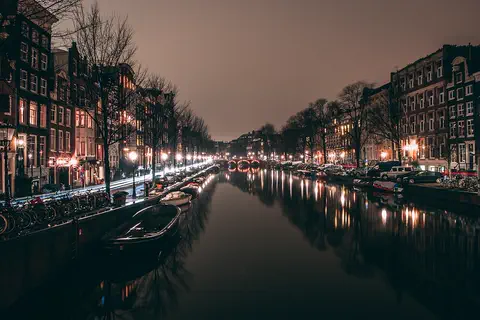
Amsterdam
Amsterdam is the capital of the Netherlands. It began as a fishing village beside a dam on the Amstel River, which gave the city its name. Today about 942,000 people live among its rings of canals, hundreds of bridges, houseboats and bicycles.
-
 Watch
City
Antwerp
Antwerp is a city in Belgium on the Scheldt river, and Universalis calls it the second port of continental Europe, after Rotterdam. Belgium's statistics office estimated 565,615 people in the city on 1 January 2026. In the 1500s it was one of Europe's great trading cities.
-
 Watch
City
Athens
Athens is the capital of Greece and one of the oldest cities in the world. Above it rises the Acropolis, a rocky hill crowned by the marble Parthenon, built about 2,500 years ago. Ancient Athens was home to early democracy, great thinkers and theater.
-
 Watch
City
Barcelona
Barcelona, the capital of Catalonia in northeastern Spain, lies on the Mediterranean between mountains and the sea. It is famous for the buildings of the architect Antoni Gaudí, including the Sagrada Família, a giant church begun in 1882. About 1.7 million people live in the city (2025).
For parents & teachers
What children will learn
- Locate Salzburg on the Salzach River near the Alps.
- Explain how salt and a river crossing helped a town grow.
- Describe Baroque domes and spires and how a skyline can show a city's history.
- Compare two climate averages and describe how Salzburg is warming.
Recommended ages: 3 to 17 · About 15 minutes
Talk about it
- Salzburg is named after salt. Why was salt so valuable long ago?
- Salzburg's hot days went from 10 to 17 a year. How might a city keep people cool?
- Mozart was born in Salzburg. How can one person's music shape a whole city?
Try at home or in class
- Salt crystals: dissolve salt in warm water, leave a string in the jar and watch crystals grow over a few days.
- Skyline drawing: draw a row of domes and spires with a fortress high up behind them.
- Bar chart: draw two bars for Salzburg's hot days (10 and 17) and compare them.
Key vocabulary: fortress, Baroque, archbishop, composer, festival, climate normal
Where these facts come from
- Wikidata , Wikimedia Foundation (CC0 1.0)
- Natural Earth vector data , Natural Earth (NACIS) (Public domain)
- Salzburg (Austria): Cities and Communes in Districts , City Population (Thomas Brinkhoff), from Statistik Austria
- Historic Centre of the City of Salzburg , UNESCO World Heritage Centre
- Salzbourg, ville , Encyclopaedia Universalis (Paul Guichonnet)
- Klima der Stadt Salzburg (press-conference slides, June 2025) , GeoSphere Austria (Claudia Riedl), published by the City of Salzburg
- File:Salzburg Altstadt vom Mönchsberg.jpg (Andreas Praefcke, May 2009) , Wikimedia Commons
- Wikimedia Commons , Wikimedia Foundation (Per file (public domain, CC0, CC BY or CC BY-SA); see each media record)
Checked, not yet human-reviewed. Last updated November 1, 2026. Spotted a mistake? Tell us.