
City Europe
Ljubljana
Ljubljana is the capital of Slovenia. A castle sits on a green hill in the middle of the city. Dragon statues guard one of its bridges.
Ljubljana is the capital of Slovenia, in Europe, at a gap between the Alps and the Dinarides mountains. A castle on a wooded hill looks down on an old town beside the Ljubljanica River, crossed by bridges such as the Triple Bridge and the Dragon Bridge. About 303,000 people lived there at the start of 2026.
Ljubljana, Slovenia's capital, grew from prehistoric pile dwellings and the Roman town of Emona into a medieval town under its castle, then was reshaped between the world wars by the architect Jože Plečnik, whose works UNESCO listed in 2021. It became the capital of an independent Slovenia in 1991. The Statistical Office of Slovenia counted 302,826 residents in the municipality on 1 January 2026.
Photo: Sieglinde Hankele, CC BY-SA 4.0, via Wikimedia Commons
Discover Ljubljana
Ljubljana is the capital city of Slovenia. Slovenia is a small country in Europe.
A river runs through the old town. A castle sits on a hill above it.
Ljubljana is the capital of Slovenia. The Statistical Office of Slovenia counted 302,826 people in the city's municipality on 1 January 2026.
The Ljubljanica River winds through the old town, below a castle on a wooded hill. In 2016 the European Commission named Ljubljana a European Green Capital; its jury was impressed by how the city had changed to become more sustainable.
Ljubljana is Slovenia's political, administrative, cultural and economic center, as the European Commission put it when it named the city European Green Capital for 2016; the jury was impressed by how far the city had transformed itself over the previous 10 to 15 years.
The Statistical Office of Slovenia's register-based figures show the municipality growing steadily: 300,354 residents on 1 January 2025, 301,268 on 1 July 2025 and 302,826 on 1 January 2026. The old town lies along the Ljubljanica River beneath Castle Hill. Between the two world wars the architect Jože Plečnik added public spaces and buildings that, in UNESCO's words, changed the identity of the city; they are a UNESCO World Heritage Site.
- Country
- Slovenia (capital)
- People in the municipality (1 January 2026)
- 302,826
- European Green Capital
- 2016
- Works of Jože Plečnik
- UNESCO World Heritage Site since 2021
A castle, three bridges in one and a bridge of dragons
A little train goes up the hill to the castle. It takes only one minute!
One bridge is really three bridges side by side. Another bridge has four big dragon statues.
Ljubljana Castle has stood on its hill above the city for about 900 years. Over time it has been a fortress, a home for the governor, army barracks and a prison. Today a funicular carries 28 people at a time to the top in about one minute.
In the old town, the Triple Bridge is three bridges side by side: a stone bridge from 1842 with two footbridges added by the architect Jože Plečnik. Nearby, four dragon statues stand on the Dragon Bridge, built in 1900 and 1901. A dragon also appears on the city's coat of arms and flag.
Ljubljana Castle has crowned its hill for about 900 years; its present outer shell dates mostly from the mid-16th and 17th centuries. It has served as a fortress, the residence of the provincial governor, a barracks and a prison, and now holds a museum of Slovenian history and a puppet museum. The funicular from Krekov trg climbs a little less than 70 m in about a minute.
The Triple Bridge's central stone span of 1842 replaced a medieval wooden crossing on a route between northwestern Europe and the Balkans; Plečnik added the two pedestrian bridges, stone balustrades and riverside terraces in 1929–1932. The Dragon Bridge (1900–1901), originally named for the jubilee of Emperor Franz Joseph I, was the city's first reinforced concrete structure, designed by the engineer Josef Melan, with dragons and lamps by the architect Jurij Zaninović.
- Ljubljana Castle
- on its hill for about 900 years; reached by funicular
- Triple Bridge
- central bridge 1842; side bridges by Plečnik, 1929–1932
- Dragon Bridge
- built 1900–1901, the city's first reinforced concrete structure
From pile dwellings and Emona to a capital
Long ago, people built houses on poles above wet, marshy land near Ljubljana. They made a wooden wheel that people can still see today.
Later, Romans built a town here. Much later, it became a capital city.
Thousands of years ago, people near Ljubljana lived in houses raised on poles above the marshes. A wooden wheel with its axle, about 5,200 years old, was found there and is now shown in the City Museum of Ljubljana.
About 2,000 years ago the Romans built the town of Emona here, at a gap between the Alps and the Dinarides mountains. In the Middle Ages a new town grew below the castle. After a strong earthquake in 1895 the city was rebuilt, and on 25 June 1991 Ljubljana became the capital of an independent Slovenia.
The City Museum of Ljubljana traces the area's story from Neanderthal visitors about 40,000 years ago to the pile dwellers of the Ljubljana Marshes, whose wooden wheel with an axle, about 5,200 years old, the museum presents as the world's oldest wooden wheel with an axle. Toward the end of the emperor Augustus's reign, Roman troops helped build Emona at the Ljubljana Gates, the lowest natural pass between the Alps and the Dinarides, beside a navigable river.
A medieval town grew below Castle Hill from the early 11th century and appears in written records about a hundred years later. Under Napoleon, Ljubljana briefly served as capital of the Illyrian Provinces. After the earthquake of 1895, Mayor Ivan Hribar raised funds to rebuild. The end of World War I closed some 600 years of Habsburg rule, and between the wars the University of Ljubljana was founded and Plečnik reshaped the city. After decades in Yugoslavia, Slovenians voted for independence in 1990, declared it on 25 June 1991, and Ljubljana became an independent state's capital for the first time.
- Wooden wheel with an axle found in the Ljubljana Marshes
- about 5,200 years old
- 1895
- a severe earthquake; the city is rebuilt
- Capital of independent Slovenia
- from 25 June 1991
Walking streets, river paths and a castle funicular
Paths for walking run along both banks of the river.
To reach the castle, you can ride a little train up the steep hill.
Promenades run along both banks of the Ljubljanica River, and footbridges link them, including the two side bridges of the Triple Bridge, built only for people walking.
To reach the castle, visitors can take the funicular from Krekov trg square in the old town. It carries 28 passengers and climbs almost 70 meters in about one minute.
UNESCO describes Plečnik's plan for the city as two main axes linked by cross-routes. The land axis, the Green Promenade, runs from the Trnovo Bridge through the Square of the French Revolution and along Vegova Street, past the National and University Library, to Congress Square and Zvezda Park. Parallel to it, the water axis follows promenades, embankments and bridges along the Ljubljanica from Trnovo to the Sluice Gate.
The Triple Bridge sits where these routes cross. For the climb to the castle, the funicular from Krekov trg, run by the public institution Ljubljana Castle, carries 28 passengers up a height difference of a little less than 70 m in about a minute. The European Commission's Green Capital jury pointed to the city's transformation in sustainability over the 10 to 15 years before 2016.
- Castle funicular
- 28 passengers, about 1 minute, almost 70 m of climb
- Plečnik's two axes
- a land axis (Green Promenade) and a water axis along the Ljubljanica
- Triple Bridge
- two side bridges for pedestrians
Cold winters and warm, rainy summers
Winter in Ljubljana is cold. On average, winter nights are below freezing.
Summer is warm. Rain falls in every month, and most in June.
Ljubljana has cold winters and warm summers. The World Meteorological Organization's averages for 1971 to 2000 give January days of about 3 °C and nights of about −3 °C, below freezing. July is the warmest month, with days of about 27 °C and nights of about 15 °C.
Rain falls on 10 to 16 days in every month. June is the wettest month, with about 154 millimeters, and a whole year brings about 1,368 millimeters.
WMO normals for Ljubljana (1971–2000) give average highs and lows of 3.0 °C and −2.7 °C in January, with average lows below freezing in December and February too (−1.7 °C and −1.9 °C). July is the warmest month at 26.5 °C and 14.6 °C, with August close behind (26.1 °C and 14.4 °C).
The monthly rainfall averages add up to about 1,368 mm, with no dry season: from 71 mm in January and February to 154 mm in June, and a second peak in autumn (147 mm in October, 137 mm in November). Every month has 10 to 16 days with rain, the most in June.
- January, average daily high and low (WMO, 1971–2000)
- 3.0 °C and −2.7 °C
- July, average daily high and low (same period)
- 26.5 °C and 14.6 °C
- Rain in a year (sum of the monthly averages)
- about 1,368 mm
Plečnik's city: markets, libraries and riverbanks
An architect named Jože Plečnik designed many places in Ljubljana. He made bridges, a library and a market by the river.
These places are still part of the city today.
Between the two world wars, the architect Jože Plečnik designed squares, parks, promenades, bridges, a market, churches and a national library for Ljubljana. He wanted the city to work well for the people living in it, and UNESCO listed his works there as a World Heritage Site in 2021.
UNESCO describes how his spaces serve different needs: a market for shopping, bridges and a square for meeting friends, riverside walks and a park for relaxing, and a library for learning.
UNESCO's 2021 listing, 'The works of Jože Plečnik in Ljubljana – Human Centred Urban Design', recognizes how Plečnik (1872–1957) helped turn a provincial town of the Austro-Hungarian Empire into the symbolic capital of the Slovenian people after World War I. Rather than rebuilding, he added new ensembles and accents in dialogue with the older city.
UNESCO groups the results by use: spiritual spaces (the Churches of St Michael and St Francis of Assisi, and the Žale funerary complex), places to relax (an archaeological park along the Roman walls, the river embankments, Trnovo Quay), Plečnik's Market, places to meet (Congress Square, the Three Bridges, the Cobblers' Bridge), and places of learning (Vegova Street and the National and University Library). The City Museum adds that the University of Ljubljana and the Academy of Sciences and Arts were founded in the same interwar years.
- Jože Plečnik
- architect, 1872–1957
- His works in Ljubljana include
- the National and University Library, Plečnik's Market, the Three Bridges and the Cobblers' Bridge
- University of Ljubljana
- founded between the two world wars
Ljubljana on the map
Find Ljubljana on the globe.
It is in Europe, in the small country of Slovenia. Look near the big Alps mountains.
Ljubljana is in central Slovenia, in Europe, south of the Alps. It lies in a gap between mountain ranges called the Ljubljana Gates, which made it a crossroads of routes.
The Ljubljanica River flows through the city center, below Castle Hill. Nearby are the Ljubljana Marshes, where the ancient wheel was found.
Ljubljana lies at about 46.1° N and 14.5° E in the Ljubljana Basin. The City Museum explains its long importance by its position at the Ljubljana Gates, the lowest natural passage between the Alps and the Dinarides, on a crossroads of routes, beside a navigable river.
On the map, Castle Hill rises just east of the river; the Triple Bridge, the Dragon Bridge and the market sit along the Ljubljanica just below it, and the National and University Library and City Museum lie a few streets to the southwest.
- Latitude
- about 46.1° north
- Longitude
- about 14.5° east
- Setting
- at the Ljubljana Gates, the lowest pass between the Alps and the Dinarides
Amazing facts
-
A wooden wheel found near Ljubljana is about 5,200 years old.
A wooden wheel with its axle, about 5,200 years old, was found in the Ljubljana Marshes.
The City Museum of Ljubljana presents the Ljubljana Marshes wheel, about 5,200 years old and found with its axle, as the oldest wooden wheel with an axle in the world.
-
Four dragon statues stand on the Dragon Bridge.
The Dragon Bridge, built in 1900 and 1901, was Ljubljana's first structure made of reinforced concrete.
The Dragon Bridge (1900–1901), designed by Josef Melan with dragons by Jurij Zaninović, was Ljubljana's first reinforced concrete structure and the first in Slovenia surfaced with asphalt.
-
The little train to the castle takes about one minute.
The funicular to Ljubljana Castle carries 28 passengers to the top in about a minute.
The castle funicular from Krekov trg holds 28 passengers and climbs a height difference of a little less than 70 m in about one minute.
-
One bridge in Ljubljana is really three bridges side by side.
The Triple Bridge is an 1842 stone bridge with two footbridges added by Jože Plečnik.
Plečnik added the Triple Bridge's two pedestrian side bridges in 1929–1932, with stone balustrades, lamps and stairways down to riverside terraces.
Words to know
- capital
- the city where a country's government meets
- funicular
- a railway on a steep slope, where cars are pulled up and down by a cable
- pile dwelling
- a house built on wooden posts above wet ground or water
- architect
- a person who designs buildings and spaces
- promenade
- a wide path made for walking, often beside water
- reinforced concrete
- concrete made stronger with steel bars inside it
Discovery challenge
-
Ljubljana is the capital of which country?
Ljubljana is the capital of which country?
Since 25 June 1991, Ljubljana has been the capital of which independent country?
- Croatia
- Slovenia
- Austria
Show the answer
Slovenia
Slovenia!
Slovenia, a small country south of the Alps.
Slovenia, which declared independence on 25 June 1991.
-
Which animal statues stand on a famous Ljubljana bridge?
Which statues gave Ljubljana's 1901 bridge its name?
Which figures by Jurij Zaninović decorate the bridge that was Ljubljana's first reinforced concrete structure?
- Lions
- Dragons
- Eagles
Show the answer
Dragons
Dragons! There are four of them.
Dragons, on the Dragon Bridge.
Dragons, on the Dragon Bridge of 1900–1901.
-
How do people ride up to the castle?
What carries visitors up the steep hill to Ljubljana Castle in about a minute?
What climbs almost 70 m from Krekov trg to Ljubljana Castle?
- A funicular
- A ferry
- A subway
Show the answer
A funicular
A funicular, a little train pulled by a cable!
A funicular, carrying 28 passengers.
The castle funicular, in about one minute.
-
What very old thing was found near Ljubljana?
What 5,200-year-old object was found in the Ljubljana Marshes?
Which object from the pile-dwelling period does the City Museum of Ljubljana present as the world's oldest of its kind?
- A wooden wheel
- A gold crown
- A stone bridge
Show the answer
A wooden wheel
A wooden wheel!
A wooden wheel, found with its axle.
A wooden wheel with an axle, about 5,200 years old.
-
Which architect made many bridges and buildings in Ljubljana?
Which architect's works in Ljubljana became a UNESCO World Heritage Site in 2021?
Whose interwar 'human centred urban design' of Ljubljana did UNESCO inscribe in 2021?
- Antoni Gaudí
- Jože Plečnik
- Otto Wagner
Show the answer
Jože Plečnik
Jože Plečnik!
Jože Plečnik, who lived from 1872 to 1957.
Jože Plečnik; Otto Wagner, in Vienna, was his teacher.
Nearby places
-
 Watch
City
Zagreb
Zagreb is the capital of Croatia, between the Sava River and Medvednica mountain. It grew from two old hilltop towns, Kaptol and Gradec, which joined in 1850. The 2021 census counted 767,131 people in the City of Zagreb, and its blue trams have run since 1891.
-
 Watch
Landmark
St Mark's Basilica
St Mark's Basilica stands on St Mark's Square in Venice, Italy. The church you see today was begun in 1063 and dedicated in 1094, and for nearly a thousand years it was the chapel of the doges, the rulers of Venice. It has 8,000 square meters of gold mosaics, which is why it is called the Church of Gold. Since 1807 it has been Venice's cathedral.
-
 Watch
City
Venice
Venice, in northern Italy, is spread over 118 small islands in a shallow lagoon off the Adriatic Sea. There are no cars in the old city: people walk or travel by boat along its canals, past palaces and over about 400 bridges. High tides sometimes flood its squares, so giant gates now protect the lagoon.
-
 Watch
Landmark
Grand Canal (Venice)
The Grand Canal is the main waterway running through the city of Venice, in Italy. About 3.8 kilometers long, it curves through the city in a backward S shape, lined with houses and grand palaces. Four bridges cross it, including the Rialto Bridge.
-
 Watch
City
Salzburg
Salzburg is a city in Austria on the Salzach River, the capital of the state of Salzburg, with an estimated 157,834 people in 2026. Its old town of spires and domes, below the Hohensalzburg Fortress, is a UNESCO World Heritage Site, and it is the birthplace of the composer Mozart.
-
 Watch
Landmark
Belvedere
The Belvedere in Vienna is made of two Baroque palaces, the Lower and the Upper Belvedere, joined by a large garden. Prince Eugene of Savoy had them built as a summer home from 1712 to 1723, to designs by Johann Lukas von Hildebrandt. In 1777 the Upper Belvedere became, the museum says, one of the world's first public museums, and today the Belvedere is an art museum.
-
Watch
City
Vienna
Vienna is the capital of Austria, on the Danube River. For centuries it was the home of emperors, and composers such as Haydn, Mozart and Beethoven lived and worked there. About 2 million people lived in the city at the start of 2026.
-
 Watch
City
Bratislava
Bratislava is the capital of Slovakia, on the Danube River close to the borders with Austria and Hungary. For more than 200 years it was the capital of the Kingdom of Hungary. The 2021 census counted 475,503 people in the city.
Explore next
-
Watch
 Country
Slovenia
Slovenia is a small country in central Europe where the Alps meet the Mediterranean. Forests cover much of the land, the Karst region is full of caves and underground rivers, and about 2.1 million people lived there in 2026.
-
Watch
City
Zagreb
Zagreb is the capital of Croatia, between the Sava River and Medvednica mountain. It grew from two old hilltop towns, Kaptol and Gradec, which joined in 1850. The 2021 census counted 767,131 people in the City of Zagreb, and its blue trams have run since 1891.
-
Watch
City
Vienna
Vienna is the capital of Austria, on the Danube River. For centuries it was the home of emperors, and composers such as Haydn, Mozart and Beethoven lived and worked there. About 2 million people lived in the city at the start of 2026.
-
Watch
City
Venice
Venice, in northern Italy, is spread over 118 small islands in a shallow lagoon off the Adriatic Sea. There are no cars in the old city: people walk or travel by boat along its canals, past palaces and over about 400 bridges. High tides sometimes flood its squares, so giant gates now protect the lagoon.
-
 Watch
City
Sarajevo
Sarajevo is the capital of Bosnia and Herzegovina, built in a valley ringed by mountains, along the Miljacka River. It grew from an Ottoman town founded in the 1400s around a market, the Baščaršija. An official estimate gives 270,608 people in the City of Sarajevo in mid-2026, and in 1984 the city hosted the Winter Olympics.
- Watch Geography Capital cities A capital is the city where a country's government is based. Many capitals grew up over hundreds of years beside rivers and trade routes. A few, like Brasília and Canberra, were built from scratch, and some countries share out their capital's jobs among two or three cities.
- Watch Geography Villages, towns and cities A place where people live together is called a settlement. A village is a small settlement, often in the countryside. A town is bigger than a village but smaller than a city. A city is a large place with many people, buildings, roads and jobs. In 2025, the United Nations reported that 45 percent of the world's people live in cities.
-
 Watch
City
Amsterdam
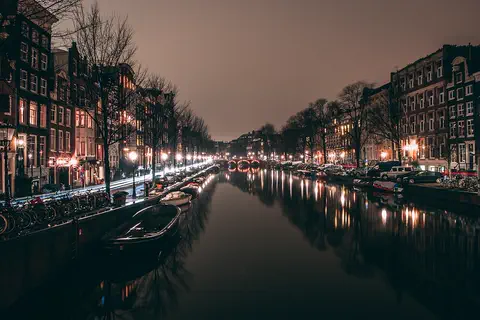
Amsterdam is the capital of the Netherlands. It began as a fishing village beside a dam on the Amstel River, which gave the city its name. Today about 942,000 people live among its rings of canals, hundreds of bridges, houseboats and bicycles.
For parents & teachers
What children will learn
- Locate Ljubljana in Slovenia, south of the Alps, at a pass between mountain ranges.
- Explain how an architect can shape the way people use a city.
- Describe how archaeology shows people lived in a place thousands of years ago.
- Read monthly temperature and precipitation averages to describe a city's climate.
Recommended ages: 3 to 17 · About 15 minutes
Talk about it
- Plečnik designed places for shopping, meeting, relaxing and learning. Which places in your town are for each of these?
- The Triple Bridge added footbridges just for people walking. Why might a city make space only for walkers?
- A 5,200-year-old wheel was found in a marsh. What could it tell us about the people who made it?
Try at home or in class
- Three bridges: build one bridge from blocks or cardboard, then add a narrower bridge on each side, like the Triple Bridge.
- Wheel test: roll a box with no wheels and then on round pencils or straws. Talk about why the wheel made moving things easier.
- Funicular: tie a string to a small toy car, run it over a pencil at the top of a sloped book, and pull it up the hill.
Key vocabulary: capital, funicular, pile dwelling, architect, promenade, reinforced concrete
Where these facts come from
- Wikidata , Wikimedia Foundation (CC0 1.0)
- Natural Earth vector data , Natural Earth (NACIS) (Public domain)
- Population by age and sex, municipalities, Slovenia, half-yearly (05C4003S) , Statistical Office of the Republic of Slovenia (SiStat)
- The works of Jože Plečnik in Ljubljana – Human Centred Urban Design , UNESCO World Heritage Centre
- Ljubljana: history city (permanent exhibition) , City Museum of Ljubljana (MGML)
- The wheel – 5,200 years , City Museum of Ljubljana (MGML)
- Ljubljana Castle , Visit Ljubljana (Ljubljana Tourism)
- Funicular railway to Ljubljana Castle , Visit Ljubljana (Ljubljana Tourism)
- Triple Bridge , Visit Ljubljana (Ljubljana Tourism)
- Dragon Bridge , Visit Ljubljana (Ljubljana Tourism)
- European Green Capital Award: winning cities , European Commission
- Ljubljana: climatological information , World Meteorological Organization, World Weather Information Service
- Wikimedia Commons , Wikimedia Foundation (Per file (public domain, CC0, CC BY or CC BY-SA); see each media record)
Checked, not yet human-reviewed. Last updated November 1, 2026. Spotted a mistake? Tell us.