
City Europe
Munich
Munich is a big city in the south of Germany. It has a tall town hall, a church with two round-topped towers and a giant science museum.
Munich is the capital of Bavaria, a state in southern Germany, and the country's third-biggest city. It began in 1158 as a market by a bridge over the Isar River, and its name means "Home of the Monks." Today it is famous for its palaces, art museums, the huge Deutsches Museum and its autumn Oktoberfest.
Munich, capital of the German state of Bavaria and Germany's third-largest city, lies on the Isar about 50 km north of the Alps. Founded as a market and bridge town in 1157–58 and seat of the Wittelsbach dynasty from 1255, it was reshaped in the 19th century by Louis I. The city registered 1,612,429 residents at the end of 2025.
Photo: Thomas Wolf, CC BY-SA 3.0 DE, via Wikimedia Commons
Discover Munich
Munich is a big city in the south of Germany.
A river called the Isar flows right through it. Tall mountains, the Alps, are not far away. In the middle is a big square with a fancy town hall.
Munich, or München in German, is the capital of Bavaria, a state in southern Germany. It is the biggest city in Bavaria and the third-biggest in Germany, after Berlin and Hamburg. About 1.6 million people lived there at the end of 2025.
The Isar River flows through the middle of the city, and the Alps begin about 50 kilometers to the south. In the old town, the twin towers of the Frauenkirche, topped with rounded domes, rise above red roofs, next to the lacy stone tower of the New Town Hall on Marienplatz.
Munich, capital of the Land (state) of Bavaria, is Bavaria's largest city, Germany's third largest after Berlin and Hamburg, and by far the largest in southern Germany. It lies along the Isar, which flows through its middle, about 50 km north of the edge of the Alps, and covers about 311 km², stretching 20.7 km north to south and 26.9 km west to east.
The city's statistics office registered 1,612,429 residents with their main home in Munich on December 31, 2025 (Britannica's 2021 estimate was 1,487,708). In 2025, 30.6 percent had no German citizenship. Munich's geographic center is measured at the north tower of the Frauenkirche.
- Country
- Germany (capital of the state of Bavaria)
- People in the city (end of 2025)
- about 1.6 million
- Area
- about 311 km²
- Name means
- Home of the Monks
Famous places
In Munich's main square stands the New Town Hall, with a tall, pointy stone tower.
Nearby, a big church has two towers with round tops. Kings once lived in a huge palace in the city. On an island in the river is a giant museum of science and machines.
Marienplatz, the old market square, is the heart of the old town. The New Town Hall, built from 1867 to 1874, fills one side of it. Close by, the Frauenkirche, Munich's cathedral, was built from 1468 to 1488, and its two massive towers with dome-shaped caps can be seen from far away. St. Peter's Church, from 1169, is the oldest church in the city.
Munich's rulers lived in the Residence, a palace in the city center, and spent summers at Nymphenburg Palace. On an island in the Isar stands the Deutsches Museum, a huge museum of science, engineering and technology.
The old town, around the marketplace at Marienplatz, keeps three of its seven 14th-century gates (Karlstor, Sendlinger Tor and Isartor), the Frauenkirche (1468–88) with its massive cupola-capped towers, the Old Town Hall (1470–80) and Peterskirche (1169), the oldest church, destroyed in World War II and rebuilt in its original form. The Residence, begun in the 16th century, tried out every style up to the 19th; Michaelskirche (1583–97) is considered Germany's most important Renaissance church. Still, the old town is predominantly Baroque and Rococo, from the Theatine Church to the Asamkirche and the Rococo Cuvilliés Theatre.
Outside the walls rose the summer palaces of Schleissheim and Nymphenburg, whose Amalienburg hunting lodge is a Rococo masterpiece. Louis I's 19th-century program created Ludwigstrasse, the Königsplatz with the Glyptothek and the Propyläen, and the Alte Pinakothek. The Olympic Tower, at 291 m, is the city's tallest structure; its tallest building is the 146 m Uptown München.
- Frauenkirche (cathedral)
- built 1468–88
- New Town Hall
- built 1867–74
- Peterskirche, oldest church
- 1169
- Olympic Tower, tallest structure
- 291 m
From monks' market to modern city
Long ago, monks lived near the river here.
A duke let them hold a market, and people built a bridge. A family of dukes and kings ruled Bavaria for more than 700 years. One king built grand streets, museums and a university.
Munich's name means "Home of the Monks." In 1157 Duke Henry the Lion gave monks the right to hold a market where the road from Salzburg crossed the Isar River. A bridge was built the next year, and walls went up around the marketplace.
From 1255, Munich was home to the Wittelsbach family, who ruled Bavaria for more than 700 years. In the 1800s King Louis I planned modern Munich, with grand streets, museums and a university. The city grew from 100,000 people in 1854 to 500,000 by 1900.
Munich traces its origins to the Benedictine monastery at Tegernsee, probably founded in 750. In 1157 Henry the Lion, duke of Bavaria, granted the monks a market where the Salzburg road met the Isar; a bridge followed in 1158 and the market was fortified. The Wittelsbachs, dukes of Bavaria from 1180, made Munich their home in 1255; Louis IV (Louis the Bavarian), the first Wittelsbach Holy Roman emperor, enlarged the town in the early 14th century. Under Maximilian I (1597–1651) it prospered until the Thirty Years' War: Swedish forces occupied it in 1632, and plague killed about a third of the people in 1634.
Louis I (king 1825–48) created modern Munich, and the population grew from 100,000 in 1854 to 500,000 by 1900. Wittelsbach rule ended in November 1918. After World War I the city became a center of right-wing politics; Adolf Hitler joined the Nazi Party there, and in November 1923 he led the failed Beer Hall Putsch. Allied bombing in World War II destroyed more than 40 percent of the city's buildings. Munich hosted the 1972 Summer Olympics.
Getting around Munich
Fast trains zoom in and out of Munich.
Under the streets, a subway carries people around. Big highways lead to other cities. Airplanes take off from a big airport outside town.
Munich is a major hub for Germany's and Europe's high-speed trains, with rail links to all the main cities of Germany and Austria. Big highways called autobahns arrive from Stuttgart, Nuremberg and Salzburg.
Under the city runs a modern subway. Munich's airport, named after Franz Josef Strauss, opened in 1992 about 27 kilometers northeast of the city. At the end of 2025, about 49,700 electric cars were registered in Munich, a quarter more than a year before.
Munich is connected by rail to all the main cities of Germany and Austria and is a major hub of the German and European high-speed passenger network; autobahns from Stuttgart, Nürnberg and Salzburg converge on the city, which also has a modern subway. Franz Josef Strauss Airport, 27 km northeast, opened in 1992.
At the end of 2025, 903,633 motor vehicles were registered, including 759,228 cars, or 332 privately registered cars per 1,000 residents. Gasoline and diesel cars were falling in number, while the 49,661 electric cars had risen 26.2 percent in a year and hybrids 24 percent.
- Airport
- Franz Josef Strauss, 27 km northeast, opened 1992
- Railways
- a major hub for high-speed trains
- Motor vehicles registered (end of 2025)
- 903,633
Weather and seasons
Munich has warm summers and frosty winters.
It rains or snows in every season. June and July are the wettest months.
Munich has warm summers, frosty winters and rain or snow in every season. In January, days average about 3 °C and nights about −4 °C. In July, days average about 23 °C and nights about 13 °C.
Summer is the wettest time of year: June and July each bring more than 120 millimeters of rain. On about 73 days a year the temperature falls below freezing, and on about 20 days it stays below freezing all day.
World Meteorological Organization normals for 1971–2000 give mean daily maxima and minima of 2.7 °C and −3.7 °C in January and 23.1 °C and 12.6 °C in July, with about 967 mm of precipitation a year, peaking in June (128 mm) and July (132 mm).
The city's statistics office reports a 1991–2020 mean annual temperature of 10.1 °C, up from 9.1 °C in 1961–1990, with 940 mm of precipitation, about 1,843 hours of sunshine, some 73 frost days and nearly 20 ice days a year; summer and hot days have become more frequent, and frost and ice days rarer.
- January, average daily high and low
- about 3 °C and −4 °C
- July, average daily high and low
- about 23 °C and 13 °C
- Frost days in a year
- about 73
Living in Munich
Every autumn, Munich holds a giant festival called Oktoberfest.
Millions of visitors come. Families also love the science museum, where you can see real machines. There is music, theater and opera too.
Every autumn, Munich holds Oktoberfest: in 2026 an estimated 7.4 million visitors came during its 16 days. Munich is also a city of music, with an opera company and orchestras, and of museums. The Alte Pinakothek holds paintings by great artists such as Albrecht Dürer and Peter Paul Rubens.
Many people work in high-tech industries, making precision instruments, electrical appliances and aerospace products, or in banking, publishing and television. In the 2024/25 school year, 50,434 children went to Munich's 163 primary schools.
Distance from seaports and the Ruhr coalfields once held Munich back, but it shifted from heavy to light industry: precision instruments, optical and electrical appliances, aerospace and other high technology, food, cosmetics and clothing. It is a banking and finance center, a hub of book publishing and television, and a major tourist and convention city with some of Germany's largest breweries and the Oktoberfest, which drew an estimated 7.4 million visitors from September 19 to October 4, 2026.
The University of Munich moved here from Landshut in 1826; the Technical University followed in 1868, and the Max Planck Society has its headquarters here. Opera flourishes with the Bavarian State Opera and the Munich Philharmonic. The Alte Pinakothek holds the Wittelsbach collections of German, Dutch and Flemish painting, the Neue Pinakothek 19th- and 20th-century art, and the Deutsches Museum is a vast museum of science, engineering and technology.
- Oktoberfest 2026
- an estimated 7.4 million visitors in 16 days
- Technical University of Munich
- founded 1868
- Children in 163 primary schools (2024/25)
- 50,434
Munich on the map
Find Munich on the globe.
Look for Germany, in the middle of Europe. Munich is in the south, not far from the tall mountains called the Alps.
Munich is in southern Germany, in the state of Bavaria, about 50 kilometers north of the Alps. The Isar River flows through the middle of the city, for 13.7 kilometers inside the city limits.
Big highways from Stuttgart, Nuremberg and the Austrian city of Salzburg all meet at Munich, and fast trains link it with the main cities of Germany and Austria.
Munich lies at about 48.1° N and 11.6° E, along the Isar about 50 km north of the edge of the Alps. Its geographic center, at the north tower of the Frauenkirche, is at 48° 8′ 19″ N, 11° 34′ 23″ E, and its lowest point, 482 m above sea level, is in the north of the city at Feldmoching.
The Isar runs 13.7 km through the city, the longest watercourse within its limits. The old town grew around the marketplace where the Salzburg road met the river; Louis I's 19th-century building program, with the monumental Ludwigstrasse, gave the city its first great push beyond the old town.
- Latitude
- about 48.1° north
- Longitude
- about 11.6° east
- River
- Isar, 13.7 km inside the city
Amazing facts
-
Munich's name means Home of the Monks.
München, Munich's German name, means "Home of the Monks." The city began as a market run by monks.
München ("Home of the Monks") traces its origins to the Benedictine monastery at Tegernsee, whose monks were granted a market on the Isar in 1157.
-
Munich's oldest church is more than 850 years old.
St. Peter's Church, from 1169, is Munich's oldest church. It has been rebuilt in its original form.
Peterskirche (1169), the city's oldest church, was completely destroyed in World War II and subsequently rebuilt in its original form.
-
Munich's tallest tower is 291 meters high.
The Olympic Tower is Munich's tallest structure, at 291 meters. The tallest building is 146 meters high.
At 291 m the Olympiaturm is Munich's tallest structure; the tallest building is the 146 m Uptown München tower.
-
Munich grew five times bigger in less than 50 years.
Munich had 100,000 people in 1854 and 500,000 by 1900.
The 19th century was Munich's greatest period of growth: from 100,000 people in 1854 to 500,000 by 1900.
-
Three of Munich's old city gates are still standing.
Munich once had seven town gates. Three of them, from the 1300s, still stand.
Of Munich's seven town gates, three survive, Karlstor, Sendlinger Tor and Isartor, all dating from the 14th century.
Words to know
- state
- one of the parts a country like Germany is divided into, with its own government
- duke
- a nobleman who ruled a region
- cathedral
- the main church of an area, led by a bishop
- town hall
- the building where a city's government meets
- Rococo
- a light, playful, richly decorated style of building and art from the 1700s
- autobahn
- a German highway for fast traffic
- festival
- a big celebration with special events, often held every year
Discovery challenge
-
Which river flows through Munich?
Which river flows through the middle of Munich?
Munich grew where the Salzburg road met which river?
- The Isar
- The Thames
- The Seine
Show the answer
The Isar
The Isar! It flows right through the city.
The Isar, which flows through the middle of the city.
The Isar, where a bridge was built in 1158.
-
What does the name Munich mean?
Munich's German name, München, means what?
What does München mean, a name that recalls the monastery at Tegernsee?
- Home of the Monks
- City of Lions
- Snowy Valley
Show the answer
Home of the Monks
Home of the Monks!
Home of the Monks. Monks held its first market.
Home of the Monks: the town grew from a market granted to the Tegernsee monks in 1157.
-
What is the Deutsches Museum full of?
The Deutsches Museum, on an island in the Isar, is a museum of what?
Which subjects does the Deutsches Museum, with its notable library, cover?
- Science and machines
- Dinosaur bones only
- Old coins only
Show the answer
Science and machines
Science and machines!
Science, engineering and technology.
Science, engineering and technology, in one huge, comprehensive museum.
-
Which country is Munich in?
Munich is the capital of Bavaria, a state of which country?
Munich is the third-largest city of which country, after Berlin and Hamburg?
- Germany
- Austria
- Switzerland
Show the answer
Germany
Germany! Munich is in the south.
Germany. Bavaria is its southern state.
Germany.
-
What big festival happens in Munich every autumn?
Which autumn festival drew an estimated 7.4 million visitors to Munich in 2026?
Which 16-day festival in September and October is Munich famous for?
- Oktoberfest
- Carnival of Rio
- Cherry Blossom Festival
Show the answer
Oktoberfest
Oktoberfest! Millions of visitors come.
Oktoberfest, held every autumn.
Oktoberfest, from September 19 to October 4 in 2026.
Nearby places
-
 Watch
Landmark
Neuschwanstein Castle
Neuschwanstein Castle stands on a rocky ridge in Bavaria, Germany. King Ludwig II had it built from 1869 as a private retreat in the style of a medieval knights' castle, but with the newest technology inside. It opened to visitors in 1886, and in 2025 about 1.1 million people came.
-
 Watch
Natural wonder
Danube
The Danube is Europe's second-longest river, after the Volga. It begins as two small streams in Germany's Black Forest and flows about 2,850 kilometers east to the Black Sea, passing through 10 countries and four capital cities. For more than 2,000 years it has been a border, a highway for boats and a home for wildlife, and it ends in a giant delta of reeds, lakes and birds.
-
 Watch
Natural wonder
Rhine
The Rhine begins as two small streams high in the Swiss Alps and flows about 1,230 kilometers north and west to the North Sea, through Switzerland, Germany, France and the Netherlands. It tumbles over the Rhine Falls and winds through a gorge lined with castles. After a chemical spill in 1986, the countries along it worked together to clean it, and salmon came back.
-
 Watch
Natural wonder
Alps
The Alps are Europe's great mountain range, an arc about 1,200 kilometers long that runs from the Mediterranean coast near Nice, in France, to Vienna, in Austria. Their highest peak is Mont Blanc, which Britannica gives as 4,807 meters. The Alps rose when the plate carrying Africa pushed north into Europe, and Ice Age glaciers carved their sharp peaks and deep valleys.
-
 Watch
City
Prague
Prague, the capital of the Czech Republic, lies on the Vltava River in the heart of Europe. With Prague Castle on its hill, the 14th-century Charles Bridge and so many church towers that it is called the 'City of a Hundred Spires', its historic center is a UNESCO World Heritage Site. About 1.4 million people lived there in 2025.
-
 Watch
City
Venice
Venice, in northern Italy, is spread over 118 small islands in a shallow lagoon off the Adriatic Sea. There are no cars in the old city: people walk or travel by boat along its canals, past palaces and over about 400 bridges. High tides sometimes flood its squares, so giant gates now protect the lagoon.
-
 Watch
Landmark
Milan Cathedral
Milan Cathedral, called the Duomo, is a giant Gothic cathedral made of pink-and-white marble. Building began in 1386, and the last details of its front were finished only in 1965. It has more statues than any other building in the world, over 3,000 of them.
-
 Watch
City
Vienna
Vienna is the capital of Austria, on the Danube River. For centuries it was the home of emperors, and composers such as Haydn, Mozart and Beethoven lived and worked there. About 2 million people lived in the city at the start of 2026.
Explore next
-
Watch
 Country
Germany
Germany is a country in north-central Europe. The land rises from flat plains by the North Sea and the Baltic Sea to forested hills and, in the far south, the Alps. About 83.5 million people (2025) live there, and its capital is Berlin.
-
Watch
Landmark
Neuschwanstein Castle
Neuschwanstein Castle stands on a rocky ridge in Bavaria, Germany. King Ludwig II had it built from 1869 as a private retreat in the style of a medieval knights' castle, but with the newest technology inside. It opened to visitors in 1886, and in 2025 about 1.1 million people came.
-
Watch
Natural wonder
Alps
The Alps are Europe's great mountain range, an arc about 1,200 kilometers long that runs from the Mediterranean coast near Nice, in France, to Vienna, in Austria. Their highest peak is Mont Blanc, which Britannica gives as 4,807 meters. The Alps rose when the plate carrying Africa pushed north into Europe, and Ice Age glaciers carved their sharp peaks and deep valleys.
-
Watch
Natural wonder
Danube
The Danube is Europe's second-longest river, after the Volga. It begins as two small streams in Germany's Black Forest and flows about 2,850 kilometers east to the Black Sea, passing through 10 countries and four capital cities. For more than 2,000 years it has been a border, a highway for boats and a home for wildlife, and it ends in a giant delta of reeds, lakes and birds.
-
 Watch
City
Berlin
Berlin, the capital of Germany, grew from two small trading towns on the Spree River. From 1961 to 1989 the Berlin Wall divided it. Today about 3.7 million people live there (2025), among lakes, forests, museums and the Brandenburg Gate.
-
Watch
City
Vienna
Vienna is the capital of Austria, on the Danube River. For centuries it was the home of emperors, and composers such as Haydn, Mozart and Beethoven lived and worked there. About 2 million people lived in the city at the start of 2026.
-
Watch
City
Prague
Prague, the capital of the Czech Republic, lies on the Vltava River in the heart of Europe. With Prague Castle on its hill, the 14th-century Charles Bridge and so many church towers that it is called the 'City of a Hundred Spires', its historic center is a UNESCO World Heritage Site. About 1.4 million people lived there in 2025.
-
 Watch
City
Amsterdam
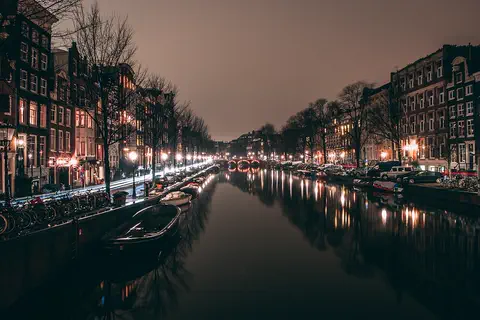
Amsterdam is the capital of the Netherlands. It began as a fishing village beside a dam on the Amstel River, which gave the city its name. Today about 942,000 people live among its rings of canals, hundreds of bridges, houseboats and bicycles.
For parents & teachers
What children will learn
- Locate Munich on the Isar in southern Germany, north of the Alps.
- Explain how a market and a bridge could grow into a big city.
- Name some of Munich's churches, palaces and museums.
- Read a city's population and climate numbers and compare them with home.
Recommended ages: 3 to 17 · About 15 minutes
Talk about it
- Munich began where a road crossed a river. Why are crossings good places for markets?
- St. Peter's Church was rebuilt exactly as it was. Should cities rebuild old buildings the way they were, or build something new?
- Which would you visit first: the science museum, the palace or the festival? Why?
Try at home or in class
- Build a bridge across a 'river' of blue paper and set up a pretend market at one end.
- Make a simple machine, such as a lever from a ruler and a pencil, like the ones in a science museum.
Key vocabulary: state, duke, cathedral, town hall, Rococo, autobahn, festival
Where these facts come from
- Wikidata , Wikimedia Foundation (CC0 1.0)
- Natural Earth vector data , Natural Earth (NACIS) (Public domain)
- Munich , Encyclopaedia Britannica
- München in Zahlen: interessante Fakten über die Stadt , City of Munich (muenchen.de), from the Statistical Office's Statistisches Taschenbuch 2026
- Munich: climatological information , World Meteorological Organization, World Weather Information Service
- Wikimedia Commons , Wikimedia Foundation (Per file (public domain, CC0, CC BY or CC BY-SA); see each media record)
Checked, not yet human-reviewed. Last updated October 28, 2026. Spotted a mistake? Tell us.