
 Country
Europe
Albania
Albania is a small country in southern Europe. It has tall mountains, a long sunny coast and old ruins from long ago.
Albania is a small, mountainous country on the Balkan Peninsula, facing Italy across the Adriatic Sea. About three-fourths of it is mountains and hills, the coastal plains are its most crowded part, and its language has no close relatives.
Albania lies on the western Balkan Peninsula at the Strait of Otranto, where the Adriatic meets the Ionian Sea. About three-fourths of its land is mountains and hills, and its 2.34 million people (January 2026) speak Albanian, the only surviving language of its branch of the Indo-European family.
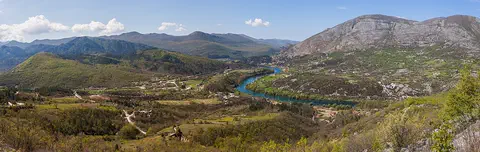
Photo: Photo: Marcin Konsek, CC BY-SA 3.0, via Wikimedia Commons
Discover Albania
Albania is a small country in Europe.
It has lots of mountains. It has a long coast by the warm sea. Italy is across the water. The capital city is called Tirana.
Albania is a small country in southern Europe, on the western side of the Balkan Peninsula. It is about 340 kilometers long and 150 kilometers wide. To the west is the Adriatic Sea, and to the southwest is the Ionian Sea; Italy is only about 80 kilometers away across the water.
About three-fourths of Albania is mountains and hills. The low, flat land along the coast is the country's most important area for farms and factories, and the most crowded. About 2.3 million people live in Albania, and its capital is Tirana.
Albania lies in the western part of the Balkan Peninsula on the Strait of Otranto, the southern entrance to the Adriatic. It measures about 340 km from north to south and 150 km across, with an area of 28,748 square kilometers. About three-fourths of the territory is mountains and hills above 200 m; the rest is coastal and alluvial lowland.
Albania's statistics institute, INSTAT, put the population at 2,335,930 on 1 January 2026, down 1.16 percent in a year, and Britannica put the urban share at 65.4 percent in 2024. Britannica describes Albania as one of the most homogeneous populations in Europe, with non-Albanians (by country of birth) about 2 percent; the largest minorities are Vlachs, Greeks in the southeast and Macedonians along the eastern border. Albania is a parliamentary democracy; its 140-member Parliament elects the president.

Cities and famous places
Tirana is the biggest city in Albania.
It has a lake and a big park. Durrës is an old city by the sea. It has a Roman theater where people once watched shows.
Tirana, the capital, lies inland, with mountains rising behind it; about 389,000 people lived in the city in 2023. On the coast, Durrës was founded by Greek settlers more than 2,600 years ago, and the remains of a Roman amphitheater still stand among its houses.
Two old towns, Berat and Gjirokastra, are World Heritage Sites. Berat has a castle that was mostly built in the 1200s, and Gjirokastra is known for its two-story houses from the 1600s, some with small towers called turrets. In the far south, Butrint is an ancient city whose ruins show every period of its long history.
Tirana (389,323 people in 2023, Wikidata) is the capital. Durrës was founded as Epidamnus by Greeks from Corcyra and Corinth in the 7th century BCE; its Roman amphitheater is on Albania's tentative list for World Heritage. UNESCO's World Heritage site, inscribed in 2005 and enlarged in 2008, presents Berat and Gjirokastra as rare examples of Ottoman-period architecture: Berat's castle, the Kala, dates mostly from the 13th century, though its origins go back to the 4th century BCE, and its citadel holds Byzantine churches and Ottoman-era mosques that show centuries of different communities living side by side. Gjirokastra, in the Drinos valley, has outstanding two-story houses developed in the 17th century and an old bazaar.
Butrint (1992), inhabited since prehistoric times, was a Greek colony, a Roman city and a bishopric; after Byzantine prosperity and a brief Venetian period it was abandoned in the late Middle Ages when marshes formed around it, leaving ruins from every period.
Mountains, lakes and the coast
Albania has high, rocky mountains.
The tallest one is called Korab. Thick forests grow in the north. Big lakes are near the borders. Summers are warm and dry.
The North Albanian Alps cover the north of the country. They are the most rugged part of Albania, thickly forested and with few people. The highest peak, Mount Korab, rises to about 2,750 meters in the east. In the south, bare limestone ridges are used as pasture for animals.
Albania's longest river, the Drin, is about 280 kilometers long. Its biggest lakes are Lake Shkodër in the northwest and Lakes Ohrid and Prespa on the eastern border. Summers are warm and dry and winters mild and wet, but the eastern mountains have cold winters.
The North Albanian Alps, an extension of the Dinaric Alps, approach 2,700 m and are the country's most rugged, heavily forested and sparsely populated region. The central mountain region is gentler and more densely settled; at its eastern edge the gypsum block of Mount Korab reaches 2,752 m in Britannica. Southern limestone ranges up to 2,500 m are bare or thinly covered with Mediterranean shrubs, oaks and pines. The fertile western plains run nearly 200 km along the Adriatic and up to 50 km inland.
The Drin (about 280 km) rises in Kosovo; the Seman, Shkumbin and Vjosë drain the central plains. The climate is Mediterranean in the west (Sarandë averages about 24 °C in July and 9 °C in January) and more continental in the east (Peshkopi about −1 °C in January). Precipitation ranges from more than 2,500 mm a year in the North Albanian Alps to less than 760 mm along much of the eastern border, and forests cover about one-third of the land.
Animals of Albania
Wolves and foxes live in Albania.
Bears live there too, and goat-like animals called chamois. Many birds come to the warm coast. Trout swim in mountain streams.
Hunting once took a heavy toll on Albania's wild animals. In the 1990s, new hunting laws and nature preserves were set up to protect jackals, wolves and foxes, and the even rarer wild boars, bears and chamois.
The mild coast attracts large numbers of migrating birds, including swallows, storks, ducks, geese and pelicans. Sardines and mullet swim in the coastal waters, and trout live in mountain streams and lakes.
Britannica notes that unrestricted hunting took a heavy toll on Albanian wildlife until hunting laws and nature preserves were introduced in the 1990s to protect the remaining jackals, wolves and foxes and the rarer wild boars, bears and chamois. Vegetation follows altitude: Mediterranean shrubs such as laurel and myrtle on the coastal lowlands, oak forests above them, beech and pine from about 900 m, and Alpine pastures above the timberline.
The mild coastal climate draws great numbers of migratory birds, among them swallows, storks, ducks, geese and pelicans. Sardines and mullet live in coastal waters and trout in the streams and lakes of the mountains.
People, language and music
About 2.3 million people live in Albania.
They speak Albanian. People in the north and south speak in slightly different ways. Singers in Albania sing together in many parts at once.
Albanian is a very unusual language. It is the only language left in its own branch of the big Indo-European language family, and it has borrowed words from Latin, Greek, Turkish, Italian and Slavic languages. Its two main dialects are Geg in the north and Tosk in the south, and speakers of both understand each other easily.
Albanian folk iso-polyphony is a kind of singing in which soloists sing a melody and a countermelody while a group holds a long, steady note called a drone. It is sung at weddings, harvest feasts and festivals, and UNESCO lists it as intangible cultural heritage, a living tradition worth protecting.
Albanian (shqip), regarded as a descendant of the extinct Illyrian language, is the only surviving member of its branch of the Indo-European family. Its two principal dialects, Geg north of the Shkumbin River and Tosk to the south, are mutually intelligible; a Roman-alphabet orthography was adopted only in 1908, and a unified standard based on Tosk was set by a congress in Tirana in 1972. The two main subgroups of Albanians are the Gegs of the north and the Tosks of the south.
Albania is predominantly Muslim by heritage after nearly five centuries of Ottoman rule; in the early 21st century about half the population was nominally Muslim, about one-fifth Orthodox and about one-tenth Roman Catholic, and Britannica notes that many people live largely secular lives. The communist government banned religious observance in 1967; freedom of worship returned in 1990. UNESCO inscribed Albanian folk iso-polyphony, with two solo parts over a choral drone, in 2008.
A long history
People have lived in Albania for a very long time.
Long ago, Greeks and Romans built cities here. Later, a big empire ruled Albania for hundreds of years. In 1912, Albania became its own country.
Many Albanians see themselves as descendants of the ancient Illyrians, a people who lived here more than 2,000 years ago. Greek settlers founded towns on the coast, such as Durrës, and later the Romans and then the Byzantine Empire ruled the land.
In the 1400s the Ottoman Empire took over Albania and ruled it for more than four centuries. Albania declared independence in 1912. After World War II it was ruled by a communist government that controlled almost all of life, until new political parties were allowed in 1990.
Albanians generally consider themselves descendants of the ancient Illyrians, who Britannica says migrated into the region at the start of the Bronze Age, about 2000 BCE. Greeks founded Epidamnus (Durrës) in the 7th century BCE; Rome conquered the Illyrians in the 2nd century BCE, and from the end of the 4th century CE the Byzantine Empire ruled. After centuries of invasions, the Ottoman Turks conquered Albania in the 15th century, and Ottoman rule cut it off from the West for more than four centuries.
Albania was declared independent in 1912, but in 1913 the great powers drew boundaries that left about half of its territory and people in neighboring states. A monarchy between the world wars, it emerged from World War II as a communist state in which the ruling party controlled almost every part of life. In December 1990 independent political parties were allowed, and in March 1992 the anticommunist Democratic Party won a decisive electoral victory.
Albania on the map
Find Albania on the globe.
It is in southern Europe, across the sea from Italy. Greece is next door to the south. Albania is long and thin.
Albania has four neighbors: Montenegro to the northwest, Kosovo to the northeast, North Macedonia to the east and Greece to the southeast and south. The Adriatic Sea lies to the west and the Ionian Sea to the southwest.
At the southern end of the Adriatic, a narrow stretch of water called the Strait of Otranto separates Albania from the heel of Italy. Lakes Ohrid and Prespa lie on the eastern border, and Lake Shkodër is in the northwest.
Albania is bounded by Montenegro to the northwest, Kosovo to the northeast, North Macedonia to the east, Greece to the southeast and south, and the Adriatic and Ionian seas to the west and southwest. Italy lies about 80 km across the Strait of Otranto. Kosovo is a partially recognized state; PlayOwl's maps, which follow Natural Earth, show it as a neighbor.
The country is about 340 km long and 150 km wide. Its most important lakes are Lake Shkodër (Scutari) in the northwest and Lakes Ohrid and Prespa along the eastern border, and the Drin, its longest river, rises in Kosovo.
- Length
- about 340 km
- Width
- about 150 km
- Distance to Italy
- about 80 km across the Adriatic
- Longest river
- Drin, about 280 km
Amazing facts
-
Albanian has no close language cousins.
Albanian is the only surviving language in its own branch of the Indo-European family.
As a descendant of the extinct Illyrian tongue, Albanian is the only surviving member of its branch of the Indo-European language family.
-
Italy is only a short boat ride from Albania.
Italy lies only about 80 kilometers from Albania across the Adriatic Sea.
Albania's immediate western neighbor, Italy, lies some 80 km away across the Strait of Otranto.
-
An old city in Albania was left when marshes grew around it.
The ancient city of Butrint was abandoned in the late Middle Ages after marshes formed around it.
Butrint, a Greek colony, Roman city and bishopric, was abandoned in the late Middle Ages when marshes formed, leaving ruins from each period.
-
Albanian got its own alphabet a little over 100 years ago.
Albanian was first given an agreed alphabet, based on the Roman letters, in 1908.
Albanian acquired a definitive Roman-alphabet orthography only in 1908; earlier texts used Latin, Greek, Turko-Arabic and Cyrillic scripts.
Words to know
- peninsula
- land with water on most sides, joined to a larger piece of land
- amphitheater
- an oval or round open-air arena with rows of seats rising around it
- dialect
- a way of speaking a language that belongs to one region or group
- polyphony
- music with two or more different tunes sung or played at the same time
- drone
- a long, steady note held under a melody
- strait
- a narrow stretch of sea between two pieces of land
Discovery challenge
-
What is the capital city of Albania?
Which city is the capital of Albania?
Which city, on Albania's western plains, is the capital?
- Durrës
- Tirana
- Berat
Show the answer
Tirana
Tirana is the capital of Albania.
Tirana is the capital. Durrës is a port on the coast, and Berat is a historic town.
Tirana is the capital; Durrës (ancient Epidamnus) is the main port.
-
Which country is across the sea from Albania?
Which country lies about 80 kilometers from Albania across the Adriatic Sea?
Across the Strait of Otranto, which country is Albania's immediate western neighbor?
- Spain
- Italy
- Norway
Show the answer
Italy
Italy is across the sea.
Italy is only about 80 kilometers away across the Adriatic.
Italy lies some 80 km west across the Strait of Otranto.
-
What covers most of Albania?
About three-fourths of Albania is covered by what?
What makes up about three-fourths of Albania's territory?
- Desert
- Mountains and hills
- Ice
Show the answer
Mountains and hills
Most of Albania is mountains and hills.
About three-fourths of Albania is mountains and hills; the rest is low coastal plain.
About three-fourths lies above 200 m; the rest is coastal and alluvial lowland.
-
In Albanian songs, what is the long, steady note called?
In Albanian iso-polyphony, what is the long, steady note held by the group called?
Albanian iso-polyphony sets two solo parts over what?
- A drone
- A drum
- An echo
Show the answer
A drone
It is called a drone. It is one long, steady note.
A drone is a long, steady note held under the melody.
A choral drone supports the melody and countermelody; UNESCO inscribed the tradition in 2008.
-
When did Albania become its own country?
In which year did Albania declare independence?
In which year was Albania declared independent after more than four centuries of Ottoman rule?
- 1912
- 1066
- 2001
Show the answer
1912
Albania became its own country in 1912.
Albania declared independence in 1912.
Independence was declared in 1912; in 1913 the great powers left about half the Albanian people outside its borders.
Places to discover in Albania
Explore next
-
Watch
City
Tirana
Tirana is the capital and largest city of Albania, on a plain about 27 kilometers from the Adriatic Sea. Founded in the early 1600s, it became the capital in 1920. About 389,000 people lived in the city in 2023.
-
 Watch
 Country
Italy
Italy is a country in southern Europe on a long peninsula that reaches into the Mediterranean Sea, often described as shaped like a boot. The Alps rise in the north, the Apennine mountains run down its length, and about 58.9 million people (2026) live there. Its capital is Rome.
-
 Watch
 Country
Greece
Greece is a country in southern Europe, at the bottom of the Balkan Peninsula, with sea on three sides and more than 2,000 islands. Most of it is mountains. About 10.4 million people lived there at the start of 2025, and its capital is Athens, a city with ruins more than 2,400 years old.
-
 Watch
 Country
Belarus
Belarus is a landlocked country in eastern Europe. Ice sheets of the last ice age shaped its low hills and wide plains, it has more than 10,000 lakes and one of Europe's largest wetlands, and about 9.1 million people lived there in 2025.
-
 Watch
 Country
Bosnia and Herzegovina
Bosnia and Herzegovina is a mountainous country in southeastern Europe. It has forests, limestone hills and many rivers, and famous old stone bridges cross some of them. Its capital is Sarajevo. It touches the Adriatic Sea along only about 20 kilometers of coast.
-
 Watch
 Country
Bulgaria
Bulgaria is a country on the eastern side of the Balkan Peninsula, with the Danube River to the north and the Black Sea to the east. Mountains cross it from west to east, and about 6.4 million people lived there at the end of 2025.
-
 Watch
 Country
Croatia
Croatia is a crescent-shaped country in southeastern Europe. Its long coast on the Adriatic Sea is fringed by more than 1,100 islands, limestone mountains rise behind it, fertile plains lie in the north, and about 3.87 million people lived there in mid-2025.
-
 Watch
 Country
Czechia
Czechia, also called the Czech Republic, is a landlocked country in central Europe. Mountains ring the old land of Bohemia, the Vltava River flows through the capital, Prague, and about 10.9 million people lived there in 2026.
For parents & teachers
What children will learn
- Locate Albania on the Balkan Peninsula and name its neighbors and seas.
- Describe how Albania's land changes from coastal plains to high mountains.
- Recognize what makes the Albanian language and iso-polyphony singing unusual.
- Outline Albania's history from Greek and Roman cities to independence in 1912 and multiparty politics from 1990.
Recommended ages: 3 to 17 · About 15 minutes
Talk about it
- Why do you think Albania's coastal plains are more crowded than its mountains?
- Albanian is the only language left in its branch. Why might people work hard to keep a language alive?
- Have you ever sung with a group where people sing different parts? How did it sound?
Try at home or in class
- Try iso-polyphony with friends: one person hums a steady low note while others sing a simple tune over it.
- On a map, measure the distance from Albania to Italy across the Strait of Otranto and compare it with a trip you know.
Key vocabulary: peninsula, amphitheater, dialect, polyphony, drone, strait
Where these facts come from
- Wikidata , Wikimedia Foundation (CC0 1.0)
- Natural Earth vector data , Natural Earth (NACIS) (Public domain)
- UNESCO World Heritage List , UNESCO World Heritage Centre (Linked as a reference; site facts come from Wikidata)
- Albania , Encyclopaedia Britannica
- Albania: Land , Encyclopaedia Britannica
- Albania: Climate, plant and animal life , Encyclopaedia Britannica
- Albania: People , Encyclopaedia Britannica
- Albania: Languages and religion , Encyclopaedia Britannica
- Albania: Collapse of communism , Encyclopaedia Britannica
- Albania: Constitutional framework , Encyclopaedia Britannica
- Durrës , Encyclopaedia Britannica
- Population, total: Albania (SP.POP.TOTL) , World Bank
- Popullsia shqiptare tkurret dhe plaket më tej (INSTAT population on 1 January 2026) , BalkanWeb
- Butrint , UNESCO World Heritage Centre
- Historic Centres of Berat and Gjirokastra , UNESCO World Heritage Centre
- Albanian folk iso-polyphony , UNESCO Intangible Cultural Heritage
- PlayOwl region table, version 1 , PlayOwl (PlayOwl original data)
- flag-icons 7.5.0 , Panayiotis Lipiridis and contributors (MIT)
- Wikimedia Commons , Wikimedia Foundation (Per file (public domain, CC0, CC BY or CC BY-SA); see each media record)
Checked, not yet human-reviewed. Last updated October 24, 2026. Spotted a mistake? Tell us.