
City Europe
Prague
Prague is the capital city of the Czech Republic. A huge castle sits on a hill above a river. An old stone bridge with statues crosses the water.
Prague, the capital of the Czech Republic, lies on the Vltava River in the heart of Europe. With Prague Castle on its hill, the 14th-century Charles Bridge and so many church towers that it is called the 'City of a Hundred Spires', its historic center is a UNESCO World Heritage Site. About 1.4 million people lived there in 2025.
Prague grew from 9th-century castles on two hills above the Vltava into the seat of the Přemyslid rulers, the imperial capital of Charles IV (1346–78) and, from 1918, the capital of Czechoslovakia and, since 1993, of the Czech Republic. Its core of some 2,000 recognized monuments, from Romanesque to Neoclassical, was preserved by post-1945 planning and inscribed by UNESCO in 1992; about 1,397,880 people lived there in 2025.
Photo: Marc-Olivier Giguere, CC BY-SA 4.0, via Wikimedia Commons
Discover Prague
Prague is the capital city of the Czech Republic.
A river called the Vltava flows through it. Many bridges cross the river. On a hill stands a giant castle, and church towers poke up everywhere.
Prague is the capital and biggest city of the Czech Republic, in the middle of Europe. It sits on the Vltava River, in the region of Bohemia, and spreads over hills, river valleys and terraces. About 1.4 million people lived there in 2025.
Prague has been a city for more than 1,000 years, and many of its old buildings survive. From the hills you can see so many church towers that it is called the "City of a Hundred Spires." Its historic center is a UNESCO World Heritage Site.
Prague, on the Vltava in Bohemia, is the seat of government of the Czech Republic and the administrative center of the Central Bohemian Region. Its metropolitan area covers 496 km², spreading from the original riverside settlements over hills, valleys and terraces; the city had 1,301,489 people in 2021 and about 1,397,880 in 2025 (Wikidata).
Britannica calls it one of Europe's finest cities, with an architectural heritage reflecting more than 1,000 years of urban life and the uncertain currents of Bohemian history. The winding Vltava and its bridges contrast with the castle of Hradčany on its hill; narrow old streets and taverns contrast with the broad sweep of Wenceslas Square. Post-1945 planning preserved the ancient core as a monument, and UNESCO inscribed the historic center in 1992.
- Country
- Czech Republic (capital)
- People in the city (2025)
- about 1.4 million
- Area
- 496 km²
- UNESCO World Heritage Site
- historic center, 1992

Famous places
Prague Castle sits high on a hill.
Inside its walls is a tall church with pointed towers. Below, the Charles Bridge crosses the river. Statues stand all along the bridge. Old Town Square has old houses with arches.
Prague Castle, or Hradčany, rises behind massive walls on a hill on the river's left bank. Inside is St. Vitus Cathedral, whose twin spires dominate the skyline. Building began in 1344 and was not finished until 1929, almost 600 years later.
The Charles Bridge, begun in 1357 under King Charles IV, links the Old Town with the Malá Strana, the "Small Side," below the castle. Across the river, Old Town Square has the Gothic Týn Church, and nearby the Old-New Synagogue and the Old Jewish Cemetery, the oldest in Europe, show the long history of Prague's Jewish community.
Britannica counts some 2,000 officially recognized architectural and artistic monuments, from Romanesque to Neoclassical. At Hradčany, the 10th-century Church of St. George is probably the most notable Romanesque building, and its larger, mainly Gothic successor, St. Vitus's Cathedral (1344–1929), dominates the skyline with its twin spires; Vladislav Hall marks the peak of late Gothic. The Charles Bridge (1357, reconstructed in 1970) succeeded the Judith Bridge of 1170, the first stone bridge on the site.
On the right bank stand the Týn Church on Old Town Square, the Powder Tower on the line of the old walls, the Bethlehem Chapel where Jan Hus preached, and St. Agnes Convent (1234). The Old-New Synagogue and the crowded gravestones of the Old Jewish Cemetery, Europe's oldest, testify to Prague's Jewish tradition. Baroque buildings, among them the Valdštejn and Clam-Gallas palaces and St. Nicholas Church, are what Britannica calls the city's greatest single artistic treasure; the National Museum and National Theatre are the main Neoclassical buildings.
- Charles Bridge
- begun 1357
- St. Vitus Cathedral
- begun 1344, completed 1929
- Old Jewish Cemetery
- Europe's oldest
- Recognized monuments
- about 2,000

A thousand years on the Vltava
More than 1,100 years ago, people built castles on two hills by the river.
Traders came, and a busy town grew. A king called Charles IV built a famous bridge and a university. Much later, Prague became the capital of a new country.
Trade routes crossed the Vltava here for thousands of years. In the second half of the 800s, people built the first castles on hills on both sides of the river, and by 965 a traveler described Prague as a busy trading center. A market grew into the Old Town.
In the 1300s King Charles IV, who was also Holy Roman emperor, made Prague his capital. He founded Charles University in 1348, the first in central Europe, began St. Vitus Cathedral and built the Charles Bridge. In 1918 Prague became the capital of the new country of Czechoslovakia. In 1989 huge protests that began on Wenceslas Square helped end communist rule, and since 1993 Prague has been the capital of the Czech Republic.
Paleolithic and Neolithic peoples, Celts and, from the 4th to 6th centuries, Slavs lived along this stretch of the Vltava. The first settlement has been traced to the second half of the 9th century, with Vyšehrad on the right bank and Hradčany on the left. The Přemyslid dynasty (about 800–1306) built a Bohemian state around Prague; in 965 Ibrāhīm ibn Yaʿqūb called it a busy trading center, and in 973 a bishopric was founded. The Old Town gained borough status by 1230, and Malá Strana was founded in 1257.
Charles IV ruled from Prague in 1346–78, founding the university (1348) and the planned New Town. Jan Hus's sermons, begun in 1402, made Prague a center of religious reform. After the Habsburgs took Bohemia in 1526, the 1618 Defenestration of Prague helped start the Thirty Years' War, and defeat at White Mountain (1620) began a long decline. Baroque palaces rose in the 18th century, and the four towns were united in 1784. Prague became Czechoslovakia's capital in 1918; its citizens rose in revolt on May 5, 1945, at the end of World War II; the Prague Spring of 1968 was ended by Soviet military action; and in November 1989 demonstrations of some half a million people helped end four decades of communist rule. On January 1, 1993, it became capital of the Czech Republic.
Getting around Prague
In Prague, people ride trams that rattle along the streets.
There are buses, and trains run under the ground. In summer, boats carry visitors along the river.
Inside the city, most people travel by tram, bus and metro, which are inexpensive. Prague's first electric trams were running by the 1890s, and its first railway arrived in 1845. Today it is one of the country's main railway junctions, with three main stations.
In summer, passenger boats cruise up and down the Vltava, a favorite with visitors. The international airport at Ruzyně, near the city, was expanded in the 1960s to serve as a hub at the center of Europe.
Britannica describes inexpensive, subsidized bus, tram and metro systems carrying much of the inner-city traffic; despite them, the number of cars and commercial vehicles has grown, prompting plans for a motorway system of 10 radial arteries. Electric streetcars arrived in the 1890s, and the first railway reached the city in 1845, eight years after its population passed 100,000.
Prague is one of the nation's major railway junctions, with three main stations and three freight circuits. The airport at Ruzyně was expanded and modernized in the 1960s as a hub for central Europe, a new port has been built where the Berounka joins the Vltava, and summer passenger boats on the river are a popular attraction. The compact historic core, with its bridges and museums, is a major center of jobs and traffic congestion.
- In the city
- trams, buses and the metro
- First electric trams
- 1890s
- First railway
- 1845
- Airport
- Ruzyně, modernized in the 1960s
Weather and seasons
Prague has four seasons.
Winters are cold and sometimes snowy. Summers are warm. Summer is also when the most rain falls.
Prague has a mid-continental climate, with cold winters and warm summers. In January, highs average about 3 °C and lows about −2 °C. In July, highs average about 25 °C and lows about 15 °C.
Prague is fairly dry, with about 435 millimeters of precipitation a year. The wettest months are in summer, from May to August, and the driest are in winter and early spring. The city's lowest point is 190 meters above sea level and its highest, White Mountain, is 380 meters.
Britannica describes a typically mid-continental climate, with average temperatures of 19.3 °C in July and −0.6 °C in January. World Meteorological Organization normals for 1981–2010 give mean daily maxima and minima of 2.6 °C and −2.4 °C in January and 25.3 °C and 14.5 °C in July.
The WMO's monthly totals add up to about 435 mm, peaking in July at about 64 mm and falling below 21 mm in January and February. The city spans 190 m above sea level at its lowest point to 380 m on White Mountain (Bílá hora), the hill where Protestant forces were defeated in 1620.
- January, average daily high and low
- about 3 °C and −2 °C
- July, average daily high and low
- about 25 °C and 15 °C
- Height above sea level
- 190 to 380 m
Living in Prague
Prague is a city of music.
Every spring there is a big music festival. Mozart once lived here. Families visit the zoo, the parks and the many museums.
Prague is famous for music. Mozart lived here, and his opera Don Giovanni was first performed in the city. Every spring, a festival celebrates the music of Czech composers such as Smetana, Dvořák and Janáček. The city has two famous orchestras and more than 20 theaters.
Charles University, founded in 1348, is the oldest university in central Europe. The astronomers Tycho Brahe and Johannes Kepler worked in Prague, and Albert Einstein taught here in 1911–12. The writer Franz Kafka is closely linked with the city. Families enjoy its parks, a large zoo at Troja and boat trips on the river.
Britannica describes a renowned musical life, peaking each year at the internationally known spring festival, with the Czech Philharmonic and the Prague Symphony; Mozart's 'Prague' Symphony and Don Giovanni had their premieres here. The novelist Jaroslav Hašek set The Good Soldier Schweik in the U kalicha beer hall, and Franz Kafka's writings seem indissolubly linked with the city. There are more than 20 theaters, many museums and galleries, and film studios at Barrandov.
Charles University (1348) is central Europe's oldest; the Academy of Arts, the Academy of Music and the Czech Academy of Sciences (1952) add to a tradition that includes Tycho Brahe, Johannes Kepler and Albert Einstein, who taught here in 1911–12. Industry, led by machinery, is the largest employer, followed by commerce and construction. In the 1990s Prague modernized, reopened its stock market and became a major tourist destination, and it was a European City of Culture in 2000.
- Charles University
- founded 1348, oldest in central Europe
- Theaters
- more than 20
- European City of Culture
- 2000
Prague on the map
Find Prague on the globe.
It is in the Czech Republic, right in the middle of Europe. Look for a river curving through hills. Prague sits on its banks.
Prague is in the Czech Republic, in central Europe, in the historic region of Bohemia. The Czech Republic borders Germany, Poland, Slovakia and Austria.
The Vltava River winds through the city. The castle and the Malá Strana are on the left (west) bank, and the Old Town and New Town are on the right (east) bank.
Prague lies at about 50.1° N and 14.5° E on the Vltava in central Bohemia. Trade routes linking northern and southern Europe crossed the river here for thousands of years, and the city grew where two defensible hills, Vyšehrad and Hradčany, faced each other across the water.
The historic city is four former towns united in 1784: Hradčany and Malá Strana on the left bank, and the Old Town and New Town on the right. Beyond them come a mixed zone of industry and housing, outer development zones and, finally, a belt of farms and market gardens. A new port has been built where the Berounka joins the Vltava.
- Latitude
- about 50.1° north
- Longitude
- about 14.5° east
- River
- Vltava
Amazing facts
-
Prague is called the City of a Hundred Spires.
Seen from the hills, Prague has so many church towers that it is called the "City of a Hundred Spires."
From the surrounding hills, Prague's many church towers form a unique skyline, giving it the description 'city of a hundred spires'.
-
A small copy of the Eiffel Tower stands on a hill in Prague.
By the 1890s, a smaller copy of the Eiffel Tower overlooked Prague from Petřín Hill.
By the 1890s, as electric trams began running, a replica of the Eiffel Tower overlooked the city from Petřín Hill.
-
Albert Einstein once taught in Prague.
The famous scientist Albert Einstein taught in Prague in 1911 and 1912.
Prague's academic tradition includes Tycho Brahe and Johannes Kepler in the 17th century and Albert Einstein, who taught there in 1911–12.
-
Prague's big church took almost 600 years to finish.
St. Vitus Cathedral was begun in 1344 and not completed until 1929.
Begun under Charles IV in 1344, St. Vitus's Cathedral was completed only in 1929.
-
Before the Charles Bridge, there was an older stone bridge.
The first stone bridge over the Vltava in Prague, the Judith Bridge, was built in 1170, almost 200 years before the Charles Bridge.
The Judith Bridge of 1170, the first stone bridge on the site, spurred the growth of the Old Town; the Charles Bridge followed in 1357.
Words to know
- capital
- the city where a country's government meets
- spire
- a tall, pointed top on a tower or church
- castle
- a large, strong building with thick walls, built to protect its rulers
- Gothic
- a style of building from the Middle Ages with pointed arches and tall windows
- Baroque
- a grand, richly decorated style of building and art from the 1600s and 1700s
- university
- a school where adults study and do research
- tram
- a passenger vehicle that runs on rails laid in the street
Discovery challenge
-
Which river flows through Prague?
Which river winds through Prague?
Prague's bridges, including the Charles Bridge, cross which river?
- The Vltava
- The Thames
- The Nile
Show the answer
The Vltava
The Vltava! Many bridges cross it.
The Vltava, with a long line of bridges.
The Vltava, in the heart of Bohemia.
-
What is Prague called because of all its towers?
Prague's nickname comes from its many church towers. What is it?
Which description does Britannica say Prague's skyline of church towers has earned it?
- City of a Hundred Spires
- City of Lights
- Windy City
Show the answer
City of a Hundred Spires
The City of a Hundred Spires!
The City of a Hundred Spires.
'City of a hundred spires', for the view from the surrounding hills.
-
Which king built Prague's famous stone bridge?
The Charles Bridge is named after which king and emperor?
Which ruler, who made Prague his capital from 1346 to 1378, built the Charles Bridge and founded the university?
- Charles IV
- Peter the Great
- Napoleon
Show the answer
Charles IV
King Charles IV! The bridge has his name.
Charles IV, king of Bohemia and Holy Roman emperor.
Charles IV, who also began St. Vitus's Cathedral and the New Town.
-
What stands on the hill above Prague?
What dominates the left bank of the Vltava from high on a hill?
What is Hradčany?
- Prague Castle
- A volcano
- A lighthouse
Show the answer
Prague Castle
A giant castle! Inside is a tall church.
Prague Castle, with St. Vitus Cathedral inside.
The castle complex of Prague, behind massive walls on its hill.
-
What is very old in Prague?
Charles University, founded in 1348, is the oldest what in central Europe?
Which institution did Charles IV found in Prague in 1348, the first of its kind in central Europe?
- University
- Airport
- Football club
Show the answer
University
Its university! People have studied there for almost 700 years.
University. It is the oldest in central Europe.
Charles University, which later drew scholars and students from across Europe.
Nearby places
-
 Watch
City
Vienna
Vienna is the capital of Austria, on the Danube River. For centuries it was the home of emperors, and composers such as Haydn, Mozart and Beethoven lived and worked there. About 2 million people lived in the city at the start of 2026.
-
 Watch
Landmark
Brandenburg Gate
The Brandenburg Gate is a grand sandstone gateway in the center of Berlin, built from 1788 to 1791 with 12 columns and five passages. On top, a statue called the Quadriga shows a chariot pulled by four horses. From 1961 to 1989 the Berlin Wall shut it off, so the gate became a symbol first of a divided Germany and then of its reunification.
-
Watch
City
Berlin
Berlin, the capital of Germany, grew from two small trading towns on the Spree River. From 1961 to 1989 the Berlin Wall divided it. Today about 3.7 million people live there (2025), among lakes, forests, museums and the Brandenburg Gate.
-
 Watch
City
Munich
Munich is the capital of Bavaria, a state in southern Germany, and the country's third-biggest city. It began in 1158 as a market by a bridge over the Isar River, and its name means "Home of the Monks." Today it is famous for its palaces, art museums, the huge Deutsches Museum and its autumn Oktoberfest.
-
 Watch
Landmark
Neuschwanstein Castle
Neuschwanstein Castle stands on a rocky ridge in Bavaria, Germany. King Ludwig II had it built from 1869 as a private retreat in the style of a medieval knights' castle, but with the newest technology inside. It opened to visitors in 1886, and in 2025 about 1.1 million people came.
-
 Watch
City
Budapest
Budapest, the capital of Hungary, was made in 1873 by joining three towns on the Danube River: hilly Buda and old Óbuda on one bank and flat Pest on the other. About 1.7 million people live there (2026), with hot springs under the ground and the first underground railway built on the European mainland.
-
 Watch
City
Hamburg
Hamburg, in northern Germany, is the country's second-biggest city and one of Europe's largest ports. It grew from a castle built about 825 into a rich trading city on the Elbe River, with canals, a big lake and brick warehouses. About 1.9 million people lived there in 2025.
-
 Watch
Natural wonder
Danube
The Danube is Europe's second-longest river, after the Volga. It begins as two small streams in Germany's Black Forest and flows about 2,850 kilometers east to the Black Sea, passing through 10 countries and four capital cities. For more than 2,000 years it has been a border, a highway for boats and a home for wildlife, and it ends in a giant delta of reeds, lakes and birds.
Explore next
-
Watch
 Country
Czechia
Czechia, also called the Czech Republic, is a landlocked country in central Europe. Mountains ring the old land of Bohemia, the Vltava River flows through the capital, Prague, and about 10.9 million people lived there in 2026.
-
Watch
City
Vienna
Vienna is the capital of Austria, on the Danube River. For centuries it was the home of emperors, and composers such as Haydn, Mozart and Beethoven lived and worked there. About 2 million people lived in the city at the start of 2026.
-
Watch
City
Berlin
Berlin, the capital of Germany, grew from two small trading towns on the Spree River. From 1961 to 1989 the Berlin Wall divided it. Today about 3.7 million people live there (2025), among lakes, forests, museums and the Brandenburg Gate.
-
 Watch
City
Warsaw
Warsaw is the capital of Poland, on the Vistula River. Much of the city was destroyed in World War II, and afterward its people rebuilt the Old Town so carefully that UNESCO made it a World Heritage Site. About 1.86 million people lived there in 2024.
-
Watch
City
Munich
Munich is the capital of Bavaria, a state in southern Germany, and the country's third-biggest city. It began in 1158 as a market by a bridge over the Isar River, and its name means "Home of the Monks." Today it is famous for its palaces, art museums, the huge Deutsches Museum and its autumn Oktoberfest.
-
 Watch
City
Vilnius
Vilnius, the capital of Lithuania, grew where the Vilnia River flows into the Neris, below a castle on a hill. It was first written about in 1323, when it was already the capital of a huge state, and its old town of Gothic, Renaissance and Baroque buildings is a UNESCO World Heritage Site. About 618,000 people lived there in 2026.
-
Watch
City
Budapest
Budapest, the capital of Hungary, was made in 1873 by joining three towns on the Danube River: hilly Buda and old Óbuda on one bank and flat Pest on the other. About 1.7 million people live there (2026), with hot springs under the ground and the first underground railway built on the European mainland.
-
 Watch
City
Amsterdam
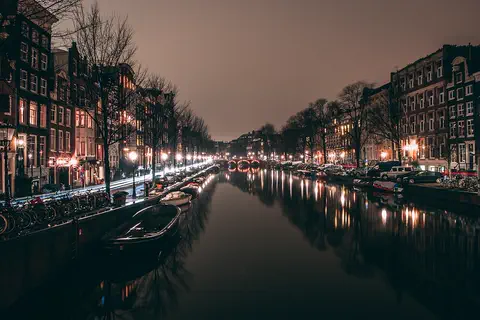
Amsterdam is the capital of the Netherlands. It began as a fishing village beside a dam on the Amstel River, which gave the city its name. Today about 942,000 people live among its rings of canals, hundreds of bridges, houseboats and bicycles.
For parents & teachers
What children will learn
- Locate Prague on the Vltava River in the Czech Republic.
- Describe how Prague grew from two castle hills into a capital city.
- Name some of Prague's historic buildings and the building styles they show.
- Explain why cities protect their historic centers.
Recommended ages: 3 to 17 · About 15 minutes
Talk about it
- St. Vitus Cathedral took almost 600 years to build. Why might a building take so long?
- Prague kept its old center and built new homes outside it. Is that a good idea? Why?
- Which would you visit first in Prague: the castle, the bridge or the music festival? Why?
Try at home or in class
- Draw a skyline of towers and spires. Can you fit a hundred?
- Build a bridge of books and cardboard across a 'river' of blue paper, then test how many toy figures it can hold.
Key vocabulary: capital, spire, castle, Gothic, Baroque, university, tram
Where these facts come from
- Wikidata , Wikimedia Foundation (CC0 1.0)
- Natural Earth vector data , Natural Earth (NACIS) (Public domain)
- Prague , Encyclopaedia Britannica
- Prague: History , Encyclopaedia Britannica
- Prague: Evolution of the modern city , Encyclopaedia Britannica
- Prague: Administration and social conditions , Encyclopaedia Britannica
- Historic Centre of Prague , UNESCO World Heritage Centre
- Prague: climatological information , World Meteorological Organization, World Weather Information Service
- Wikimedia Commons , Wikimedia Foundation (Per file (public domain, CC0, CC BY or CC BY-SA); see each media record)
Checked, not yet human-reviewed. Last updated October 27, 2026. Spotted a mistake? Tell us.