
 Country
Europe
Estonia
Estonia is a small country by the Baltic Sea. It has forests, lakes, hundreds of islands and old lighthouses.
Estonia is the northernmost of the three Baltic states in northeastern Europe. Its low land of forests, bogs and lakes was shaped by ice, it has about 1,500 islands and islets, and about 1.36 million people lived there at the start of 2026.
Estonia is a low-lying Baltic state whose landscape of moraine hills, lakes and wetlands was left by glaciers. Its 1,360,745 residents (1 January 2026) live mostly in towns; in 1940 it was forcibly incorporated into the Soviet Union, and it restored its independence in 1991.
Photo: Ivo Kruusamägi, CC BY-SA 3.0, via Wikimedia Commons
Discover Estonia
Estonia is a country in the north of Europe.
The Baltic Sea is on two sides. Estonia has lots of forests and lakes. It has many, many islands. The capital city is Tallinn.
Estonia is a country in northeastern Europe, the farthest north of the three Baltic states. The Baltic Sea wraps around it on the north and west. Russia lies to the east and Latvia to the south.
Estonia is small and low, with forests, lakes, rivers and wetlands. About 1,500 islands and islets belong to it, and the two biggest, Saaremaa and Hiiumaa, lie off the west coast. Tallinn is the capital. About 1.36 million people lived in Estonia at the start of 2026.
Estonia occupies about 45,300 square kilometers on the eastern shore of the Baltic Sea, which bounds it to the north and west. Its eastern border with Russia follows mostly the Narva River and Lakes Peipus, Tyoploye and Pskov; Latvia lies to the south. Some 1,500 islands and islets are part of its territory, the largest being Saaremaa and Hiiumaa.
Statistics Estonia counted 1,360,745 residents on 1 January 2026: 68.5 percent were ethnically Estonian and 20.2 percent Russian. Britannica notes that more than two-thirds of the population is urban. Tallinn, the capital, faces Helsinki across the Gulf of Finland, and Tartu is the second-largest city.
Cities and famous places
Tallinn is the capital of Estonia.
Its Old Town has narrow, winding streets. Tall church spires point at the sky. Old lighthouses stand by the sea to help ships.
Tallinn's Old Town is a World Heritage Site. It grew in the 1200s to 1500s as a busy trading city of the Hanseatic League, a big group of merchant towns around the Baltic. Its narrow, winding streets still have their old names, and a town wall, a Town Hall and merchants' houses survive.
On the island of Hiiumaa, the Kõpu Lighthouse stands on a hill in a forest. It was first built as a beacon, a tower for ships to see by day, and it was finished in 1531. Keri Lighthouse stands on a small, bare island in the Gulf of Finland.
UNESCO inscribed the Historic Centre (Old Town) of Tallinn in 1997 as an exceptionally complete and well-preserved medieval northern European trading city. Its origins date to the 13th century, when a castle was built by knights of the Teutonic Order, and it became a significant center of the Hanseatic League in the 13th to 16th centuries. The upper town on the limestone hill of Toompea, with the castle and cathedral, has long been the administrative center; the lower town keeps narrow winding streets, a town wall, Town Hall and merchants' houses, and building plots that survive almost intact from the 13th and 14th centuries.
Kõpu Lighthouse on Hiiumaa took 26 years to build, interrupted by war and plague, and was completed in 1531 as an unlit beacon of granite and limestone; it became a lighthouse in 1649. The Estonian Maritime Administration calls it the third-oldest operating lighthouse in the world. Keri Lighthouse, on an uninhabited island in the Gulf of Finland, had its first wooden tower in 1724; its present metal tower dates from 1858.

Land shaped by ice
Long ago, thick ice covered Estonia.
The ice left small hills and lots of lakes. Forests cover almost half of the land. The tallest hill is called Great Egg Hill.
Estonia's land was shaped by glaciers, huge sheets of ice. They left hills of rock and soil in the south, long flat-topped hills in the middle and long, narrow ridges in the north, made by rivers of meltwater. The land is low: on average just 50 meters above the sea. The highest point, Suur Munamägi (Great Egg Hill), is 318 meters high.
Mixed forests of pine, fir, birch and aspen cover almost half the country, and there are many rivers, lakes, marshes and bogs. January averages -8 to -5 °C, and July averages 16 to 17 °C.
Estonia's relief is largely glacial: moraine hills in the south, elongated flat-topped hills in the center, and in the north long narrow ridges of deposits left by meltwater rivers, with sandy areas marking the former ice edge. The mean elevation is 50 m, only about a tenth of the land lies above 90 m, and the highest point is Suur Munamägi (Great Egg Hill) in the Haanja Upland, which Britannica gives as 318 m.
Atlantic air masses bring warm air in winter and cool air in summer; the coasts are milder and the southeast more continental. Mean temperatures are -8 to -5 °C in January and 16 to 17 °C in July, and annual precipitation of 600 to 700 mm, with little evaporation and low relief, leads to waterlogging. Mixed forests with about 90 native tree and shrub species cover almost half the territory, Scots pine being the most common, and a quarter of Estonia's 1,500 plant species grow in its marshes and swamps. The largest lake, Peipus (about 3,550 km²), is shared with Russia, and the longest river, the Pärnu, runs about 145 km.

Animals of Estonia
Big elk live in Estonia.
Deep in the woods live bears and lynx. Foxes and otters live there too. Many birds come and go each year.
About 60 kinds of mammals live in Estonia. The biggest is the elk, the animal Americans call a moose. Roe deer, red deer and wild pigs live there too, and bears and lynx can be met in the deep forests of the northeast. Foxes, badgers, otters and hares are fairly common.
More than 300 kinds of birds have been seen in Estonia, and most of them migrate, so few stay all year. Fish such as cod, herring and salmon are important catches, and about a tenth of the country is set aside as nature reserves.
Britannica counts about 60 mammal species in Estonia. The largest is the elk (Alces alces, called moose in North America); roe deer, red deer and wild pigs also occur, and bears and lynx are found in the deep forests of the northeast. Foxes, badgers, otters, rabbits and hares are fairly common, as are mink and nutria (coypu) along riverbanks.
More than 300 bird species have been identified, but most are migratory and few live there all year. Cod, herring, salmon, eel and plaice are commercially important fish. Since independence was restored in 1991, air and water pollution have been reduced, forest cover has increased, and about one-tenth of the country is protected as nature reserves.

People, languages and food
About 1.36 million people live in Estonia.
Many speak Estonian. Many others speak Russian. Many people love to sing together. Rye bread is a traditional food.
More than two-thirds of the people in Estonia speak Estonian as their first language, and about a quarter speak Russian first, mostly in the northeast. Most people live in towns and cities, especially Tallinn and Tartu.
Singing together is a big part of life. The first national song festival was held in Tartu in 1869, and today huge celebrations bring together thousands of singers and dancers from amateur choirs and dance groups. Traditional foods include rye bread, stews, berry jams, pickled gherkins and salt herring.
On 1 January 2026, 68.5 percent of residents were ethnically Estonian, 20.2 percent Russian and 10.8 percent of other nationalities (Statistics Estonia). Estonian, the official language, belongs to the Finno-Ugric branch of the Uralic family; more than two-thirds speak it as a first language and about a quarter speak Russian first, mostly in the northeast. The Seto of the southeast speak a distinct dialect. There is no state religion, and many people are nonreligious; among Christians are Evangelical Lutheran and Eastern Orthodox communities.
Song and dance festivals began in the mid-19th century as an early expression of Estonian nationalism; the first national song festival was held in Tartu in 1869. UNESCO lists the Baltic Song and Dance Celebrations, held every fifth year in Estonia, which gather as many as 40,000 singers and dancers, most from amateur groups. Traditional dishes include leavened rye bread, stews, berry jams, pearl barley and salt herring, and many people cross-country ski in winter.
A long history
People have lived in Estonia for a very long time.
Long ago, traders came to Tallinn by ship. Later, people built tall lighthouses. Today Estonia is an independent country.
A Roman writer named Tacitus wrote about the Estonians almost 2,000 years ago. From the 1200s, rulers from other lands controlled Estonia for hundreds of years, among them Danes, Germans, Swedes and Russians. Tallinn grew rich as a trading town.
In 1869 the first national song festival was held, and in 1918 Estonia declared independence. In 1940 it was made part of the Soviet Union. In 1991 it became independent again, and in 2004 it joined the European Union.
The Estonians are first mentioned by the Roman historian Tacitus in the 1st century CE. In the early 13th century German crusading knights and the Danish king conquered the country; northern Estonia was sold to the Teutonic Order in 1346, and German nobles dominated government, trade and the church for five centuries while Estonian peasants became serfs. Sweden ruled all Estonian lands after 1629, and by the Peace of Nystad (1721) they passed to Russia. Serfdom was abolished in Estonia in 1816, and a national awakening followed in the 19th century.
The national council (Maapäev) declared independence on 24 February 1918, and a war against the Red Army followed until all Estonian territory was freed in early 1919. In 1940 Estonia was forcibly incorporated into the USSR; in 1941 some 10,000 people were deported on a single night, which Estonia now remembers on 14 June. Estonia declared its independence in 1991 (Restoration Day, 20 August), the Soviet Union recognized it on 6 September 1991, and in 2004 Estonia joined NATO and the European Union.
Estonia on the map
Find Estonia on the globe.
It is in the north of Europe. The sea is on two sides. Finland is just across the water.
Estonia is on the eastern shore of the Baltic Sea. To the north is the Gulf of Finland, and across it lies Finland: Tallinn is closer to Helsinki than it is to Tartu. To the west is the open Baltic Sea and its islands, and to the southwest the Gulf of Riga.
On land, Estonia shares borders with Latvia in the south and Russia in the east. Much of the eastern border runs along the Narva River and the big Lake Peipus.
Estonia juts into the Baltic Sea, which bounds it to the north and west; its rivers drain to the Gulf of Finland, the Gulf of Riga and Lake Peipus. The eastern land boundary with Russia runs mainly along the Narva River and Lakes Peipus, Tyoploye and Pskov, and Latvia lies to the south.
The west coast is fringed by some 1,500 islands and islets, of which Saaremaa and Hiiumaa are the largest; the Muhu archipelago lies between them and the mainland. Across the Gulf of Finland, Helsinki is closer to Tallinn than Tartu is.
- Islands and islets
- about 1,500
- Average height of the land
- about 50 m above sea level
- Lake Peipus (shared with Russia)
- about 3,550 km²
- Land neighbors
- Latvia and Russia
Amazing facts
-
Estonia's tallest hill is called Great Egg Hill.
Estonia's highest point is Suur Munamägi, which means Great Egg Hill. It is 318 meters high.
Suur Munamägi (Great Egg Hill) in the Haanja Upland, 318 m by Britannica's figure, is Estonia's highest point, in a country whose mean elevation is only 50 m.
-
A lighthouse in Estonia is almost 500 years old.
The Kõpu Lighthouse on Hiiumaa was finished in 1531. At first it had no light at all: ships just looked for the tower by day.
The Estonian Maritime Administration calls Kõpu the third-oldest operating lighthouse in the world: completed in 1531 as an unlit beacon, lit by fires from 1649, and fitted with an LED light in 2020.
-
Up to 40,000 people sing and dance at one big festival.
The Baltic Song and Dance Celebrations can bring together as many as 40,000 singers and dancers.
UNESCO lists the Baltic Song and Dance Celebrations, first organized in Estonia in 1869, which gather up to 40,000 mostly amateur singers and dancers every fifth year in Estonia.
-
Tallinn's streets still have their old names.
Many of the narrow, winding streets in Tallinn's Old Town still have the names they had in the Middle Ages.
UNESCO notes that the plots of land in Tallinn's lower town survive virtually intact from the 13th and 14th centuries, and many streets keep their medieval names.
-
Forests cover almost half of Estonia.
Mixed forests of pine, fir, birch and aspen cover almost half of Estonia. Scots pine is the most common tree.
Almost half of Estonia is mixed forest with about 90 native tree and shrub species; Scots pine is the most common native tree.
Words to know
- glacier
- a huge, slow-moving sheet or river of ice
- islet
- a very small island
- bog
- soft, wet, spongy ground where water collects
- beacon
- a tall tower or light that ships can steer by
- Hanseatic League
- a group of trading towns around the Baltic and North Seas in the Middle Ages
- choir
- a group of people who sing together
- World Heritage Site
- a place UNESCO lists as important to all people, to be protected
Discovery challenge
-
What is the capital city of Estonia?
Which city is the capital of Estonia?
Which Estonian city's Old Town does UNESCO call an exceptionally complete medieval trading city?
- Tallinn
- Tartu
- Pärnu
Show the answer
Tallinn
Tallinn is the capital. It is by the sea.
Tallinn is Estonia's capital, and its Old Town is a World Heritage Site.
Tallinn, a Hanseatic center in the 13th to 16th centuries, is the capital; its Old Town was inscribed by UNESCO in 1997.
-
About how many islands does Estonia have?
About how many islands and islets belong to Estonia?
Roughly how many islands and islets, led by Saaremaa and Hiiumaa, are part of Estonia?
- About 15
- About 1,500
- About 150,000
Show the answer
About 1,500
Estonia has about 1,500 islands. That is a lot!
About 1,500 islands and islets belong to Estonia. The biggest are Saaremaa and Hiiumaa.
Britannica gives some 1,500 islands and islets; Saaremaa and Hiiumaa, off the west coast, are the largest.
-
Estonia's tallest hill has a funny name. What does it mean?
Estonia's highest point is Suur Munamägi. What does its name mean?
Suur Munamägi, 318 m in the Haanja Upland, is Estonia's highest point. What does the name mean?
- Great Egg Hill
- Big Bear Mountain
- Windy Peak
Show the answer
Great Egg Hill
It means Great Egg Hill.
Suur Munamägi means Great Egg Hill. It is 318 meters high.
Suur Munamägi means Great Egg Hill; it rises to 318 m in a country whose mean elevation is 50 m.
-
The Kõpu lighthouse helps ships stay away from what?
What does the Kõpu Lighthouse on Hiiumaa warn ships about?
What danger northwest of Hiiumaa was the Kõpu beacon built to warn ships about?
- Dangerous shallow water
- Icebergs
- Volcanoes
Show the answer
Dangerous shallow water
The water is not deep there. That is dangerous for ships.
Kõpu warns ships away from dangerous shallow water off the island of Hiiumaa.
Kõpu warns against Hiiu madal, limestone shallows northwest of Hiiumaa beside an important shipping route.
-
What do people do at Estonia's big Song and Dance Celebration?
At the Song and Dance Celebration, what do thousands of people do together?
The Baltic Song and Dance Celebrations, on UNESCO's list since 2008, bring up to 40,000 people together to do what?
- Sing and dance
- Ski races
- Build sandcastles
Show the answer
Sing and dance
They sing and dance together. Many people practice all year.
Thousands of singers and dancers, mostly from amateur choirs and dance groups, perform together.
Up to 40,000 singers and dancers, mostly amateurs and many of whom rehearse all year, perform; Estonia held its first national song festival in Tartu in 1869.
Places to discover in Estonia
Animals of Estonia
-
 Watch
Animal
Moose
The moose is the largest member of the deer family. It lives in northern forests, wades and even dives into lakes to eat water plants, and bull moose grow enormous new antlers every year. In Europe it is called an elk.
-
 Watch
Animal
Eurasian lynx
The Eurasian lynx is the largest of the four kinds of lynx. It has black ear tufts, a ruff of fur around its face, a short black-tipped tail and big furry paws for snow. It hides in forests and ambushes deer such as roe deer, and it has returned to parts of Europe where it had disappeared.
Explore next
-
Watch
City
Tallinn
Tallinn, the capital of Estonia, lies on a bay of the Gulf of Finland. Its walled Old Town, with towers, church spires and a town hall finished in 1404, is, says UNESCO, an exceptionally complete and well-preserved medieval trading town, and today the city is also known for its technology companies.
-
Watch
Animal
Moose
The moose is the largest member of the deer family. It lives in northern forests, wades and even dives into lakes to eat water plants, and bull moose grow enormous new antlers every year. In Europe it is called an elk.
-
Watch
Animal
Eurasian lynx
The Eurasian lynx is the largest of the four kinds of lynx. It has black ear tufts, a ruff of fur around its face, a short black-tipped tail and big furry paws for snow. It hides in forests and ambushes deer such as roe deer, and it has returned to parts of Europe where it had disappeared.
-
 Watch
 Country
Latvia
Latvia is the middle one of the three Baltic states, on the shores of the Baltic Sea and the Gulf of Riga. It is mostly low and green, with forests over more than half its land, and about 1.845 million people lived there at the start of 2026.
-
 Watch
 Country
Belarus
Belarus is a landlocked country in eastern Europe. Ice sheets of the last ice age shaped its low hills and wide plains, it has more than 10,000 lakes and one of Europe's largest wetlands, and about 9.1 million people lived there in 2025.
-
 Watch
 Country
Bosnia and Herzegovina
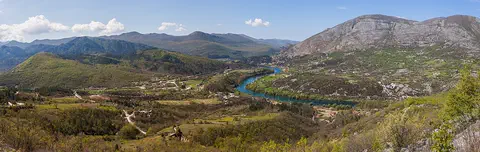
Bosnia and Herzegovina is a mountainous country in southeastern Europe. It has forests, limestone hills and many rivers, and famous old stone bridges cross some of them. Its capital is Sarajevo. It touches the Adriatic Sea along only about 20 kilometers of coast.
-
 Watch
 Country
Bulgaria
Bulgaria is a country on the eastern side of the Balkan Peninsula, with the Danube River to the north and the Black Sea to the east. Mountains cross it from west to east, and about 6.4 million people lived there at the end of 2025.
-
 Watch
 Country
Croatia
Croatia is a crescent-shaped country in southeastern Europe. Its long coast on the Adriatic Sea is fringed by more than 1,100 islands, limestone mountains rise behind it, fertile plains lie in the north, and about 3.87 million people lived there in mid-2025.
For parents & teachers
What children will learn
- Locate Estonia on the Baltic Sea and name its neighbors and largest islands.
- Explain how glaciers shaped Estonia's low hills, lakes and wetlands.
- Describe some of Estonia's wildlife, places and ways of life, including its song festivals, without treating them as one single culture.
- Outline Estonia's history from a Hanseatic trading town to independence in 1918 and its restoration in 1991.
Recommended ages: 3 to 17 · About 15 minutes
Talk about it
- Why might a country with so much coast and so many islands need lighthouses?
- Singing in a choir is a big tradition in Estonia. What do people in your community do together?
- What would the land look like where you live if it had been covered by a glacier?
Try at home or in class
- Sing a favorite song together as a family choir, then try singing it in a round.
- Shine a flashlight across a dark room and talk about how a lighthouse helps ships find their way.
Key vocabulary: glacier, islet, bog, beacon, Hanseatic League, choir, World Heritage Site
Where these facts come from
- Wikidata , Wikimedia Foundation (CC0 1.0)
- Natural Earth vector data , Natural Earth (NACIS) (Public domain)
- UNESCO World Heritage List , UNESCO World Heritage Centre (Linked as a reference; site facts come from Wikidata)
- Estonia (Land, People) , Encyclopaedia Britannica
- Estonia: History , Encyclopaedia Britannica
- Estonia: Cultural life , Encyclopaedia Britannica
- Population , Statistics Estonia
- Historic Centre (Old Town) of Tallinn , UNESCO World Heritage Centre
- Baltic song and dance celebrations , UNESCO Intangible Cultural Heritage
- Kõpu Lighthouse (text from the Estonian Maritime Administration's 2020 nomination) , IALA Lighthouse Heritage
- Keri lighthouse , Estonian Lighthouse Society
- Moose , Encyclopaedia Britannica
- PlayOwl region table, version 1 , PlayOwl (PlayOwl original data)
- flag-icons 7.5.0 , Panayiotis Lipiridis and contributors (MIT)
- Wikimedia Commons , Wikimedia Foundation (Per file (public domain, CC0, CC BY or CC BY-SA); see each media record)
Checked, not yet human-reviewed. Last updated October 24, 2026. Spotted a mistake? Tell us.
Picture credits
- Photo: Ivo Kruusamägi, CC BY-SA 3.0, via Wikimedia Commons · source · license
- Photo: Hiiumaamudeliklubi, CC BY-SA 4.0, via Wikimedia Commons · source · license
- Photo: Abrget47j, CC BY-SA 3.0 EE, via Wikimedia Commons · source · license
- Photo: John Samuel, CC BY-SA 4.0, via Wikimedia Commons · source · license