
 Country
Europe
Liechtenstein
Liechtenstein is a tiny country in the mountains of Europe. It sits between Switzerland and Austria. A prince is its head of state.
Liechtenstein is one of the smallest countries in Europe, tucked between Switzerland and Austria. Its west is the flat valley of the Rhine River, and its east is steep Alpine mountains. About 41,000 people live there, and its head of state is a prince.
Liechtenstein is a principality of 160 km² between Switzerland and Austria, one of only two doubly landlocked countries in the world. The Rhine floodplain forms its west and the Rhätikon foothills of the Alps its east; about 41,200 people lived there at the end of 2025, and it has been independent since 1866.
Photo: Lucas Kendall, CC BY-SA 4.0, via Wikimedia Commons
Discover Liechtenstein
Liechtenstein is a very small country.
It has big mountains and a wide river valley. The capital is a small town called Vaduz. A prince is the head of the country.
Liechtenstein is a principality, a country whose head of state is a prince. It covers just 160 square kilometers, which makes it one of the smallest countries in Europe. It lies between Switzerland and Austria.
Its capital is Vaduz, a small town on the edge of the Rhine valley. About 41,000 people lived in Liechtenstein at the end of 2025. The country has no army: it abolished its army in 1868. It uses the Swiss franc as its money.
Liechtenstein is a western European principality between Switzerland and Austria, covering 160 km². Its capital is Vaduz, the administrative and commercial center; Schaan is the main industrial community. The Amt für Statistik counted 41,237 permanent residents on December 31, 2025 (preliminary figures), 35.3 percent of them foreign nationals.
It is a constitutional monarchy. The prince inherits the throne through the male line, and a 25-member Landtag (Diet) is elected for four years. The standing army was abolished and neutrality proclaimed in 1868. Liechtenstein adopted the Swiss franc in 1921 and joined a customs union with Switzerland in 1923, and it belongs to the European Free Trade Association and the European Economic Area.
Towns and famous places
Vaduz is the capital town.
It has museums with paintings and stamps. Above the town, the mountains rise up high. There is no airport in Liechtenstein.
Liechtenstein is divided into 11 communes. Vaduz, the capital, is where most visitors go. Its museums include the Liechtenstein National Museum, with objects from early and Roman times, and the Postal Museum, with stamps the country has printed since 1912.
The princes of Liechtenstein have a famous art collection, with paintings by Dutch and Flemish artists of the 1600s. High up on the mountain slopes, the village of Triesenberg was settled by Walser people from Switzerland at the end of the 1200s. There is no airport, but a railway crosses the north.
Liechtenstein has 11 Gemeinden (communes): Vaduz, Balzers, Triesen, Triesenberg, Schaan and Planken in the Upper Country (Oberland) to the south, and Eschen, Mauren, Gamprin, Ruggell and Schellenberg in the Lower Country (Unterland) to the north. The two regions descend from the old lordships of Vaduz and Schellenberg and form separate electoral districts.
Vaduz holds the National Museum (mainly early and Roman artifacts), the Postal Museum (founded 1930, with national stamp issues since 1912) and the princely art collections, rich in 17th-century Dutch and Flemish painting. Britannica reports that the Liechtenstein Treasure Chamber (2015) housed the world's largest Fabergé egg, the princely crown jewels and lunar rocks given by NASA. The country has no airport; the Paris-Vienna rail route passes through the north.
Mountains, valley and weather
Most of Liechtenstein is mountains.
The tops are covered in snow. Forests and flowers grow on the lower slopes. The Rhine River flows along the west side.
About two-thirds of Liechtenstein, the eastern part, is rugged mountains of the Rhätikon range, part of the Alps. The highest peak, Grauspitz, is 2,599 meters tall. Evergreen forests and Alpine flowers cover the lower slopes, and the bare peaks are covered in snow.
The west is the flat floodplain of the Rhine River. It used to be marshy, but a drainage channel built in the 1930s turned it into rich farmland. A warm wind from the south, called the foehn, keeps the climate mild, so farmers can even grow grapes and corn.
The eastern two-thirds of Liechtenstein are the rugged foothills of the Rhätikon Mountains, part of the central Alps, rising to Grauspitz at 2,599 m; Britannica notes that much of the principality lies above 1,800 m. Three major valleys drain via the Samina River. The western section is the Rhine floodplain, which with the valley of the Ill forms a triangular lowland widening northward; once marshy, it was drained by a channel built in the 1930s.
The climate is mild and strongly affected by the foehn, a warm southerly wind. Precipitation ranges from about 900 to 1,200 mm a year, up to 1,900 mm in parts of the mountains. Winter temperatures rarely fall below −15 °C, and summer daily maximums average about 20 to 28 °C, allowing grapes and corn, unusual in a mountainous area. All forests are protected to keep slopes stable and prevent erosion.

Animals of Liechtenstein
Red deer live in the forests.
Chamois climb on the rocky slopes. Marmots dig burrows in the mountains. Foxes and badgers live there too.
For such a small country, Liechtenstein is rich in wildlife. Red deer and roe deer live in the forests, and chamois, a kind of goat-antelope, climb the mountain slopes. Marmots, foxes, badgers, hares, martens, stoats and weasels live there too.
Birds include pheasants, partridges, hazel grouse and black grouse, called blackcocks. Plants are varied as well: orchids, reeds and bird's-eye primroses all grow there, and the forests mix copper beeches, maples, lindens, elms and ashes.
Britannica describes Liechtenstein as rich in wildlife: red deer, roe deer, chamois, hares, marmots, foxes, badgers, martens, polecats, stoats and weasels among the mammals, and blackcocks (black grouse), pheasants, hazel grouse and partridges among the birds.
Its vegetation is remarkably varied. Water milfoil and mare's-tail, reeds, bulrushes, bird's-eye primrose and orchids all occur, and the forests are mixed woodland of copper beech, common and Norway maple, sycamore, linden, elm and ash. Every forested area is protected to maintain the ecology of the mountain slopes and guard against erosion, and the Alpine slopes are grazed by livestock in summer.

People, languages and food
About 41,000 people live in Liechtenstein.
The official language is German. Many people speak their own local way of German. Farmers keep cows and grow corn and potatoes.
German is the official language, but most people speak an Alemannic dialect with its own local words and sounds. In Triesenberg, Walser families, whose ancestors came from Switzerland more than 700 years ago, still speak a very distinctive form of the language. About a third of people living in Liechtenstein are citizens of other countries.
Few people work on farms. The biggest farms keep livestock and make dairy products, and crops include corn, potatoes and cereals. In summer, cattle graze on the Alpine slopes. Many more people work in small factories, banks and tourism.
Ethnic Liechtensteiners, about two-thirds of the population according to Britannica, descend from the Alemanni, who entered the region after 500 CE. German is official, but most people speak an Alemannic dialect, and the Walsers of Triesenberg, settled from the Swiss canton of Valais at the end of the 13th century, keep a distinctive form of it. The statistics office reports that 35.3 percent of permanent residents held foreign citizenship at the end of 2025. About four-fifths of people are Christian.
After World War II, industrialization drew people to the larger communes, though most of the population is still classed as rural. Small firms make precision instruments, pharmaceuticals, electronic equipment and metal goods; farms concentrate on livestock and dairying; and tourism, centered on Vaduz, is a leading sector. Education is compulsory from age 7, and the University of Liechtenstein offers degrees in architecture and business administration.
A long history
Long ago, two small lands joined together to make Liechtenstein.
That was in 1719. In 1866, it became its own country. It has no army.
People have always settled on the flat Rhine plain. For centuries the valley held two small lordships, Vaduz and Schellenberg. In 1719 they were joined to form the Principality of Liechtenstein, which was part of the Holy Roman Empire.
In 1866 Liechtenstein became fully independent, and in 1868 it gave up its army. It stayed neutral in both World Wars. After 1945 it changed quickly from a quiet farming land into a country of factories and banks. It joined the United Nations in 1990.
The Rhine plain has always been the focus of settlement, and the National Museum's early and Roman finds show its long past. For centuries the valley held two independent lordships of the Holy Roman Empire, Vaduz and Schellenberg, united as the Principality of Liechtenstein in 1719. It belonged to the Confederation of the Rhine (1806–15) and the German Confederation (1815–66) before becoming independent in 1866; it abolished its army and proclaimed neutrality in 1868 and stayed neutral in both World Wars.
Under Francis Joseph II (prince 1938–89), Liechtenstein industrialized rapidly after World War II. His son Hans Adam II led it into the UN (1990), EFTA (1991), the European Economic Area and the World Trade Organization (both 1995). In a 2003 referendum, voters gave the prince wider powers, including a veto over legislation, and gave citizens the right to call a vote of confidence in the prince. Crown Prince Alois took over day-to-day duties in 2004. After a 2008 tax-evasion scandal, reforms in 2009 led the OECD to remove Liechtenstein from its "black list" of tax havens, and in 2011 it joined the Schengen area.
Liechtenstein on the map
Find Liechtenstein on the globe.
It is so small you have to look closely! It is in the Alps. Switzerland and Austria are its only neighbors.
Liechtenstein is in central Europe, in the Alps, between Switzerland and Austria. It is so small that on a world map it is just a dot.
Liechtenstein is landlocked, and so are both of its neighbors. That makes it doubly landlocked: to reach the sea, you would have to cross at least two borders. Only one other country in the world, Uzbekistan, is doubly landlocked.
Liechtenstein lies between Switzerland and Austria. The Rhine floodplain and the Ill valley form a triangular lowland widening northward, while the Rhätikon foothills occupy the eastern two-thirds.
Guinness World Records lists Liechtenstein, enclosed by Austria and Switzerland, as the smaller of the world's two doubly landlocked countries; the other is Uzbekistan. Excellent roads connect it with its neighbors, the Paris-Vienna rail route crosses the north, and Switzerland is responsible for its defense. Since 2011 it has been part of the Schengen area of passport-free travel.
- Area
- 160 km²
- Highest point
- Grauspitz, 2,599 m
- Neighbors
- Switzerland and Austria, both landlocked
- People (December 31, 2025, preliminary)
- 41,237 permanent residents
Amazing facts
-
Liechtenstein has no army.
Liechtenstein gave up its army in 1868, and Switzerland is responsible for its defense.
The standing army was abolished and neutrality proclaimed in 1868; Britannica notes that defense is the responsibility of Switzerland.
-
To reach the sea from Liechtenstein, you cross two borders.
Liechtenstein and its neighbors are all landlocked, so it is one of only two doubly landlocked countries. The other is Uzbekistan.
Guinness World Records counts two doubly landlocked countries: Uzbekistan, the larger, and Liechtenstein, enclosed by Austria and Switzerland.
-
There is no airport in Liechtenstein.
Liechtenstein has no airport, but good roads and a railway connect it with its neighbors.
There is no airport; excellent roads link Liechtenstein with its neighbors, and the Paris-Vienna express rail route passes through the north.
-
Liechtenstein has a museum full of stamps.
Liechtenstein has printed its own stamps since 1912, and its Postal Museum shows many of them.
The Liechtenstein Postal Museum, founded in 1930, exhibits a large stock of stamps, including national issues since 1912.
-
Grapes and corn grow in Liechtenstein, even near big mountains.
A warm wind called the foehn keeps Liechtenstein mild enough to grow grapes and corn, which is unusual in a mountain country.
The foehn, a warm southerly wind, gives Liechtenstein a mild climate that allows grapes and corn, unusual in a mountainous area.
Words to know
- principality
- a country or state ruled by a prince
- landlocked
- having no coastline; surrounded by land and other countries
- doubly landlocked
- landlocked and surrounded only by countries that are landlocked too
- floodplain
- flat land beside a river that can flood when the river rises
- foehn
- a warm, dry wind that blows down the side of mountains
- dialect
- a local way of speaking a language, with its own words and sounds
- neutral
- not taking sides in a war
Discovery challenge
-
What is the capital of Liechtenstein?
Which town is the capital of Liechtenstein?
Which town is Liechtenstein's administrative and commercial center and capital?
- Vaduz
- Zurich
- Vienna
Show the answer
Vaduz
Vaduz is the capital of Liechtenstein.
Vaduz is the capital. Zurich is in Switzerland, and Vienna is the capital of Austria.
Vaduz is the capital and administrative center; Schaan is the main industrial community.
-
Who is the head of Liechtenstein?
Liechtenstein is a principality. Who is its head of state?
In Liechtenstein's constitutional monarchy, who is head of state?
- A president
- A prince
- A queen
Show the answer
A prince
A prince is the head of Liechtenstein.
A principality has a prince as head of state; Liechtenstein's prince works with an elected parliament.
The prince succeeds through the male line under the rules of the princely house, alongside a 25-member elected Landtag.
-
Which two countries are next to Liechtenstein?
Which two countries border Liechtenstein?
Which two landlocked countries enclose Liechtenstein?
- France and Spain
- Switzerland and Austria
- Italy and Germany
Show the answer
Switzerland and Austria
Switzerland and Austria are next to Liechtenstein.
Liechtenstein lies between Switzerland and Austria, two mountain countries.
Switzerland and Austria, both landlocked, enclose it, making it doubly landlocked.
-
Which river flows beside Liechtenstein?
The flat western part of Liechtenstein is the floodplain of which river?
Which river's floodplain, drained in the 1930s, forms Liechtenstein's western lowland?
- The Rhine
- The Thames
- The Volga
Show the answer
The Rhine
The Rhine River flows beside Liechtenstein.
The Rhine's flat floodplain makes up the west of the country; once marshy, it is now rich farmland.
The Rhine floodplain, with the Ill valley, forms a triangular lowland; a 1930s drainage channel made its soils good for farming.
-
Does Liechtenstein have an army?
What did Liechtenstein give up in 1868?
What did Liechtenstein abolish in 1868, when it proclaimed neutrality?
- Its army
- Its prince
- Its money
Show the answer
Its army
No. Liechtenstein has no army.
In 1868 Liechtenstein gave up its army. Switzerland is responsible for its defense.
The standing army was abolished in 1868; the principality remained neutral in both World Wars.
Places to discover in Liechtenstein
-
Watch
Natural wonder
Alps
The Alps are Europe's great mountain range, an arc about 1,200 kilometers long that runs from the Mediterranean coast near Nice, in France, to Vienna, in Austria. Their highest peak is Mont Blanc, which Britannica gives as 4,807 meters. The Alps rose when the plate carrying Africa pushed north into Europe, and Ice Age glaciers carved their sharp peaks and deep valleys.
-
 Watch
Natural wonder
Rhine
The Rhine begins as two small streams high in the Swiss Alps and flows about 1,230 kilometers north and west to the North Sea, through Switzerland, Germany, France and the Netherlands. It tumbles over the Rhine Falls and winds through a gorge lined with castles. After a chemical spill in 1986, the countries along it worked together to clean it, and salmon came back.
Animals of Liechtenstein
Explore next
-
Watch
Natural wonder
Alps
The Alps are Europe's great mountain range, an arc about 1,200 kilometers long that runs from the Mediterranean coast near Nice, in France, to Vienna, in Austria. Their highest peak is Mont Blanc, which Britannica gives as 4,807 meters. The Alps rose when the plate carrying Africa pushed north into Europe, and Ice Age glaciers carved their sharp peaks and deep valleys.
-
Watch
Natural wonder
Rhine
The Rhine begins as two small streams high in the Swiss Alps and flows about 1,230 kilometers north and west to the North Sea, through Switzerland, Germany, France and the Netherlands. It tumbles over the Rhine Falls and winds through a gorge lined with castles. After a chemical spill in 1986, the countries along it worked together to clean it, and salmon came back.
-
 Watch
 Country
Switzerland
Switzerland is a small, landlocked country in central Europe. The Alps cover its south and east, great rivers such as the Rhine and Rhône begin there, and its 9.1 million people share four national languages: German, French, Italian and Romansh.
-
 Watch
 Country
Austria
Austria is a landlocked country in central Europe. The Alps cover much of it, the Danube River flows across the north, and about 9.2 million people live there. Its capital, Vienna, is famous for its music and palaces.
-
 Watch
Animal
Red deer
The red deer is one of the largest deer in the world. It lives in forests, hills and moors across Europe and into western Asia and North Africa. Males, called stags, grow huge branching antlers every year and roar to win mates in autumn.
-
 Watch
 Country
San Marino
San Marino is a very small country on the slopes of Mount Titano, completely surrounded by Italy. It is one of the oldest republics in the world, and its capital, with walls and fortress towers, sits high on the mountain. About 34,000 people live there.
-
 Watch
 Country
Belarus
Belarus is a landlocked country in eastern Europe. Ice sheets of the last ice age shaped its low hills and wide plains, it has more than 10,000 lakes and one of Europe's largest wetlands, and about 9.1 million people lived there in 2025.
-
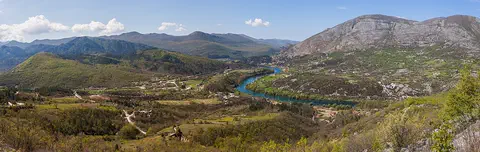 Watch
 Country
Bosnia and Herzegovina
Bosnia and Herzegovina is a mountainous country in southeastern Europe. It has forests, limestone hills and many rivers, and famous old stone bridges cross some of them. Its capital is Sarajevo. It touches the Adriatic Sea along only about 20 kilometers of coast.
For parents & teachers
What children will learn
- Locate Liechtenstein between Switzerland and Austria and explain what doubly landlocked means.
- Describe how the land rises from the Rhine valley to the Alps, and how the foehn affects the climate.
- Explain what a principality and a constitutional monarchy are.
- Outline Liechtenstein's history from 1719 to joining the UN in 1990.
Recommended ages: 3 to 17 · About 12 minutes
Talk about it
- What might be different about living in a country of about 41,000 people?
- Liechtenstein has no army. How do you think it keeps safe?
- Why might a small country choose to use a neighbor's money?
Try at home or in class
- Look up the area of your town or county and compare it with Liechtenstein's 160 square kilometers.
- On a map of Europe, trace a route from Vaduz to the nearest sea and count the borders you cross.
Key vocabulary: principality, landlocked, doubly landlocked, floodplain, foehn, dialect, neutral
Where these facts come from
- Wikidata , Wikimedia Foundation (CC0 1.0)
- Natural Earth vector data , Natural Earth (NACIS) (Public domain)
- Liechtenstein , Encyclopaedia Britannica
- Liechtenstein: History , Encyclopaedia Britannica
- Bevölkerungsstand: vorläufige Ergebnisse 31. Dezember 2025 , Amt für Statistik Liechtenstein
- Largest double landlocked country , Guinness World Records
- PlayOwl region table, version 1 , PlayOwl (PlayOwl original data)
- flag-icons 7.5.0 , Panayiotis Lipiridis and contributors (MIT)
- Wikimedia Commons , Wikimedia Foundation (Per file (public domain, CC0, CC BY or CC BY-SA); see each media record)
Checked, not yet human-reviewed. Last updated October 27, 2026. Spotted a mistake? Tell us.
Picture credits
- Photo: Lucas Kendall, CC BY-SA 4.0, via Wikimedia Commons · source · license
- Photo: Lr Photographie, CC BY 3.0, via Wikimedia Commons · source · license
- Photo: © Giles Laurent, gileslaurent.com, License CC BY-SA, CC BY-SA 4.0, via Wikimedia Commons · source · license
- Photo: Charles J. Sharp, CC BY-SA 4.0, via Wikimedia Commons · source · license